








Web3 Payment Report: Industry Giants Launch Full-Scale Offensive, Potentially Reshaping the Crypto Market Landscape
TechFlow Selected TechFlow Selected
Web3 Payment Report: Industry Giants Launch Full-Scale Offensive, Potentially Reshaping the Crypto Market Landscape
This article will briefly outline the concept and trajectory of Web3 payments, and then examine why Web3 payments have the potential to reshape the crypto market landscape from both business and legal compliance regulatory perspectives.
 Navigating Web3 tides with focused insights
Authors: Will Wang; Diane Cheung
The emergence of blockchain and cryptocurrency technologies has not only enabled people to purchase NFT digital art, interact with players in the Metaverse, and earn money through GameFi gameplay, but also provides the most fundamental decentralized peer-to-peer payment solutions. These fast and convenient Web3 payment solutions are transforming our current ways of paying—and even reshaping the entire financial market.
Since PayPal launched its stablecoin PayPal USD in August, we have seen numerous industry giants announce expansions into Web3 payments or integration with Web3 payment channels—indicating a full-scale push into the Web3 payment space. We observe moves such as MetaMask’s on- and off-ramp aggregation solution, X (formerly Twitter) applying for payment licenses, and VISA's USDC settlement blockchain network—a series of strategic actions by major players across the industry chain.
Because Web3 payments encompass nearly all infrastructure layers in the industry—including payments, stablecoins, wallets, custody, and trading—understanding the broad use cases and potential advantages of Web3 payments is crucial for all participants in the Web3 ecosystem.
This article will briefly explain the concept and pathways of Web3 payments, then analyze from both business and legal compliance perspectives why Web3 payments are poised to reshape the crypto market landscape. We hope this piece offers valuable insights. Feel free to reach out for discussion. The full text is approximately 16,000 words, with an estimated reading time of 30 minutes.
TL; DR
-
Traditional payments and Web3 payments are not isolated—they are moving toward convergence, with fiat and cryptocurrencies increasingly interacting and integrating into real-world applications like stablecoins and central bank digital currencies (CBDCs);
-
Bitcoin was designed to realize a decentralized peer-to-peer electronic cash system, from which Web3 payments evolved. Currently, Web3 payments can be broadly categorized into two types: on/off-ramps, and cryptocurrency payments (on-chain and off-chain);
-
Industry giants like PayPal, Coinbase, and MetaMask are gradually opening up or integrating Web3 payment services and scenarios—including wallets, custody, payments, trading, and stablecoins—eventually covering their entire ecosystems and forming closed-loop ecosystems;
-
Web3 payment infrastructure is gradually taking shape, linking wallets, custody, and stablecoins. But more importantly, building actual payment use cases is key. Consider how platforms like X (Twitter), Telegram, MetaMask, and PayPal might each develop vast crypto ecosystems. Under this backdrop, the existing structure of the crypto market is bound to change;
-
Compliance is the foundation of any payment business. The cross-jurisdictional and multi-scenario complexity of Web3 payments presents significant regulatory challenges. However, as crypto regulations become clearer, adoption of cryptocurrencies may increase, accelerating the growth of the Web3 payment industry;
-
From a monetary system perspective, the Bank for International Settlements (BIS) believes that after digitization, the key development of money lies in tokenization—the process of digitally representing claims on programmable platforms. This could be seen as the next logical step in digital record-keeping and asset transfer;
-
The biggest opportunity for cryptocurrency may not lie in viewing it merely as currency, but rather as a new payment system. Some believe Web3’s killer app hasn’t arrived yet—but it may already be here: it’s payments!
1. Overview of Web3 Payments
Simply put, Web3 payments refer to a payment method based on blockchain and cryptocurrency technology. However, due to the unique characteristics of blockchain and crypto, Web3 payments go beyond just being a means of payment.
Cryptocurrencies like Bitcoin have multidimensional attributes: they are not only a form of payment, but also an innovative technology, a store of value, and a financial infrastructure (a distributed ledger), while also serving as a unit of account to denote value during transactions.
Traditional payments and Web3 payments are not disconnected—they are converging. Fiat and cryptocurrencies continuously interact and are gradually merging into practical applications such as stablecoins and central bank digital currencies. Web3 payments are redefining our methods of payment and financial systems.
1.1 Traditional Payments
Let’s first look at traditional payments. Payment refers to the act of a payer transferring money (or equivalent value) or debt obligations to a payee—an information flow and capital flow matching process that completes the exchange of goods and money. The essence of payment is the transfer of funds.
Broadly speaking, payments include physical cash and electronic money. There are four main ways of fund transfer: cash payments, bank account transfers, debit card transfers, and credit card payments. The latter three forms of electronic payments require centralized financial institutions like banks to complete the transfer. When banks cannot directly facilitate payments, third-party payment providers are needed.
Depending on the currency used, payments are further divided into domestic and cross-border payments. Since Web3 payments operate on blockchains and support cross-currency (fiat vs. crypto) and cross-regional functions, they can be classified under cross-border payments.
The cross-border payment industry involves many participants: customers, commercial banks, third-party acquiring/payment platforms, clearing institutions, and merchants. The entire industry chain can be roughly divided into three layers: the first layer consists of users and merchants—the origin and endpoint of payments; the second layer includes payment service providers such as banks and third-party payment platforms; the third layer is the underlying cross-border payment network, such as SWIFT and SEPA.
Below is a diagram of the cross-border payment architecture:
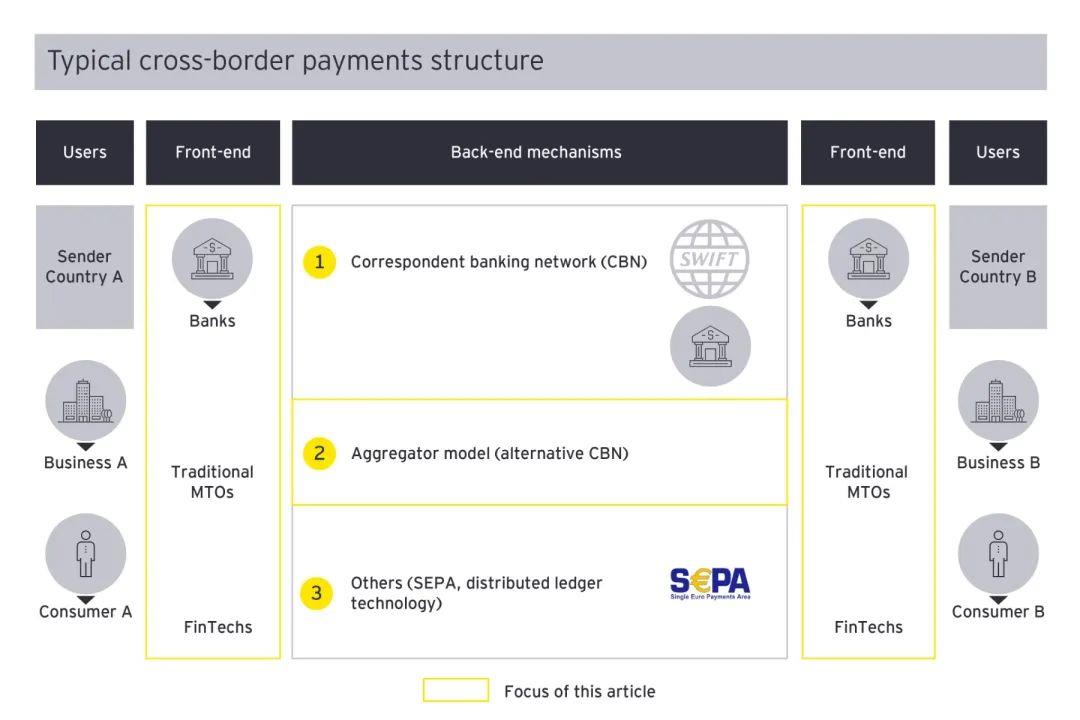
Based on the type of cross-border payment service provider, these services can be categorized into bank wire transfers, specialized remittance companies, card network clearing institutions, and third-party payment platforms. The following examples will contrast these with blockchain-based Web3 payments.
1.1.1 Interbank Cross-Border Payments
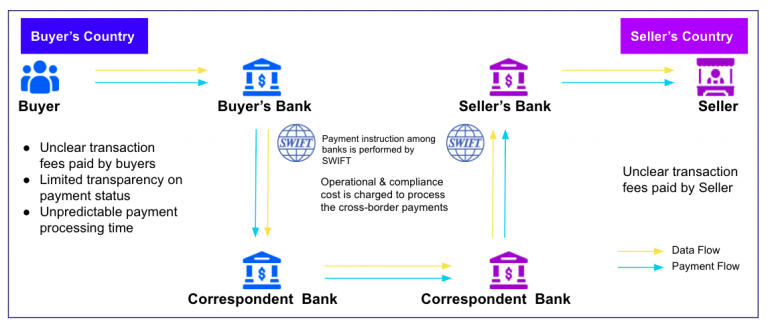
Early cross-border payments were mainly conducted through banks, such as bank wire transfers originally used for interbank settlements and international trade. This method relies on complex banking networks and can take days or even weeks to complete. It often involves multiple currency conversions and relatively high fees.
Traditional interbank cross-border payments primarily depend on the SWIFT network. SWIFT does not hold funds or manage accounts for users—it provides a communication network for exchanging standardized financial messages. Think of SWIFT as a global network connecting nearly all major banks, enabling them to communicate using a common language for foreign exchange transactions. However, SWIFT has drawbacks: if a transaction passes through multiple intermediary banks or undergoes anti-money laundering checks, delays or even failed transfers can occur, along with issues like exchange rate losses.
As shown in the figure above, when the recipient bank and sending bank have established correspondent relationships, funds are transferred directly via their correspondent accounts, and the banks charge corresponding fees. When no such relationship exists, an intermediary bank must be involved. The intermediary charges additional fees, and settlement times are prolonged due to increased transaction parties.
Interbank cross-border payments are highly regulated, with differing regulatory policies across jurisdictions, creating certain limitations. Additionally, these payments typically involve strict KYC/AML requirements, necessitating user account registration, resulting in higher costs.
1.1.2 International Card Networks
Similar to SWIFT, international card networks are major traditional cross-border payment infrastructures, but they focus more on merchant acquiring scenarios (deducting funds from buyers’ accounts). They offer diverse payment methods and handle currency conversion during the payment process, settling local currency for merchants.
Card networks serve as regional international payment processing systems. Currently, there are six major global card networks: Visa, Mastercard, China UnionPay, American Express, JCB, and Discover. Cross-border payments processed through these networks usually take T+1 day or longer to settle into merchant accounts. Operating such networks requires licensing and is subject to varying national regulations.
1.1.3 Third-Party Cross-Border Payments
With the development of e-commerce and internet technologies, electronic transfers have become a popular form of cross-border payment. These services are generally provided by non-bank entities (such as Alipay, PayPal, etc.) acting as third-party payment platforms offering full or partial fund transfer services. Such third-party providers play important roles in cross-border e-commerce retail, remittances, import/export, and overseas mobile payments.
Third-party cross-border payments need to connect to international card networks or banks for clearing and settlement. Currency exchange in cross-border payments is mostly handled by banks, while third-party platforms often provide custodial functionality—holding funds temporarily before transferring them to sellers upon transaction confirmation.
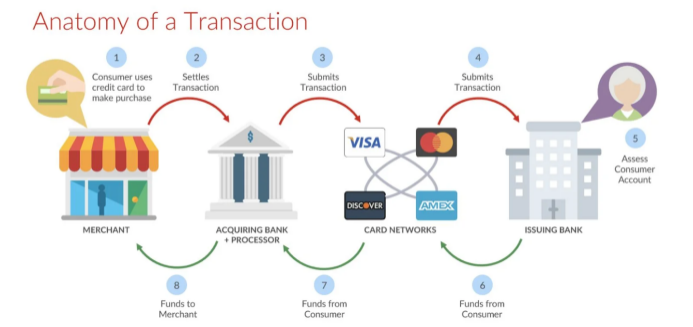
As shown above, in a cross-border e-commerce scenario, the user side is where the fund transfer originates. The third-party payment platform links the user’s bank account with credit/debit cards issued by card-issuing banks. After the user makes a purchase, funds move to the payment channel and connect with the card network for clearing and settlement. After settlement, the third-party platform transfers funds to the merchant. In offline shopping scenarios, an acquiring agent connects the merchant to the third-party platform.
Traditional payments have matured over time and now cover most application scenarios with extensive functionality. However, cross-border payments still face real problems such as high costs, slow speeds, limited access, and lack of transparency. According to a Federal Reserve survey, user pain points mainly fall into two areas: one is the need for faster payments—current timelines don’t meet demand, and users expect 7×24×365 availability; the other is growing demand for periodic real-time payment scenarios.
1.2 Web3 Payments
Although current payment methods are rapidly digitizing, the involvement of numerous intermediaries makes the fund transfer process cumbersome and friction costs high, leading to elevated overall costs. Improvements in payment experience have long been constrained by intermediaries, banks, tech companies, and others.
Bitcoin was designed from the outset to achieve a decentralized peer-to-peer electronic cash payment system. In 2008, amid the global financial crisis, Satoshi Nakamoto released the Bitcoin whitepaper, aiming to transform the traditional bank-centric financial system and achieve full financial decentralization. Since Bitcoin’s launch on January 9, 2009, large-scale adoption of cryptocurrencies began.
Bitcoin enables direct transfers between users without requiring third-party institutions like banks, clearing centers, or electronic payment platforms—thus avoiding high fees and complicated processes. Any user with an internet-connected device can use it permissionlessly.

As cryptocurrency adoption grows, interaction between crypto and real-world fiat currencies becomes inevitable. Here, on/off-ramp providers play a role similar to banks in cross-border payments, facilitating exchange between fiat and cryptocurrencies.
Therefore, Web3 payments today can mainly be divided into two categories:
(1) On-/Off-Ramp Payments: involving exchange between fiat and cryptocurrencies;
(2) Cryptocurrency Payments, including (2.1) Native On-Chain Asset Payments—transfers between two addresses on a blockchain or interactions between cryptocurrencies and on-chain assets (e.g., buying NFTs with crypto, swapping between different cryptos); and (2.2) Off-Chain Real-World Payments—using crypto as a medium of exchange to buy goods or services;
Web3 payments connect fiat and cryptocurrencies through on/off-ramps and enable crypto asset circulation through cryptocurrency payments, forming a complete payment loop.

Since cryptocurrency payments occur on-chain, they are largely不受 geographic restrictions, though regulations across jurisdictions are gradually improving. On/off-ramp payments, however, involve fiat currencies and thus remain subject to existing financial regulations.
1.3 Advantages of Web3 Payments Over Traditional Payments
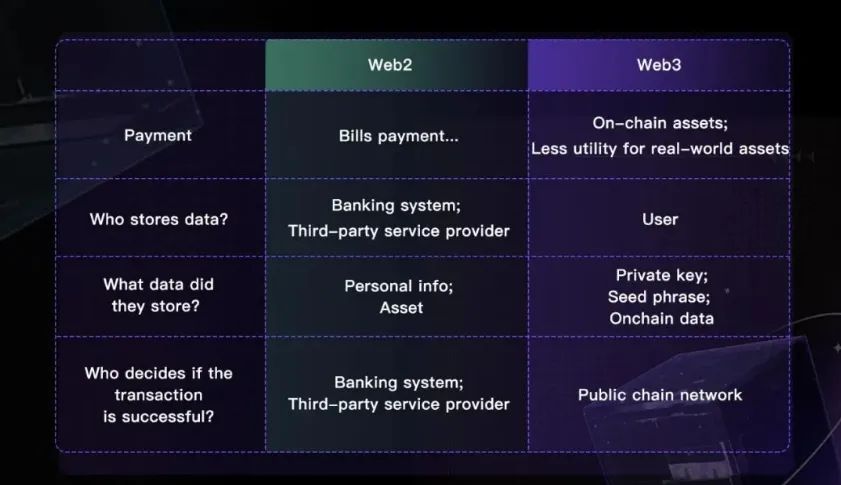
Traditional payments rely on an account-based system, where value transfers are recorded within intermediaries’ (e.g., banks, third-party payment companies) ledgers. With many participants involved, the process is complex and incurs high friction costs, making it expensive.
In contrast, Web3 payments represent a value-based or token-based system, where value transfers are stored directly by users on the blockchain’s distributed ledger. Built on blockchain infrastructure, Web3 payments allow seamless transfer of cryptocurrencies between sender and receiver, solving issues of high cost, inefficiency, and slow speed in traditional cross-border payments.
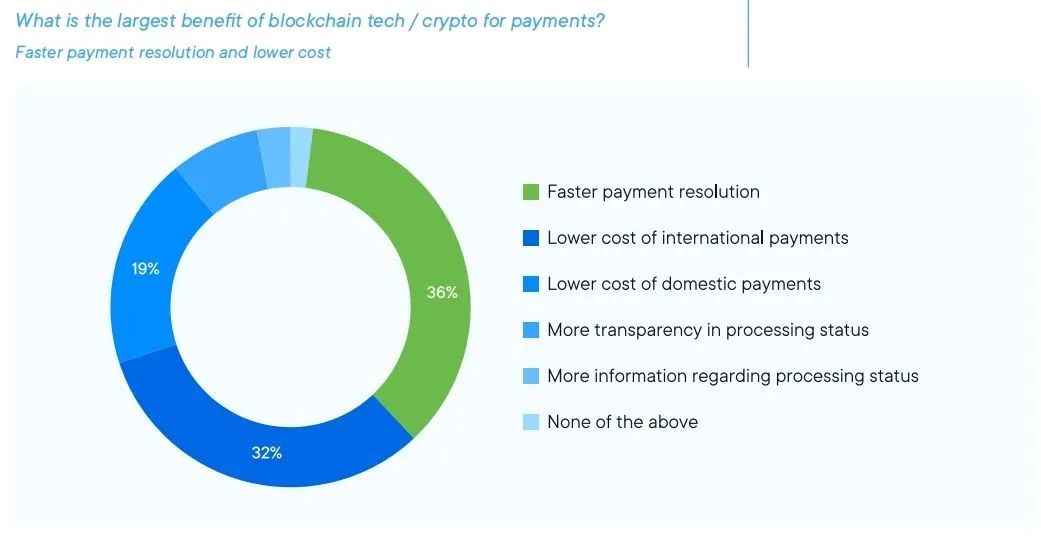
What are the advantages of Web3 payments compared to traditional ones?
First, blockchain technology reduces trust costs between transacting parties, making payments more direct, faster, and secure. Smart contracts enable programmable and automated payments, increasing efficiency and reliability.
Second, cryptocurrency payments currently offer significant speed advantages over traditional methods—especially in cross-border contexts—making this a key driver for crypto payment adoption and a catalyst for upgrading legacy systems.
Additionally, the decentralized nature of Web3 payments simplifies processes reliant on centralized clearing institutions, reducing friction and significantly improving cross-border payment efficiency and settlement speed.
All signs indicate that traditional and Web3 payments are not entirely separate—they are converging from multiple angles. On one hand, blockchain technology is being increasingly adopted in traditional finance: beyond CBDCs tested in various countries, major players like SWIFT, Visa, and PayPal are exploring Web3 payment solutions. On the other hand, Web3 projects are actively collaborating with traditional financial institutions and third-party payment providers, and accelerating the use of compliant stablecoins.
Despite facing challenges in technology, user adoption, security, and compliance, Web3 payments hold profound significance—not only for the crypto industry but also for the broader traditional financial sector.
2. Main Pathways of Web3 Payments
Currently, Web3 payments can be broadly divided into two types:
(1) On-/Off-Ramp Payments;
(2) Cryptocurrency Payments (including on-chain native scenarios and off-chain real-world transactions).
Web3 payments link fiat and cryptocurrencies through on/off-ramps and enable crypto asset circulation through cryptocurrency payments, forming a complete payment loop.
Given the relatively small size of native crypto markets and limited payment use cases, most discussions about Web3 payments today revolve around fiat-to-crypto on/off-ramp exchanges.
2.1 On-/Off-Ramp Payments
On-/off-ramp mechanisms are critical bridges connecting fiat and cryptocurrencies, enabling a complete payment cycle. Beyond OTC/P2P methods, most on/off-ramp processes require third-party payment providers.

2.1.1 On-/Off-Ramp Payment Flow
The underlying fund flow in on/off-ramp payments: users transfer fiat currency via a payment channel to liquidity providers behind third-party platforms (Crypto Liquidity Providers). These liquidity providers act like merchants in traditional payment scenarios, transferring crypto “goods” on-chain to user addresses while supplying crypto liquidity to the payment platform. The reverse applies for off-ramping.
These liquidity providers are typically centralized exchanges (e.g., Coinbase Prime, Binance, Kraken), stablecoin issuers (e.g., Tether, Circle), or crypto-friendly banks (e.g., the defunct Silvergate Bank and Signature Bank). Liquidity providers play a vital role in bridging fiat and crypto during on/off-ramping.
2.1.2 Major On-/Off-Ramp Payment Methods
A. Centralized Exchanges
Since centralized exchanges also perform monetary transmission functions—overlapping with payment providers—they often apply for the same crypto/payment licenses and thus commonly offer on/off-ramp services.
Combined with their ability to serve as liquidity providers, most centralized exchanges have dedicated on/off-ramp business units, allowing users to directly purchase crypto via debit/credit cards or bank transfers—for example, Binance Pay, Coinbase Pay, XXX Pay, etc.
Centralized exchanges provide hosted wallet interfaces for traders, who can choose between different accounts within the same custodial wallet or use non-custodial wallets. The former avoids gas fees and is therefore cheaper.
Moreover, in more strictly regulated jurisdictions, centralized exchanges may need to integrate independent on/off-ramp providers as underlying payment channels to facilitate user deposits and withdrawals. This approach also applies to decentralized exchanges—for instance, Uniswap integrates MoonPay, PayPal, and others to support user on/off-ramps.
B. Independent On-/Off-Ramp Payment Providers
Independent on/off-ramp providers are payment institutions (including crypto-friendly banks) with cryptocurrency transfer capabilities, required to obtain relevant crypto/payment licenses in their operating regions.
MoonPay is currently the leading project in crypto on/off-ramping, positioning itself as the “PayPal for Web3,” with over 5 million registered users. It supports crypto payments in over 160 countries and regions, enabling exchange between more than 80 cryptocurrencies and over 30 fiat currencies, holding most necessary payment licenses globally.
In terms of payment methods, MoonPay currently supports credit/debit cards, mobile payments, and account-to-account transfers. Users simply input their on-chain address and amount to complete the transaction. Backed by Coinbase as its liquidity provider, MoonPay leveraged early-mover advantage and comprehensive on/off-ramp features to quickly dominate the Western markets where credit card usage is prevalent, reaching a valuation of $3.5 billion.
Additionally, recent moves by traditional payment giant PayPal—leveraging its robust payment infrastructure and partnering with stablecoin issuer Paxos to launch the PYUSD stablecoin—signal its entry into the Web3 payment market. Previously collapsed Silvergate Bank and forcibly shut down Signature Bank were also significant on/off-ramp channels.
C. Other On-/Off-Ramp Payment Methods
Other on/off-ramp methods are essentially payment products built by integrating the above two models.
Aggregated payment products combine multiple independent on/off-ramp providers, allowing users to compare rates and quotes. MetaMask is a prime example of such aggregation, with other notable leaders including TransitSwap and KyberSwap.
Crypto retail terminals such as ATMs and POS systems have emerged alongside industry growth. Crypto ATMs allow users to buy crypto directly with cash offline. ATM operators source liquidity from third-party suppliers to fulfill user purchases. These transactions are notable for anonymity—requiring little or no identity verification—but suffer from extremely high fees (5%–20%). Bitcoin Depot leads this segment.
Crypto POS systems offer another avenue for offline crypto payments. Users pay with crypto, while merchants receive fiat directly—effectively enabling off-ramping. These systems require licensing, but fees are lower than ATMs. Pallapay is one provider offering such solutions.

Overall, users today have many choices for Web3 payments. However, since on/off-ramps involve fiat-crypto conversion, operators generally need to obtain regional operating licenses. Fees vary slightly depending on the payment model.
Beyond on/off-ramps, some centralized exchanges and payment providers partner with card networks like Visa and Mastercard to issue debit and credit cards that combine both on/off-ramp and crypto payment functionalities.
2.2 Cryptocurrency Payments
As cryptocurrency adoption grows, Web3 payments are entering traditional markets such as e-commerce (online shopping), gig economy (contractors and freelancers), cross-border remittances, travel bookings, and online gaming (in-game item exchanges). These use crypto for online spending and money transfers instead of relying on outdated infrastructure from traditional banks or third-party payment providers.
Currently, cryptocurrency payments fall into two main categories: those involving off-chain real-world transactions and those in native on-chain environments.

2.2.1 Cryptocurrency Payments – Off-Chain Real-World Transactions
According to a 2022 report by PYNMTS and BitPay surveying over 2,330 online merchants with annual sales exceeding $250 million, approximately 85% of large retailers (annual revenue >$1 billion) already accept cryptocurrency as payment. Among all surveyed merchants, half already accept crypto, and among those that don’t, 42% are planning to. The report also found that most merchants use non-native crypto wallets like PayPal and Venmo to support crypto payments.
To meet growing consumer demand for Web3 payments, leading payment giants like Mastercard, Visa, PayPal, Stripe, and Venmo have partnered with crypto firms to offer cryptocurrency as a payment option to millions of users. Most major retailers—including Overstock, Microsoft, Expedia, and Starbucks—have integrated crypto payments, allowing customers to directly purchase digital and physical goods with crypto. Other notable adopters include streaming platform Twitch, Norwegian Air, Etsy, and Burger King.
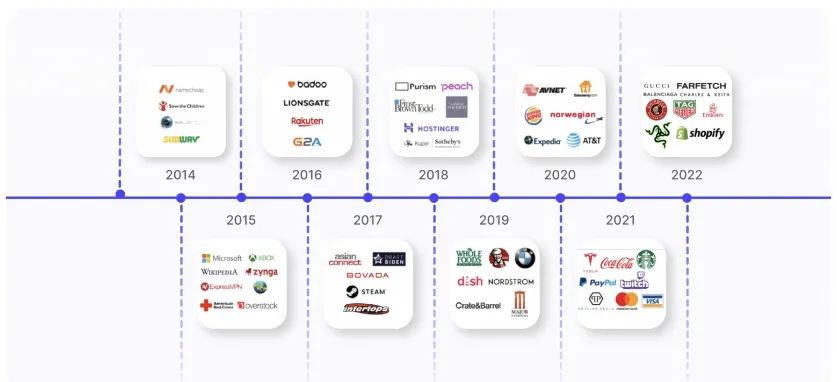
For off-chain real-world transactions, consider a scenario where a user pays with crypto and the merchant receives fiat. The fund flow involves a third-party provider first converting the crypto into fiat via off-ramping, then settling fiat to the merchant.
The most common solution today is issuing crypto debit/credit cards. Centralized exchanges or wallet providers typically partner with card networks like Visa or Mastercard. As long as users hold crypto in their platform account, they can use the card for online or offline purchases. At the point of sale, the issuer converts the crypto into local fiat via off-ramp channels before paying the merchant. For example, Crypto.com partnered with Visa to issue the Crypto.com Visa Card debit card. Besides fiat payments, it also supports on-chain crypto payments.
2.2.2 Cryptocurrency Payments – Native On-Chain Scenarios
In native on-chain payment scenarios, users pay with crypto and merchants also accept crypto. This should not be viewed simply as a blockchain-based peer-to-peer transfer—it must also address trust issues present in real-world transactions, which requires third-party solutions.
Take an online shopping example: between trusted friends, a simple blockchain transfer suffices—user pays, merchant ships, user receives. But in an untrusted marketplace, who ensures the merchant ships after receiving payment? How do we verify the received goods match expectations?
Similarly, we can easily send money peer-to-peer to family and friends via blockchain, but what about dealing with strangers? Hence, we need an account system linked to the blockchain settlement layer to coordinate physical goods delivery with on-chain payments.
This is where third-party crypto payment providers come in. They include payment protocols, core payment systems, front-end interfaces, and supporting modules—as illustrated above. Ripple and Stella are notable examples exploring this space.
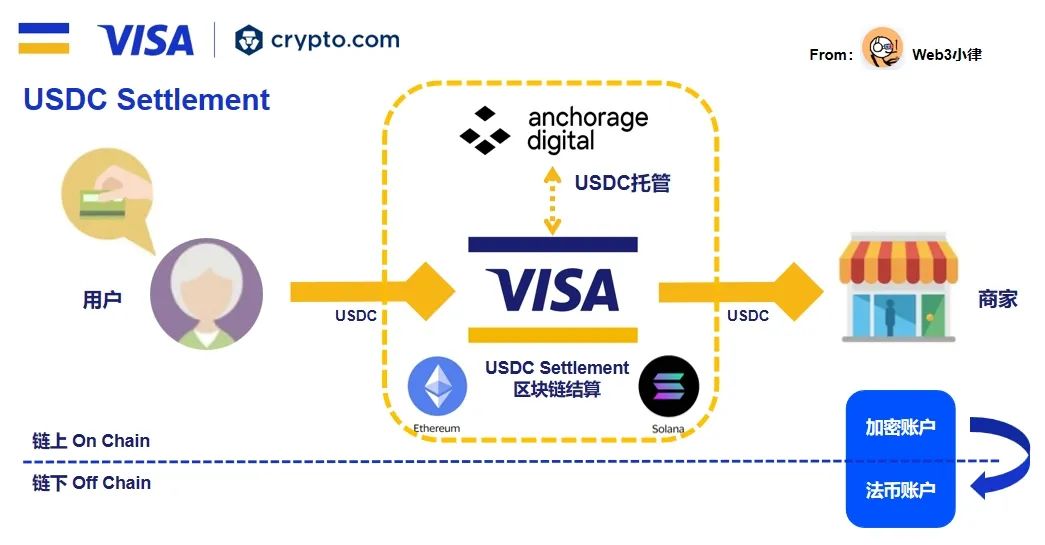
Visa recently introduced a USDC-based settlement solution, implemented in a case with Crypto.com. Previously, when a user paid with crypto and the merchant received fiat, Crypto.com had to convert the crypto into fiat and then settle via traditional payment rails. Using traditional channels meant added participants, transaction costs, complexity, and restricted settlement to banking hours.
With Visa’s USDC settlement, the need for fiat conversion and traditional payment steps is eliminated—enabling 24/7/365 real-time global settlement directly on blockchain. This flexible, no-conversion settlement opens new commercial opportunities for Crypto.com—such as merchant crypto payment gateways and blockchain-based cross-border payments.
Visa’s USDC settlement can also be applied to cross-border remittances. The nearly $1 trillion global remittance market suffers from high-cost legacy systems, with traditional providers charging up to 8% per transaction. In contrast, Web3 remittance products like Strike’s Send Globally leverage Bitcoin’s Lightning Network to offer affordable alternatives, charging only 0.01%–0.1% per transaction.
Combining such settlement methods with stablecoins can reduce traditional cross-border payment costs by up to 80%. This means a $500 remittance via on-chain crypto and on/off-ramp payments would cost only $4.80—far below the average ~$20 fee. In 2022, migrant workers sent nearly $800 billion globally. Web3-based remittances could save the industry $40–64 billion annually.
3. Industry Giants Entering Web3 Payments
Major players are progressively opening or integrating Web3 payment services—covering wallets, custody, payments, trading, and stablecoins—around their core businesses in transactions, payments, communications, and social networking. They aim to eventually cover their entire ecosystems, forming closed loops. Below we outline the strategies of PayPal, Coinbase, and MetaMask.
3.1 PayPal’s Web3 Payment Strategy – Payments, Wallet Custody, and Stablecoins
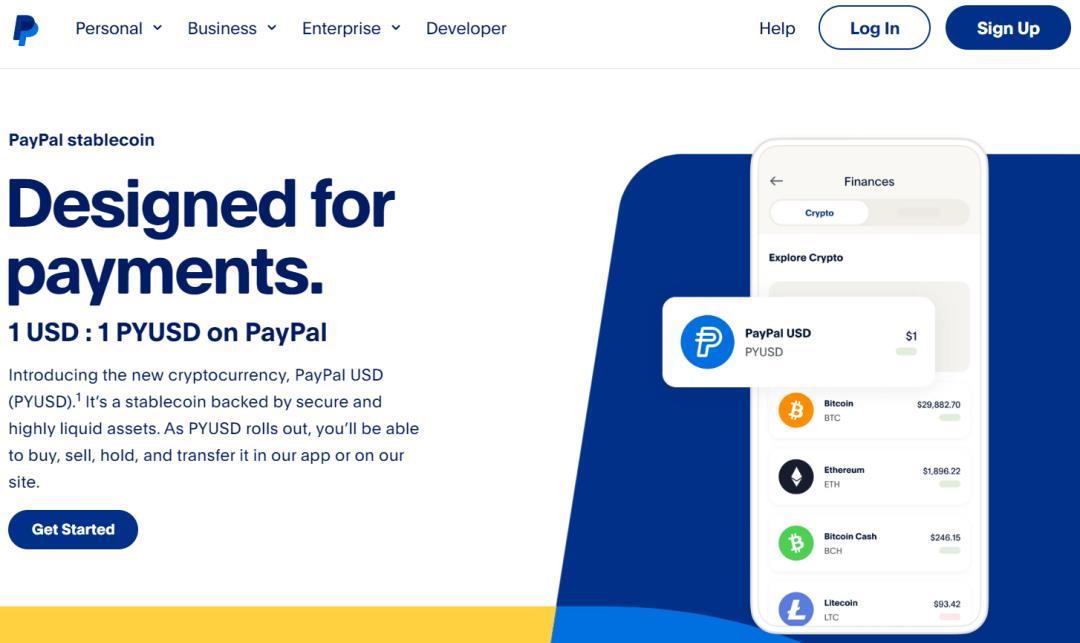
In our previous article, “PayPal’s Stablecoin Could Bring Crypto Into the Mainstream”, we discussed PayPal’s launch of the PYUSD stablecoin on August 7, 2023. As the only supported stablecoin in PayPal’s ecosystem, PYUSD aims to bridge PayPal’s 431 million existing users, providing a seamless connection between fiat and crypto for Web2 consumers, merchants, and developers.
3.1.1 Implementation Path of On-/Off-Ramp Services
By reviewing PayPal’s Cryptocurrency User Agreement, we see the crucial bridging role of the PYUSD stablecoin in connecting Web2 and Web3 payments, PayPal accounts, and crypto custodial wallets.
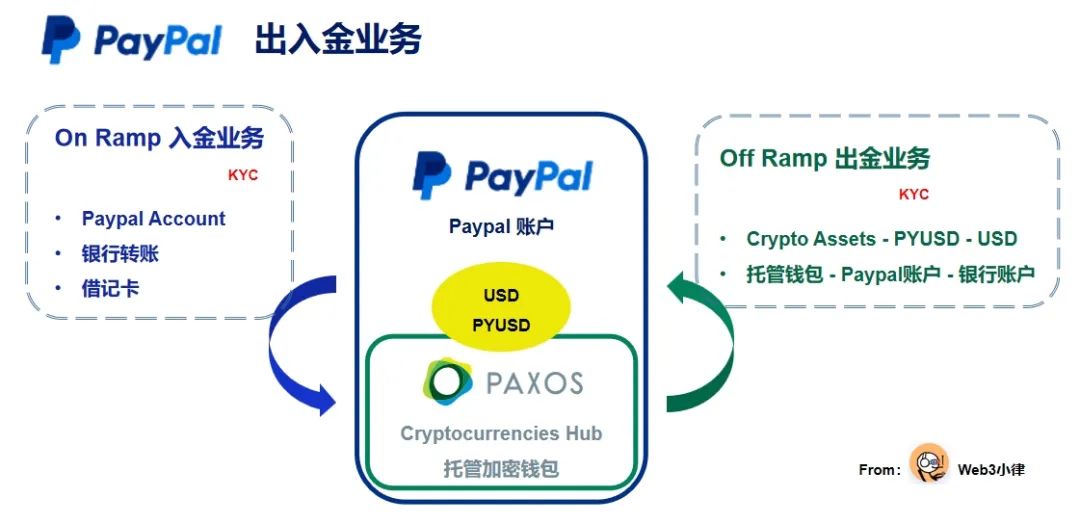
As shown above, PayPal uses the PYUSD stablecoin as a bridge between fiat and cryptocurrencies. Whether depositing, withdrawing, or making crypto payments, the flow follows USD → PYUSD → Crypto Asset (and vice versa). For example, when paying a merchant with crypto, the crypto asset is first sold into PYUSD/USD, which is then used to pay the merchant’s PYUSD/USD balance.
Fiat payments use the standard PayPal account, whereas for cryptocurrencies, PayPal creates a “Cryptocurrencies Hub” wallet within the user account. This wallet is custodied by Paxos, the issuer of PYUSD—meaning users surrender control of their assets (private keys). PayPal’s user agreement explicitly states: “You will not hold the digital Crypto Assets themselves in your Crypto Asset balance / You do not own any specific, identifiable, Crypto Asset.”
Thus, PayPal has established a comprehensive Web3 payment framework by connecting fiat and crypto payment channels, issuing a stablecoin as a medium, and building a wallet-account ecosystem—forming a logical closed loop within its own ecosystem.
Building on this, PayPal can leverage its strengths in payments to externally support on-ramp functions for wallets like MetaMask and Ledger, as well as centralized exchanges like Kraken. Additionally, PayPal’s off-ramp function, announced on September 12, will support wallets, DApps, and NFT marketplaces.
With channels, tools, and infrastructure in place, the key challenge is guiding PayPal’s 431 million existing users into Web3 and driving true mass adoption.
3.1.2 Traditional Payment Companies Are Ready
PayPal’s path is highly replicable for other traditional payment firms. Companies like Stripe and Square are already active in on/off-ramp and exchange services. For example, Stripe announced crypto on-ramp services in December 2022, and Block (Square’s parent company)’s Cash App offers BTC trading in addition to basic P2P payments.
Since traditional payment companies already comply with local payment regulations and hold necessary licenses, the timing and manner of their Web3 payment rollout are merely questions of strategy and pace. In contrast, newer entrants like X (formerly Twitter) are actively applying for Money Transmitter Licenses (MTL) across U.S. states to meet compliance requirements.
3.2 Coinbase’s Web3 Payment Strategy – Trading, Custody, and Payments
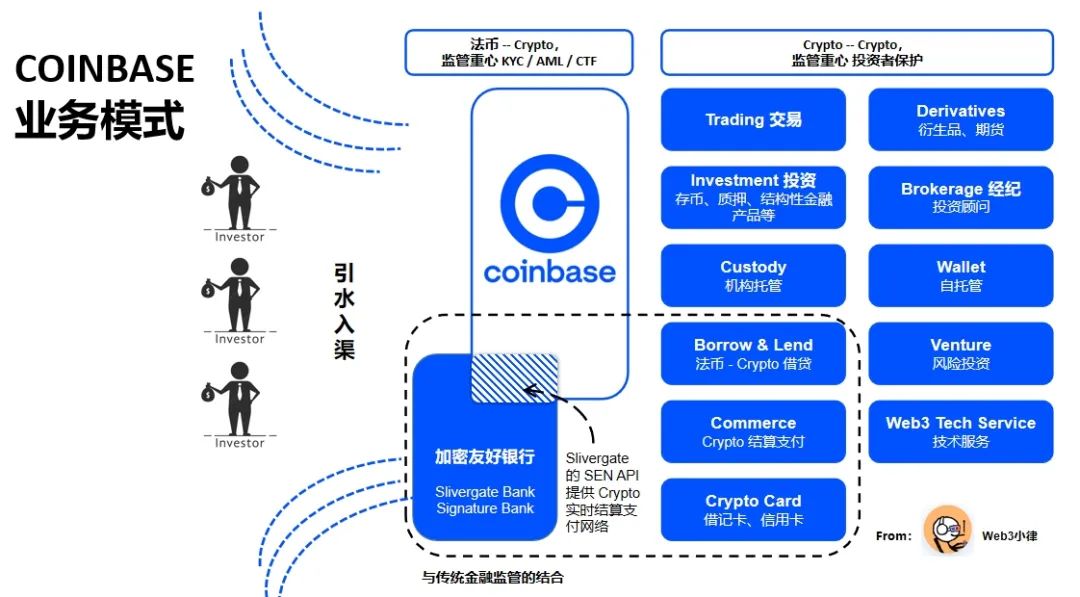
As one of the most compliant centralized exchanges globally, Coinbase’s regulatory journey offers valuable insights. Coinbase has created a self-contained ecosystem encompassing on/off-ramp channels, Commerce merchant payment solutions, a stablecoin transaction medium (USDC), custodial and non-custodial wallets, and core exchange functionality.
3.2.1 Trading as Core, Payments as Support
While centralized exchanges primarily seek payment licenses to ensure trading compliance, these licenses also open up on/off-ramp and payment channels. Due to regulatory uncertainty, heavy reliance on third-party on/off-ramp providers—like the collapsed Silvergate Bank and regulator-forced bankruptcy of Signature Bank—can create business instability. Thus, most exchanges now have their own payment divisions—such as Binance Pay, Coinbase Pay, and XXX Pay.
Under “Licenses & Disclosures,” we see Coinbase holds Money Transmitter Licenses (MTL) in most U.S. states. Notably, in 2017, Coinbase obtained the BitLicense from New York State Department of Financial Services (NYDFS), becoming the first licensed Bitcoin exchange in the U.S. authorized to offer Bitcoin buying, selling, receiving, and storage services in New York.
Outside the U.S., Coinbase actively expands overseas, securing
Join TechFlow official community to stay tuned
Telegram:https://t.me/TechFlowDaily
X (Twitter):https://x.com/TechFlowPost
X (Twitter) EN:https://x.com/BlockFlow_News
 0xWillmfer


