








Between Two TOKEN 2049 Events: Justin Sun and TRON's Strategy and Ambitions
TechFlow Selected TechFlow Selected
Between Two TOKEN 2049 Events: Justin Sun and TRON's Strategy and Ambitions
stUSDT is just the beginning of TRON's foray into the RWA sector, with more RWA tokenized products and services to come in the future.
 Navigating Web3 tides with focused insights
At the TOKEN 2049 conference held in Singapore in 2022, TRON founder and Huobi Global Advisory Council member Justin Sun attended as a guest speaker. He proposed a new ecological vision for TRON: "The next step for TRON is to become a mainstream financial institution," unveiling a fresh strategic direction for the TRON ecosystem and reflecting Sun’s long-standing advocacy and forward-looking perspective on the future of blockchain and cryptocurrency.
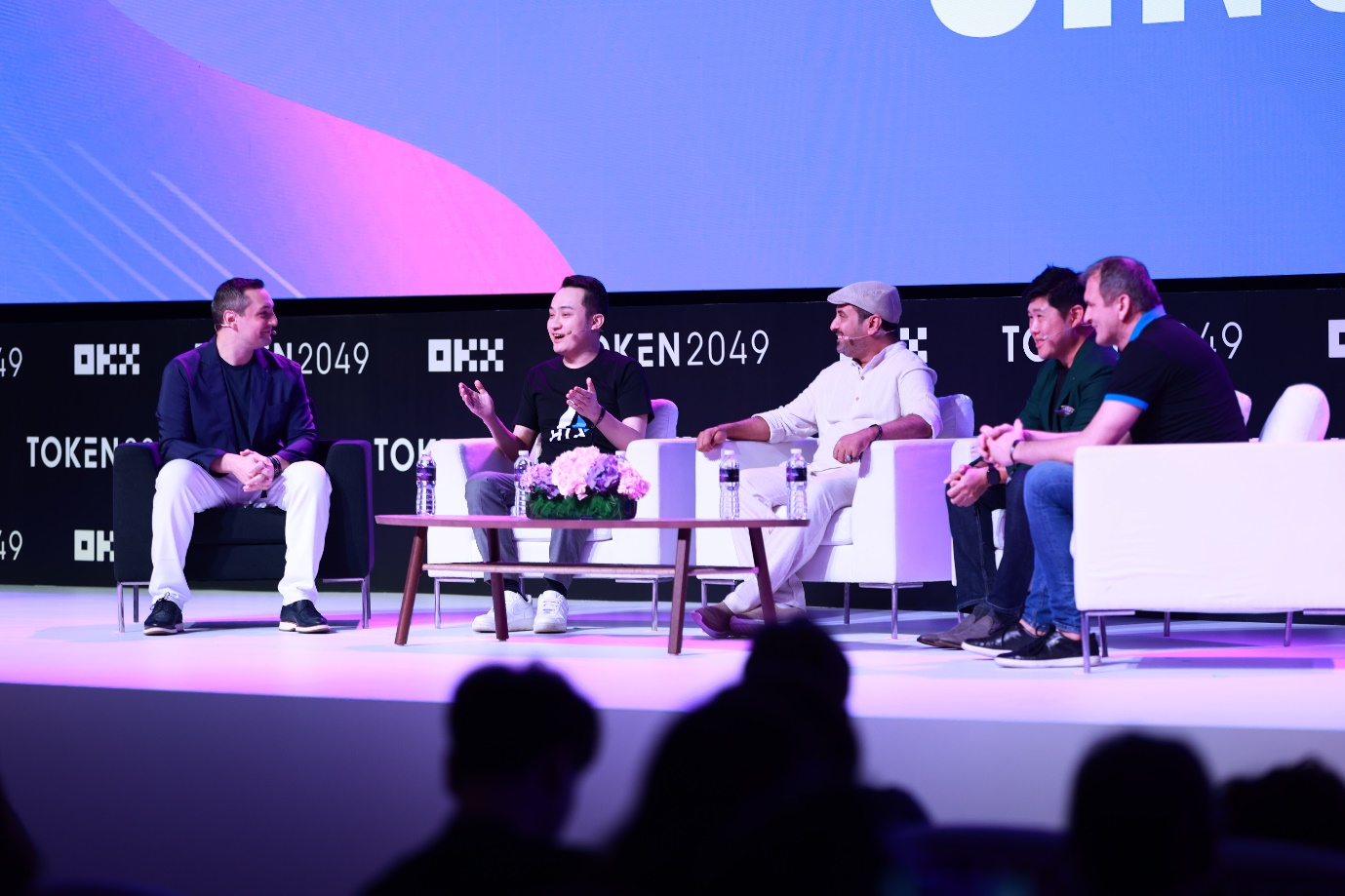
One year later, at the 2023 TOKEN 2049 event once again hosted in Singapore, Justin Sun has advanced the TRON ecosystem through layered strategic initiatives, driving rapid progress over the past year.
Today, TRON has become one of the most critical ecosystems within the crypto stablecoin landscape, while also achieving strong results in cutting-edge DeFi areas. For example, its supported RWA protocol stUSDT is emerging as the new "dominant force" in this sector. Currently, TRON ranks among the industry leaders in user activity, leading in key metrics such as transaction volume and TVL, firmly securing its position as the second-largest crypto ecosystem.
Justin Sun's consistent strategy and ambition for TRON are becoming increasingly clear—and are now being realized.
Breaking Through Amid Adversity
The sudden collapse of the Terra ecosystem in 2022 became the first "domino" that plunged the crypto industry into a bear market. This was followed by a series of black swan events, including the FTX meltdown and the bankruptcy of Three Arrows Capital. At the same time, the SEC aggressively wielded regulatory pressure, filing lawsuits against Bittrex, Coinbase, Binance, and even Justin Sun himself. The crypto industry faced one dark moment after another. Under these circumstances, many industry participants and investors adopted a pessimistic outlook on the long-term prospects of the sector.
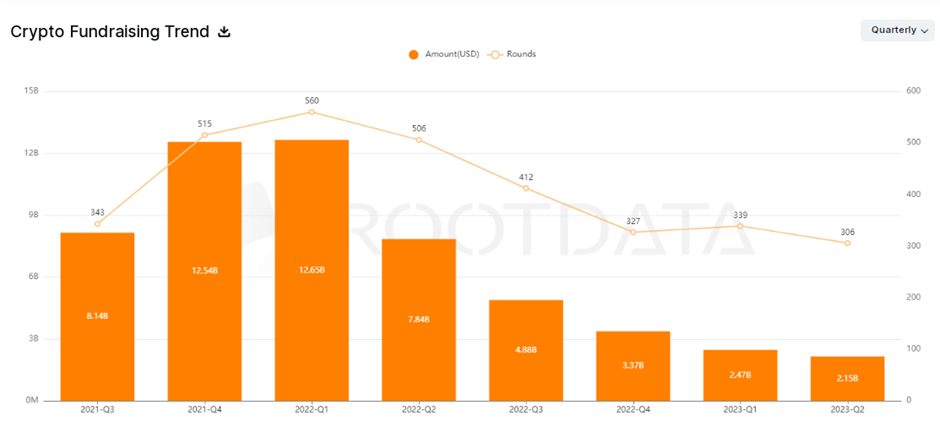
Crypto market funding rounds statistics. Source: Rootdata
Although Justin Sun was caught in the SEC regulatory storm, he was not significantly deterred. He maintains unique insights into regulation and remains highly optimistic about the industry's development.
On September 8 this year, during his appearance at the Korea Blockchain Week (KBW), Sun stated that although countries like the United States have adopted aggressive policies toward crypto technology, the broader trend shows that crypto will serve as the foundation for the next generation of decentralized finance—a globally shared technology that will impact everyone's lives.
When asked about when the crypto industry might emerge from its downturn, he said short-term policy-driven slumps cannot undermine the long-term trajectory. Over the past year, the industry has largely undergone deleveraging and addressed liquidity crises at certain firms. Over the next two years, with continuous improvements in market mechanisms and increasingly stable regulations—especially in Asia—the crypto market stands a strong chance of entering a new bull cycle.
In fact, since Sun articulated last year that “TRON’s next goal is to become a mainstream financial institution,” he has actively pursued expansion into high-potential regions and aligned with compliance trends to accelerate TRON’s path toward mainstream adoption.
After Hong Kong’s government released its virtual asset policy declaration last year and announced plans for a series of supportive measures, the region gradually emerged as fertile ground for crypto development.
During his attendance at the Hong Kong Web3 Summit, Sun remarked, “Over the past three years, Hong Kong’s regulatory framework has evolved significantly—for the better. I am therefore confident about the future of crypto compliance in Hong Kong and across Asia.” He added that both TRON and Huobi would fully support Hong Kong’s new policies, closely monitor developments, and actively apply for relevant compliance licenses, aiming to become the preferred partner for Hong Kong clients and Web3 entrepreneurs.
On July 14 this year, the Hong Kong Securities and Futures Commission (SFC) officially accepted Huobi’s application for Type 1 (Securities Trading) and Type 7 (Automated Trading Services) licenses. Huobi HK will be launched to fully capture the Hong Kong market. Sun also emphasized that proactive preparations are already underway.
Beyond Hong Kong, amid global economic slowdowns, Japan began promoting a “Web3 National Strategy” last year, introducing a series of crypto-friendly policies aimed at fostering a favorable environment for Web3 industries and stimulating regional economic growth.
On July 25 this year, Japan hosted the “WebX” conference, inviting numerous Web3 industry figures. Japanese Prime Minister Fumio Kishida delivered a video address, and senior officials including Koichi Hagiuda, head of the LDP’s Policy Research Council, attended in person.
As an invited speaker, Justin Sun delivered a keynote speech. In addition to expressing confidence in the future of Web3.0, he stressed that cryptocurrencies must serve all global users—not just traders within the industry. He believes crypto will become as ubiquitous as Alipay, offering vast untapped opportunities beyond infrastructure alone. He sees greater potential today in practical applications and solving real-world problems.
Shortly after the WebX conference concluded, under Sun’s strategic leadership, TRON joined Japan’s prestigious industry association—the Japan Cryptoasset Business Association (JCBA). This signifies TRON’s commitment to adhering to Japan’s regulatory standards and compliance requirements, enhancing its credibility and security capabilities in the Japanese market.
Currently, the TRON network maintains a leading position across multiple domains, especially in stablecoins. The TRON ecosystem has achieved significant breakthroughs in stablecoin services, establishing a comprehensive stablecoin ecosystem comprising USDT, USDC, TUSD, USDJ, and USDD—covering various use cases in terms of liquidity, compliance, decentralization, and high collateral ratios. Moreover, the TRON network hosts the largest amount of USDT in circulation globally—over $46 billion—accounting for 60% of total USDT circulation. Regardless of the direction in which TRON expands, it stands to gain substantial benefits from this robust foundation.
With the support of Japan’s new policies and frameworks, TRON is poised to leverage its ecosystem to collaborate with the Japanese government and regulators on innovative financial projects—including yen-pegged stablecoins and tokenized bonds—and could become a key infrastructure enabling Japanese users to access transparent and reliable crypto asset services.
Earlier this year, Messari, a leading blockchain data firm, released its Q2 2023 Public Chain Performance Report. It revealed that TRON achieved a strong 2.8% deflationary rate by burning all transaction fees collected. Ethereum and TRON together accounted for 93% of total public chain revenue in Q2, reaffirming their dominant positions in the blockchain space.
While the crypto market remains in a bear phase and most on-chain ecosystems experience stagnation, the TRON ecosystem—under Justin Sun’s guidance—is making continuous breakthroughs by building an open and comprehensive ecosystem, thriving even in adverse conditions.
Could the TRON Ecosystem Be the Next Alibaba?
Currently, the crypto industry remains in a bear market. Amid a general lack of compelling narratives, RWA (Real World Assets) has emerged as a transformative narrative for Web3, capable of bringing over $80 trillion in traditional financial markets on-chain and bridging the vast gap between crypto and traditional finance.
Justin Sun is a strong advocate of the RWA narrative. He has stated that RWA tokenization will usher in a new era of physical asset investment and bring greater innovation and value to the blockchain industry.
In July this year, Sun took direct action by launching stUSDT—an RWA product—to actively drive TRON’s exploration into this field.
stUSDT is modeled after Lido’s restaking mechanism, distributing stablecoin yield to all holders. Additionally, stUSDT can circulate and be used within the TRON ecosystem and can be bridged to other major blockchains like Ethereum and BNB Chain, achieving interoperability with digital assets such as NFTs and DeFi protocols. Furthermore, stUSDT holders enjoy various incentives and reward programs within the TRON ecosystem, including free airdrops and high-yield returns.
In fact, stUSDT attracted over $400 million in total staked USDT within less than a month of launch. By early September, total staked value surpassed $900 million, with over 100,000 holding addresses and more than 550,000 transfer transactions recorded—making stUSDT the new "dominant player" in the sector.
The success of stUSDT is closely tied to the strength of the TRON ecosystem.
By early September this year, TRON had surpassed 181 million total accounts, exceeded 6.3 billion total transactions, and facilitated over $8 trillion in transaction value. Meanwhile, TRON remains the largest stablecoin network, hosting 60% of all circulating USDT. This massive user base, capital pool, and liquidity provide stUSDT with a powerful advantage, allowing it to outpace competitors from the outset.
From another angle, Justin Sun is steering the long-term development of the TRON ecosystem toward becoming a mainstream financial institution. Following regulatory breakthroughs in Hong Kong, Japan, and Singapore last year, Sun has intensified strategic expansion into these promising and compliant-friendly regions—with notable achievements.
Previously, legal and regulatory frameworks governing RWA tokenization struggled to seamlessly integrate with the digital realm. Markets needed to resolve issues related to jurisdiction, ownership rights, and enforceability to protect tokenized assets and ensure their legality. However, with the gradual rollout of friendly policies, there is growing momentum toward establishing clear RWA-related laws and regulations. Thus, Sun’s ecological vision and early compliance-focused strategy from last year appear remarkably prescient. As a result, investors and users alike place strong confidence in stUSDT, TRON’s first RWA product.
Sun has stated that stUSDT is merely the beginning of TRON’s journey in the RWA space. More RWA tokenization products and services are planned to meet diverse user needs and preferences.
Despite the crypto industry still being in the depths of a bear market, Justin Sun and TRON consistently pioneer exploration and implementation amid skepticism, finding ways to break through. As a Chinese entrepreneur, Sun is shaping the TRON ecosystem into the next "Alibaba."
Join TechFlow official community to stay tuned
Telegram:https://t.me/TechFlowDaily
X (Twitter):https://x.com/TechFlowPost
X (Twitter) EN:https://x.com/BlockFlow_News






