Analyzing DAO Treasury Management Tool Safe: Leading the Way in Security and Transparency for Decentralized Vaults
TechFlow Selected TechFlow Selected
Analyzing DAO Treasury Management Tool Safe: Leading the Way in Security and Transparency for Decentralized Vaults
DAO treasuries need to become increasingly standardized and transparent, helping DAO participants better achieve their goals while maintaining security.
 Navigating Web3 tides with focused insights
Intro
As decentralized autonomous organizations (DAOs) evolve, they are entrusted with increasingly diverse roles and expectations. Amid this rapid growth, asset management has become a critical issue. As DAOs continue to develop, handling assets—whether fungible tokens (FTs) or non-fungible tokens (NFTs)—requires efficient wallet solutions.
The primary challenge is asset security. Due to the complexity of DAO structures, vulnerabilities may arise from both technical and internal design aspects. Beyond security, scalability in asset management is also crucial. Seamless integration with various ecosystem applications determines how effectively asset management paradigms can be executed, directly impacting the realization of DAO functionality.
Considering these factors, multi-signature mechanisms have emerged as the preferred method for on-chain asset management within DAOs. This article examines the current state of DAO treasuries, beginning with an in-depth exploration of Safe (formerly Gnosis Safe), the leading tool for managing DAO treasuries today.
Overview of Safe
Smart Contract Accounts
Currently, Ethereum supports two types of accounts (also referred to as wallets):
● Externally Owned Accounts (EOA): Accounts controlled by private keys; most current wallets fall into this category, such as MetaMask;
● Smart Contract Accounts: Accounts accessed and controlled via smart contract code rather than private keys. This model allows for nearly unlimited functional extensions.

External vs Contract Accounts
Most on-chain users are accustomed to using EOAs, but if a private key is compromised, funds are at risk of being stolen. In July 2023, Ethereum's monthly active external accounts reached 5 million, while smart contract accounts numbered only about 10,000—highlighting a significant 500-fold difference.
Moreover, for managing crypto assets within multi-member organizations like DAOs, EOAs are far from ideal. Allowing each individual independent access to funds increases centralization and creates single points of failure. If someone intentionally or accidentally exposes their private key, funds could be irreversibly lost.
In contrast, smart contract accounts manage funds through code, defining who can access them and under what conditions. Thanks to the versatility of smart contracts, smart wallets not only break user dependence on private keys but also introduce beneficial new features and deliver a user experience similar to traditional financial service apps (TradFi). Some functionalities offered by different smart wallets include:
● Multi-signature: A transaction requires approval from two or more users, enhancing security. Smart wallets can also enable offline signing of multi-sig transactions, saving time;
● Spending limits: Transaction amount caps can be set to reduce costly user errors and prevent attackers from draining the wallet in one transaction;
● Whitelisting: Users can specify transfers only to known addresses, helping prevent phishing attacks;
● Bundled transactions: For convenience, multiple interactions with DApps can be executed within a single “bundled” transaction;
● Emergency freeze: The account can be locked in cases of device loss or theft to secure funds;
● Account recovery: Various recovery options (e.g., social recovery) help mitigate the high risk of losing private keys or seed phrases;
Multi-signature
Among these features, multi-signature is the easiest to implement and best meets the urgent needs of DAOs. Multi-signature wallets provide an additional layer of security by enabling "shared ownership" over a single wallet—rather than having a single founder hold the private key—within a DAO.
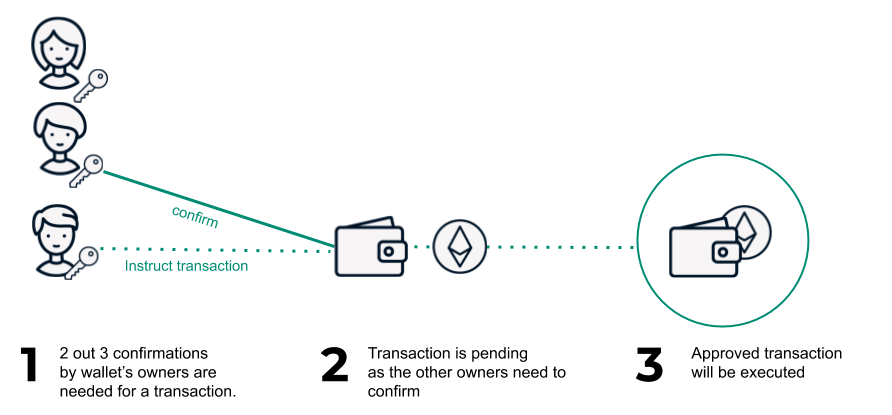
Multi-sig process
Multi-signature involves multiple sub-accounts jointly managing funds in a primary account. Before any transaction is executed, consensus must be obtained from all designated signers overseeing the multi-sig wallet. These sub-accounts collectively constitute the wallet’s owners.
Transactions are authorized only when a pre-defined number of owners, specified within the smart contract, jointly verify them. This mechanism effectively prevents malicious actions by any single node (e.g., manager or asset handler) during public fund management and reduces the risk of asset loss due to poor private key management.
Safe
In 2018, Gnosis launched an open-source on-chain multi-signature wallet solution—Gnosis Safe. This project underwent a split and reorganization in 2022, giving rise to Safe. Safe’s implementation of shared fund management aligns closely with DAO principles. In DAOs, decisions typically require member votes before being executed by a core signing team. Prominent DAOs such as BitDAO have adopted Safe as a key financial management tool.
The following chart provides a comparative overview of Safe against other cryptocurrency wallets.
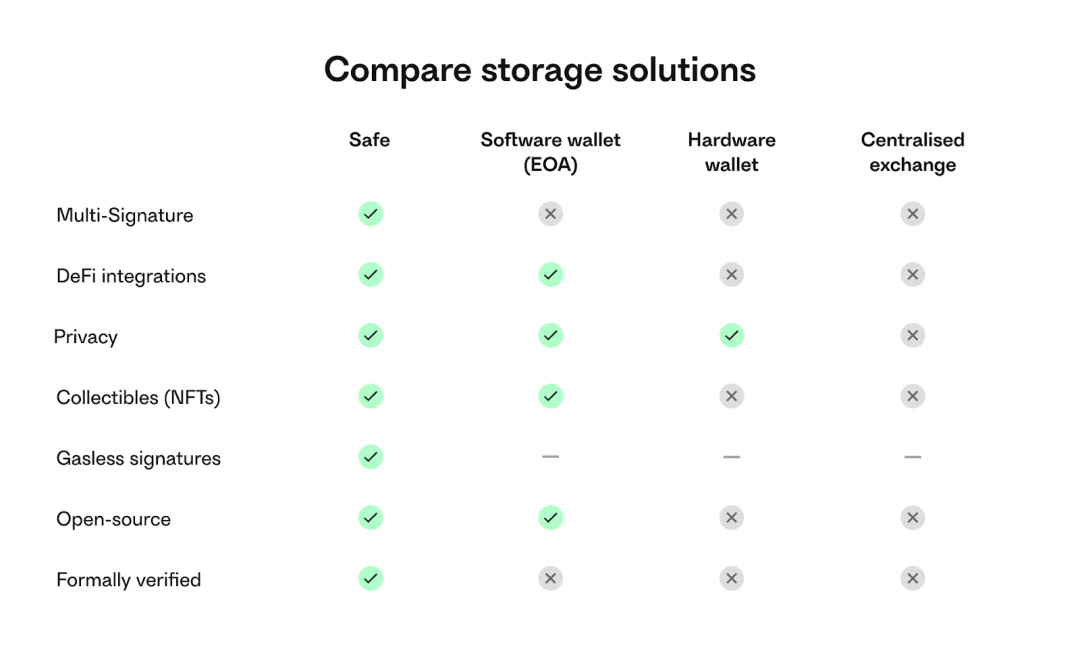
Safe vs Other Solutions
Data Analysis
After five years of evolution, Safe has expanded from Ethereum to other Layer 1 and Layer 2 solutions, covering numerous mainstream EVM-compatible smart contract platforms. This expansion has resulted in over 4.3 million Safe accounts created, generating a staggering 16.8 million transactions. Notably, each address averages four transactions.

Current State of Safe Data
Collectively, these addresses hold an astonishing $50 billion in assets. If Safe were a centralized exchange (CEX), this accumulation would surpass OKX, making it the second-largest exchange after Binance. Alternatively, if viewed as a U.S. bank, it would rank as the 45th largest, ahead of 4,799 other banks.
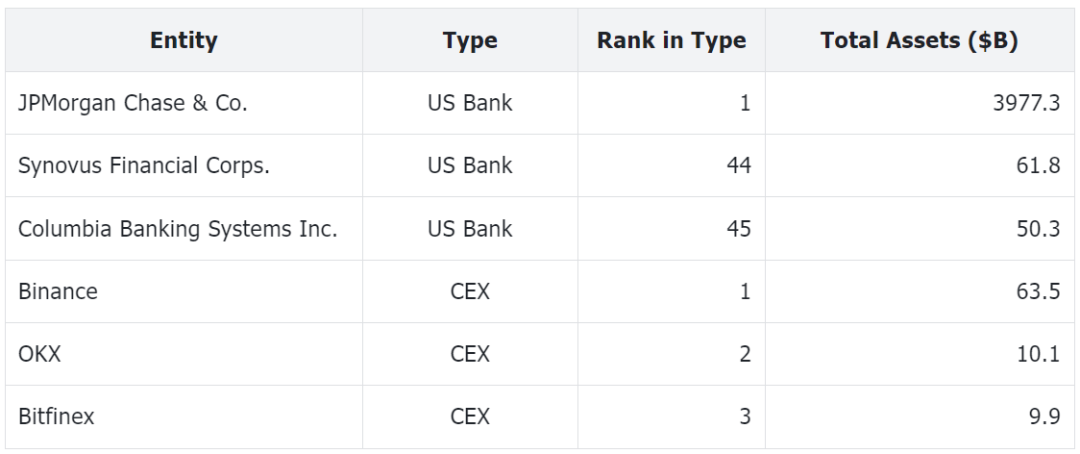
Total Asset Rankings
Multi-chain
Regarding asset distribution across different blockchains, Ethereum accounts for approximately 60% of total value, followed by Optimism, Polygon, and Avalanche, each representing about 10% of total market capitalization. Most funds are concentrated in ERC-20 tokens rather than native tokens (such as ETH, BNB, etc.).
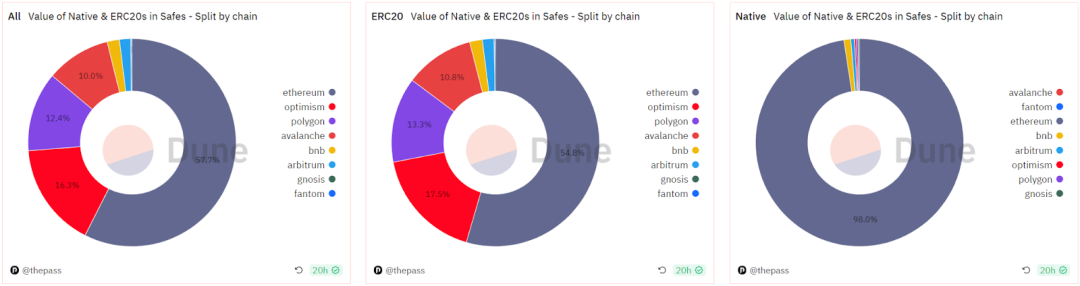
Safe Address Value - Multi-chain
Focusing on Safe addresses across different chains, surprisingly, 85% originate from Polygon and Optimism. Since the summer of 2020 (DeFi Summer), the influx of new Safe addresses has shown a continuous upward trend. Notably, Polygon experienced explosive growth starting late 2022. Similarly, Optimism saw its own surge in June 2023.
This surge may partly stem from the launch and adoption of Worldcoin. The Worldcoin app beta was initially on Polygon, but in June 2023, users were prompted to migrate to Optimism. Worldcoin chose Safe due to its user-friendly Web2-style interface, which simplifies cryptocurrency adoption—particularly appealing to users with little prior exposure to crypto. This strategic move enhances accessibility and usability in the cryptocurrency space.

Monthly New Safe Addresses - Multi-chain
Monthly active addresses follow a similar fluctuation pattern to new addresses. Since late 2022, Polygon has demonstrated explosive growth and dominance. Excluding Polygon, active addresses on other chains show steady growth, hovering around 30,000 since late 2022, with Ethereum and Arbitrum standing out.

Monthly Active Safe Addresses - Multi-chain
Transaction volume follows the trajectory of new and active addresses. Prior to 2022, the Gnosis Chain led in transaction volume. However, in 2022, Ethereum and Polygon saw a sharp increase. After August 2022, due to lower fees, most Safe transactions shifted to Polygon, Gnosis, and Optimism.
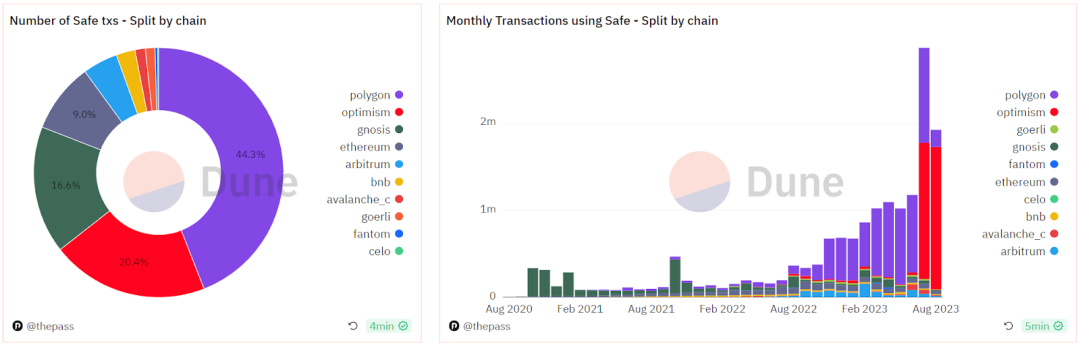
Monthly Safe Transactions - Multi-chain
The proportion of transactions involving Safe addresses across different chains shows a consistent upward trend. Currently, about 0.6% of all transactions on Ethereum, Polygon, Optimism, and Arbitrum involve Safe addresses.
Compared to transaction count, Ethereum dominates in transaction volume primarily due to the concentration of high-value assets on the platform. Notably, the peak in transaction volume differs from trends in transaction count and active addresses. That peak occurred in November 2021, followed by a gradual decline. However, as previously mentioned, transaction counts and active addresses continue to rise. This divergence is partly due to the sharp drop in token prices after the peak. This trend suggests that even during periods of falling token prices, Safe users remain actively engaged in transactions.

Share of Transactions and Transaction Volume Using Safe - Multi-chain
Ethereum
Ethereum dominates among major smart contract platforms, hosting significant transaction and fund activity—including operations of mainstream DAO treasuries. In this context, we now examine Safe’s role within the Ethereum ecosystem. On Ethereum, Safe addresses collectively hold nearly $30 billion in assets (excluding NFTs), including $3.4 billion in ETH and a substantial $26.3 billion in ERC-20 tokens. These figures represent over half of the total assets held across all Safe addresses on all chains.

Safe Address Value [Ethereum]
These substantial assets are distributed across approximately 162,000 addresses, resulting in a cumulative 1.5 million transactions. Each address averages 10 transactions. Last month, both new and active addresses were around 10,000.

Safe Overview [Ethereum]
Since DeFi Summer in 2020, the number of new Safe addresses on Ethereum has shown a steady upward trend. The peak occurred in July 2022, reaching about 12,000, followed by a decline during a period of market turbulence. However, starting in June 2023, the number of new addresses surged again. Even under challenging external conditions, Safe’s unique product appeal continues to attract new users.
Beyond the monthly influx of new addresses, the number of active addresses has also steadily increased. Active addresses peaked in September 2022 at about 15,000. Although the number of new addresses per month has decreased, highlighting user loyalty, active addresses have remained stable at around 10,000 since then.
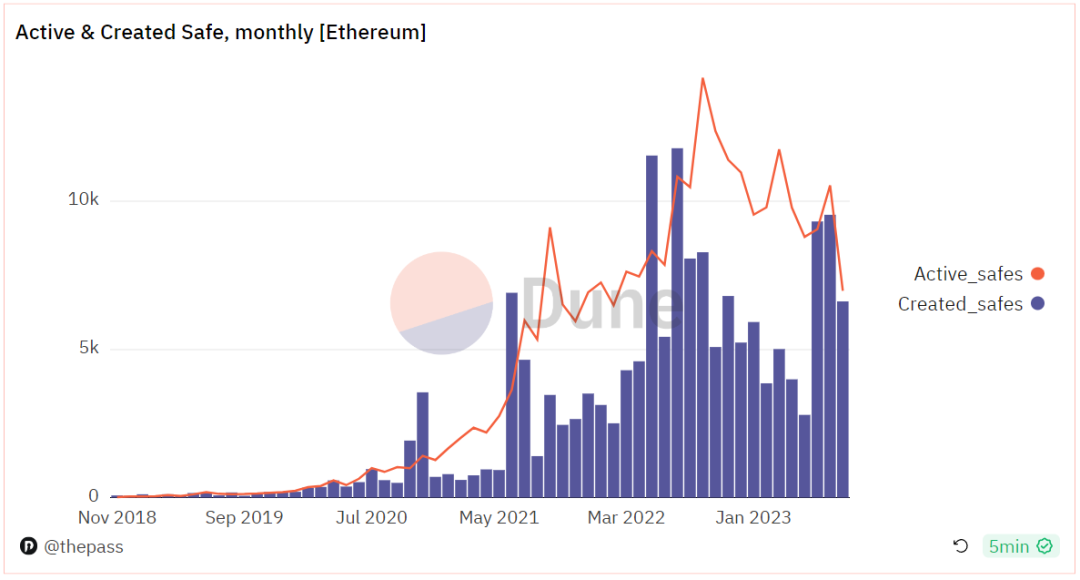
Monthly Active & New Safe Addresses [Ethereum]
Transaction volume parallels active addresses, rising steadily since summer 2020 and peaking in September 2022, maintaining levels above 60,000. In contrast, transaction value peaked in November 2021.
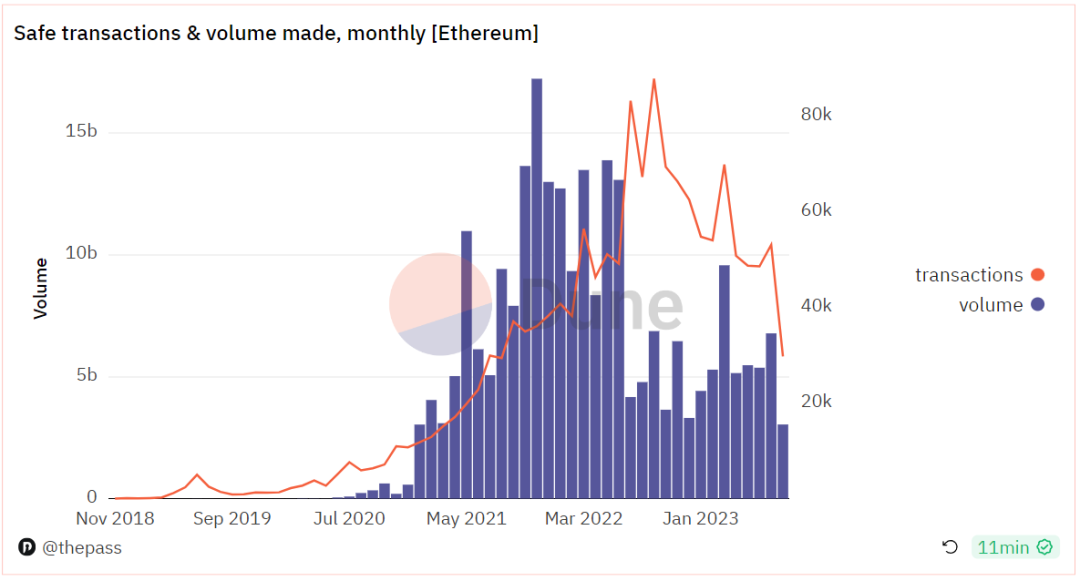
Monthly Transactions & Volume Using Safe [Ethereum]
Polygon
As the blockchain with the highest number of Safe addresses and transactions, Polygon warrants closer examination. Safe addresses on Polygon collectively hold over $6.3 billion in assets (excluding NFTs), mostly in ERC-20 tokens. These assets account for over 12% of all assets held in Safe addresses across blockchains, placing Polygon second only to Ethereum and Optimism in this regard.

Value in Safe [Polygon]
These tokens are distributed across about 2.4 million addresses on Polygon, resulting in 7.4 million transactions. Each address averages three transactions—fewer than Ethereum’s ten. The majority of addresses (87%) conducted only 1–5 transactions. Last month, approximately 170,000 new addresses were added, with over 475,000 active addresses—ten times more than on Ethereum.

Safe Overview [Polygon]
Unlike Ethereum, growth in new Safe addresses on Polygon has been unstable. Starting October 2022, it experienced a sudden surge, averaging 200,000 new addresses per month—a trend that continues today. This growth is largely attributable to Worldcoin. Meanwhile, active addresses have also steadily increased, reaching about 470,000 last month.

Monthly Active & New Safe Addresses [Polygon]
Monthly transaction volume and active address numbers show a synchronized trend, experiencing a sudden explosive growth starting October 2022. In contrast, transaction value peaked early in 2022 and has since stabilized around $200 million.

Monthly Safe Transactions & Volume [Polygon]
DAOs
Activity
We selected well-known DAOs on Ethereum that use Safe for treasury management as our analytical sample, leveraging data provided by ThePass. It should be noted that while most mainstream DAO treasuries are indeed on Ethereum, not all DAOs use Safe for treasury management. Even DAOs using Safe may have other addresses that are either Safe-based or not. However, from a security standpoint, we strongly believe multi-signature wallets are likely to become the standard for treasury management in the DAO space.
ThePass covers most DAOs, encompassing approximately 3,400 DAOs on the Ethereum network alone, with combined treasuries totaling about $16 billion. Among them, over 700 DAOs use Safe, operating more than 800 Safe addresses. Some DAOs choose to use multiple addresses to enhance flexibility and security.
The signer thresholds for these multi-sig wallets are mainly concentrated between 1 and 3, with 87.5% falling into the 1–3 threshold category. However, for DAO treasury multi-sigs, too few signers may imply centralization risks and single points of failure.
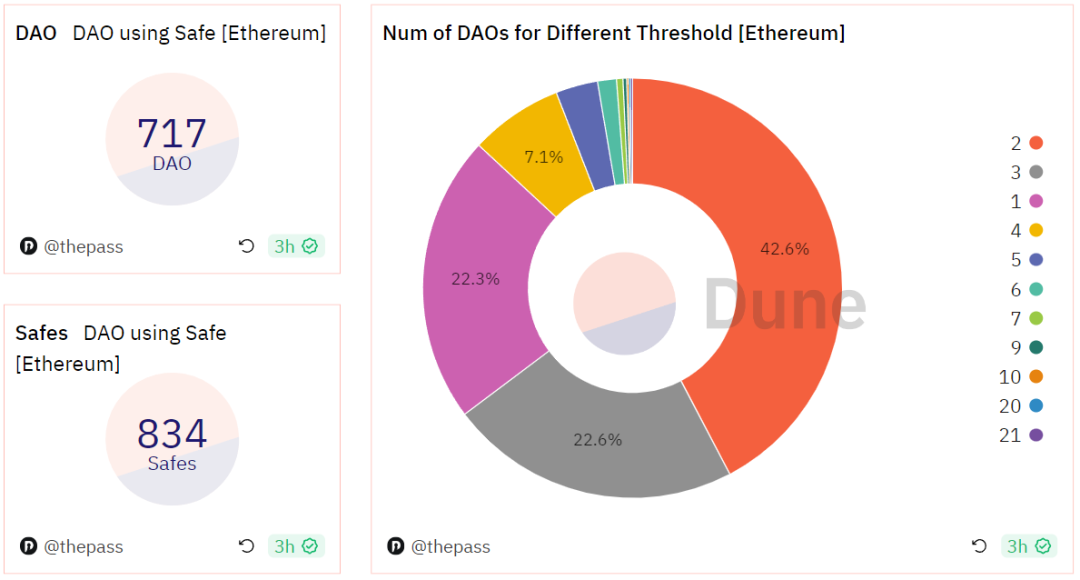
DAOs Using Safe [Ethereum]
Since early 2020, the number of new Safe addresses adopted by DAOs has increased steadily month by month. This trend peaked in the second half of 2021 and gradually slowed from April 2022 onward. The growth in new Safe addresses has been accompanied by a cumulative surge in active addresses, highlighting sustained engagement post-creation.
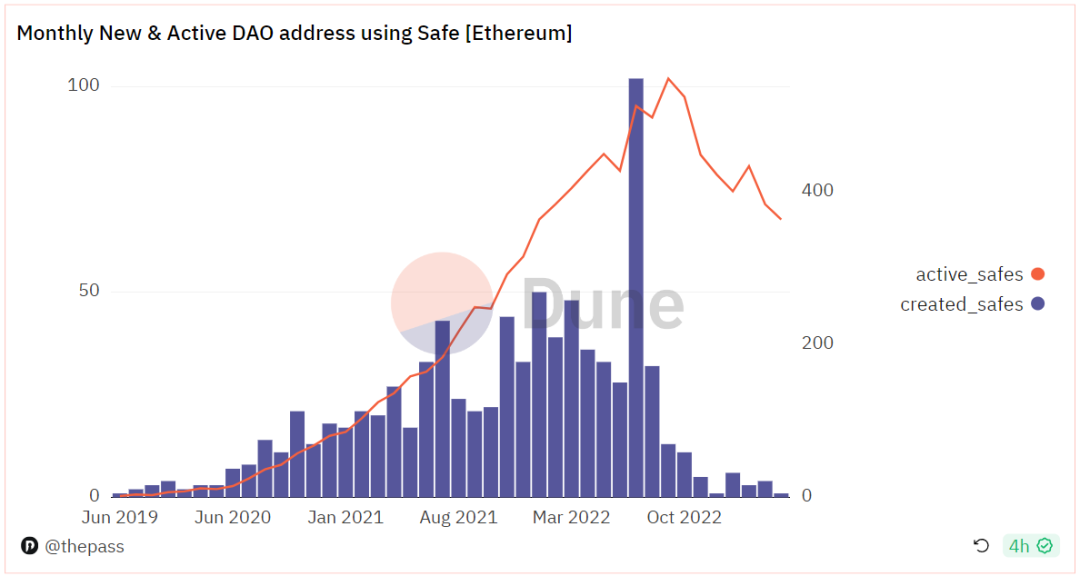
DAO Activity Using Safe [Ethereum]
Treasury
Just over 800 Safe addresses belonging to DAOs hold nearly $7 billion in assets (excluding NFTs). This accounts for almost one-seventh of all funds stored in Safe addresses on Ethereum. This substantial pool includes $6.265 billion in ERC-20 tokens and $677 million in ETH.

DAO Treasuries Using Safe [Ethereum]
When ranking DAOs by treasury size, infrastructure and DeFi projects dominate the top tier. In terms of asset distribution, DAOs with less than $1 million in treasury make up over 70% of the surveyed DAOs. A striking example is BitDAO, whose treasury holds a massive $2.17 billion—over 30% of the total assets across all surveyed DAO treasuries—demonstrating a clear head-end effect.
Different types of DAOs require varying levels of funding to achieve their diverse goals. Crypto Relief, ranked fourth, is a community-run fund dedicated to providing aid during the Covid crisis. Compared to ambitious projects building Layer 2 solutions (like BitDAO), DeFi protocols (such as Frax Finance and Synthetix) generally require relatively smaller treasuries.
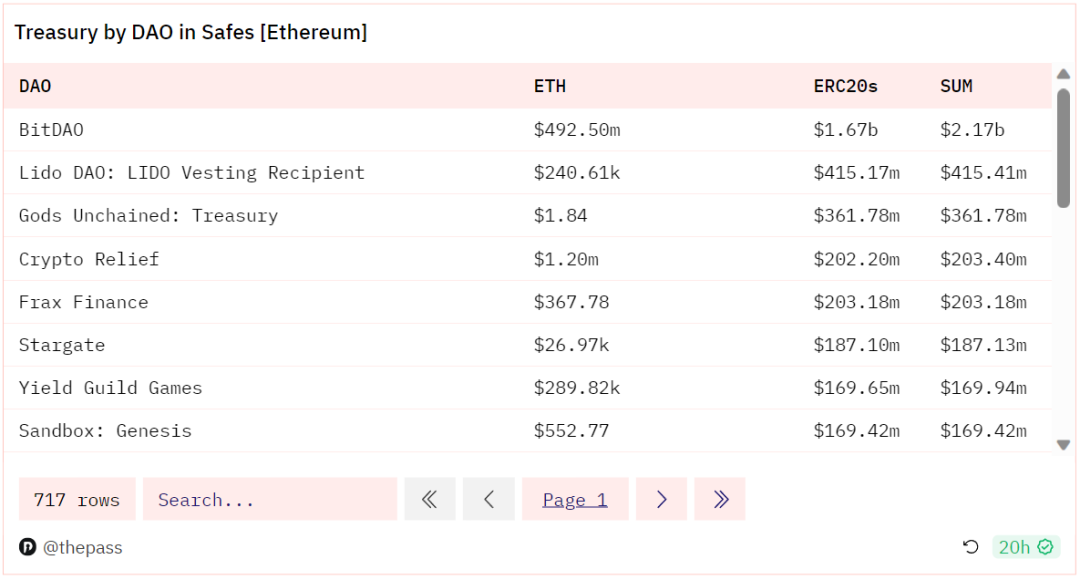
DAO Treasury Leaderboard Using Safe [Ethereum]
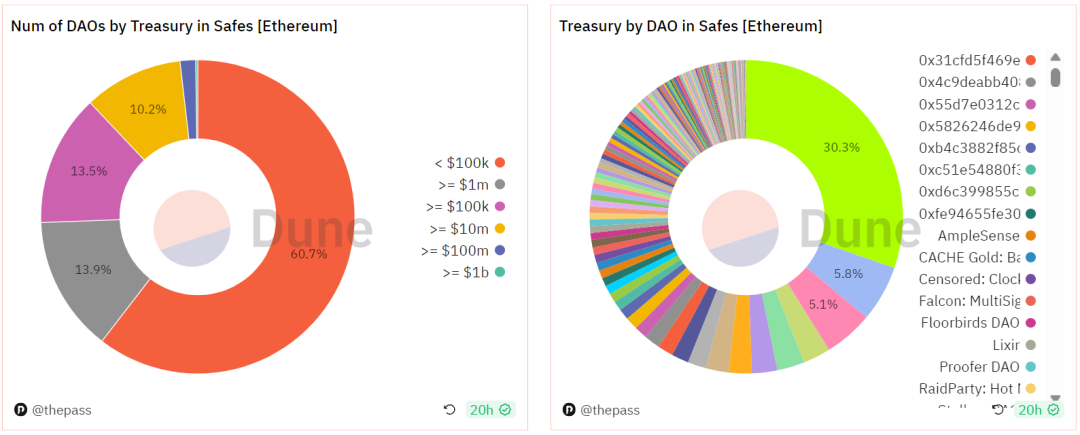
Analysis of DAO Treasuries Using Safe [Ethereum]
Apart from BitDAO, which receives steady income from Bybit, most DAOs hold more ERC-20 assets than ETH. This indicates that most DAO treasuries are primarily composed of their own governance tokens. However, excessive concentration in these tokens may introduce risks of unhealthy balance sheets.
Assets within these treasuries, both in number of DAOs and total value, have grown rapidly since early 2021. In the first months of 2021, the most influential DAO was 1inch, managing nearly $10 billion in funds. In October 2021, prominent DAOs like YGG and BitDAO significantly contributed to the surge in DAO treasury assets, though this declined gradually in early 2022.
Currently, nearly all DAOs have seen their assets shrink substantially compared to their peaks, dropping by nearly four-fifths from around $40 billion in early 2022. This decline is primarily due to falling prices of their governance tokens. Holding large amounts of native tokens means price fluctuations can greatly impact treasury value. Without low-risk treasury construction, portfolio value may swing sharply during volatility.
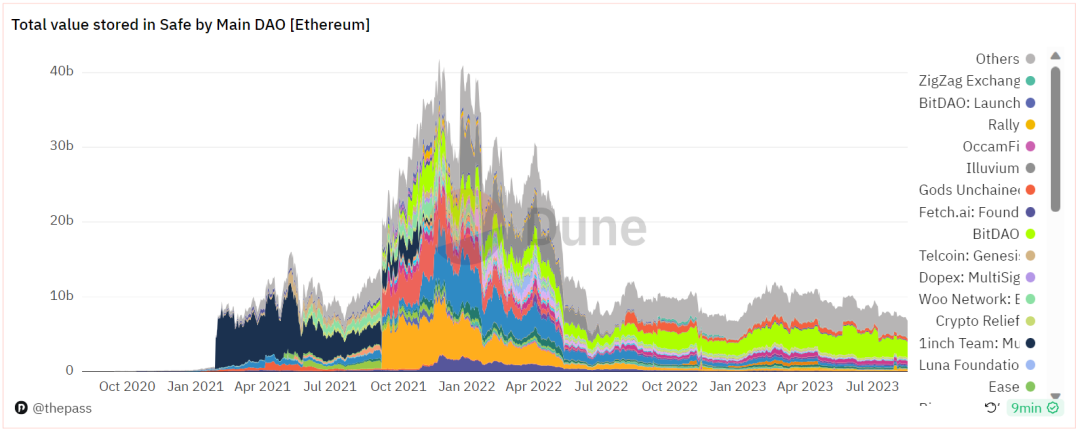
Historical Changes in DAO Treasuries Using Safe [Ethereum]
Conclusion
DAOs have disrupted the top-down models of traditional businesses, shifting toward more community-driven operations. Yet, this field remains young, lacking regulation and tools tailored to its unique needs. In treasury management, there are virtually no established guidelines. DAO treasuries need to become increasingly standardized and transparent, helping participants better achieve their goals and maintain security.
Safe is a secure and scalable asset management platform that safely stores nearly $60 billion in assets. Safe is moving toward becoming the standard for DAO treasuries. The tools are ready—the next step is for DAO participants to innovate. We have already seen the flaws of over-reliance on governance tokens. A long journey lies ahead.
Join TechFlow official community to stay tuned
Telegram:https://t.me/TechFlowDaily
X (Twitter):https://x.com/TechFlowPost
X (Twitter) EN:https://x.com/BlockFlow_News
 @thepass_to