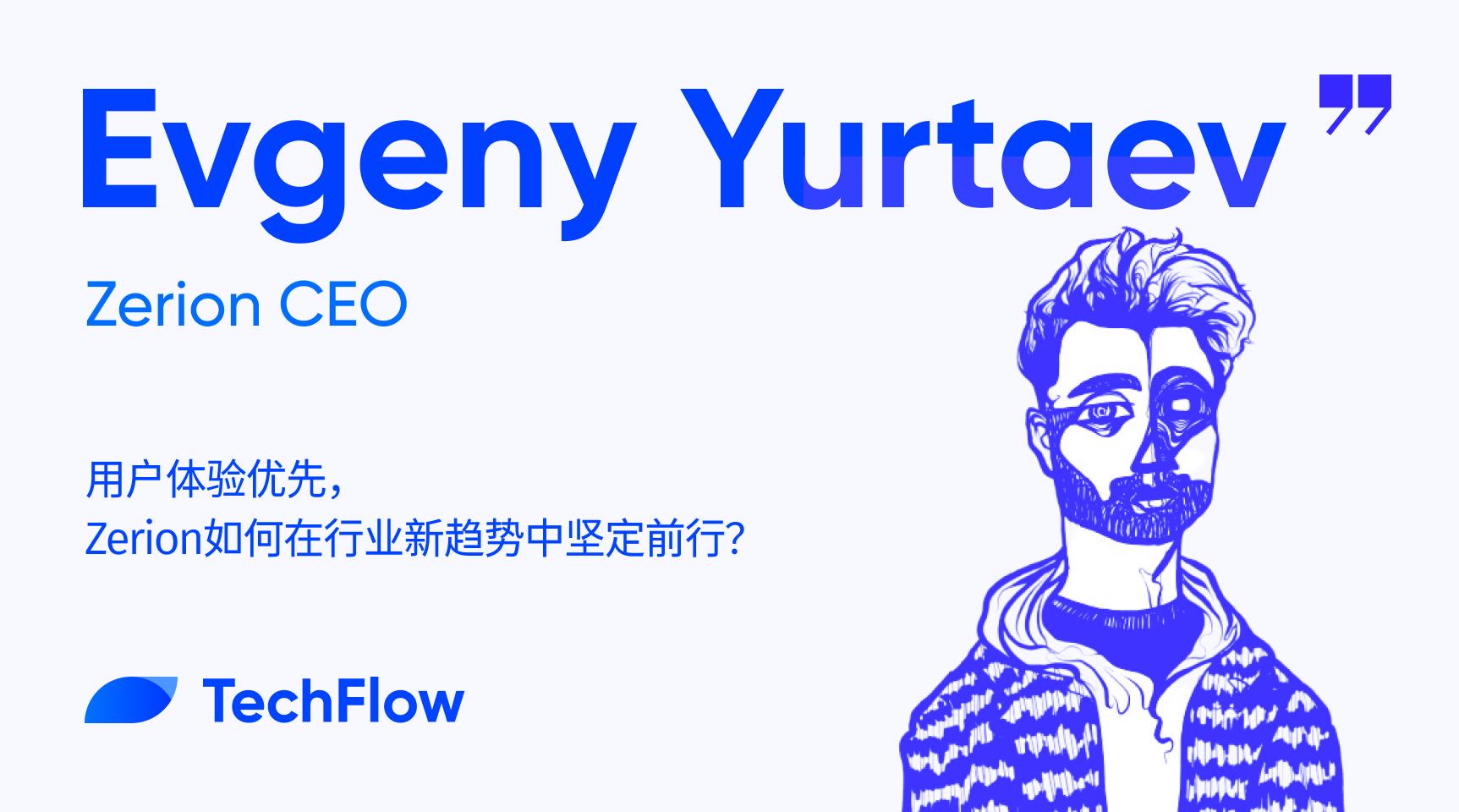
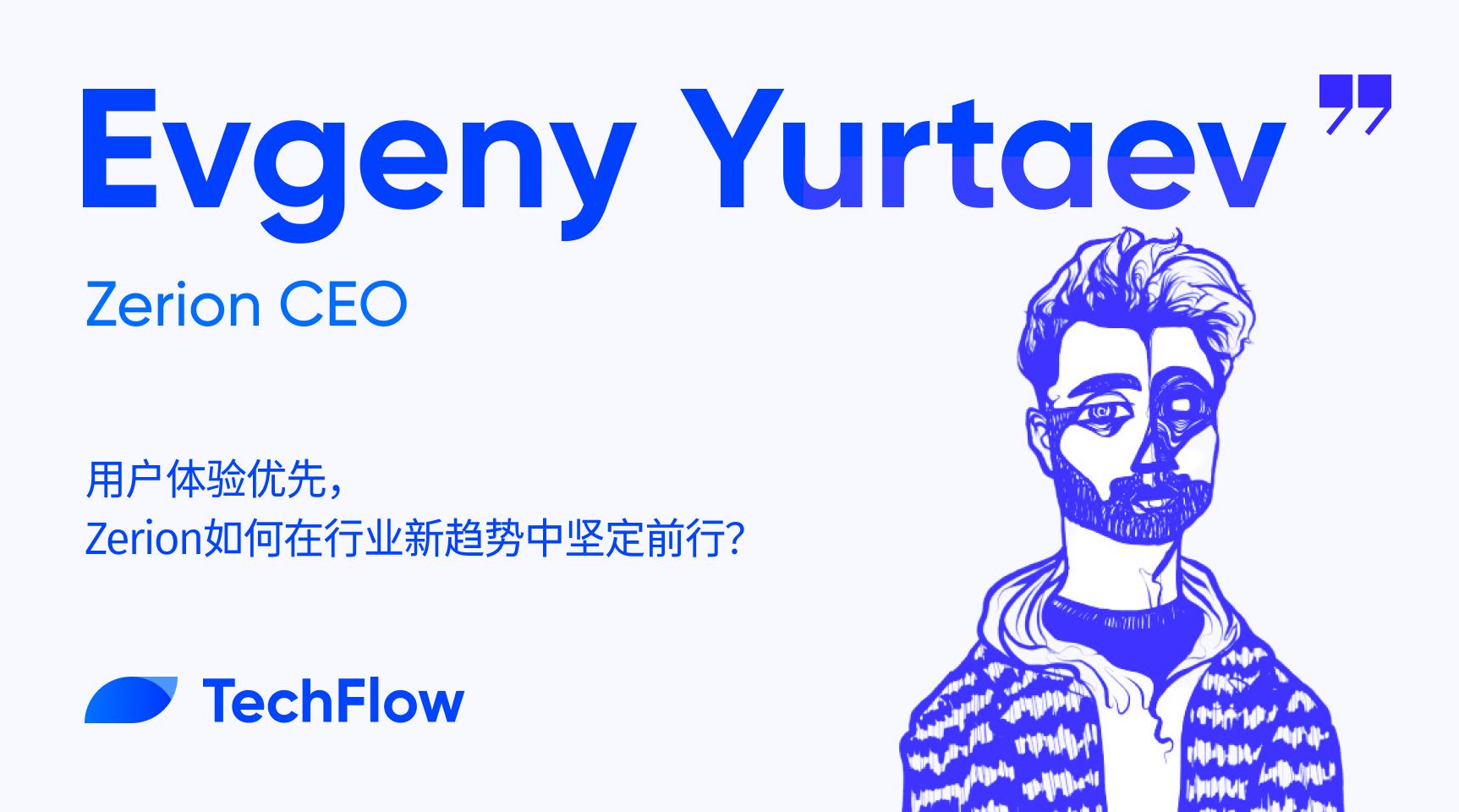
Interview with Zerion CEO: Putting User Experience First—How Zerion Forges Ahead Amid Industry Trends
TechFlow Selected TechFlow Selected
Interview with Zerion CEO: Putting User Experience First—How Zerion Forges Ahead Amid Industry Trends
The objective presentation of a product is largely an abstract reflection of the founding team's thinking.
 Navigating Web3 tides with focused insights
TechFlow: Sunny and David
Zerion: Evgeny Yurtaev
Preface
Zerion is one of today’s leading self-custody Web3 wallets—no further introduction needed. It enables users to easily manage crypto assets, DeFi positions, and NFTs, while also allowing seamless navigation across decentralized applications (dApps) on various Ethereum Virtual Machine (EVM) chains.
In any world where money exists—whether fiat or cryptocurrency—the importance of wallets is self-evident. Following the 2019 DeFi Summer, Zerion emerged as a household name in both Eastern and Western crypto communities. From mobile and web UI/UX design to functional architecture, it's clear that the Zerion team has deeply reflected on and invested heavily in the wallet as a tool. Creating a consumer software product that stands the test of time and delivers excellent user experience is no easy feat—it demands profound industry insight and vision from the founding team: a product is largely an abstract reflection of its founders’ thinking.
Recently, TechFlow had the privilege of speaking with Evgeny Yurtaev, CEO of Zerion, for an in-depth conversation about wallet-related topics and broader industry trends.
From past interviews, we know Zerion’s journey hasn’t been smooth sailing. Before DeFi Summer, the team nearly collapsed after burning through early funding, leading to layoffs. As the saying goes, “The camp remains firm while soldiers come and go.” So long as the core team and product remain strong, hardships are temporary—a lesson that may inspire many projects navigating today’s bear market.
In our discussion with Evgeny (referred to as Evg), we explored three perspectives: 1. Zerion’s founding story and team ethos, 2. The evolution of Web3 wallets, and 3. Industry trends—to understand how a leading player thinks carefully about 2C product design, Web3 company management, and how key themes (account abstraction, Layer2s, privacy, and SocialFi) interact. We hope these insights offer some guidance during this challenging market phase.
Chapter One: Zerion’s Founding Story and Team Ethos
Evg first encountered cryptocurrency in 2014. The release of the Ethereum whitepaper made him realize that blockchain was no longer limited to finance—smart contracts could unlock a new era of decentralized internet. At the time, Evg was still a university student. In 2016, he began collaborating with like-minded classmates Vadim (now Zerion COO) and Alex (now Zerion CTO), participating in numerous crypto hackathons and launching a B2B smart contract SaaS startup. After Evg moved to California for further studies, the trio continued working remotely. It wasn’t until 2018 that the project evolved into what we now know as Zerion.
When asked how Zerion manages distributed remote work across its 40-person team, Evg offered the following:
“One of our core values is self-managing individuals. The act of using a self-custody wallet embodies a deeper meaning—that people take responsibility for their own lives, just as they do for their funds. This value of self-management is crucial.”
The principle of self-custody extends beyond product design into team management. A strong startup team must be capable of self-governance. Evg applies this same philosophy when designing self-custody wallets, always approaching product development from the user’s perspective.
To outsiders, Zerion may appear relatively conservative, adopting traditional strategies—for instance, Zerion has not issued a token to generate revenue or attract users, even to this day. In Evg’s view, investing time in thoughtful product iteration to meet real user needs is far more important than chasing short-term market sentiment.
“I believe at every stage and in every decision, we need to think carefully throughout the process. This truly helps us prepare for worst-case scenarios. If you get carried away by bull markets, assuming everything will keep going up, that’s exactly what could destroy you or your company.”
Evg emphasizes deliberate execution—not only in product design but also in fundraising timing and operational cost adjustments. Even during early-stage fundraising, carefully selecting investors, especially lead institutions, is critical. This mindset also extends to hiring.
Notably, each member of Zerion’s team is highly capable, autonomous, and thoughtful, contributing to a distinctive team culture. We were naturally curious about their management approach. At just 27, Evg has already been recognized by Insider magazine as one of the founders most likely to build the next unicorn. What secrets lie behind his effectiveness as CEO?
“I strongly emphasize teamwork, deep market understanding, and empowering each team member to become an expert in their domain. By creating feedback loops, we collectively build a fairer, better product than our competitors.”
Evg remains humble, believing his leadership style isn’t particularly innovative—it’s fundamentally about balance: absorbing external information, reflecting on it, and then creating value for the world. Zerion is certainly not the first company to recognize this.
Reading, understanding the root causes of industry and global developments, and fostering collaboration form the core of Evg’s approach as CEO. He continues learning how to manage remote teams more effectively and adapt to the fast-changing dynamics of the crypto industry.
“I aim to understand any given field or skill to a certain level—say, 80%. Then I’m ready to delegate it to someone who can do it even better. But having that baseline understanding allows me to maintain structural awareness and assist in cross-team communication or individual decision-making. Sometimes other team members lack broader organizational context.”
Chapter Two: The Evolution of Web3 Wallet Products
Over five years—from pre-seed to Series B—Zerion has evolved from a parallel DeFi interface into a focused non-custodial wallet provider. As products grow increasingly refined, questions arise: How does a wallet company operating in a decentralized industry ensure decentralization and high security? And how does Zerion view competitors like DeBank launching their own Layer2 solutions?
On how wallet companies can achieve decentralization, Evg has two clear product principles:
-
Non-custodial wallets (decentralized);
-
Blockchain interfaces with on-chain verifiability (user experience);
Non-custodial wallets require little explanation. Unlike custodial wallets offered by centralized exchanges, non-custodial wallets embody the cryptographic essence of decentralized finance and blockchain. As for the second point—what does “on-chain verifiable” mean? Evg explains:
“Most people even associate Etherscan directly with the actual state of the blockchain, not just as an access interface.”
For average users, it’s difficult to observe real-time blockchain activity. Like Etherscan, Zerion uses efficient backend data mining, annotation, and processing to deliver a readable, real-time DeFi interface. It’s precisely this added layer of UI/UX design and market-aligned functionality that makes DeFi accessible to more people. So if you ask how a data company can be decentralized, the answer is:
“While pursuing decentralization, we must balance usability. Because without users, there can be no sustainable growth.”
Decentralized data storage isn’t the wallet company’s responsibility—specialized firms exist to solve that problem. Until blockchain scalability becomes both efficient and secure, compromising full decentralization to enhance consumer UX is necessary for delivering usable and efficient DeFi interfaces.
“We know some blockchain systems have had scalability issues. Only recently have they become more scalable and suitable for broader use cases.”
Could Layer2 be an effective solution for decentralized interfaces? Regarding DeBank’s Layer2 move, Evg sees it more as building a social layer atop Layer1.
From a wallet application standpoint:
“For wallets like MetaMask, this creates imbalance. If they choose to support zk-rollups, they’ll likely favor their own solution. If built via consensus, it could create problems for users. Commercially, this might not benefit end consumers.”
From a wallet provider’s perspective, Layer2 offers better monetization models. But from a consumer’s viewpoint, it undermines wallet neutrality.
“I don’t think wallets need to go down the path of owning their own scaling solution (L2). L2s can and should exist independently of wallets—that’s the ideal scenario. But recent trends suggest otherwise: every major project may launch its own L2 and shift all transaction activity onto it.”
Could Layer2 be a path toward tokenization for wallet companies?
Evg notes that Zerion’s current revenue model consists of:
-
Per-transaction DEX trading fees on the consumer side;
-
API fees on the enterprise side;
-
And Evg believes subscription models are unsuitable for Web3.
“Perhaps owning a blockchain could be a path forward for wallet tokenization—but the two should still remain independent.”
MetaMask is already showing signs of shifting toward Linea. But Evg stresses that currently, no successful token economic model supports wallet tokenization.
“The future direction for wallets remains unclear because there’s no proven token model in the wallet space yet. Plus, technical scalability isn’t sufficient to migrate most of our on-chain operations—and protocolizing them is even harder.”
Only time will tell how things unfold.
Regarding wallet security, Evg says Zerion plans to add dedicated security guidelines on its landing page and open-source parts of its key management code.
“Zerion’s key handling is based on the Trust Key Management Library, which has existed for a long time and is an open-source, shared standard in the field. ”
Zerion takes a relatively conservative approach in executing its core product. When improving consumer-facing features, user experience is paramount. Any change affecting UX is approached cautiously, always from the user’s perspective.
Chapter Three: Interplay of Four Major Industry Trends
If you’ve attended many conferences this year, you’ve likely seen Evg at events like Eth Denver in spring, EdCon in Montenegro in early summer, ETHcc in Paris over summer—and perhaps he’ll appear at another fall conference too. Like you, Evg attends these events to stay informed about what’s happening in crypto, what new technologies and trends are emerging. Amid this cold bear market, the direction of progress within the Ethereum community has become quite clear: account abstraction, zk-scaling (Layer2), and privacy. On-chain social (SocialFi) also appears to be a growing trend, though user adoption remains uncertain.
Evg has distinct reflections on each of these four areas.
On-Chain Identity and Social (SocialFi)
Evg views major on-chain social apps like Lens Protocol and Farcaster as early-stage experiments. To achieve real adoption and compete with Twitter, innovations unseen in the market today are required—because unlike Web2, on-chain social carries financial attributes.
“I think it’s just a matter of time, but we need technology to mature slightly. More importantly, we need social users to flock in.”
While effective go-to-market strategies for on-chain social remain elusive, infrastructure supporting on-chain identity (DID) is rapidly advancing.
“I have great confidence in on-chain identity as a concept. I believe we’re inevitably moving in this direction. I’m very excited about a future where we no longer rely on Facebook or Google as identity providers—something that’s still the reality today.
The internet started simple and open, but over time became monopolized. Your identity is now controlled by a few corporations.
These big companies now use identity to lock in users. Your identity ties you to ecosystems like Apple or Google because everything is built around your Google account.
Web3 offers a truly viable alternative—and I’m extremely excited about it.”
In the on-chain identity space, ENS currently leads in market share, followed by Zerion’s Dynamic NFT Avatar ('DNA') decentralized identity.
“We’ve seen how identity forms around public keys—essentially tied to ENS (Ethereum Name Service)—making it a user’s name. Then, profile pictures (PFPs) can link to the same public key. Users can gradually shape their identity, not tied to any single blockchain.”
Unlike Web2 social platforms, owning a decentralized on-chain identity isn’t just about posting tweets under a public key—it’s about cryptographically recording your entire on-chain footprint, which extends far beyond social media posts.
“I believe the future of identity lies here. The current challenge is: how do we merge different identity fragments—such as account-abstraction wallets across multiple blockchains—into a single address?”
Privacy
In my view, a unified on-chain identity application requires mature privacy infrastructure. Similarly to Web2, part of the market value generated by users’ on-chain footprints should be returned to users themselves. But without mature privacy tech, standardization is difficult.
According to Evg, current market demand for privacy isn’t strong, partly because on-chain data volume is still relatively small. Most privacy demand comes from anti-government or anti-establishment groups—not the mainstream. Many enter Web3 out of curiosity about DeFi technology, not absolute privacy (true anonymity).
Yet Evg finds the intersection between privacy and on-chain identity fascinating. But before industry standards mature:
“First, I believe we need better identity mechanisms across the blockchain ecosystem and Web3—whether in wallets or other identity systems.
Then, we depend on wallet providers to offer stronger privacy—like the privacy addresses Vitalik mentioned in a blog post, or recent ideas about multiple smart accounts controlled by a single user, without linking them on-chain—only the user’s wallet knows which addresses belong together.
I see this as the first step toward a more private system.
A good analogy is Bitcoin, where users must scan each UTXO to identify their own. In such cases, only the wallet provider—the local software storing all necessary knowledge—can parse what belongs to a specific wallet.”
Most users don’t care about true anonymity (opaque on-chain trails) but desire basic transaction privacy. This is a service wallet providers must offer, and competition among wallets will intensify in this area.
“Product-wise, I believe Zerion should eventually offer a privacy account feature—allowing you to deploy a smart account under your control, unlinked to your other wallets. We’ll help manage this separate, private entity. ”
Account Abstraction
What exactly is a smart contract wallet / account abstraction? Evg offers a clear, accessible explanation:
“The abstraction part is simply the private key and key pair.
These smart accounts are just smart contracts compliant with certain standards. All transactions from these wallets are called user operations.
Account abstraction creates a separate mempool, processed by relayers who execute transactions on behalf of users. Since these new accounts are smart contracts, users gain upgradeability—enabling improvements and new features like gas payment in tokens, social recovery, or custom logic (e.g., buying ETH every few weeks). Ultimately, any logic can be attached to a user’s smart account.
The key driver is standardization.”
However, Evg believes the main barrier to mass adoption of smart wallets is high cost.
First, deploying them on-chain—especially across multiple chains—is expensive. In contrast, EOAs require no deployment and exist by default on every chain.
Second, transaction costs for smart wallets are currently 3–5x higher than EOAs—costs ultimately borne by users.
Deploying smart contract wallets on Layer2 is more cost-effective. Still, Evg remains cautious about current adoption levels, though his intuition suggests Layer2s will eventually standardize around smart wallets:
“Account abstraction across everything on Ethereum makes more sense. But that might not happen. Frankly, Layer2s may become Ethereum’s long-term solution. Maybe Ethereum no longer cares. Perhaps Ethereum will simply become a collection of connected Layer2 solutions.”
Zero-Knowledge Proofs and Layer2
Readers are likely familiar with zero-knowledge proofs as a technical enabler for blockchain scalability. The maturity of on-chain social, privacy, and smart contract wallets all seem inseparable from Layer2. Only with robust infrastructure can broader on-chain applications emerge. Yet Layer2 security remains an open question.
Evg is enthusiastic about testing on-chain applications to gauge market response. In on-chain identity, Zerion’s integration of users with 'DNA' has brought notable success, a source of pride for the team. Regarding Layer2 and smart wallets, Evg remains optimistic and plans to launch a smart wallet beta version in the near future.
Epilogue: Outlook on Staking
When asked about other interesting innovations observed at conferences, Evg mentioned “staking.” He believes staking will be the first industry-level financial catalyst, enabling new DeFi product possibilities—not just variable returns tied to trading volume, but stable yields.
Evg speculates that greater liquidity and staked tokens will benefit the entire ecosystem and allow companies to earn more. For example, without bridges, you can incentivize users to stake tokens on Ethereum and then release equivalent tokens on your Layer2 network. All tokens previously locked in bridging can now be used to generate yield—like running a small decentralized bank. The more attractive your use case, the more revenue you can generate. This opens up monetization opportunities for non-trading applications.
Join TechFlow official community to stay tuned
Telegram:https://t.me/TechFlowDaily
X (Twitter):https://x.com/TechFlowPost
X (Twitter) EN:https://x.com/BlockFlow_News
 深潮TechFlow