
Top Gaming Guilds in a Bear Market: Some Thrive, Others Fall Behind
TechFlow Selected TechFlow Selected
Top Gaming Guilds in a Bear Market: Some Thrive, Others Fall Behind
This article provides a comprehensive review of the gaming guild sector from four perspectives: operational capability, investment capability, risk management capability, and valuation.
 Navigating Web3 tides with focused insights
Author: Scarlett Wu
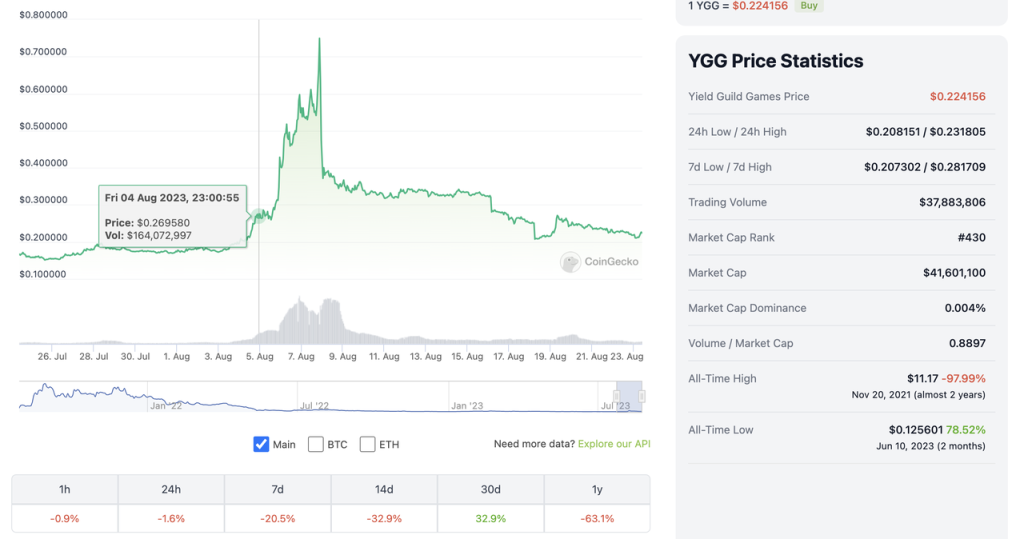
The rollercoaster price of YGG over the past two weeks has refocused market attention on the gaming guild sector. At the beginning of the rally, I shared a summary on Twitter titled “Gaming Guild Treasury Comparison & Valuation Review: $YGG, $MC & $GF—Which Is More Reasonably Valued?” In that analysis, $MC was my top pick—and it has since risen 50%. Meanwhile, YGG surged to double its price before crashing back down to pre-summary levels. This article serves as an updated and expanded version of that initial review, offering a comprehensive assessment of gaming guilds across four dimensions: operational capability, investment performance, risk management, and valuation.
Numerous gaming guilds, quest platforms, game news aggregators, and pay-later NFTfi protocols are essentially variations of the same service. Game projects have only three core needs:
-
User acquisition
-
User activation
-
Driving in-game spending
Web3 gamers, on the other hand, have just two primary demands:
1. A sense of companionship
During 2020–2022, Ponzi-style models created demand for upfront capital (e.g., when Axie Infinity NFTs were priced in the thousands of dollars, guilds bought NFTs and rented them to players in Southeast Asia, taking a cut of their future earnings). The explosive growth of these economic systems generated a wealth effect, leading many to believe the music would never stop—giving rise to another perceived function of Web3 gaming guilds:
2. Capital advancement
The need for companionship arises only if users spend significant time in a game—something most non-Ponzi Web3 games today fail to deliver. As for guilds purchasing "tool" NFTs to rent out, this requires a Web3 game with a continuously expanding economy. If the principal invested two weeks ago is already losing value, any institution advancing capital must be deeply concerned. The reality is that aside from Axie Infinity—the original crypto game Ponzi—there hasn’t been a single Web3 game with sustained user growth beyond six months. Given that Ponzis rely on continuous user growth to generate profits, a guild willing to advance capital might take two months to identify a "profitable" game, another two to confirm its sustainability, and by the time they roll out their program, they’ll find the capital cannot be recovered—because their "scholars" (the term guilds use for their players) may never recoup their costs, even after playing for years.
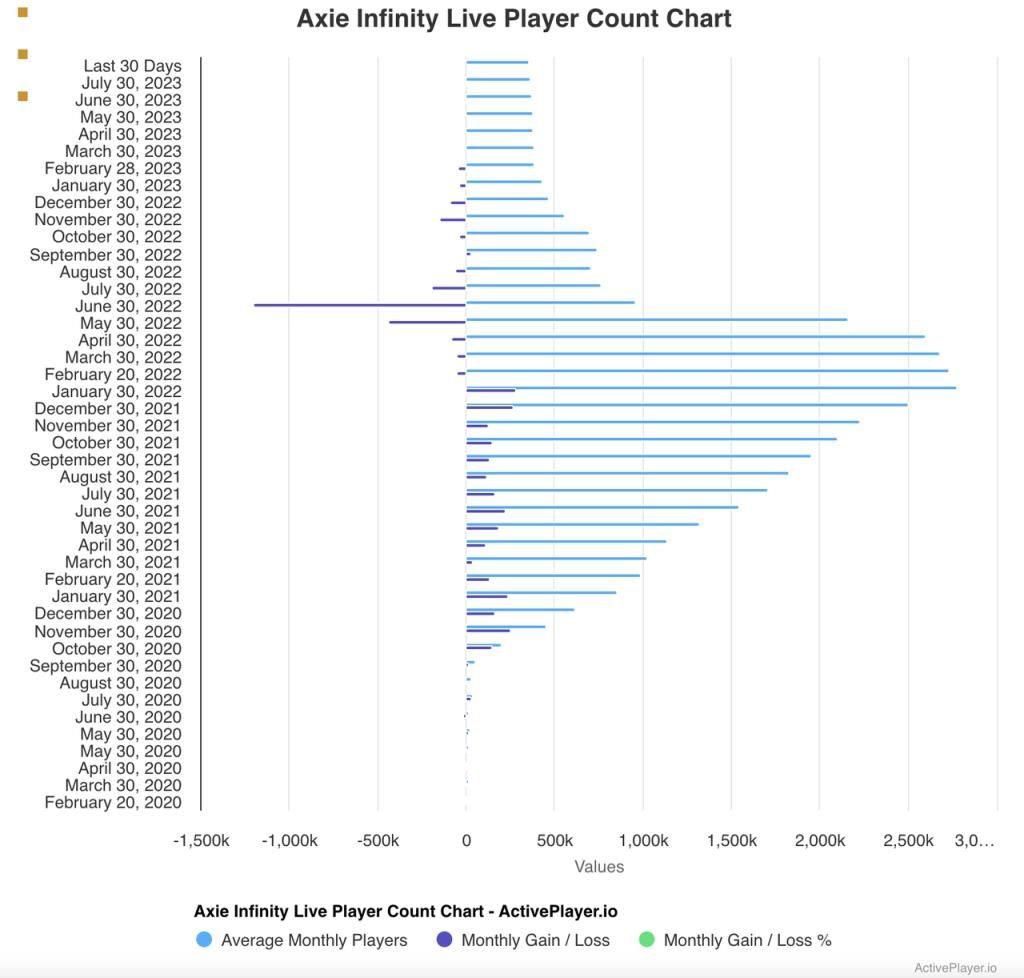
Guilds clearly recognized this issue early. With no Ponzi able to replicate Axie’s momentum and no game generating strong enough engagement to monetize through streaming (a revenue model traditional gaming guilds rely on), guilds have shifted from “serving players” to “serving project teams.” On one hand, guilds control access to large player bases (though this is increasingly questionable, as discussed below); on the other, their treasuries still hold substantial funds (though liquidity remains uncertain, also discussed below), allowing them to benefit from the broader growth of the Web3 gaming sector via investments. Some, like Merit Circle, have partnered with Avalanche to launch a sidechain, leveraging the narrative of a dedicated gaming blockchain to boost valuation potential.
1. Operational Data Comparison: YGG and MC Remain Active; GF Has Fallen Behind
Currently, major guilds primarily operate across three platforms:
-
Quest systems
-
Twitter
-
Discord
Discord can be misleading—even YGG’s 70,000-member server sees only around 100 messages per day in General Chat, half of which are just “gm” or “hi,” while the rest are team members posting Medium articles or official links to answer questions.
Twitter offers more transparency. Despite having 180K followers, YGG’s posts typically receive only a few thousand to tens of thousands of views, with major updates peaking at 40K–50K. Merit Circle, with 100K followers, sees around 5K views for regular content and up to 10K for major announcements. GuildFi performs even worse: routine updates get fewer than 1,000 views, and even its semi-annual report barely reached 10,000. For context, my own Twitter account—with just over 2,000 followers—routinely gets hundreds of views per post, and in-depth threads often exceed tens of thousands. Under Twitter’s transparent metrics, the inflated data claims of gaming guilds are laid bare.
As for Quest systems, we can evaluate them from two angles: project activity and incentive structure:
-
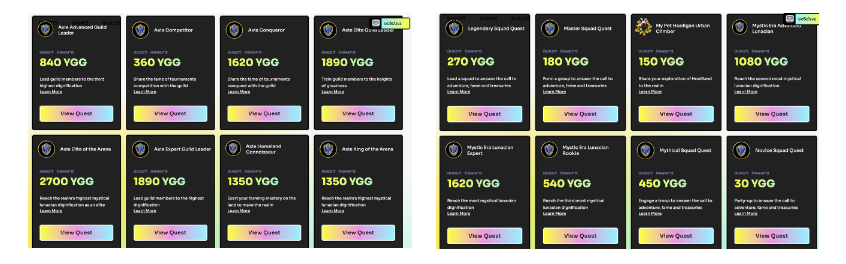
YGG Guild Advancement Program: Recently, YGG launched Season 4 of its Guild Advancement Program. Players complete tasks and submit proof to share prize pools. Axie rewards remain dominant, with top prizes reaching 2,700 $YGG (worth ~$900 at current prices). Other games offer rewards ranging from 30 $YGG (~$10) to over 1,000 $YGG. For players still capable of competing for Axie’s prize pool, the official Axie rewards (worth up to tens of thousands of dollars) are far more attractive. For others, splitting prize pools worth only dozens to hundreds of dollars isn’t compelling—especially when compared to simply farming airdrops. From a user perspective, YGG’s Quest System struggles to capture widespread attention.
-
From a project’s standpoint, YGG likely receives cash or in-game assets from partners but pays out rewards denominated in $YGG—effectively swapping its own tokens for external capital or game assets.
-
-
-
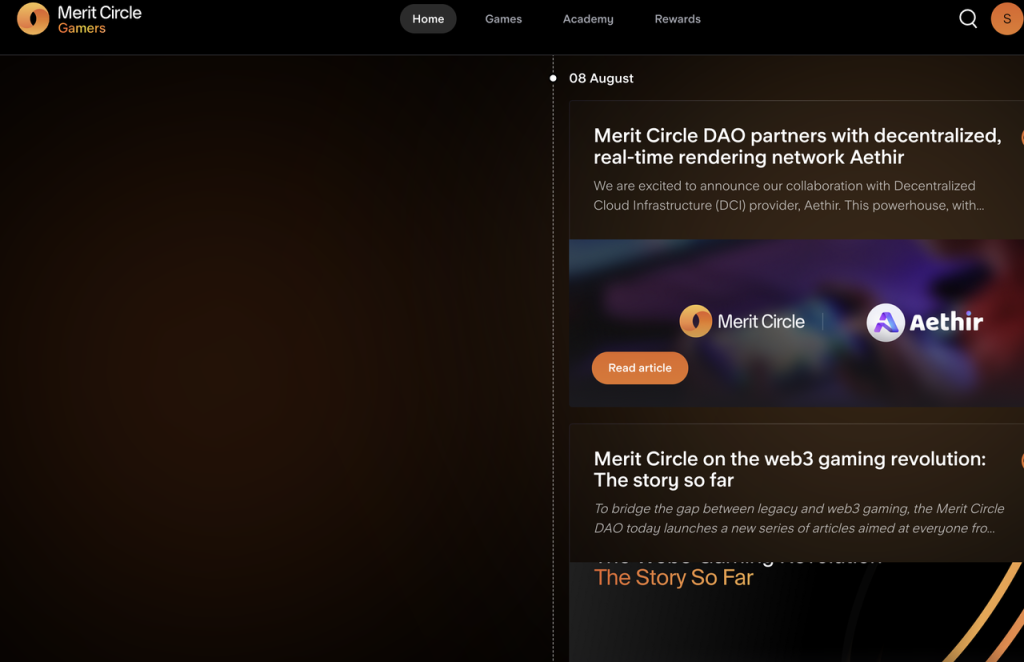
Compared to YGG’s straightforward task-based approach, Merit Circle’s interface is more gamer-friendly. Its incentive platform consists of four sections: Homepage (highlighted games and event timelines), Games (featured games and summaries), Academy (game tutorials and Web3 basics), and Quest System (complete tasks to earn experience points and NFT raffle entries).
-
In YGG’s system, players can calculate ROI directly (though low, still somewhat appealing to Southeast Asian users). Merit Circle’s system leans more toward information aggregation and discovery, with rewards mostly distributed via lotteries.
-
Merit Circle – Homepage
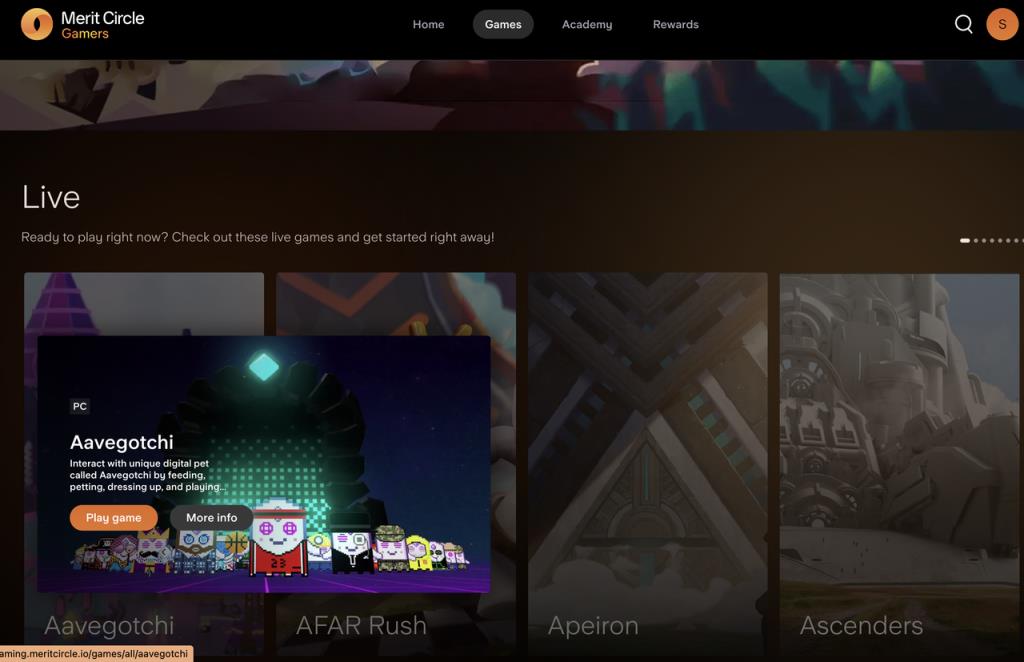
Merit Circle – Featured Games
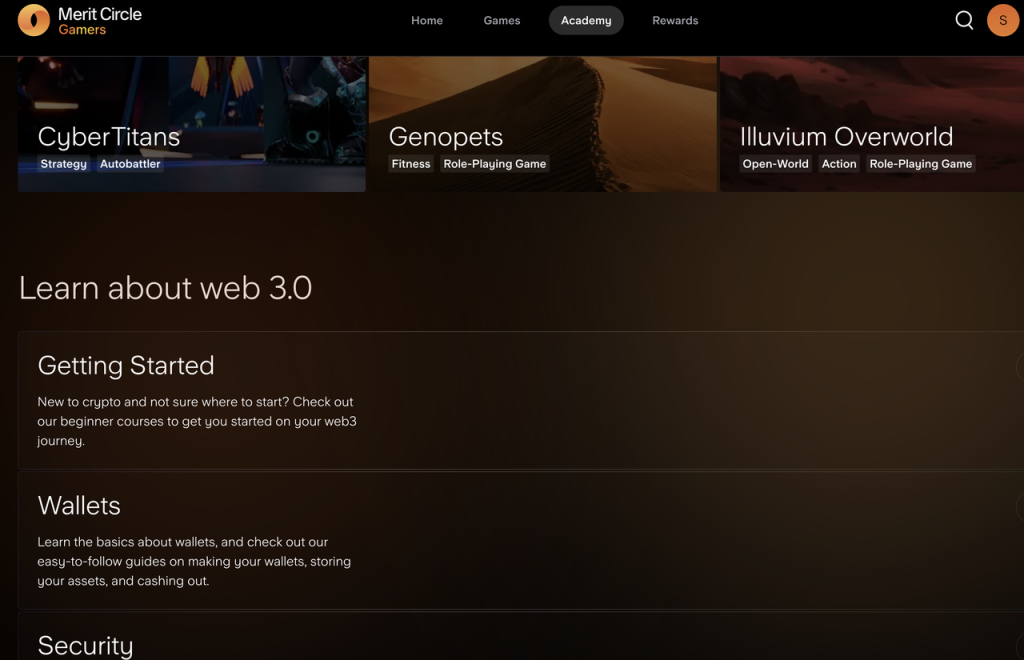
Merit Circle – Academy
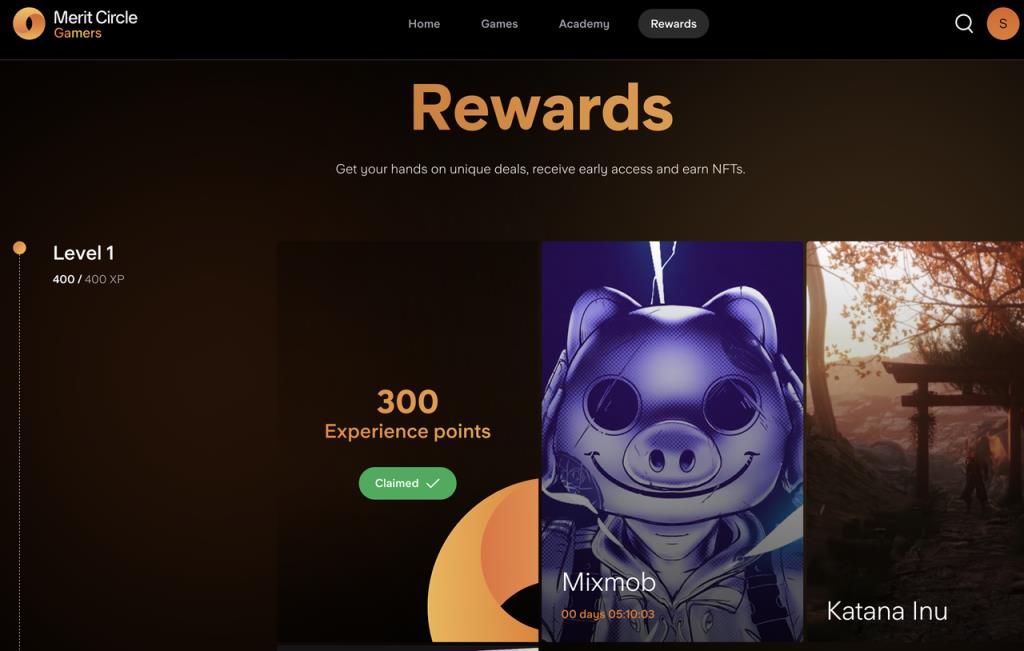
Merit Circle – Quest Reward System
-
-
GuildFi uses an in-game point system to power its Quest & Achievement framework. Completing tasks or achievements earns corresponding points.
-
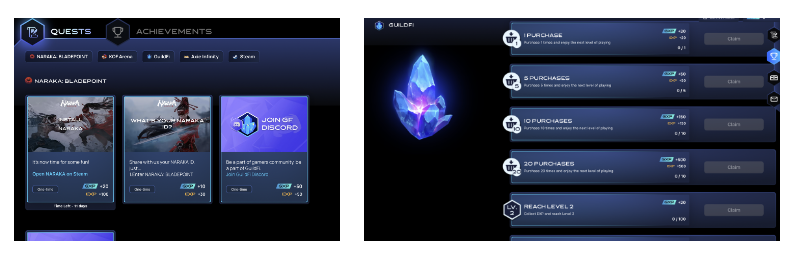
GuildFi Quest & Achievements
Points can be redeemed for gift cards, game tickets, whitelists, loot boxes, and NFTs. However, redemption options are currently limited—mostly Steam gift cards (randomly valued between $0.5–$30, sometimes refunding 15% of cost), Genopet and Axie play passes, Axie and CyBall NFTs (distributed via time-limited raffles). This blind-box redemption model is already common on traditional game info aggregators and casual gaming platforms. GuildFi collaborates with game projects to distribute assets (though BD capabilities appear weak, mostly older titles) while converting part of its revenue into assets players already value, using gamified mechanics to offset inflation.
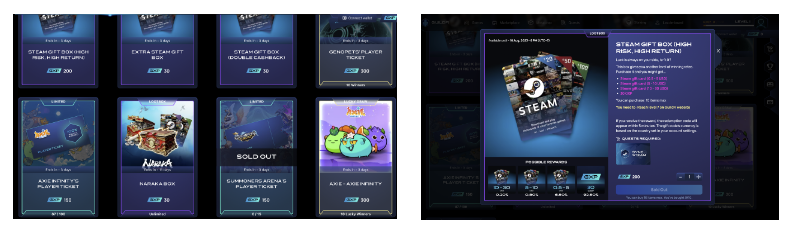
GuildFi Marketplace
In its semi-annual report, GuildFi stated: “Over the past year (H2 2022–H1 2023), there were over 200,000 purchases on our platform, a 42% increase from the previous year—clearly indicating rising community enthusiasm for our game products. Notably, the Diablo IV Lootbox campaign led with over 65,000 purchases, followed by KOF Lootbox with over 30,000.” Through such collaborations, GuildFi delivered a total of 92,000 pre-registrations across 21 partner games—an average of fewer than 5,000 per title. Considering pre-registration usually doesn’t require wallet interaction and is easily exploited by sybil farmers creating multiple accounts on promising projects, the actual number of effective users is likely even lower.
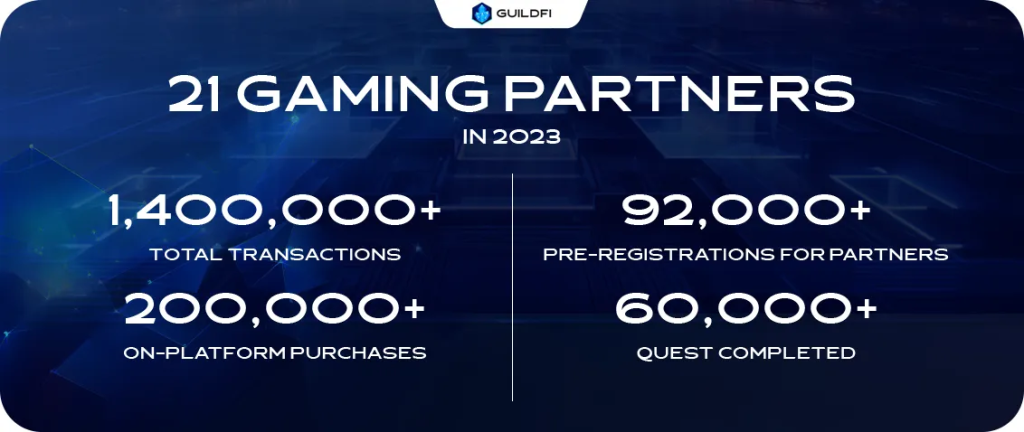
Source: GF Semi-Annual Report
Taken together, it’s clear that gaming guilds’ market influence has significantly declined. YGG and Merit Circle remain relatively active, while GuildFi has fallen behind in both business development and content output.
2. Financial Comparison: MC Shows Balanced Growth in Finance and Operations; YGG Strong Operationally but Weak Financially; GF Market Cap Below Blue-Chip + Stablecoin Holdings
YGG: Game Promotion Platform + Gaming Investment Fund; Treasury Almost Entirely $YGG, Less Than 4.4% High-Liquidity On-Chain Assets
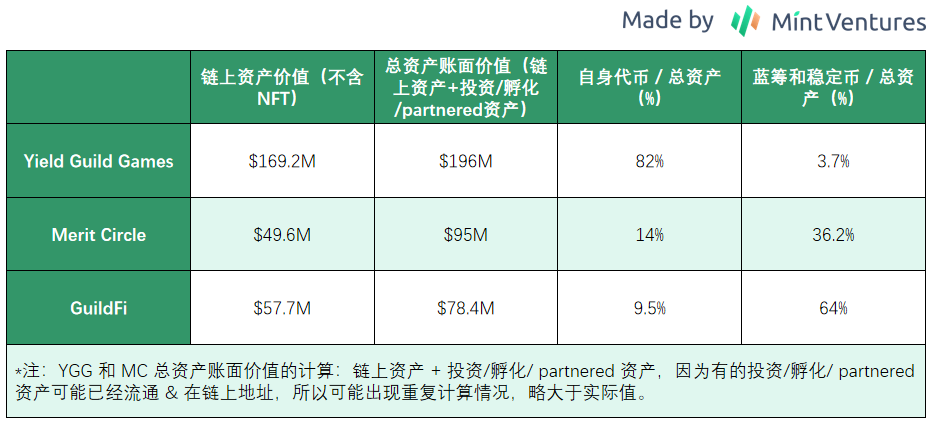
Given the sharp depreciation and poor liquidity of gaming NFTs today, we can roughly estimate treasury health based on fungible tokens (FTs). According to addresses published by YGG, 95% of its on-chain treasury consists of its own token $YGG, with less than 4.4% in highly liquid stablecoins and blue-chip assets ($USDC / $USDT / $ETH), indicating a highly unbalanced asset allocation.
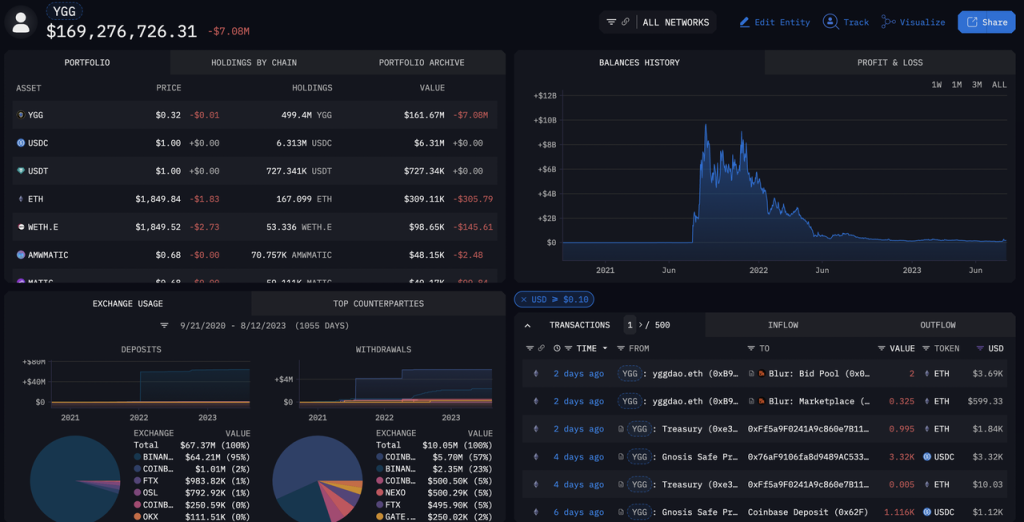
YGG Treasury Address Asset Breakdown – Arkham, Mapped by Mint Ventures
*Excludes non-EVM chain assets (~$220K), negligible in calculations
Additionally, in its 2023 Q2 Community Update released in early August, YGG reported a total investment/cooperation portfolio valued at $27.2M (NFTs, tokens, equity), acquired at a cost of $18.3M—representing a 32% unrealized gain.
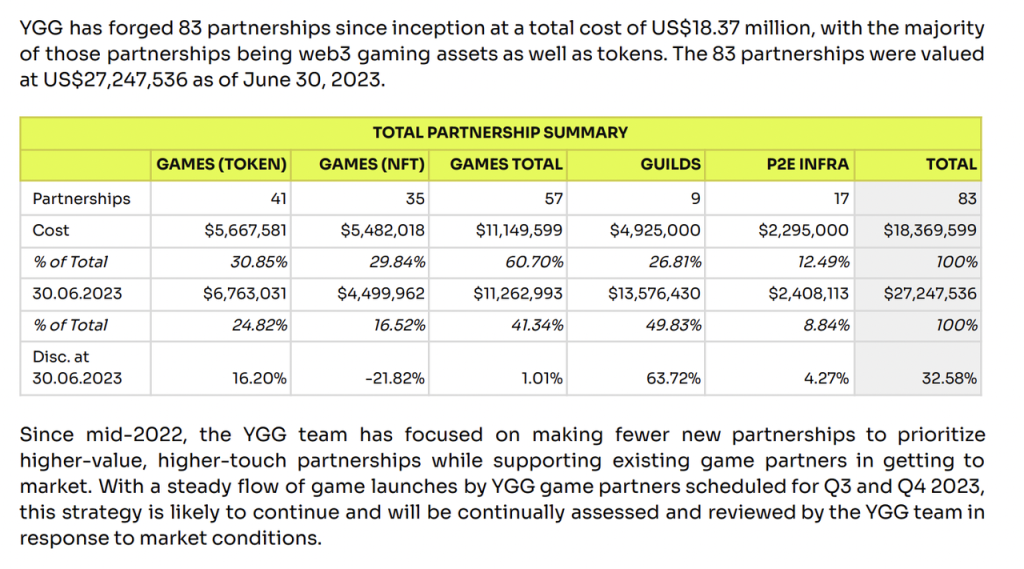
While YGG openly disclosed the market decline of gaming NFTs, valuations for game-related tokens/NFTs may still contain some optimism: even if YGG secured favorable entry prices, first-tier game tokens often suffer steep devaluations post-listing. Under current conditions of extremely poor NFT liquidity, exiting positions would require fire sales. The same applies to Merit Circle and GuildFi.
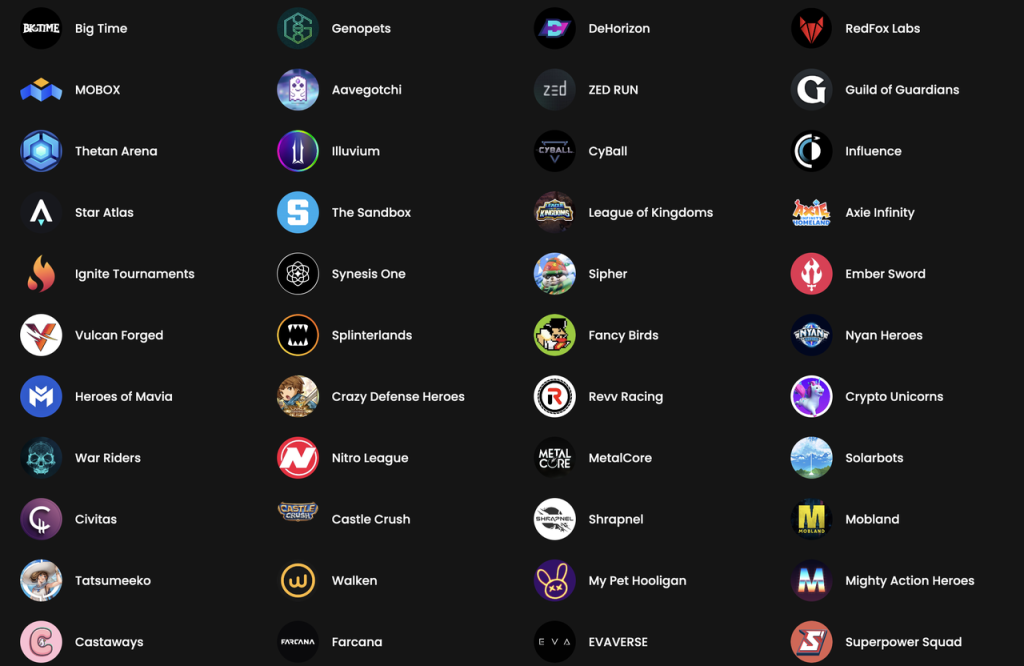
YGG Partnered Games (held assets including primary investments and secondary purchases, chainplay.gg incomplete data)
Merit Circle: Steady Operations, Best Treasury Balance, Nearly Equal Allocation Between Stable Returns and High-Risk Assets
Merit Circle (hereafter MC) defines itself on its website as a Gaming DAO with four functions: investment, game studio, reward system, and infrastructure (via Avalanche’s Beam sidechain). In terms of communication transparency, MC surpasses the other two guilds: its treasury dashboard is regularly updated, including not only on-chain FT/NFT data but also private investments. We focus on two aspects here: investment/incubation performance and treasury allocation.
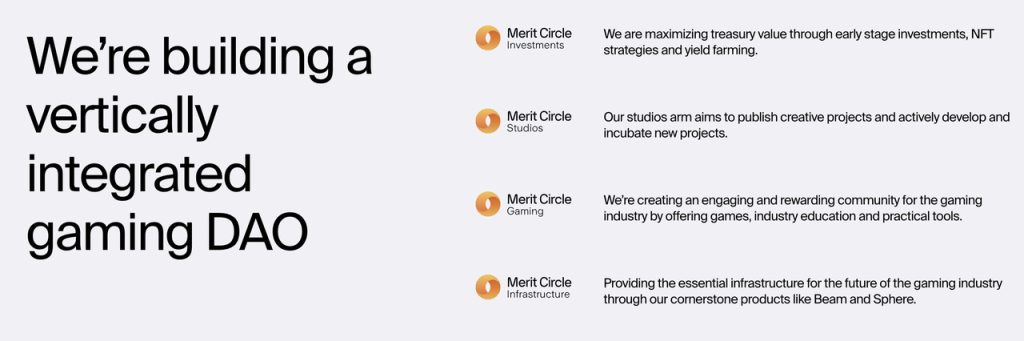
Merit Circle Official Website
First, regarding investments and incubation, according to MC’s public treasury data, as of June 2023, MC held equity/tokens in 79 game projects, including high-profile teams like OhBabyGames and Xterio. These assets are valued at $45.4M, of which $1.6M are publicly tradable, $43.8M are illiquid, and $0.3M in $MC. Based on disclosed purchase prices, the total cost was $29.9M, representing a 51.8% unrealized gain.
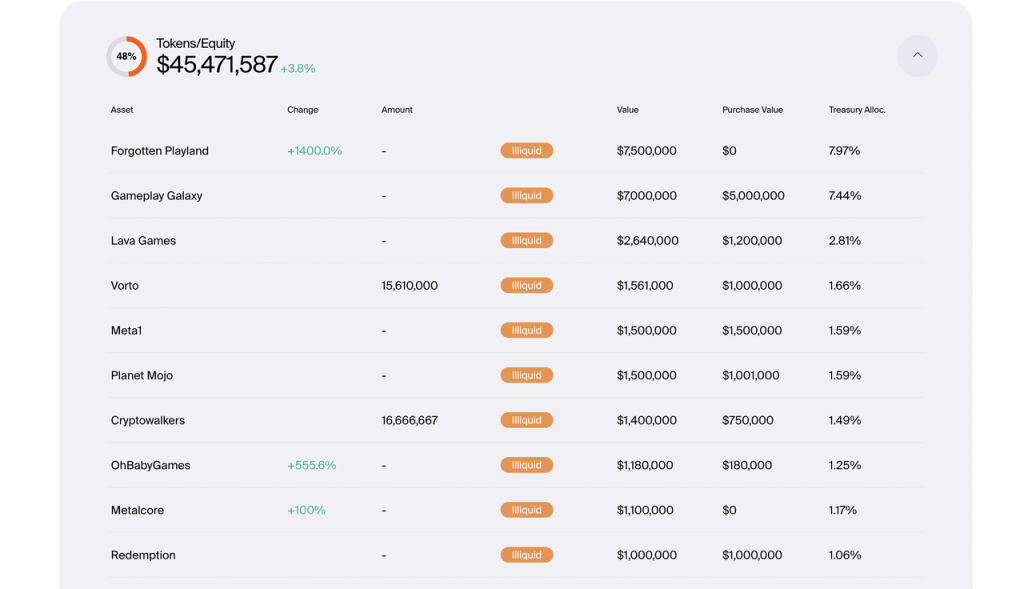
Partial Screenshot of Invested Projects
On-chain treasury quality is clearly superior to YGG: only 27.4% of MC’s wallet holds $MC, while 69.5% consists of highly liquid stablecoins and mainstream assets.
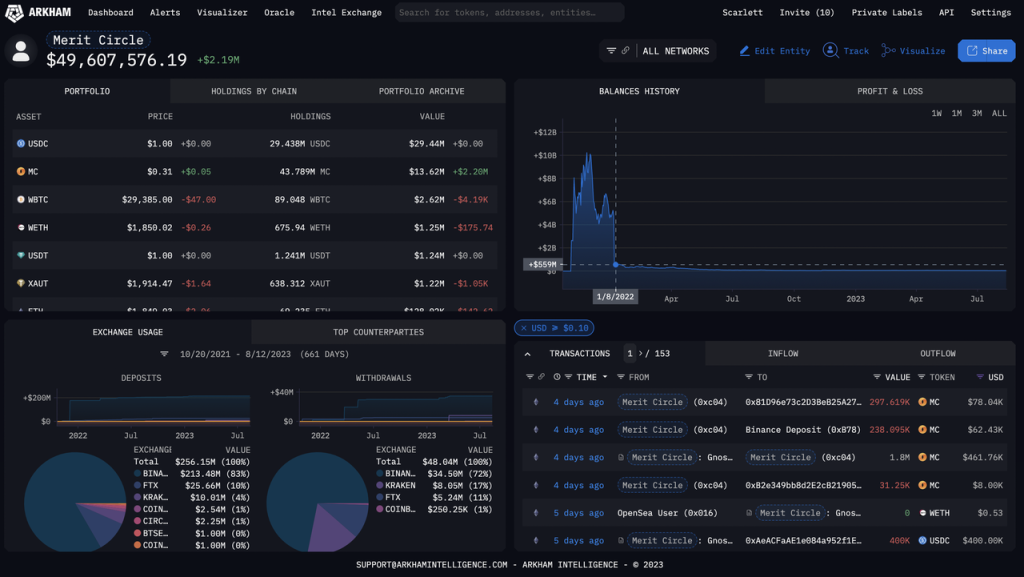
Merit Circle Treasury Address Asset Breakdown – Arkham, Mapped by Mint Ventures
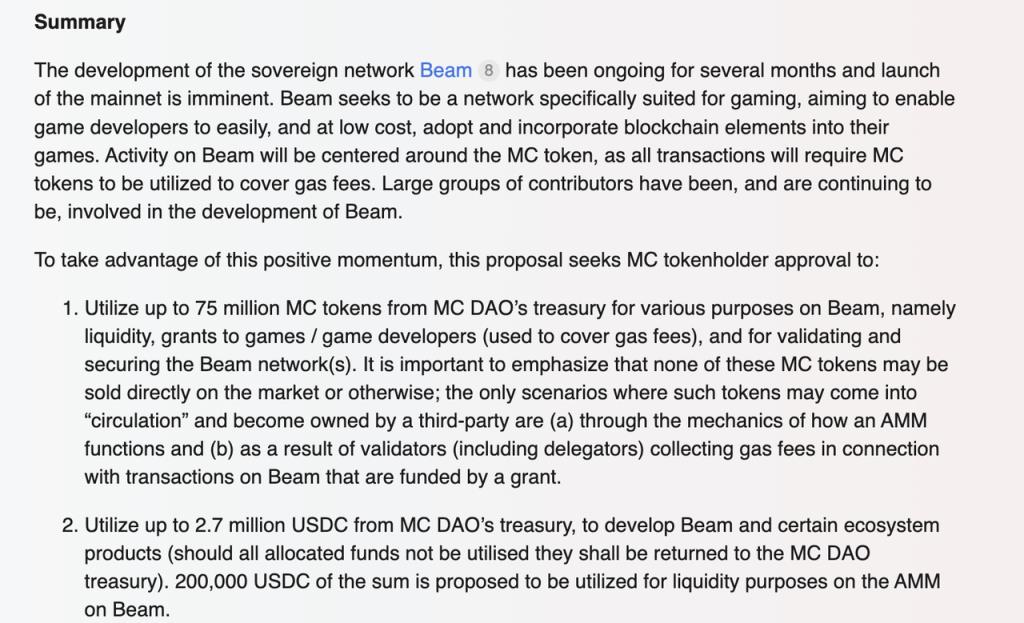
Moreover, MC’s upcoming Avalanche sidechain Beam—a key catalyst—is now live on testnet. Beam will use Proof-of-Stake, with $MC as gas token, and LayerZero for cross-chain interoperability. Three games are already building on Beam. On August 14, the team proposed a governance draft for community discussion:
GuildFi: Weaker Operations, Relatively Healthy On-Chain Treasury: 13% GF, 46% Stablecoins, 41% stETH for Stable Yield
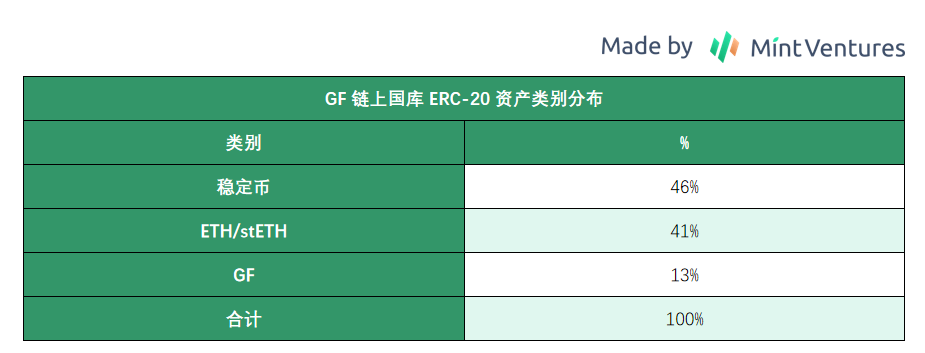
Since much of GF’s assets are deployed as LP on Uniswap, Arkham cannot fully reflect holdings. The chart below shows ERC-20 assets from disclosed wallets: 46% stablecoins, 41% ETH/stETH, 13% GF, plus minor game-related token investments—totaling $57.7M.
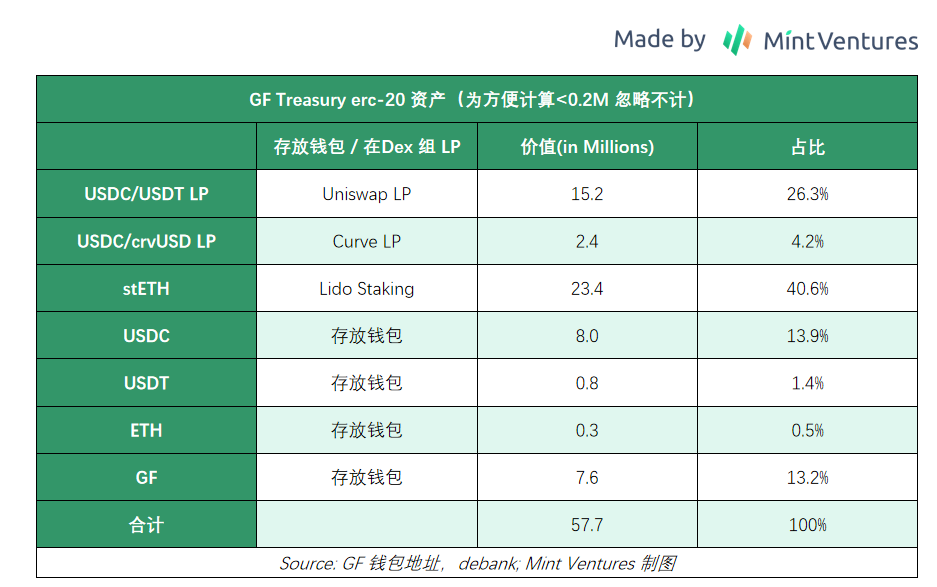
Compared to GF’s semi-annual financial report, on-chain assets have shrunk by 19% from $71M—mainly due to token depreciation and an $8M USDT transfer to Binance. The team states CEX-held funds are used for daily operations and buybacks from investors.

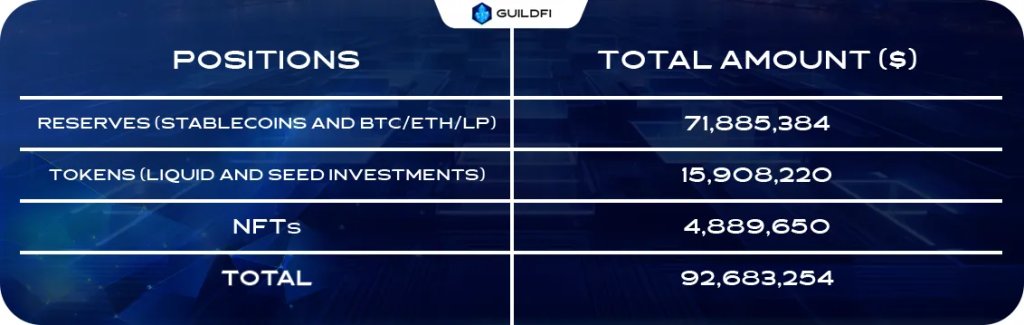
Source: GuildFi
However, when asked about “public buyback mechanisms & historical records,” beyond a two-day “please wait patiently,” no substantive response was provided.
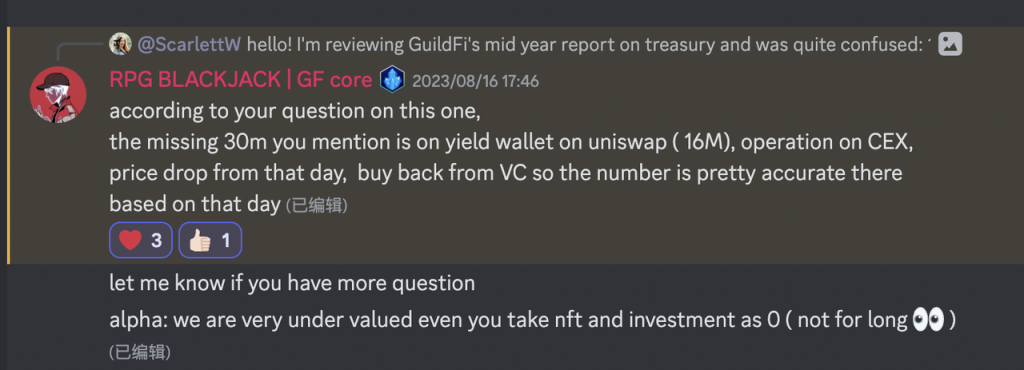
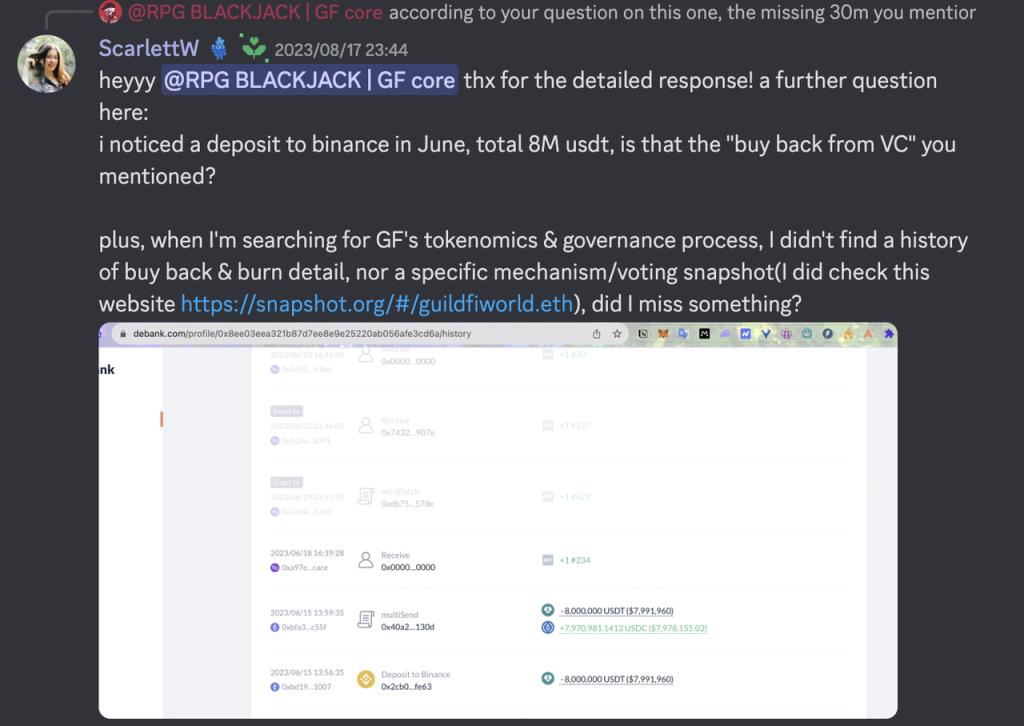
Discord Q&A Log
The semi-annual report also lists $15.9M in private market investments and other game tokens, and $4.8M in NFTs, in addition to the $71M in reserves (now $57.7M on-chain).
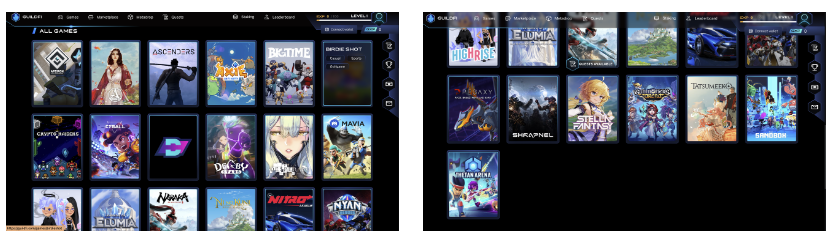
GF Partnered Games
3. DAO Development and Governance Comparison: Merit Circle Far Outpaces Competitors
Although both YGG and GuildFi stated in their 2021 whitepapers that their ultimate goal is to become a Gaming DAO, only Merit Circle has truly achieved this.
Visiting YGG and GuildFi’s Snapshot pages reveals only a few outdated votes:
-
YGG: A proposal for SubDAOs from two years ago.
-
GuildFi: Eight months ago, three proposals regarding Staking System rollout and details.
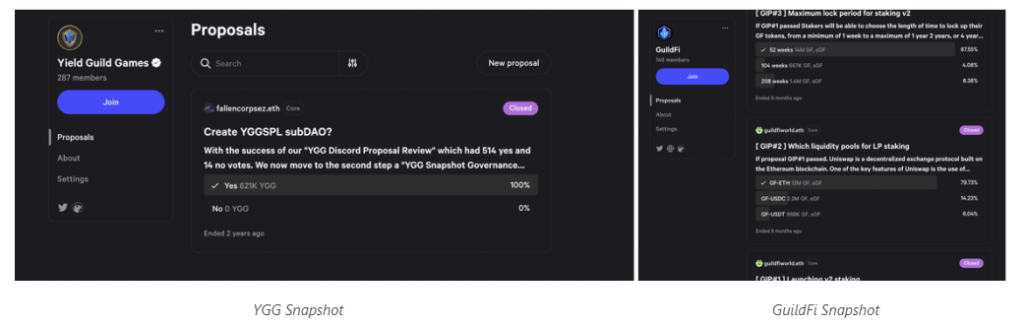
Merit Circle, however, demonstrates how a well-run, risk-aware Gaming DAO / Investment DAO should operate: over the past two years, it has hosted 26 Snapshot proposals covering DAO governance, investment risk management (exit strategies and investment caps), and game development. Key proposals include:
-
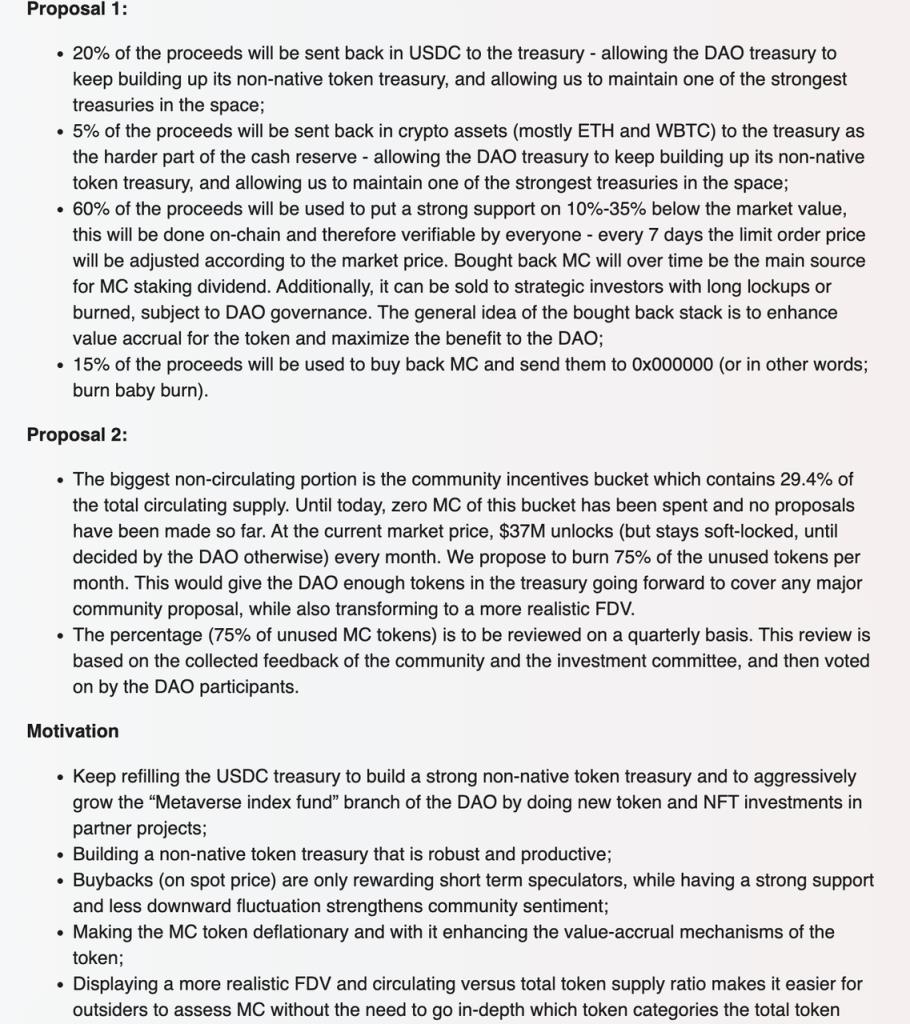
Jan 2022 MIP-7: Established revenue distribution and token burn mechanism. 20% of revenue kept in treasury as $USDC, 5% as $ETH/$WBTC, 60% used to repurchase $MC at opportune times (when price is 10–35% below 7-day average, mainly allocated to staking rewards or sold to long-term strategic buyers), 15% used for direct buyback and burn. Additionally, since most token unlocks go to “community incentives,” the proposal decided to burn 75% of unlocked community-incentive tokens monthly (proportion adjustable via community vote). This ensures sufficient treasury tokens to fund major community proposals and shifts mCap to a more realistic FDV. It’s hard not to admire $MC’s foresight and discipline—voluntarily burning 75% of community-released tokens is no easy decision. This robust mechanism is foundational to MC’s balanced treasury.
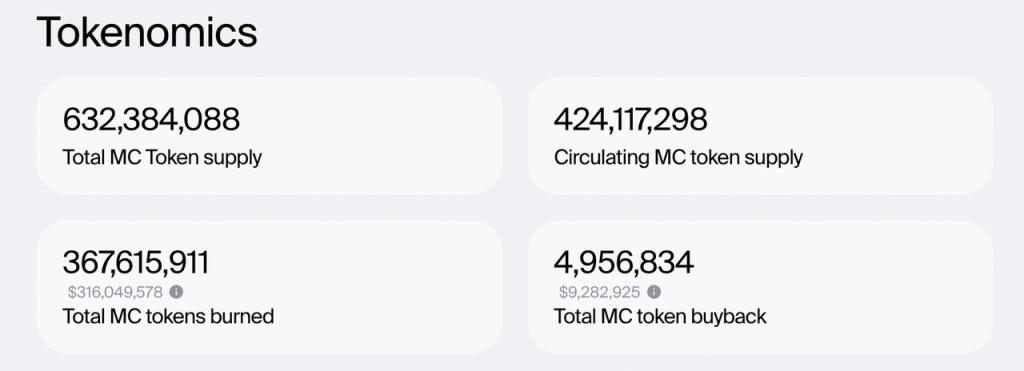
$MC Buyback and Burn Announcement
-
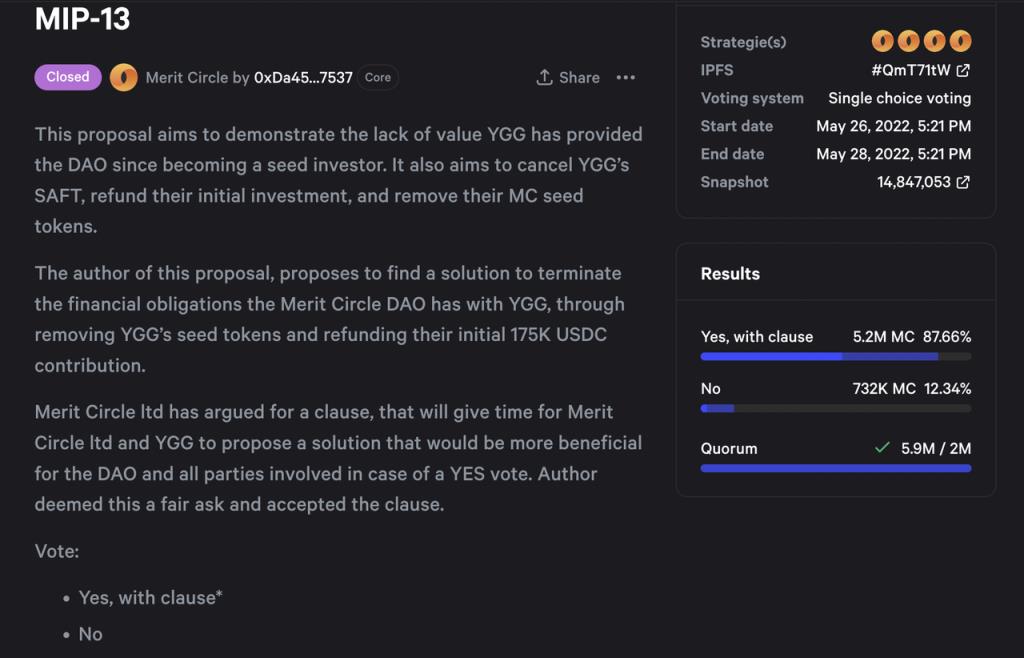
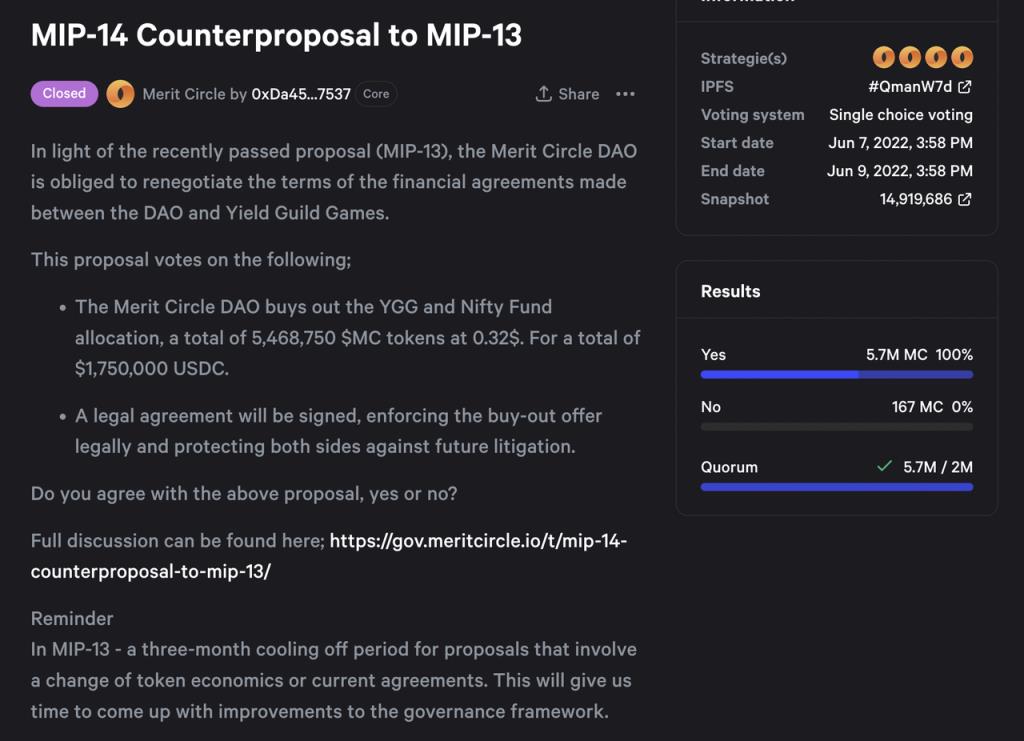
May–Jun 2022: Returned YGG’s investment. Terminated relationship with investors who provided no real support.
-
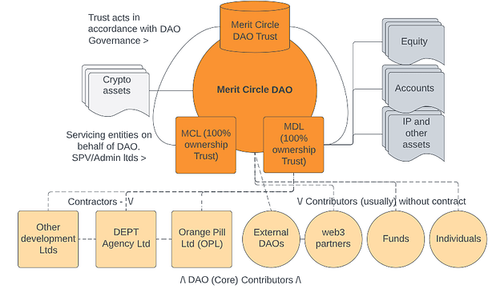
Jul 2022: DAO structural reorganization.
-
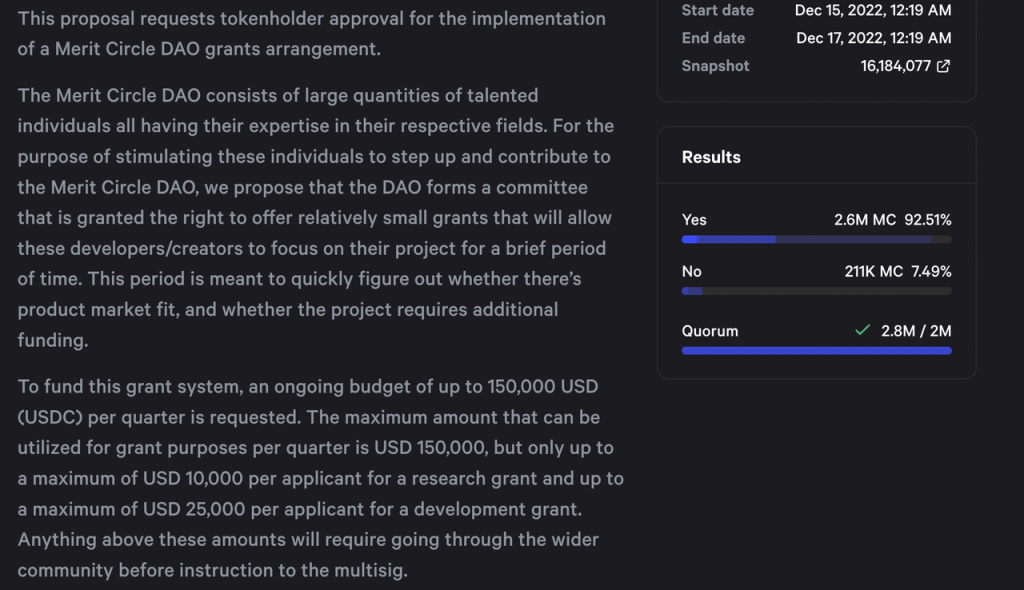
Dec 2022: Proposal for Merit Circle Grants. Allocate $150K USDC quarterly for small research and game dev grants—Research Grants capped at $10K, Development Grants at $25K.
-
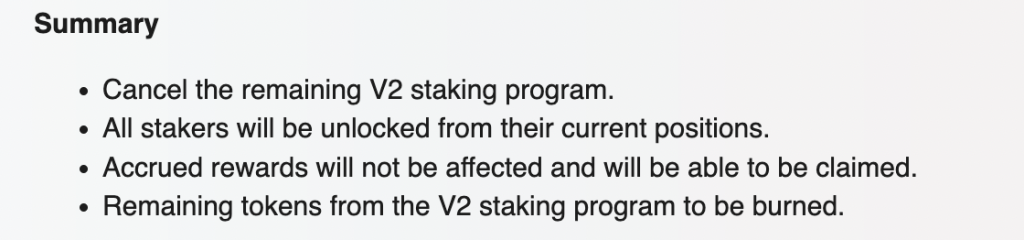
Jul 2023: Cancel future Uni V2 staking rewards and burn them. Since existing staking offers little benefit to MC, but staking on Beam (MC’s planned PoS gaming chain) has clear utility, future rewards were redirected to Beam.
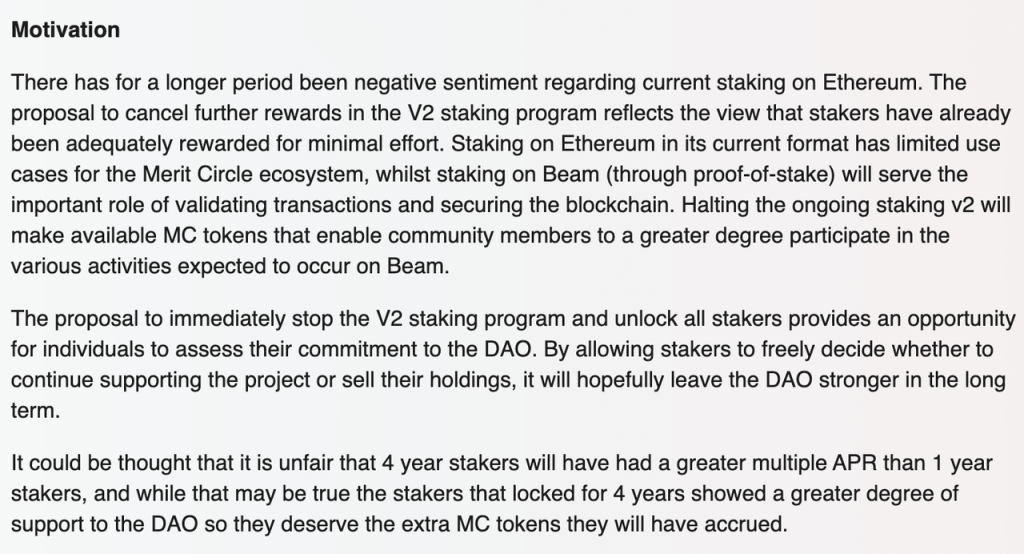
Reviewing these proposals, while proposers are mostly core team members and voter turnout modest (~5M $MC), MC’s team exhibits exceptional strategic clarity, sacrificing short-term gains for long-term community value, with relatively transparent governance.
4. Summary Comparison: Operational Capability, Investment Performance, Risk Management, and Market Cap
4.1 Operational Capability: MC More Diversified, YGG Broader User Base, GF Lags Behind
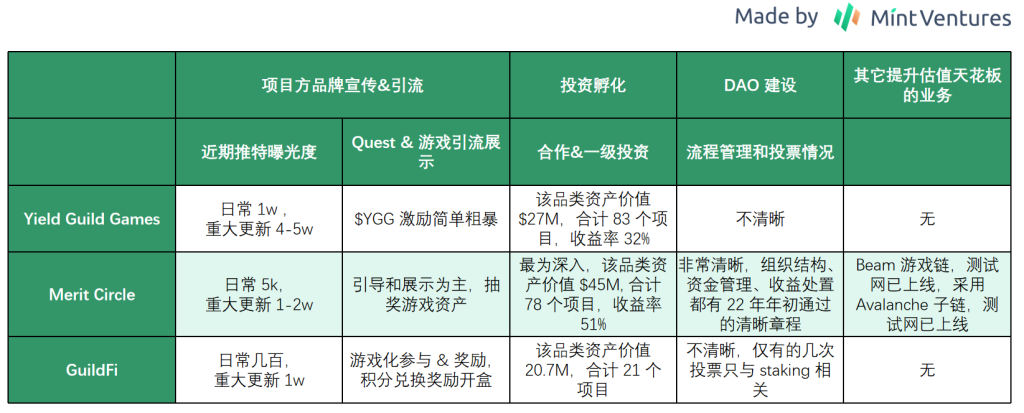
Additionally, organizationally, YGG reflects the Axie era—regional sub-DAOs under YGG enable localized outreach and management, but lack modern risk controls. Merit Circle resembles a full-scale game studio, excelling across investment (with mature risk frameworks), incubation, marketing, and infrastructure. GuildFi lags in both investment capacity and market presence.
4.2 External Partnerships and Investment Capacity: MC Leads, YGG Second in Scale and Returns, GF Smallest with Unknown Returns
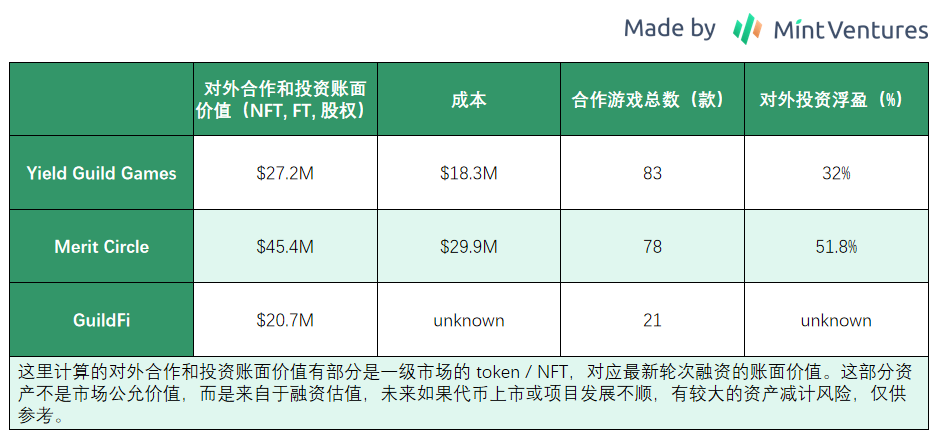
4.3 Risk Management: MC First, GF Second, YGG Performs Poorly
Evaluation criteria:
-
Transparency and adherence to predefined mechanisms in asset trading, management, and control—MC >> GF/YGG;
-
Impact of native token value on total assets—high “native token / total assets” ratio indicates poor risk control. Position management: GF > MC > YGG.
Overall, MC leads, GF follows, YGG performs poorly.
4.4 Valuation Comparison: $MC Already Elevated, $YGG Normal Correction, $GF Market Cap < Treasury Stablecoin + Blue-Chip Value Due to Weak Operations
Due to their business nature, a guild’s treasury assets partially reflect operational strength. As previously noted, guilds now primarily serve two functions:
-
Leveraging player base to serve game projects;
-
Investment and incubation.
These functions translate into on-balance-sheet assets (NFTs, FTs, equity) or converted stablecoins/blue-chips retained in treasury. Thus, treasury comparisons offer partial insight into valuation.
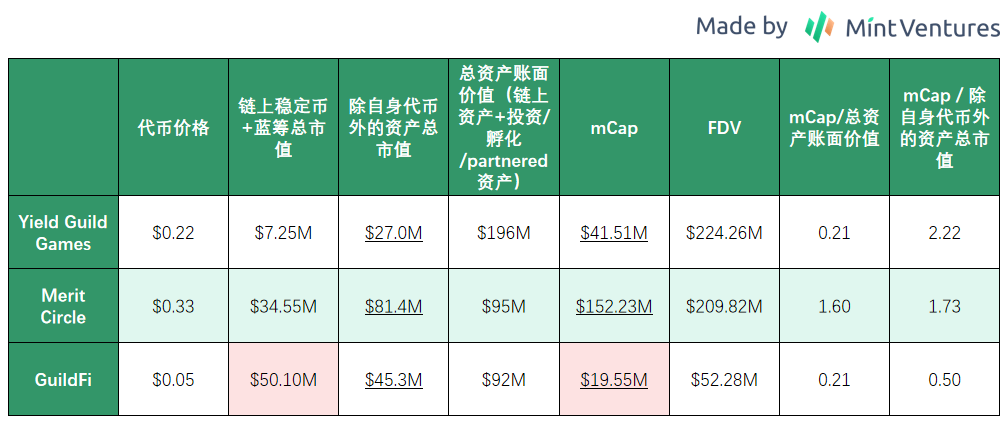
Prior to the recent $YGG rally, daily trading volume was only in the millions, indicating limited liquidity. With $YGG making up 82% of YGG’s treasury, any sell-off would crash the price. Therefore, we compare both “mCap / total asset book value” and “mCap / non-native asset market cap” for objectivity. Overall, value support ranks as $GF > $MC >= $YGG (Note: Both “total asset book value” and “non-native asset market cap” include “stablecoins + blue-chips” and “FT/NFT from investments/partnerships,” the latter valued based on funding rounds rather than market prices—posing significant write-down risks upon token listing or project failure. Only Merit Circle discloses full cost and book values; others lack transparency, raising potential data inconsistency concerns.)
With most $MC tokens already unlocked, but significant $YGG and $GF supplies yet to vest, downside risk ranks $YGG > $GF > $MC from an FDV/mCap perspective.
Beyond $MC’s explicit buyback mechanism, neither YGG nor GF have buyback programs. GF has a fixed-release staking system; YGG lacks even staking. Combined with GuildFi’s operational weakness, despite its market cap being below on-chain stablecoin and blue-chip holdings, it’s difficult to conclude it’s “undervalued.”
Looking ahead, MC has narrative upside via its gaming chain and natural yield capture from POS staking. YGG plans to launch a new Quest System on Base. GF currently lacks any compelling operational narrative.
Join TechFlow official community to stay tuned
Telegram:https://t.me/TechFlowDaily
X (Twitter):https://x.com/TechFlowPost
X (Twitter) EN:https://x.com/BlockFlow_News
 Mint Ventures