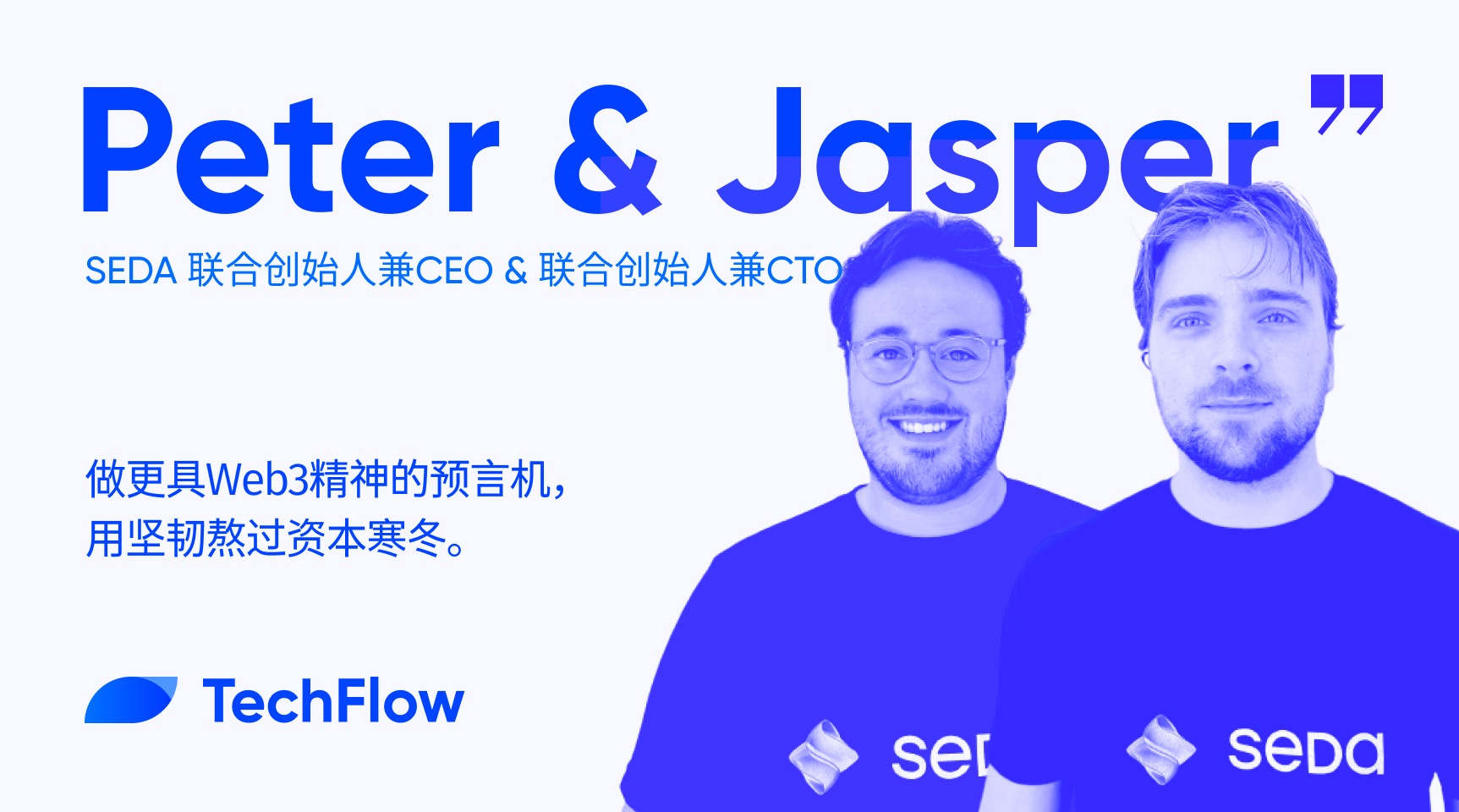
Interview with SEDA Co-founder: Building a More Web3-Spirited Oracle, Enduring the Capital Winter with Resilience
TechFlow Selected TechFlow Selected
Interview with SEDA Co-founder: Building a More Web3-Spirited Oracle, Enduring the Capital Winter with Resilience
SEDA created a unified data layer that enables information, liquidity, and message passing to flow not only from the real world but also between blockchains.
 Navigating Web3 tides with focused insights
Written by: Sunny & David
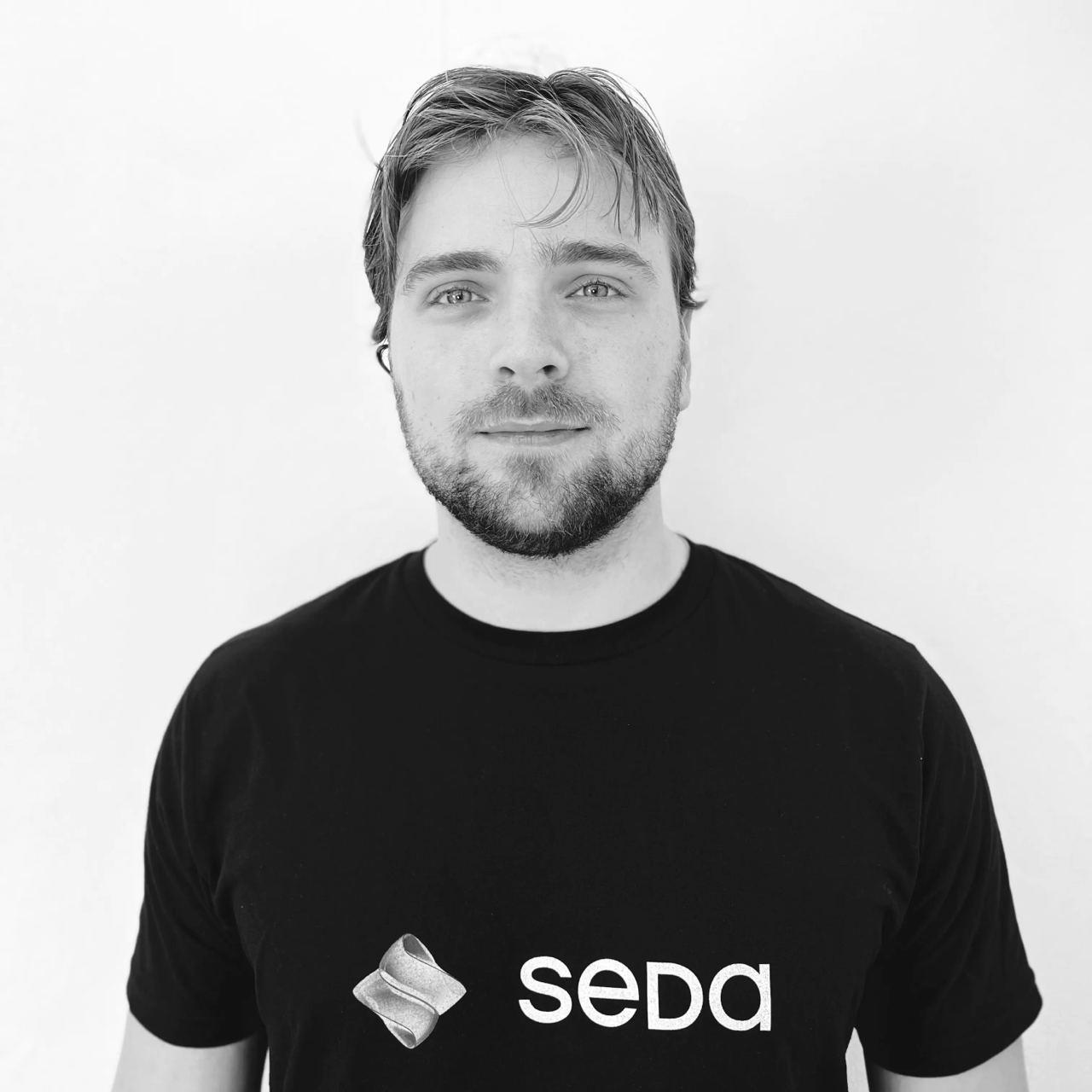
SEDA: Peter and Jasper

Preface
Oracles are essential components in maintaining and enhancing blockchain—the "machine of trust."
In June, Vitalik wrote about how the crypto ecosystem needs a definitive oracle as foundational infrastructure. Beyond well-known projects like Chainlink, many other important teams continue building in this space—SEDA being one of them.
SEDA aims to become the HTTP of Web3 by constructing a data transport layer that allows querying data from any Layer 1. Compared to other solutions, SEDA is more egalitarian and accessible, striving to build a true 'People's Oracle' aligned with Web3 values—supporting data from arbitrary sources, offering friendlier pricing, and providing greater cost efficiency for simple data requests.
From the following interview, we will learn about the co-founders of SEDA—their backgrounds, motivations, and why they chose to build such an oracle. We’ll also explore how they persevered through two difficult years amid widespread skepticism to achieve remarkable success. We hope this conversation deepens your understanding of SEDA and oracles in general, while also offering warmth and encouragement to those enduring the current startup winter.
Cross-Border Founding: Meeting at ETH Berlin
TechFlow: Could you briefly introduce your backgrounds and what drew you into cryptocurrency?
Peter Mitchell:
-
I’m the co-founder and CEO of SEDA. When we developed our first application, I took charge of Jasper’s portion. I was introduced to crypto through EveryDapp, the first platform to curate and rank dApps.
-
My goal was to create a user-friendly platform where Web3 newcomers could explore various smart contracts. We audited and verified the code, and provided beginner guides to help users get started.
-
This project marked my debut in the crypto space. In 2018, I reached out to Jasper looking for a technical co-founder to start a new venture together.
Jasper:
-
I’m the co-founder and CTO of SEDA. Before entering crypto, I focused on Facebook data analytics, building dashboards for large publishers using the Facebook API. I left my previous startup because Facebook frequently changed its API, making it hard to maintain viable software. We were constantly patching bugs instead of innovating.
-
I was drawn to the promise of cryptocurrency and transitioned into contract development. One notable project during this time was working on Finality Labs’ plasma client, funded by the Ethereum Foundation, focusing on Ethereum scalability.
TechFlow: Peter is from the U.S., and Jasper is from the Netherlands. How did you meet and decide to found SEDA under such a cross-border context?
Peter:
-
We actually met at ETH Berlin. In 2018, I found Jasper on GitHub—he was developing a hackathon project for ETH Berlin 2018. At the time, I was looking for a co-founder and CTO, so I messaged him saying, “Hey, we’d love to meet.” We basically spent the entire weekend hacking together, and continued building and collaborating afterward.
Jasper:
-
I presented my first project at ETH Berlin, where I met Peter. We collaborated on several initiatives and eventually built an application specifically for derivatives trading based on startup milestones and funding rounds.
-
However, we realized platforms like Augur and 0x, which were built on Ethereum, had prohibitively high costs, making broad adoption impossible.
-
So we shifted our focus to open market infrastructure. During this phase, we identified a major opportunity in the oracle space. That led us to dive deeper and begin developing oracles. To date, we’ve launched two oracle products—one of which secured over $3.7 billion in support during the recent bull market.
-
But seeing potential improvements within our own product, we revisited our original concept. We’re now upgrading our infrastructure with the goal of becoming Web3’s foundational data layer—enabling data queries from any Layer 1 and supporting computation across our network.
Three Questions About SEDA: What? Why? How?
TechFlow: Can you explain in detail what SEDA is today and what problems it solves?
Jasper:
-
When you deploy a smart contract on platforms like Ethereum, all data within that contract is, by definition, public (though sometimes partially obscured). This means anyone can read it—including other smart contracts, which can then use that data. Essentially, this resembles open, permissionless APIs that communicate with each other, emphasizing interoperability.
-
However, this approach has limitations—smart contracts can only access data on Layer 1. What we’re building is a bridge connecting Layer 1 to all other data in the world. This enables smart contracts not only to query data from other contracts but also to make internet requests to retrieve any desired external data, seamlessly linking on-chain and off-chain information.
Peter:
-
You can think of SEDA as the foundational transport layer for Web3, similar to HTTP in traditional web. The problem we face today is fragmentation. With every new Layer 1 ecosystem or Layer 2 rollup—including sovereign chains, subnets, and various other options for building niche ecosystems—everything becomes scattered. As a result, resources like users, liquidity, and adoption are dispersed across a complex web of distinct and unique ecosystems.
-
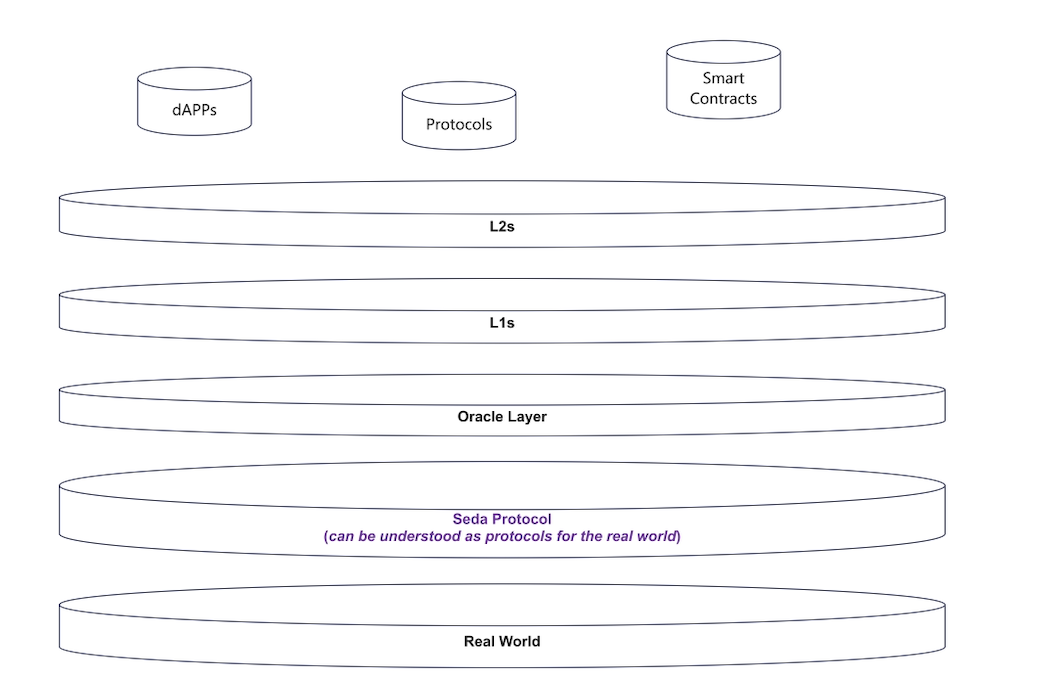
SEDA creates a unified data layer that allows information, liquidity, and message passing to flow—not just from the real world, but also between blockchains. You can imagine SEDA as a base layer beneath Layer 1 and Layer 2, cohesively connecting them. That’s exactly what we’re launching in the market today.
TechFlow: Will the SEDA protocol disrupt the existing oracle market?
Jasper:
-
Consider the system dynamics where you view cryptocurrencies as having secure, decentralized, and permissionless immutable Layer 1s—like Ethereum.
-
On top of these, you can build mutable code—like Compound. Here, you have a decentralized contract that is immutable and permissionless, allowing anyone to inspect the code and understand exactly how the protocol behaves under specific conditions. Everything becomes transparent: how much USDC is borrowed, how much ETH is collateralized, and the exact borrowing APY, etc.
-
But there’s an opaque middleware layer—analogous to building a skyscraper on sand. This middle layer represents a centralization failure point in crypto. If an oracle fails or delivers incorrect data, the consequences can be severe.
-
Many existing oracles are not very decentralized. They operate with a whitelist of validators—only 10 or 20 companies can submit data—or they offer Web 2-style data access requiring signed contracts or exclusive agreements, making data access highly permissioned and opaque, much like unstable middleware.
Peter:
-
For DeFi oracle use cases, we believe that for decentralized finance (DeFi) to truly scale—especially if we want to see $1 trillion in value within DeFi—we cannot rely on a small group of opaque, centralized firms.
-
Doing so would be as bad as handing the entire infrastructure over to traditional banks. In such cases, you end up placing your trust in relatively small software companies that may have non-transparent business practices.
-
Our vision is to ensure a fully permissionless system—from the bottom stack of Layer 1 to the top protocol layer.
TechFlow: How does the SEDA protocol establish this tight data layer between L1/L2 blockchains and real-world data?
Peter:
-
Think of the oracle in the SEDA framework as a module. For example, you can build a module on our network dedicated to oracle data like price feeds.
-
Imagine the architecture as a stack, with SEDA serving as the foundational data layer. Above it sits the network layer, composed of Layer 1 or Layer 2 chains. Then, on top of that, protocols and smart contracts are built that can query data, perform cross-chain computations, or pass messages.
-
In this setup, oracles can be seen as a feature or module specifically designed to operate atop our data standard.
Jasper:
-
Within eight weeks of launching our first oracle product, we had three active networks securing over $3.7 billion in crypto assets, making SEDA the second-largest oracle in the cryptocurrency space. This rapid growth highlights the demand for adoption, liquidity, and usage across these networks. However, the evolving crypto landscape faces an integration challenge: without reliable data and bridging capabilities, new networks risk isolation.
-
Each L1 and L2 operates as an independent entity, akin to Web 2 data silos. SEDA aims to connect these entities. The fast growth of our initial product underscores the complexity of oracle deployment. Typically, an oracle is a smart contract on an L1 or L2, supported by infrastructure components like data providers. Each new integration requires redeveloping and redeploying the oracle.
-
For instance, redeployment on Ethereum or EVM-based L2s is straightforward, but rebuilding on Solana in Rust introduces new security challenges.
-
SEDA’s solution is to aggregate data on our Cosmos SDK mainchain—where our security and consensus processes reside—and then relay that data via intermediary smart contracts to each L1 or L2. This streamlined approach allows us to scale without constantly reassessing trust assumptions.
A Cosmos-Based Omnichain Oracle
TechFlow: Why use the Cosmos SDK?
Jasper:
-
We built using the Cosmos SDK. To query our data, you only need a smart contract capable of verifying cryptographic proofs from our network, thereby gaining access to our data. Although our infrastructure runs on Cosmos, we don’t rely on Identity-Based Cryptography (IBC). Instead, we’ve implemented our own fully trust-minimized bridging mechanism.
-
We chose Cosmos because it offers the most mature and plug-and-play infrastructure for creating custom networks. Our goal is to act as a data hub—aggregating data on our main network and distributing it to all connected chains.
-
Cosmos, as a dedicated application-specific blockchain, seamlessly supports this function. It’s battle-tested, backed by an active community, and uses the proven Tendermint proof-of-stake system.
-
We use Cosmos for settlement and checkpointing. However, we also have an overlay network made up of custom nodes responsible for data queries. These nodes are randomly selected by the Cosmos chain via the randomness built into its validator set.
-
The Cosmos chain randomly selects overlay nodes to execute specific computations. Once completed, results are returned to the Cosmos chain and subsequently distributed. Essentially, Cosmos provides the go-to SDK for developers aiming to build chain-agnostic, application-specific blockchains.
TechFlow: How is decentralization achieved within the protocol?
Jasper: The system runs on the Cosmos SDK. While I may not be the best person to dive deep into technical specifics, I can walk you through how data is collected and delivered back to users. Here’s how it works:
-
A user issues a price feed request—for example, the ETH-USDC price on Ethereum.
-
Our network identifies the data request, and our validator set randomly selects a number of overlay network nodes to fetch this data.
-
In the price feed request, the user can specify which data sources to use by providing API endpoints. Additionally, the request includes a binary file defining how the data should be computed.
-
The request is sent to the selected overlay network nodes.
-
These overlay nodes operate as a secret committee, meaning they don’t know which other nodes are handling the same request. They retrieve the necessary data and perform the specified computation.
-
Using a commit-reveal scheme, each node first submits its result, then reveals it in sequence.
-
Individual results are aggregated according to a predetermined method.
-
The aggregated result is then delivered back to the individual or entity requesting the price feed.
-
Subsequently, protocols can access and utilize this data.
Peter:
-
In Cosmos, there are multiple validator sets, each with subsets. The system is robust, leveraging randomness to determine which validators are chosen to query data.
-
Instead of designating specific companies or entities as data-querying nodes, any validator in the network may be selected. A challenge with Cosmos is its limited validator set. In our network, around 100 validators handle the data chain—a relatively small number. To further decentralize the execution of data requests, we implemented the overlay network design. The primary role of these 100 validators is to use verifiable random functions to select nodes from the overlay network.
-
Our goal is to grow the overlay network to consist of thousands of nodes, ensuring a much broader selection pool than the core chain.
Public Goods and Monetization
TechFlow: As a data layer protocol, what is SEDA’s revenue model?
Peter:
-
Essentially, when a data request is made, you attach a payment—which can be in various currencies depending on what the relayers accepting notifications from our network support. Relayers then use that payment at their discretion.
-
However, to perform computation through our network, relayers must burn a certain amount of our network token. Our goal is to ensure easy access to our data. So while relayers can accept various currencies, they ultimately burn our token to pay for computation. Since this token is burned, our network is deflationary, similar to EIP-1559.
TechFlow: How does the concept of public goods intersect with SEDA’s protocol compared to Ethereum?
Jasper:
-
Ethereum is a public good. It’s non-excludable and non-rivalrous, meaning anyone can use it without limiting others’ access. Ethereum is primarily funded through gas fees and issuance—where a certain percentage is minted annually and distributed to validators along with their base income.
-
Ethereum has become the foundation for decentralized computing and numerous financial applications, including lending protocols, perpetual contracts, real-world asset tokenization, and NFT minting randomness—all of which often require oracles.
-
Currently, oracles are largely funded by private companies, and this economic model isn’t sustainable. We believe it’s crucial to build a decentralized, permissionless, self-sustaining ecosystem funded by usage. This is vital for long-term reliability. Relying on private companies for data is risky—if such a company goes bankrupt, dependent systems could collapse.
-
Therefore, treating data infrastructure as a public good is critical. We focus on request-driven computation, which shares many similarities with smart contracts.
TechFlow: How can SEDA, as a public good, generate revenue?
Jasper:
-
The network and infrastructure remain open and permissionless. There are built-in parameters, such as burning tokens to request data. If a protocol uses our service, they compensate relayers in whatever currency they choose (e.g., USDC or ETH), which is then converted and burned within our core network.
Peter:
-
Although our team built the protocol, we operate as a non-profit association based in Switzerland. Our goal isn’t to impose extra fees or embed them into our consensus. However, we can design monetization tools.
-
For example, we might create data modules that allow institutions like Nasdaq to privately link their APIs to our network. Any monetization tools would be supplementary, enhancing user experience. But the main network remains open, transparent, and free—we operate without financial motives.
Jasper:
-
It must be emphasized that network participants need incentives. This isn’t charity. Validators in the network aren’t running nodes purely out of goodwill. Therefore, built-in mechanisms to support these decentralized network members are crucial.
-
One approach we’re taking is becoming an MEV-aware oracle. When prices update on Ethereum and transactions are visible in the mempool, MEV searchers predict the updated network state. They assess potential opportunities and often execute flashbot auctions to strategically position specific oracle updates based on extractable value.
-
Currently, this auction revenue goes to Ethereum validators. We believe this shouldn’t be the only way. We’re innovating by holding internal auctions for the right to position our oracle updates, redirecting this potential revenue to our network validators.
Two Years Through the Capital Winter
TechFlow: Capital markets in European countries may not be as mature as those in the U.S. Can you share your experience raising funds and achieving growth for your project?
Peter:
-
Our journey began during the 2018 bear market. For two years, we tried to raise funds but barely managed to secure enough to keep the project alive. Many VCs we approached were hesitant, explaining they weren’t deploying capital due to the market downturn.
-
European VCs we contacted were especially cautious, waiting for us to have a large team and significant traction before considering investment.
-
For a startup like ours—just Jasper and me with only a concept—finding investors willing to take a risk was extremely challenging. Most of our fundraising happened between late 2020 and early 2021, right as the Covid pandemic hit.
-
I remember traveling to cities like San Francisco and New York to meet investors, paying nearly $4,000 for short hotel stays despite financial strain. Fundraising was truly a tough battle.
Jasper: A notable point is that while we engaged with investors for two years, we were simultaneously building the product. Investors recognized this resilience. They saw we weren’t chasing quick profits, but were committed to sustained development. Demonstrating steadfast determination during the bear market significantly boosted our credibility. This perseverance earned immense trust from our investors.
Peter:
-
Today, we’ve raised over $22 million, with investors including Distributed Global, Coinbase Ventures, Coin Fund, Reciprocal, and many others. Fortunately, during this bear market, we’re well-capitalized with solid runway. This allows us not only to survive but to thrive. Even in these tough times, we’re expanding, hiring, and accelerating growth—we’re deeply grateful for this.
-
Learning from the last bear market, we remember the challenges of 2018 and 2019 when capital wasn’t as accessible as it is today. We ensured financial responsibility and secured sufficient resources to grow and maintain an offensive posture in any future bear market.
Peter: When Jasper and I first started working together, we lived in Hamburg, just a five-minute walk apart. Being founders brought an emotional rollercoaster—ups and downs. Sometimes everything felt promising; other times, challenges piled up. Jasper and I have always been strong support systems for each other.
Our mutual understanding played a key role. That shared foundation shaped how we built our team. We took time hiring team members, ensuring a strong, talented core base. As we continue to grow, consistent feedback from our team highlights appreciation for our culture—one that emphasizes hard work and mutual understanding.
Afterword: Reflections from ETHcc
This interview was conducted in the interview room at ETHcc 2023, generously provided by the YAP team. Within this concentrated conference environment, the dominant themes driving Web3 developers became clear: infrastructure, real-world assets, and account abstraction.
Although Jasper and Peter chose to stay in Europe to further develop SEDA, they noted that compared to North America, the startup environment in Europe tends to be more cautious. SEDA’s early VC backers were all from North America, with European investors joining later once market signals emerged.
Surrounded by charming cafés, bakeries, and picturesque scenery, one can’t help but wonder—what would it be like if Europe had a startup ecosystem as vibrant as San Francisco?
Join TechFlow official community to stay tuned
Telegram:https://t.me/TechFlowDaily
X (Twitter):https://x.com/TechFlowPost
X (Twitter) EN:https://x.com/BlockFlow_News
 深潮TechFlow