









Beyond Complexity: Building a User-Friendly New World with Intent-Centric Design
TechFlow Selected TechFlow Selected
Beyond Complexity: Building a User-Friendly New World with Intent-Centric Design
Unlike the aforementioned scenarios, intent-centric focuses only on the outcome, not the process.
 Navigating Web3 tides with focused insights
Author: BadBot
Imagine this scenario: you hold 1,000 USDT on the Ethereum mainnet and want to buy $OP on a DEX in the Optimism Layer-2 network. What should you do?
First, you need to select a wallet that supports Optimism and manually add the corresponding network settings. Then, via a secure cross-chain bridge, you transfer your 1,000 USDT and some ETH for gas fees to Optimism. After connecting your wallet to the target DEX, you execute the trade. While this process may seem straightforward, it involves multiple interactions, waiting times for confirmations, and uncertain factors such as potential network fees and slippage. For blockchain beginners, each step can be challenging—hindering broader adoption of decentralized applications. Could we reduce the complexity of on-chain interactions to the simplicity of using a centralized exchange (CEX)?
Intent-centric, or "intent-centered," differs from the above scenario by focusing solely on outcomes, not processes. Users only need to submit and sign an instruction like "I want to buy $OP on Optimism." The intent-centric protocol then coordinates third parties to handle all necessary steps, lowering the barrier to entry and delivering a seamless experience akin to CeFi.
Several projects are currently exploring intent-centric architectures.
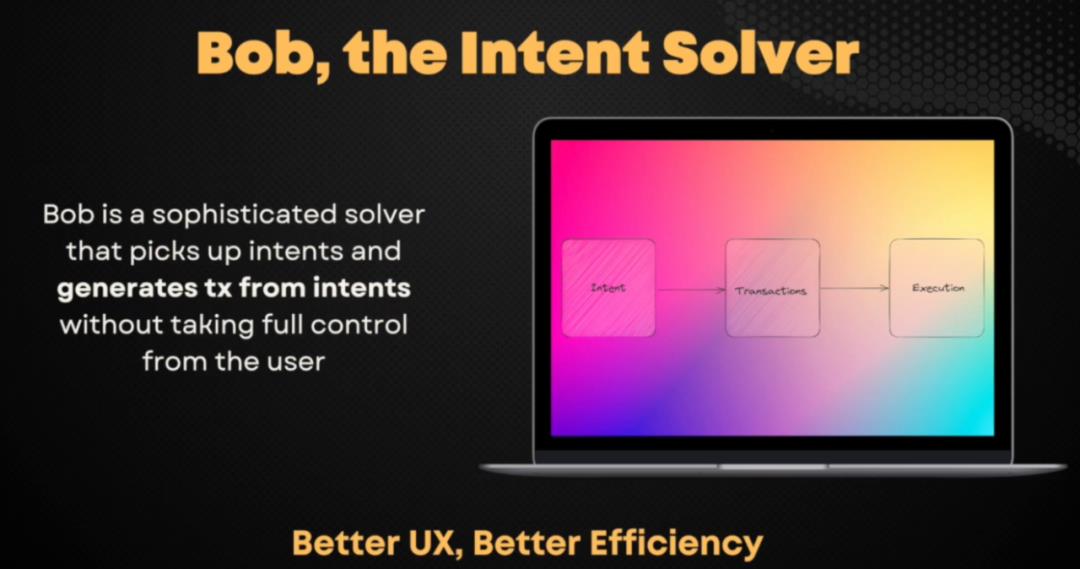
Bob the Solver
Bob the Solver is intent-based transaction infrastructure designed to integrate into account abstraction wallets and dApps. It stood out at ETHGlobal Paris and won the Best Use Case award from 1inch. It consists of two components:
Solver: Equipped with machine learning (ML), the solver identifies and classifies user intent, plans the optimal path to fulfill it, and constructs the required transactions before forwarding them to an account abstraction wallet.
Account Abstraction Wallet (AA Wallet): Responsible for executing transactions, composed of a bundler and a paymaster. The bundler receives and schedules transactions from the solver, while the paymaster manages associated gas fees.
Anoma
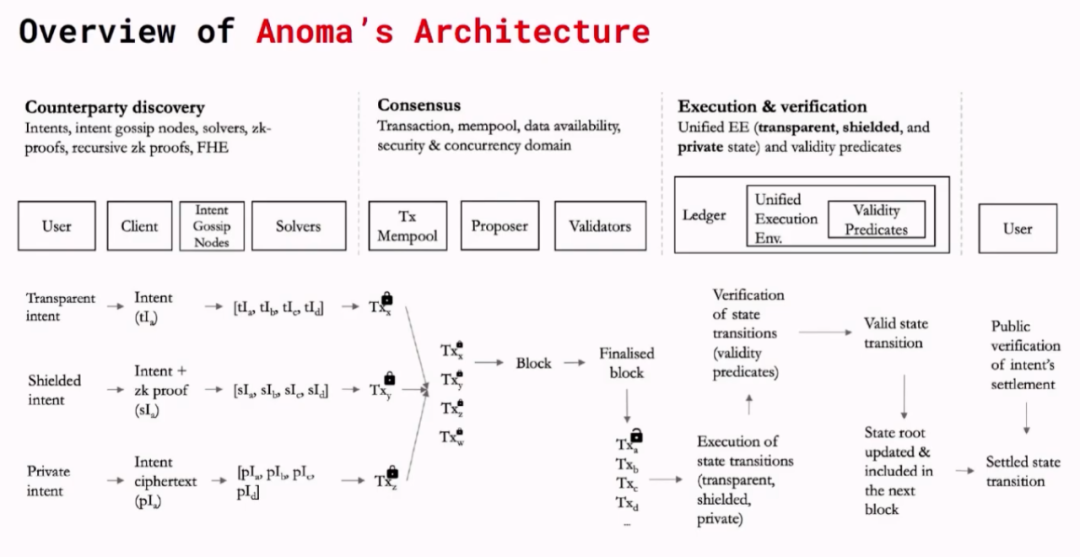
Anoma is an intent-centric, privacy-preserving protocol for decentralized counterparty discovery, resolution, and multi-chain atomic settlement. Its core workflow includes the following steps:
-
User Interaction: Users send transparent, private, or protected intents to Anoma’s intent gossip network (a P2P layer).
-
Intent Collection & Matching: Solvers (which could be searchers or similar roles) collect intents, perform balanced state transitions, and match counterparties.
-
Transaction Processing: Matched transactions are submitted to an encrypted mempool. Validators receive blocks proposed by proposers, execute and validate them, and finally update the state root.
Anoma’s execution layer is built on Taiga, a zk-circuit based on Halo2, enabling Anoma to deploy Ethereum zk-rollups and share part of Ethereum’s security.
Beyond zk-rollups, Anoma can also support fully decentralized development of op-rollups, NFT marketplaces, DEXs, and more. It offers a simplified way to build and operate such applications while preserving user privacy and security.
Essential
Essential focuses on building intent-based infrastructure and tools to address MEV (Maximal Extractable Value). Its primary goal is to minimize the negative externalities of MEV and enable users to achieve their intents at the lowest possible cost. Essential aims to establish a solver network that captures user intents and competes to find optimal solutions—transforming profit-driven searchers into solvers focused on delivering the best outcomes for users.
To achieve this, Essential is developing a suite of products:
General-purpose Domain-Specific Language (DSL) for Intent Expression: A standardized intent language that makes it easier for solvers to understand and reason about user intents.
Intent-Centric Account Abstraction Standards for Ethereum and EVM: Since solvers require permission to perform on-chain operations, account abstraction is essential. The new standard will leverage ERC-4337, allowing users to delegate solvers to construct valid transactions that satisfy their intents.
Modular Intent Layer: Designed to avoid architectural compromises when integrating intent-centric designs with underlying systems. Benefits include:
-
Simplified Architecture: By abandoning the concept of transactions, "intent-only" allows solvers to focus purely on solution-finding without needing to understand dependencies between intents and transactions;
-
Order Flow Aggregation: All orders are routed through a single solver network, ensuring transparency and optimizing results by leveraging multiple liquidity sources;
-
MEV Resistance: Incentivizes solvers to return more value to users by rewarding those who deliver optimal outcomes;
-
Modular Design: Enables deployment across multiple stacks and ecosystems, facilitating cross-chain intent execution.
Flashbots Suave
Notably, Flashbots’ Suave focuses specifically on intent-centric cross-chain MEV extraction. As previously mentioned, Suave’s architecture revolves around user trading preferences, structured into three layers: preference expression, execution, and settlement. Here, "preferences" can be understood as user intents with conditions and constraints. Execution agents compete to serve these intents, returning part of the MEV profits to users to maximize their benefits.
Last month, Flashbots launched MEVM, introducing new precompiles for MEV that allow any centralized MEV infrastructure to be converted into smart contracts on a decentralized blockchain. Additionally, MEVM enhances privacy and efficiency by moving sensitive computations to off-chain execution nodes. MEVM will significantly enrich the Suave ecosystem, bringing in more order flow, better outcomes for users, and higher-quality blocks for proposers.
What Opportunities Lie Ahead for Intent-Centric Architectures?
Integration of Intent Languages with AI: In most cases, user intents are complex and poorly expressed, making it difficult for solvers to interpret them accurately and plan optimal paths. AI can help precisely identify user intent—for example, by using machine learning models trained on user transaction history and request patterns to infer underlying goals and needs.
Third-Party Execution Layers: After identifying the intent, solvers forward transaction workflows to third-party execution layers. These often involve complex multi-step processes and multiple participants. A fast, accurate, secure, and stable third-party execution layer is key to fulfilling user intents. However, risks such as centralization and DoS attacks must be carefully managed.
Mass Adoption of DeFi: Some DeFi projects already use intent-centric models, including Cowswap, 1inch Fusion, and UniswapX. Cowswap introduced Cow Hooks for intent-based AMM swaps; UniswapX allows users to sign intents, which solvers execute off-chain and settle on-chain. As intent-centric approaches gain wider adoption in DeFi, they could significantly improve capital efficiency and liquidity provision.
Development of Fully On-Chain Games: In fully on-chain games, all game logic and data are stored as smart contracts. Due to limitations in blockchain speed and scalability, such games currently cannot support complex strategies or high-quality graphics. Intent-centric models can simplify player interactions—players only need to issue and sign intent commands to complete in-game actions, rather than approving and signing every single step. This greatly enhances gameplay experience.
As Web3 continues to evolve, user experience and interaction efficiency are becoming focal points. Intent-centric architectures enable us to build and operate complex systems in entirely new ways—ushering in a more user-friendly, efficient, and transparent decentralized world.
Join TechFlow official community to stay tuned
Telegram:https://t.me/TechFlowDaily
X (Twitter):https://x.com/TechFlowPost
X (Twitter) EN:https://x.com/BlockFlow_News
 @iobc_capital











