









Intent-Centric Narratives (I): The Current and Future State of Intents in Web3
TechFlow Selected TechFlow Selected
Intent-Centric Narratives (I): The Current and Future State of Intents in Web3
Ultimately, this abstraction layer will make Web3 applications feel like ordinary apps. It reduces the current technical learning curve and will help us attract millions of new users.
 Navigating Web3 tides with focused insights
Author: Mike Calvanese, Brink
Translation: TechFlow

This is Part 1 of a 3-part series on the Intents narrative, written by Mike Calvanese and the Brink team.
The intents narrative is spreading rapidly. They are one of many user experience improvements enabled by account abstraction—a topic Vitalik also discussed at EthCC. Intents allow users to define the outcomes they wish to achieve on-chain and outsource the work of achieving those outcomes to third-party solvers, who interact directly with networks and protocols on behalf of users. Ultimately, this abstraction layer will make Web3 applications feel like regular apps. It reduces the current technical learning curve and will help us attract millions of new users.
The paradigm shift toward intents means future users won’t need to worry about technical tasks such as submitting transactions, using ETH to pay gas fees, mitigating MEV on AMMs via slippage settings, aggregating token swaps for optimal routing, or bridging assets across chains.
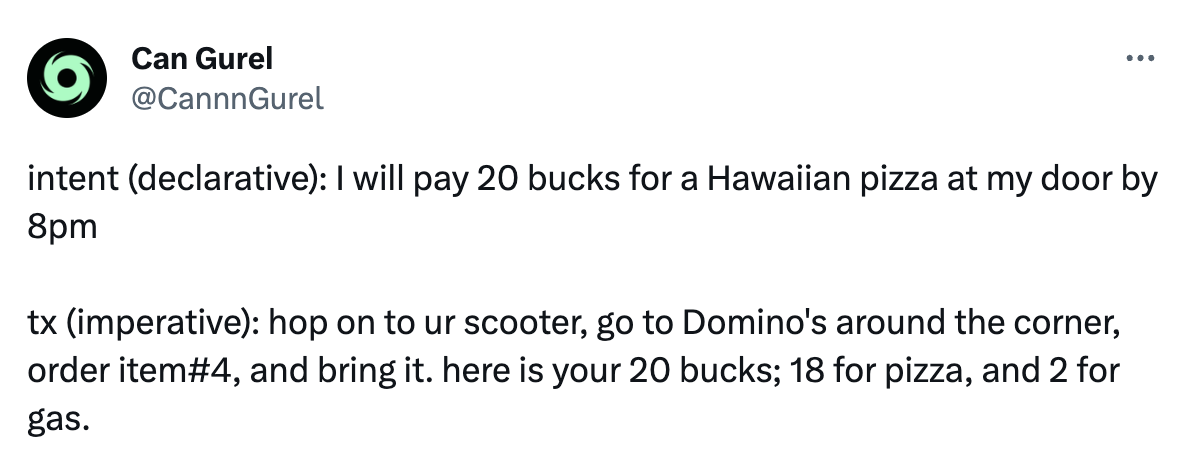
A simple way to understand intents is to view them as declarative expressions of what a user wants to happen, rather than imperative step-by-step instructions on how something should happen.
Current State of Intents
Intents are not a new concept. Before Uniswap and AMMs, Ethereum projects like EtherDelta and 0x offered order books based on intents. NFT marketplaces have used signed intents for listing and bidding on NFTs for years. New systems like CoW Swap and UniswapX now provide more advanced intent-based infrastructure for ERC20 limit orders. From today’s perspective, the term “intents” might seem synonymous with “limit orders,” since in current Web3, widely supported intents are limited to “I want X and am willing to pay Y.”
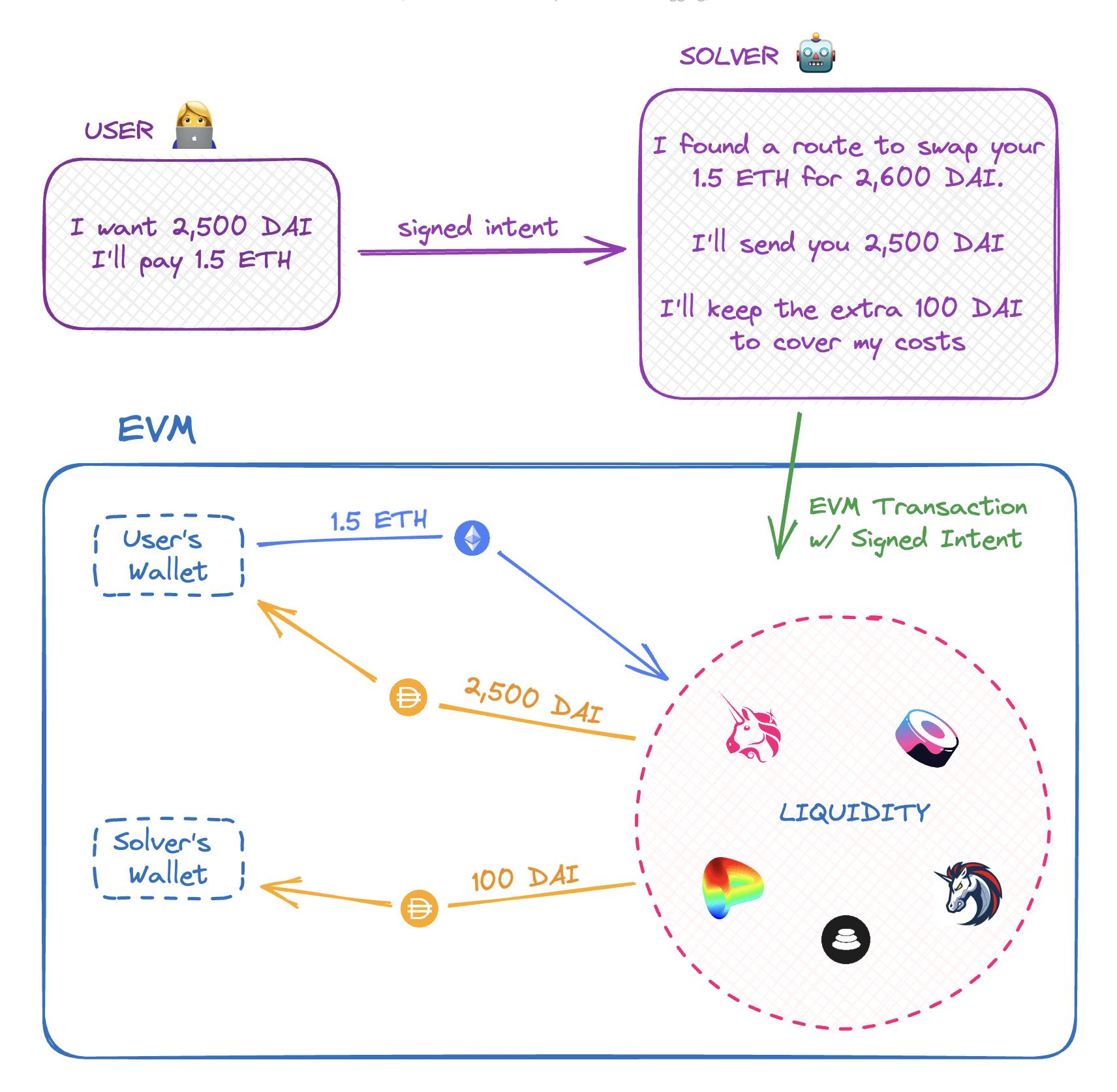
The intent architecture for limit orders is typically simple and single-purpose: the intent to swap at a better price. Users sign their limit order intent, and solvers find paths to “fill” the signed intent—using AMMs, other liquidity sources, or even matching against other intents. Solvers are incentivized to perform pathfinding because they can keep any surplus value remaining after fulfilling the user’s intent.
Many systems have been built to support the use case of limit orders, but as more advanced intent-based tools emerge, we’ll begin to see more generalized architectures supporting broader use cases.
Examples of general intent systems currently under active development include Anoma and Flashbots SUAVE. They will provide an intent propagation layer where users can broadcast signed intents to relay nodes. These will be intent-specific chains that facilitate connections between users signing intents and solvers executing those intents across different networks.
Another example is Brink, a solution for creating composable intents. Brink enables users and developers to build, sign, and solve intents across multiple EVM-compatible networks based on conditional states.
The Future of Intents
Let’s explore how Web3 intents could evolve beyond simple limit orders. Here are some new concepts:
-
Conditional intents: Execute an action when one or more conditions are met
-
Recurring intents: Express needs for repeated actions
-
Multi-step intents: After one intent is resolved, open one or more new intents
-
Intent graphs: Paths formed by a set of related intents
Conditional Intents
Current Web3 applications support only one type of conditional intent: limit orders. In the future, we will have intents capable of combining any number of conditions with arbitrary states, leading to any desired action.
As a Web3 user, you’ve likely made many conditional decisions in the past. These decisions can be expressed as intents, signed, and delegated to third-party solvers. Here are some examples:
-
Price thresholds: “If the A/B price drops below X, swap B for A.” In traditional finance, this is known as a “stop-loss.”
-
Governance decisions: “If a governance proposal I oppose passes, sell token A.”
-
Wallet balance: “If my hot wallet has insufficient ETH, transfer more ETH from my cold wallet to my hot wallet.”
-
Time/block: “If more than X blocks have been mined, transfer ETH to a recipient address.”
All of these can be signed as individual intents. Once the condition is satisfied, solvers monitor these intents and act on behalf of users. If users sign these conditions as part of an intent, solvers will prove fulfillment via some form of on-chain state verification.
An intent can contain any number of conditions. For example:
-
“I want to buy 2 ETH with DAI when 1) ETH price falls below $1,750, 2) average DAI yield for borrowing ETH is high, and 3) a whale wallet I’m tracking has bought at least 10 ETH in the past 24 hours.”
Users will be able to express their willingness to buy, sell, stake, transfer, or bridge assets whenever any number of complex state conditions are met—all through a single signed intent.
Recurring Intents
Intents will offer a protocol-agnostic way to execute recurring operations. While current intents usually involve a single signature corresponding to a single action (e.g., a limit order), we will soon see the emergence of recurring intents.
Today, users perform recurring operations by depositing funds into protocols or exchanges. Here are some examples:
-
Dollar-cost averaging (DCA): “Buy ETH with DAI at market price every month.” Users typically do this via centralized exchanges like Coinbase.
-
Reward compounding (also called restaking): “Withdraw rewards in token A, swap for token B, and restake.” This is a tedious process involving multiple transactions and interactions with several DeFi protocols.
-
Hot wallet top-up: “I have a cold wallet with 50 ETH. Whenever my hot wallet’s ETH balance falls below X, transfer Y ETH from my cold wallet to my hot wallet.” Also requires many separate transactions.
-
Payment streams: “Transfer X USDC to a recipient address every two weeks.” Streaming payment apps support this, but require users to deposit assets into smart contracts.
-
Market making: AMM-based LP positions essentially follow an infinite loop pattern of two reverse swaps: “If the A/B price exceeds X, swap A for B; if the A/B price drops below X, swap B for A.”
As evident from these examples, current recurring operations require users to deposit funds into specific protocols and submit numerous transactions. With intents, users can express their desired recurring operations through a single signature.
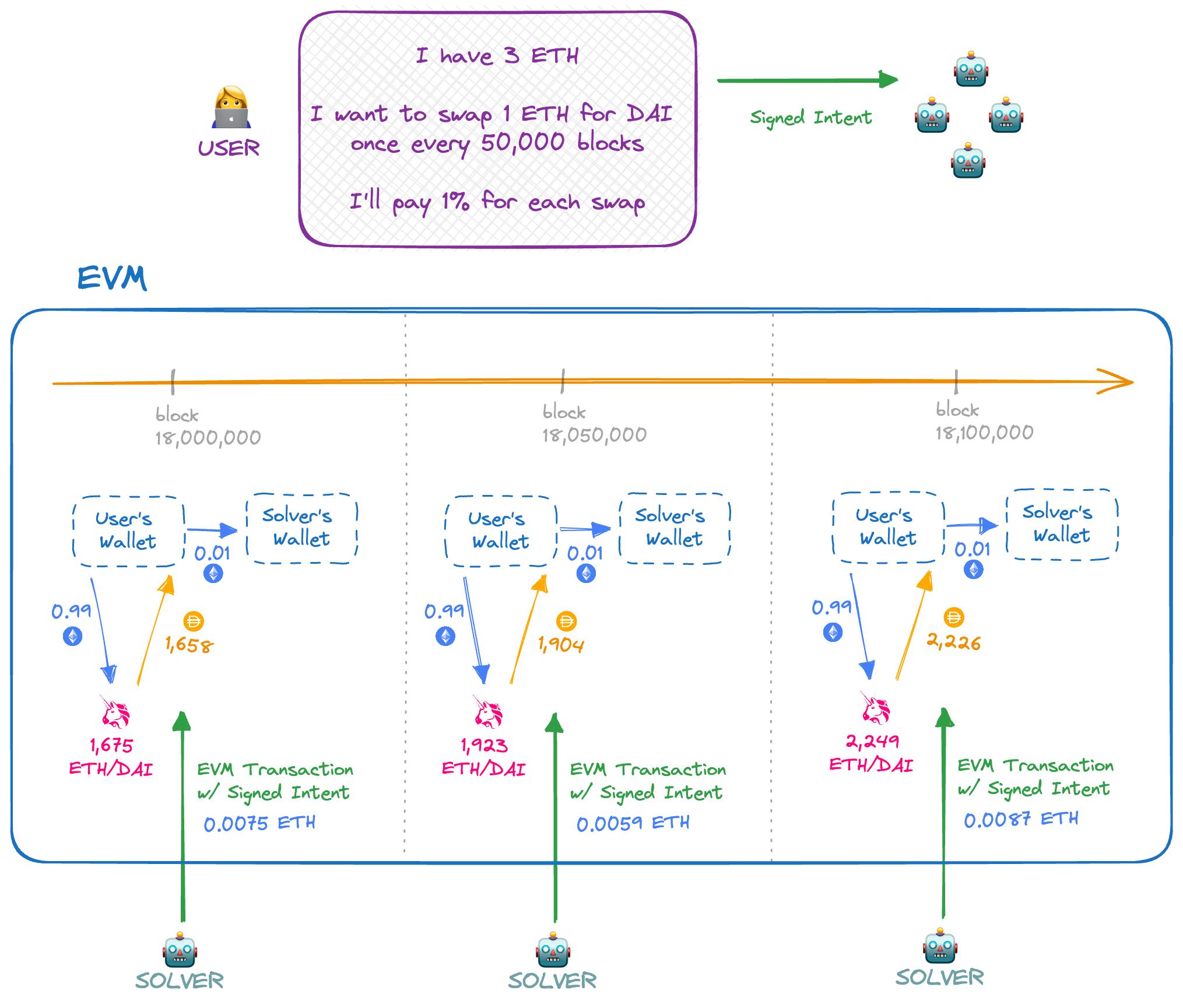
Dollar-cost averaging is a perfect example. A user intending to DCA (repeatedly buy or sell over time) could express this as a single signature allowing a swap of 1 ETH and DAI every 50,000 blocks (approximately once per week on Ethereum mainnet) at a price provided by a tamper-resistant ETH/DAI TWAP oracle, charging a 1% fee (0.01 ETH). Solvers would monitor this intent and check the following:
-
Does the user’s account have 1 ETH available for swapping?
-
Have 50,000 blocks been mined since the last swap?
-
Is 1% (0.01 ETH) sufficient to cover gas costs for the swap?
-
After paying gas, does enough ETH remain to cover the solver’s operational costs—including risks like rollback after losing a PGA (priority gas auction)—and are potential profits worthwhile for the solver?
If all checks pass, the solver sends a transaction to fulfill the user’s intent to swap ETH→DAI. As long as the user’s account holds sufficient ETH, a single signed intent for “cost averaging” can be monitored by solvers and result in a series of recurring transactions. Users get what they want without directly interacting with EVM networks or specific protocols.
Using intents for market making is another example of a recurring and potentially infinite action that can be delegated to solvers. A user wishing to provide ETH/DAI market making could create an intent allowing DAI→ETH swaps at 1,800 ETH/DAI or lower, and ETH→DAI swaps at 2,000 ETH/DAI or higher. Through this intent, the user aims to lock in a 200 DAI profit as the market fluctuates between 1,800 and 2,000 ETH/DAI.

Think of this as two inverted limit orders—one activates when the other executes, and vice versa. The user signs a single intent enabling swaps at each price point. As long as the market keeps fluctuating between these levels, solvers could theoretically fill an infinite number of such orders, with no further action required from the user.
Multi-Step Intents
Intents can consist of multiple steps. Think of these intents as state machines, where each transaction transitions from a previous state to a new one. The next state depends on conditions defined in the prior state.
A simple example of a multi-step intent is the classic trad-fi Bracket Order. Their complexity varies, but simple versions are commonly found in trading apps. Leveraging Web3 composability and multi-step intents, we can create highly powerful bracket orders.
A Web3 bracket order intent could be expressed as: “I want 1 ETH and am willing to pay 1,800 DAI. Once I’ve paid 1,800 DAI and own 1 ETH, I’m willing to hold it until I can sell it for 2,000 DAI. If the ETH/DAI price drops below 1,620 DAI, I want to minimize losses by selling this 1 ETH—I’ll accept 1,600 DAI and pay the solver 20 DAI. If I still hold this 1 ETH when [random governance proposal] passes, I want to sell it at whatever price the ETH/DAI market offers, giving 10% of proceeds to the solver.”
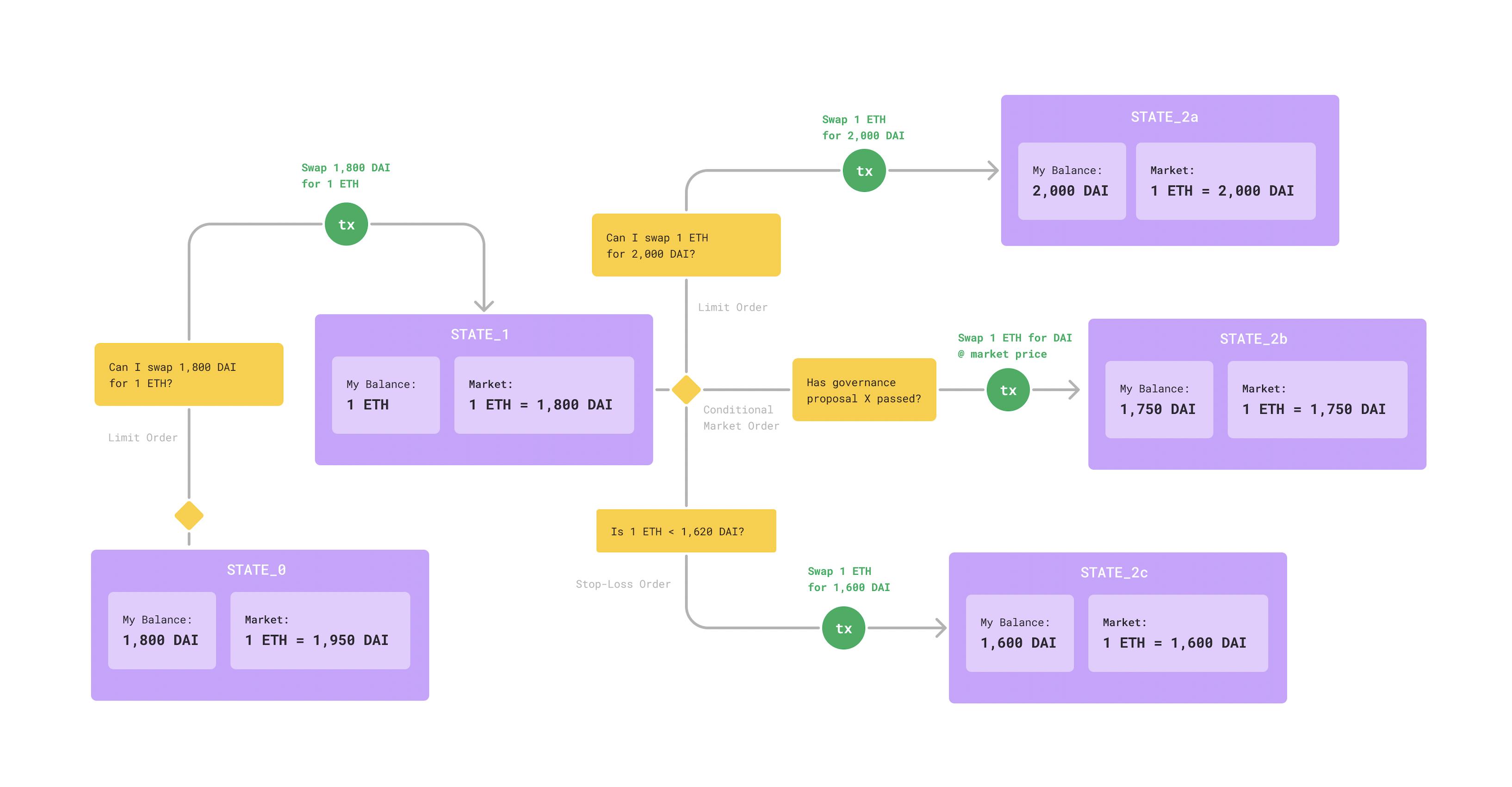
This is a relatively simple three-step order with some conditional triggers, but as you can imagine, such orders could become far more complex.
Intent Graphs
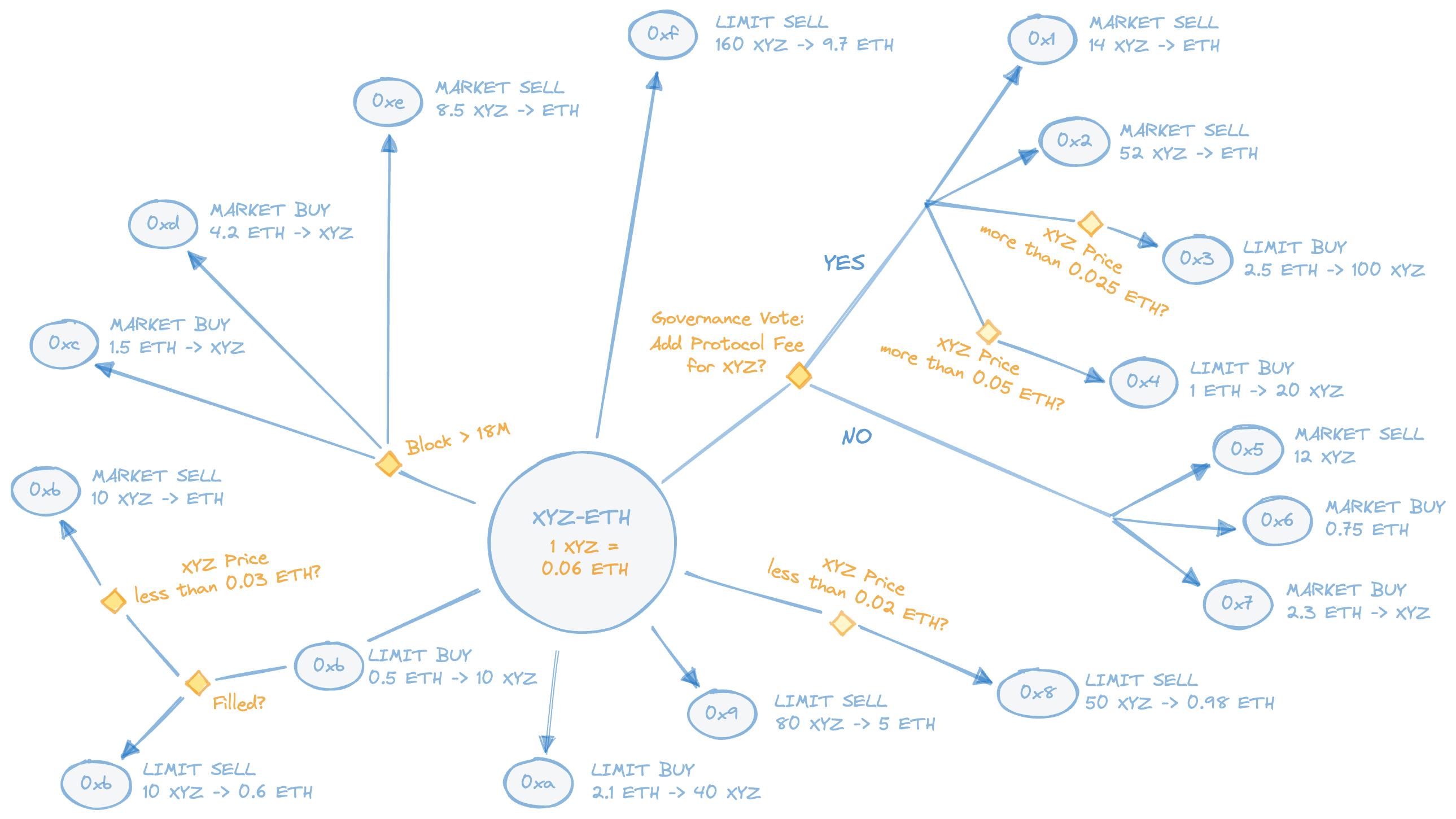
Relationships between user intents can form intent graphs. These graphs represent groupings of user-defined conditions and actions that lead to swaps, asset transfers, or other on-chain operations. All previous intent examples are essentially just named variations of specific graph configurations.
Just as a limit order book represents the current state of market liquidity, intent graphs can represent not only current states but also many different potential future states of conditional liquidity.
Consider an example: In a fictional market where users trade XYZ and ETH, users express intents to buy and sell XYZ under various conditions—such as governance proposal outcomes, mining of specific blocks, increases or decreases in market prices, or whether other intents have already been fulfilled.
Conclusion
Intents are advancing rapidly, with new developments emerging daily. Here are some useful resources:
Join TechFlow official community to stay tuned
Telegram:https://t.me/TechFlowDaily
X (Twitter):https://x.com/TechFlowPost
X (Twitter) EN:https://x.com/BlockFlow_News
 @BrinkTrade











