








Interpreting Binance Research's L2 Market Report: Evolution Trends and Analysis of Key Players in the L2 Sector
TechFlow Selected TechFlow Selected
Interpreting Binance Research's L2 Market Report: Evolution Trends and Analysis of Key Players in the L2 Sector
The L2 ecosystem has made significant progress in enhancing industry scalability, efficiency, and usability.
 Navigating Web3 tides with focused insights
Recently, Layer 2 (L2) solutions have surged in number, intensifying market competition.
Almost every chain claims to offer low cost and high efficiency. Many are adopting modular designs, enhancing scalability, and moving toward building Layer 3 (L3) networks.
What kind of L2 do we need? What are the distinguishing features among current L2 projects, and what developments are underway? And in the future, what new trends might emerge in the evolution of L2s?
Binance Research previously released a report titled "The L2 Evolution," offering detailed answers and forward-looking insights on these questions. The report analyzes the complexities of different L2 approaches, evaluates their current market positions, and dives deeper into potential new directions emerging within the L2 landscape.
Given the report's length, TechFlow has summarized and interpreted it to help readers quickly, systematically understand the state of various L2 projects and anticipate future opportunities.
Key Summary:
-
L2s are evolving new trends including Superchain, L3, and Hyperchain. These advancements are being adopted across multiple L2 platforms and could become the foundation for the next generation of Ethereum scaling—simplifying development, enhancing security, and increasing interoperability across the ecosystem.
-
Optimism’s OP Stack is advancing toward a Superchain with high interoperability; the Bedrock upgrade marks an initial step toward realizing this vision.
-
Arbitrum is also at the forefront of Ethereum scaling, developing L3 networks via Arbitrum Orbit—an open framework enabling permissionless deployment of customized chains atop Arbitrum L2.
-
zkSync has introduced Hyperchain—a set of customizable, trustless interconnected blockchains designed for ultra-scalability, improved composability, and enhanced security.
-
StarkWare is developing a multi-layered solution, exploring L3s for customized scaling while leveraging L2 for general-purpose scaling.
-
Polygon 2.0 aims to create a “value layer for the internet” by unifying its suite of L2 solutions, including Polygon PoS, Supernets, and zkEVM.
Market Background
-
Scalability remains a core challenge for Ethereum, which itself struggles to scale to internet-level capacity.
-
Current L2 solutions still face limitations and may not be optimal for all applications. They either sacrifice scalability or increase dependency risks tied to specific ecosystems.
-
Cross-chain interoperability remains a pain point. Existing cross-chain bridges are fragile and frequently targeted by attacks.
-
The next stage of L2 development must simplify Rollup deployment and lower barriers for developers. The goal is “one-click” Rollup deployment—making it as easy as creating a webpage.
-
Currently, each Rollup chain needs to build its own infrastructure, leading to resource waste and high fragmentation. New Rollup models can enable shared infrastructure and interoperability, reducing redundancy.
-
Emerging examples include OP Chains, Arbitrum Orbit, and hyperchains on zkSync.
Key Player 1: Optimism and OP Stack
-
Optimism is the team behind OP Mainnet, an EVM-compatible optimistic rollup launched in December 2021 and one of the leading Ethereum L2 solutions. As of June, OP Mainnet’s total value locked (TVL) exceeded $2.2 billion, giving it the second-largest market cap among Ethereum L2s and over 23% market share.
-
In October 2022, Optimism launched the OP Stack, described as a “modular, open-source blueprint for highly scalable, highly interoperable blockchains.” This marked an evolution in Optimism’s design and vision for Ethereum scalability beyond just operating its own optimistic rollup.
-
The OP Stack introduces the concept of “Hyperchain”—a network of highly integrated and unified L2 blockchains built using the OP Stack.
-
Optimism’s latest advancement in this phase was migrating its flagship L2 rollup to Bedrock—the first official version of the OP Stack—delivering numerous operational and user experience improvements.

OP Stack Explained
-
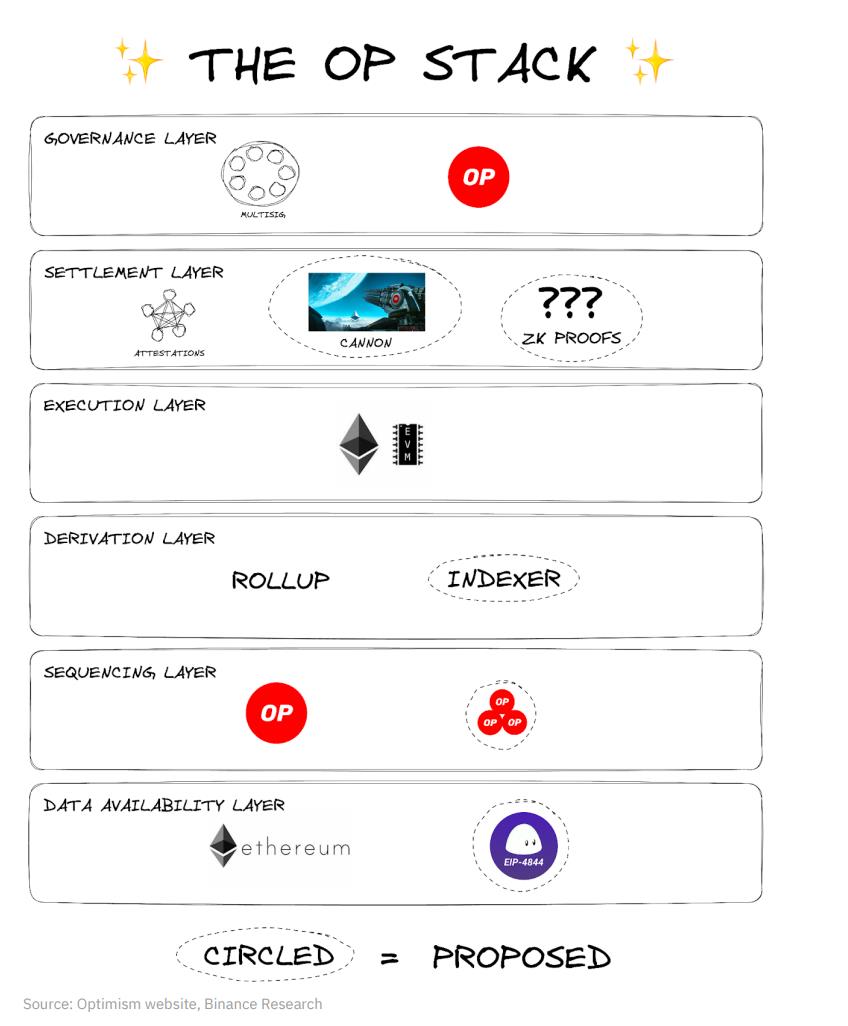
The OP Stack is a standardized, shared, and open-source development stack powering OP Mainnet. It consists of software components that make up Optimism’s L2 rollup and can be used to create a network of L2 blockchains that share resources, interoperate, and coordinate.
In essence, the OP Stack aims to simplify the creation of L2 blockchains—it can be seen as a “build-your-L2” supermarket.
-
Key components are as follows:
-
Data Availability Layer: This layer defines where raw inputs for OP Stack chains are published. Most OP Stack modules use Ethereum’s data availability layer, which is used by the OP Mainnet rollup.
-
Sequencing Layer: This determines how transactions on OP Stack chains are collected and published to the data availability layer. Currently, the OP Stack uses a single sequencer setup. Future proposed upgrades will introduce multiple sequencers to enhance decentralization.
-
Derivation Layer: This defines how raw data from the data availability layer is processed into inputs sent to the execution layer. It is tightly coupled with the data availability layer because it must parse raw data from there.
-
Execution Layer: This defines the state of the OP Stack chain and how it changes upon receiving inputs from the derivation layer. The current execution module used in OP Stack is a slightly modified version of the EVM.
-
Settlement Layer: Traditionally responsible for asset withdrawals from the blockchain by proving the target chain’s state and processing withdrawals accordingly. More broadly, for OP Stack, the settlement layer enables third-party blockchains to observe and build views of OP Stack chain states.
-
Governance Layer: This refers to the tools and processes used to manage upgrades, design decisions, and system configurations. Compared to other layers, this is more abstract and can encompass various mechanisms.
-
Benefits of OP Stack:
-
Scalability: The OP Stack code is designed for reuse and extension by other builders. Thus, it is open-source and typically modular.
-
Simplicity: They strive to keep their code as simple as possible and prefer reusing battle-tested existing code.
-
Understandability: Existing Ethereum developers can relatively easily build on the OP Stack.
-
Client Diversity: Multiple client implementations are possible across the OP Stack.
Benefits of the Bedrock Upgrade
-
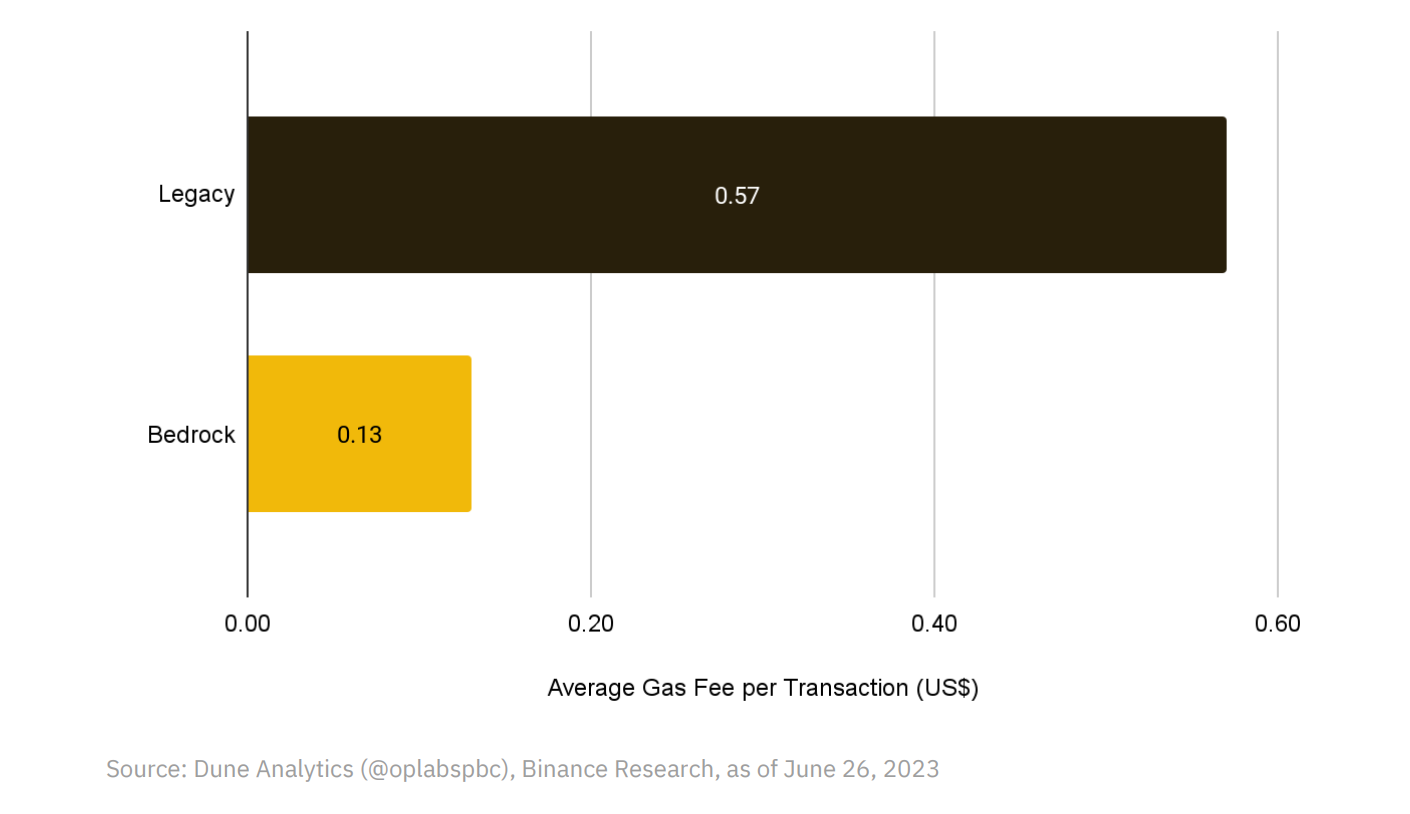
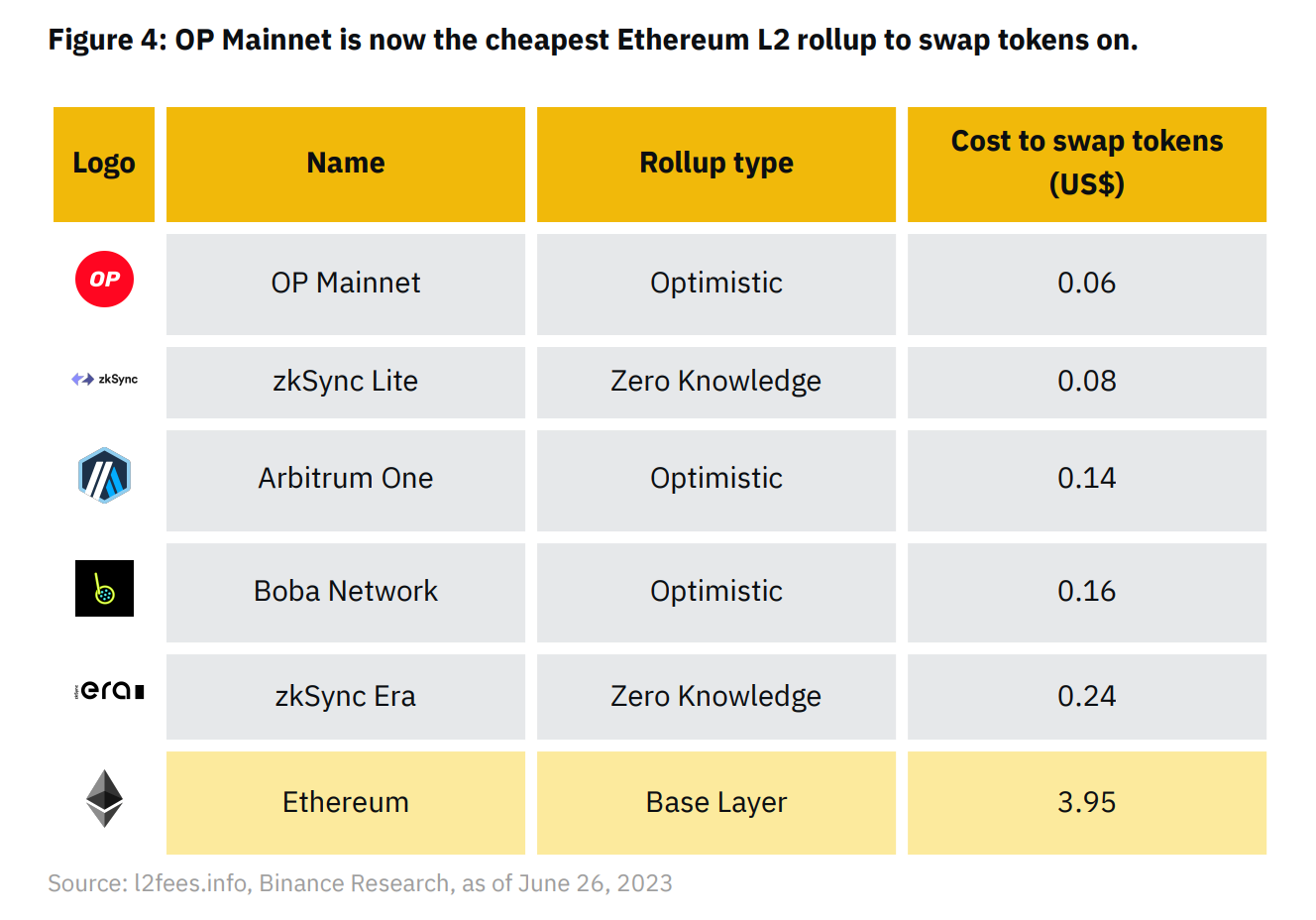
Lower Fees: Bedrock implements optimized data compression strategies to minimize data costs. Average transaction fees have dropped by over 77%. This makes Optimism’s L2 rollup now the cheapest Ethereum L2.
-
Improved User Experience: Especially beneficial for users less familiar with or experienced in using L2 rollups.
-
Enhanced Proof Modularity: Bedrock abstracts the proof system from the OP Stack (specifically in the settlement layer shown in Figure 2), allowing OP Stack chains to use either fraud proofs or validity proofs (i.e., ZK-proofs) for transaction validation. Notably, an RFP is already underway to build a ZK validity prover for the OP Stack.
-
Improved Node Performance: Bedrock allows multiple transactions to be executed within a single rollup “block,” replacing the previous “one transaction per block” model. At current transaction volumes, this reduces annual state growth by approximately 15GB.
-
Summary: The OP Stack helps decompose the components required to build an L2 chain. Bedrock is the first implementation of this software. Keyword: Modularity.
Optimism’s Superchain Architecture
-
Following the Bedrock upgrade, Optimism’s next step is to evolve into a Superchain.
-
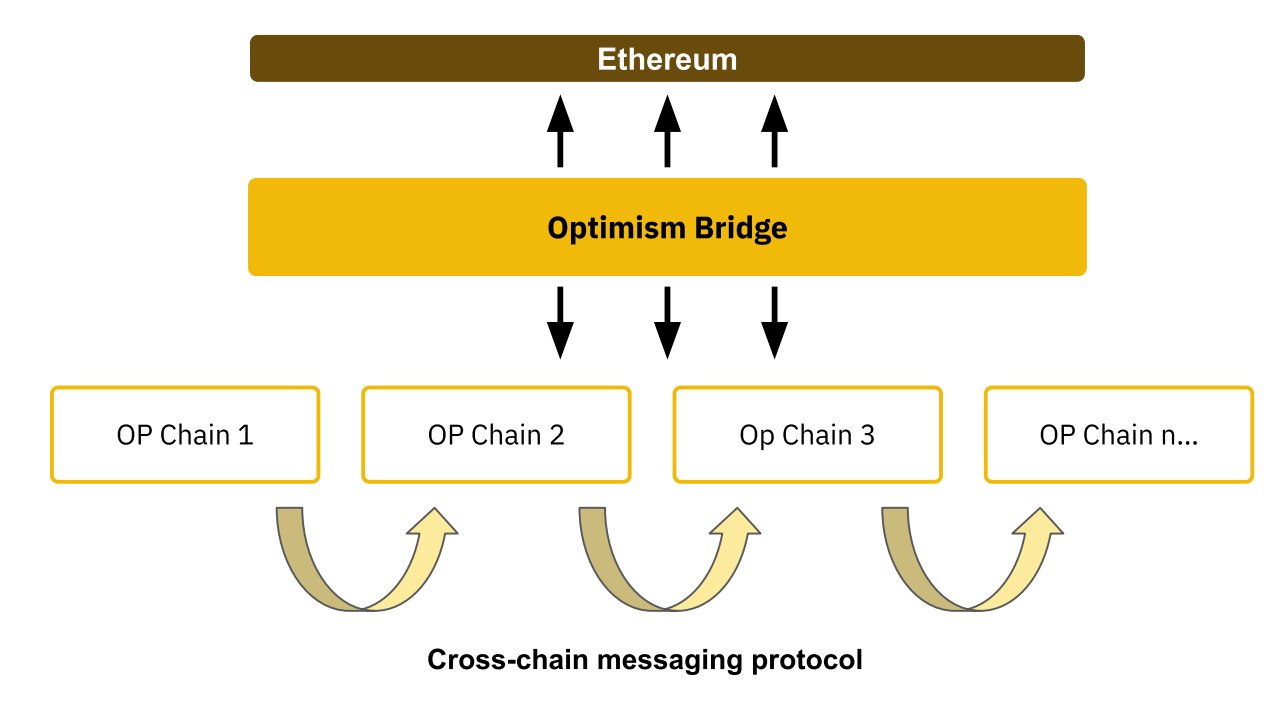
The Superchain is envisioned as a decentralized network of L2 chains (called OP Chains) that share security, a communication layer, and an open-source technology stack (the OP Stack).
-
These chains will be standardized, intended to function as interchangeable resources. This standardization will allow developers to build applications targeting the Superchain as a whole, rather than just the underlying individual chain.
-
Benefits of Superchain:
-
Robust and Secure Codebase: As the number of chains grows, each contributes to and shares the same modular, standardized codebase, strengthening the overall system.
-
Atomic Cross-Chain Composability: Transactions can occur seamlessly and simultaneously across different OP Chains without requiring bridges or intermediaries.
-
Unified Ethereum Infrastructure: Enables existing Ethereum developers to seamlessly transition to building OP Chains.
-
Projects joining Optimism:
-
Optimism’s L2 rollup chain post-Bedrock is the first member of the Superchain.
-
Coinbase’s Base L2 will be the second member, launching on mainnet this year.
-
Worldcoin has committed to building on the OP Stack.
-
Conduit aims to make it easier for developers to launch their own OP Stack rollups, eventually becoming part of the Superchain.
-
Aevo, a decentralized options exchange, recently partnered with Conduit to launch its rollup based on the OP Stack, with Conduit operating the Aevo rollup sequencer.
-
BNB Chain has announced the testnet for opBNB, its EVM-compatible L2 chain built on the OP Stack.
-
In the NFT space, the decentralized NFT marketplace Zora recently launched Zora Network—a L2 based on the OP Stack aimed at making NFTs cheaper and more accessible. Their documentation notes minting costs below $0.50 and confirmation within seconds.
Key Player 2: Arbitrum Orbit
Since its launch in August 2021, Arbitrum has become the largest and dominant L2 network, with TVL exceeding $5.9 billion and over 60% market share.
Arbitrum Ecosystem Products:
-
Arbitrum One: The first and core mainnet Rollup of the Arbitrum ecosystem.
-
Arbitrum Nova: Arbitrum’s second mainnet Rollup, targeting cost-sensitive projects with high transaction volume requirements.
-
Arbitrum Nitro: The technical software stack powering Arbitrum L2, enabling faster, cheaper, and more EVM-compatible Rollups.
-
Arbitrum Orbit: A development framework for creating and deploying L3s on top of Arbitrum mainnet.

What is Layer-3?
-
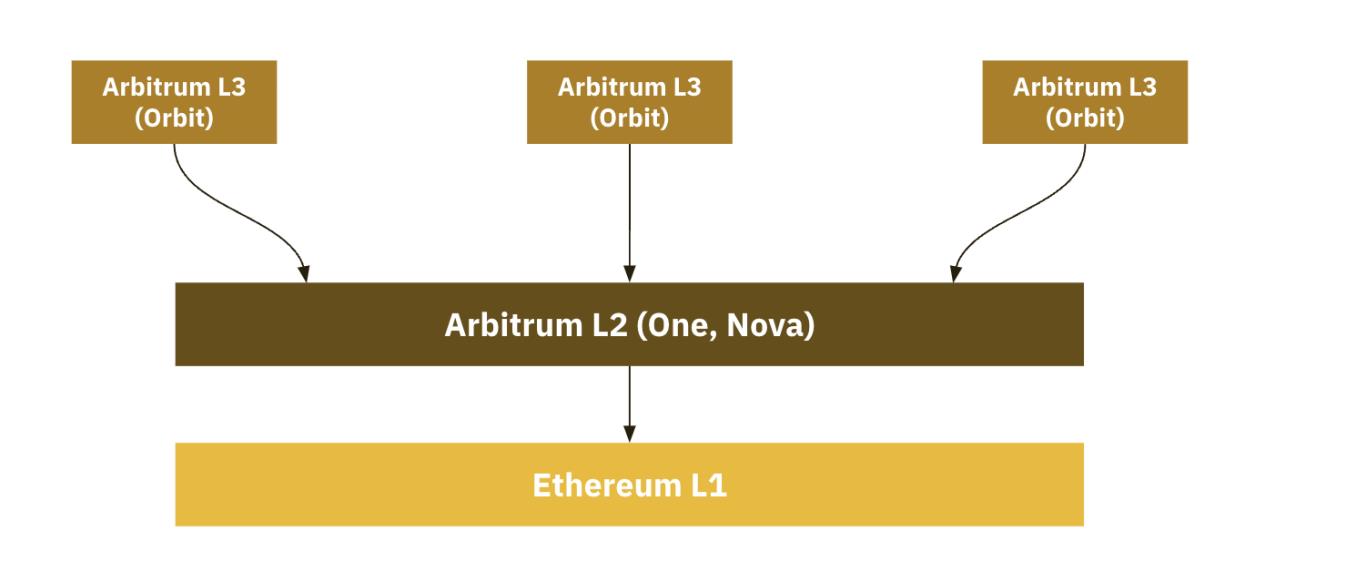
L3 networks, sometimes called app-chains, are specialized networks built on top of L2s, each hosting smart contracts supporting specific dApps.
-
The simplest way to understand L3s is to think of them as Rollups for L2s—they settle on L2 instead of L1.
Where Arbitrum Orbit Fits In
-
Orbit is a permissionless development framework allowing anyone to deploy L3 chains atop Arbitrum L2.
-
Through Orbit, Arbitrum intends to support protocols launching their own L3 chains for the following use cases:
-
Layer-3 Rollup: Launching L3 Rollup chains similar to Arbitrum One.
-
Layer-3 AnyTrust: Launching L3 AnyTrust chains similar to Arbitrum Nova.
-
Customizable Layer-3: Deploying application-specific L3 chains on Arbitrum L2 using Arbitrum Nitro. This includes components such as privacy, permissions, fee tokens, governance, etc.
-
-
Summary: Through this solution, Arbitrum aims to attract developers seeking greater control and customization, allowing them to freely fork and modify Arbitrum’s source code to meet their specific needs—and even brand their solutions as “custom chains.”
Key Player 3: zkSync and Hyperscaling
-
zkSync Era, Matter Labs’ zkEVM rollup, has become one of the most widely used L2 and zkEVM solutions since its mainnet launch, with TVL exceeding $625 million.
-
Ultra-scalability is its ultimate ambition: handling an infinite number of transactions without compromising security or decentralization.
-
To meet growing Web3 demands, zkSync has designed its ultimate solution around the concept of Hyperchain.
-
The zkSync architecture aims to integrate a network of Hyperchains, all anchored to a basechain.
Hyperchain
-
Hyperchain represents zkSync’s vision for L3—a broad ecosystem of trustless, customizable, interconnected blockchains.
-
Implementation uses a modular approach, providing developers with a Hyperchain Software Development Kit (SDK) framework to choose or develop various components for their blockchain.

Benefits:
-
Security: Hyperchain will overcome typical vulnerabilities associated with non-native bridges, which often lead to hacks. Interactions between fractal Hyperchains in zkSync’s L3 will occur through native bridges, further enhancing security.
-
Performance: Implementing Hyperchain architecture and achieving hyperscaling improves L3 performance.
-
Cost: Data fees are significantly reduced due to data availability solutions.
-
Usability: zkSync anticipates major enhancements to the SDK, including low-code and no-code solutions, simplifying application development.
-
Composability: The system’s LLVM compiler supports Solidity and any modern programming language, improving accessibility for developers using Rust, C++, Swift, etc.
Hyperscaling Theory
-
A hyperscalable blockchain system involves multiple ZK chains (or hyperchains) running in parallel, with block proofs aggregated and settled on L1. Theoretically, this could involve an infinite number of hyperchains representing the entire system.
-
This process relates to a concept first introduced by StarkWare called fractal scaling—a multi-layered network where application-specific L3s are recursively built on L2.
-
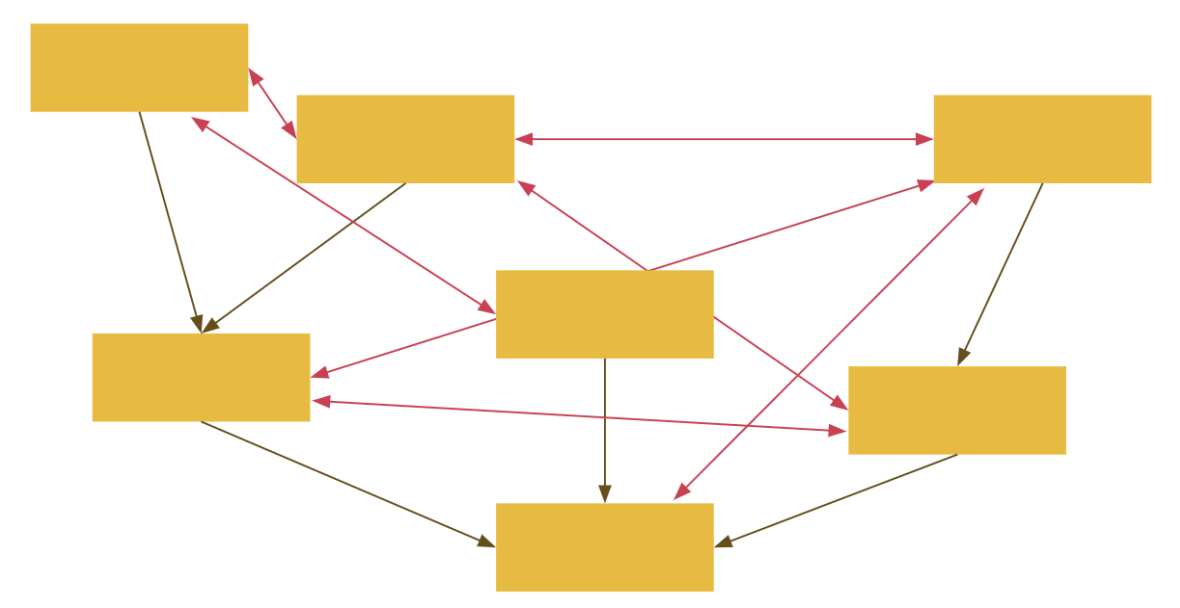
Hyperscaling advances this further by introducing hyperbridges—native bridges connecting each L3 app chain. This allows transfers between hyperchains without consuming resources on a third chain and ensures the basechain does not become a central scalability bottleneck, maintaining the principle of parallel hyperscaling.
As shown in the figure, without hyperbridges, fractal scaling could make the basechain the primary junction for most transfers over time, potentially becoming a scalability obstacle.

With hyperbridges, transferring from one hyperchain to another becomes as simple and cost-efficient as a regular transfer—much like hyperlinks allow seamless navigation from one webpage to another with a single click, eliminating the need for additional routing through intermediate layers.
Key Player 4: StarkWare and Fractal Scaling
-
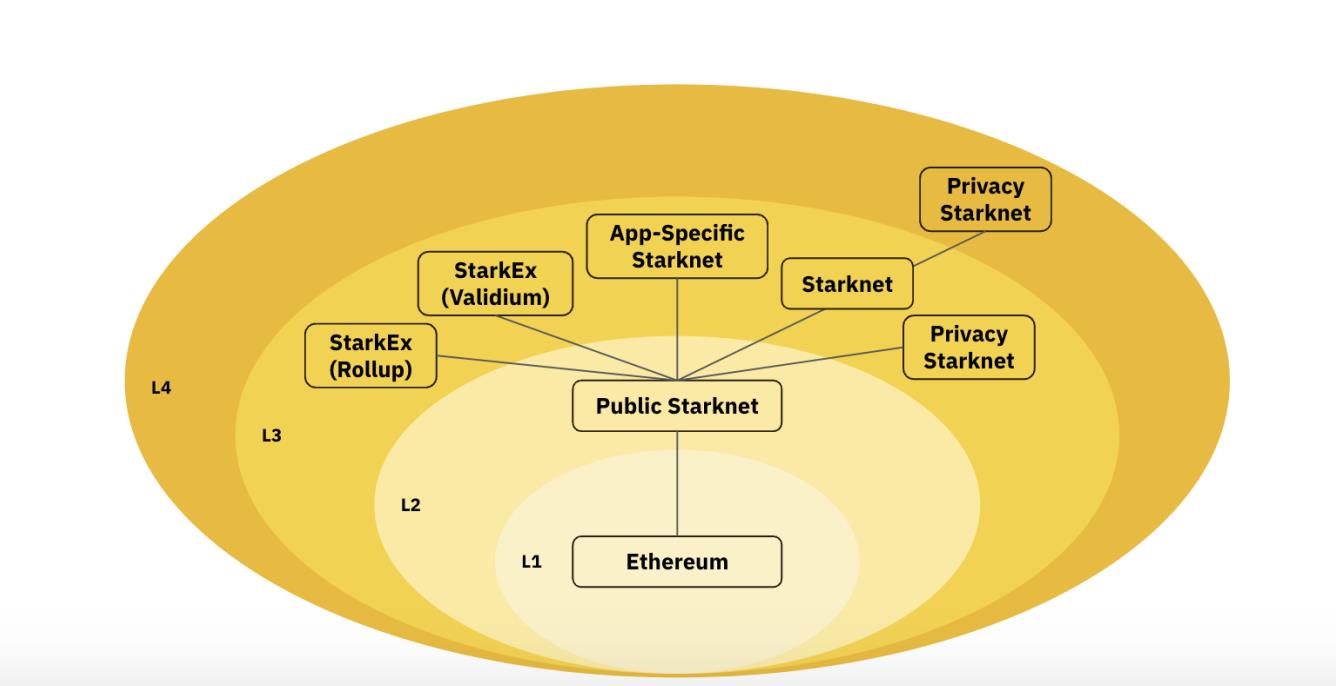
StarkWare proposes a multi-layered network where L2 is used for general-purpose scaling and L3 for customized scaling.
-
StarkWare’s concept of fractal scaling may have inspired other L2 projects to explore Ethereum scaling.
-
Slush is developing an SDK for building zkVM L3s on Starknet.
-
StarkWare launched Recursive STARKs—a technology enhancing L2 scalability by bundling multiple transaction proofs into one.
-
This technology relies on the Cairo programming language and SHARP, which aggregates transactions from multiple apps into a single STARK proof.
-
StarkWare aims to optimize cost, latency, and computational resources to support L3 development on the public Starknet network.
Key Player 5: Polygon 2.0
-
Background:
-
Polygon’s L2 solutions handle about 2–3 million transactions daily, with 300,000–400,000 consistently active addresses.
-
Polygon has also launched its own app-chain solution called Supernets, enabling developers to create customized app-chains.
-
Core of Polygon 2.0:
-
Aims to unify Polygon’s various platforms into a seamless user interface.
-
As a collection of ZK-powered L2 chains, Polygon 2.0 employs a unique cross-chain coordination protocol.
-
The network can accommodate an unlimited number of chains, ensuring secure and instant cross-chain interactions.
-
Key Points:
-
Interoperability: Polygon 2.0 aims to enable smooth movement and interaction across multiple blockchains using ZK proofs.
-
Security: Aims to enhance security and privacy through zero-knowledge technology and existing PoS mechanisms.
-
Scalability: The Polygon team is building Polygon 2.0 to support “an effectively infinite number of chains.”
-
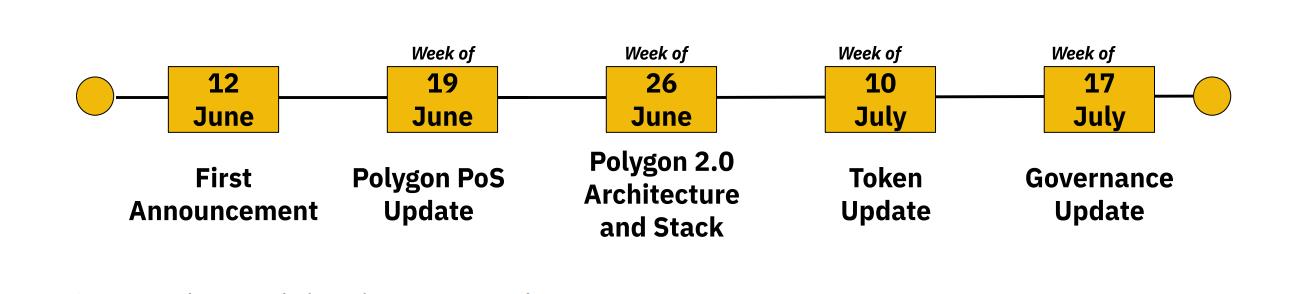
Latest Updates and Timeline:
-
The Polygon PoS sidechain is currently secured by its own validator set rather than ZK proofs, but the vision for Polygon 2.0 is that every Polygon chain should be a ZK L2.
-
User and developer experience won’t change during this transition. Polygon PoS will continue operating normally, only becoming more secure with added ZK proofs.
-
If initial proposals gain support, the Polygon team expects to launch the zkEVM validium mainnet by Q1 2024.
-
Conclusion: Given Polygon’s strong performance on its PoS sidechain and successful deployment of its zkEVM solution, this new vision holds significant promise and could bring interesting enhancements to the broader L2 ecosystem.
L2 Market Comparative Overview
-
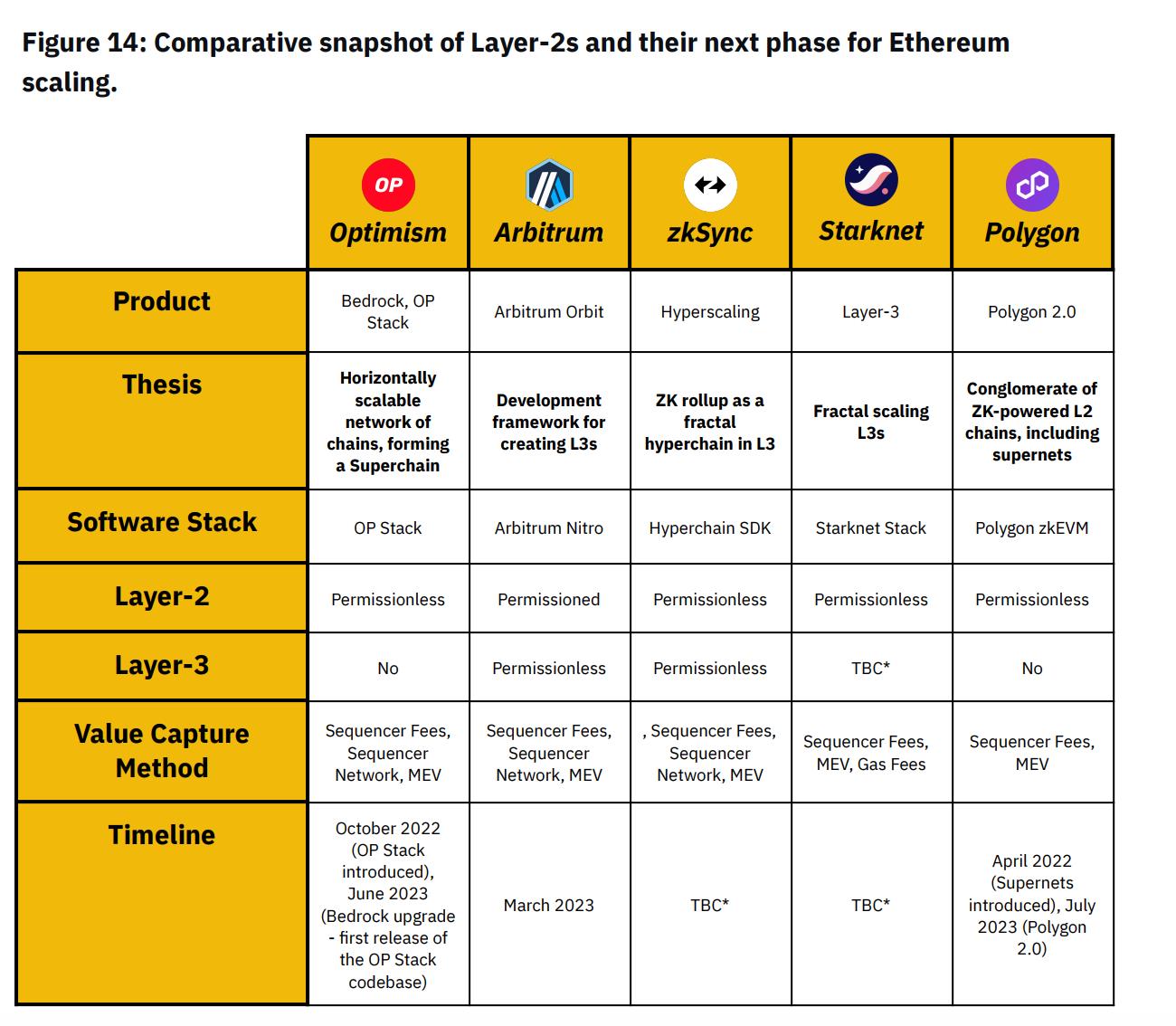
The L2 market is dynamic and competitive, with each network bringing its unique perspective—despite commonalities, notable differences exist.
Key characteristics of major projects:
-
Optimism: Differentiates itself through its Superchain vision. It offers a fully open-source framework, though this may lead to fragmentation of liquidity and users across other OP Stack-based rollups.
-
zkSync: Shares some overlap with Optimism but differs in execution strategy from both Optimism and Arbitrum.
-
Arbitrum: Offers a permissionless platform for creating L3 chains, though it still requires DAO approval to use Arbitrum’s IP for launching L2s.
-
Starknet: Adopts a multi-layered structure using fractal scaling for L3s.
-
Polygon: Chooses a more integrated model, combining its L2 offerings into a unified suite.
Despite differing visions, the core focus of these L2s is customization and application-specific chains.

Subtle differences among L2s can be illustrated in the table below:
Finally, regardless of technical similarities or differences, L2s must consider the following factors to determine how projects accumulate value within their respective ecosystems:
-
Software Customizability: How easy it is to copy code and build on the L2 will be a key differentiator. Projects building on L2s will likely seek specific modifications and may invest resources to fund these customizations. The L2 software stack best able to accommodate such needs will undoubtedly hold a competitive advantage.
-
Transaction Fees and Sequencers: Sequencers bear significant responsibility and operational costs in maintaining infrastructure and cloud services, and should be fairly compensated through user-paid transaction fees.
-
Role of Governance Tokens: As the trend shifts toward decentralization, the functionality of L2 governance tokens becomes increasingly important. Most rollups will likely require token staking to participate in shared sequencer networks.
Conclusion and Reflection
-
The L2 ecosystem has already made significant progress in enhancing industry scalability, efficiency, and usability.
-
The industry is actively exploring the next stage of L2 evolution, resulting in diverse visions and approaches. Despite differing perspectives, the shared goal is infinite scalability—hoping the Web3 world can scale as seamlessly as Web2.
-
Currently, this field remains in its early stages, and specific methods and practices have yet to be fully established.
Join TechFlow official community to stay tuned
Telegram:https://t.me/TechFlowDaily
X (Twitter):https://x.com/TechFlowPost
X (Twitter) EN:https://x.com/BlockFlow_News
 Binance Research






