LSD Sector Analysis: With Many Competitors Emerging, Why Is Lido Still the Favored Player?
TechFlow Selected TechFlow Selected
LSD Sector Analysis: With Many Competitors Emerging, Why Is Lido Still the Favored Player?
Compared to other protocols with cyclical businesses, liquid staking protocols should command higher valuation multiples.
 Navigating Web3 tides with focused insights
Author: Arthur0x
Translation: TechFlow
Summary
-
Liquid staking is one of the few areas in crypto where protocols have achieved a unique product-market fit by addressing capital efficiency issues faced by token holders on proof-of-stake (PoS) blockchains. This has led the sector to hold the largest total value locked (TVL) in decentralized finance (DeFi), at $22 billion. As long as capital inefficiency persists on PoS chains, there will be sustained demand for liquid staking solutions.
-
The liquid staking market scales with the growth of the chains it serves. Today, liquid staking protocols across the top five smart contract chains generate over $800 million in annual revenue. Moreover, due to its widespread utility and non-volatility, this sector exhibits higher-quality profitability than other DeFi sectors.
-
Lido is well-positioned to capture industry growth, thanks to strong network effects built around stETH, a proven track record of reliability, and adoption of decentralized validator technologies such as SSV and Obol.
-
We believe that Lido's revenue has the potential to triple in the medium term, driven primarily by: 1) increased Ethereum market cap, 2) rising ETH staking ratio post-Shanghai upgrade, 3) growing market share of decentralized liquid staking protocols, and 4) Lido’s continued dominance.
Liquid staking protocols have achieved strong product-market fit by solving capital efficiency problems faced by proof-of-stake participants.
Today, leading smart contract chains by TVL operate on PoS or variants of PoS—such as delegated proof-of-stake, proof-of-authority, etc.

These blockchains allow users to stake their tokens in exchange for rewards that enhance network security. However, staked tokens typically face an unstaking period, which varies by protocol and often lasts from several days to weeks. This creates a key capital efficiency issue for stakers.
Liquid staking protocols emerged to solve this problem by allowing users to stake their tokens and receive a receipt token representing their claim on the staked assets and corresponding staking rewards. This receipt token can be freely transferred and used across DeFi activities such as trading, liquidity pools, and lending.
Most importantly, liquid staking protocols offer stakers two key value propositions—1) yield generation and 2) liquidity of staked assets—together resolving the capital efficiency challenge. As a result, the liquid staking sector holds $22 billion in TVL, making it the highest TVL segment in DeFi.

We believe this product-market fit is unique to the liquid staking sector—as long as PoS-type chains remain popular, capital inefficiency will persist, creating long-term demand for liquid staking solutions.
Liquid staking protocols provide a sustainable revenue stream for a large market.
From a macro perspective, the potential size of liquid staking revenue is determined by four growth drivers: market cap of L1 tokens, L1 staking ratio, staking yield, and market share of staking providers.
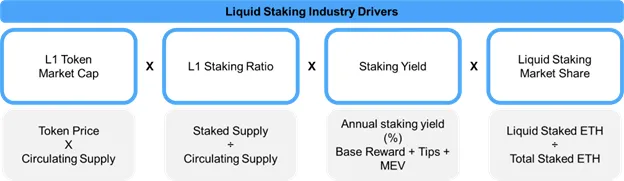
Together, these drivers have created an industry generating hundreds of millions in annual revenue. The top five PoS smart contract platforms alone generate $893 million in annual rewards that flow to liquid staking protocols.
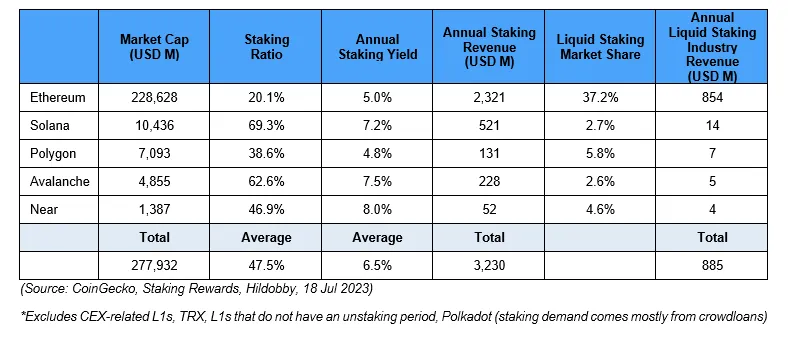
Moreover, compared to other blockchain applications, this revenue stream is of higher quality due to its recurring nature. For example, decentralized exchange (DEX) revenue is cyclical and highly dependent on market conditions. In general, DEX volumes are high during bull markets and decline during bear markets, resulting in unstable protocol-level revenues. Unfortunately, this is also true for many other blockchain applications—NFT marketplace revenues fall during NFT bear markets, and money market revenues decline as leverage demand drops. Therefore, we believe the stable revenue source of the liquid staking sector is an often-overlooked advantage in a volatile and reactive market.
The quality of this sector’s revenue can be easily illustrated by comparing monthly revenues of Uniswap and Lido, the leader in liquid staking. Uniswap’s monthly revenue peaked twice—May and November 2021—in line with market tops. Subsequently, during the ensuing bear market, monthly revenue gradually declined as trading volume and liquidity decreased.

In stark contrast, Lido’s revenue has remained stable over the past few years without major fluctuations. This reflects the stability of staking income—as long as the blockchain continues to operate, liquid staking protocols will continue generating revenue regardless of market sentiment. We believe a key implication is that liquid staking protocols deserve higher valuation multiples compared to other protocols with cyclical businesses.

Lido is currently the market leader in liquid staking, with nearly $15 billion in TVL. In fact, it is the DeFi protocol with the highest TVL across all chains. Lido’s ETH receipt token, stETH, is also the most liquid staked ETH token and has the greatest composability. We are confident that Lido will continue to grow and leverage its established network effects to consolidate market share.
When evaluating the strengths of specific liquid staking protocols, we consider two additional factors—1) market share and 2) fee take rate on staking rewards. In the following sections, we will explain the rationale behind each growth driver and how they contribute to Lido’s ongoing success.

1. Growth in L1 Token Market Cap
Lido benefits from the growth of the underlying L1 chains it serves, as its USD-denominated TVL is linearly correlated with the price of these L1 tokens. Currently, Lido actively serves three chains—Ethereum (98.9% of TVL), Polygon (0.7%), and Solana (0.4%). If these chains continue to grow, their tokens should reflect these fundamentals. Therefore, even if token-denominated TVL remains flat, Lido’s USD-denominated TVL will continue to expand.
Notably, Ethereum’s growth has a massive impact on Lido’s fundamentals. Ethereum is by far the largest smart contract L1, with a market cap six times that of BNB Chain and 23 times that of Solana. ETH also constitutes the vast majority of Lido’s TVL.
In this regard, we are particularly bullish on Ethereum’s long-term prospects. We have witnessed successful major protocol upgrades, including London (EIP-1559—improving transaction fee UX and ETH tokenomics), Paris (PoS—reducing energy consumption and laying groundwork for scalability), and Shanghai/Capella (ETH withdrawals). From an adoption standpoint, Ethereum remains the preferred platform for secure L1 DeFi activity, with applications like Aave and Uniswap enabling seamless trading and lending. It also continues to serve as the secure settlement layer for numerous scaling solutions—from zkRollups (Polygon zkEVM, zkSync, Starknet) to Optimistic rollups (Arbitrum, Optimism)—enabling cheap and fast transactions while contributing to ETH transaction fees. Thus, we believe Lido will materially benefit from this native advantage.
Additionally, we view Lido’s multi-chain operations as a call option on the growth of alternative L1s. We believe developers and users have diverse needs that can be met by different chains. From Lido’s perspective, serving these chains is a prudent move toward decentralized business diversification.
2. Growth in L1 Staking Ratio
We believe Ethereum’s staking ratio will continue to rise, especially following the successful Shanghai/Capella upgrade. When Ethereum first introduced staking on the Beacon Chain, early stakers faced uncertainty about technical feasibility and withdrawal timelines, resulting in a relatively low staking ratio compared to other PoS chains. With the completion of the Shanghai/Capella upgrade, this risk factor has been largely mitigated, becoming a key catalyst for staking ratio growth. Indeed, ETH’s staking ratio has steadily increased from around 15% at the time of the upgrade to approximately 20% today.
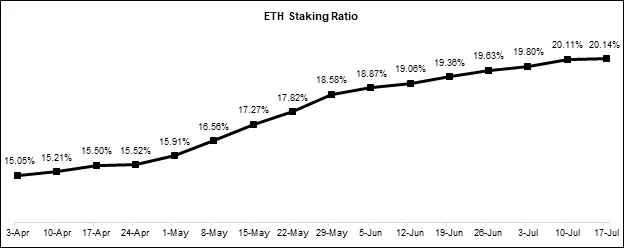
We expect this growth in staking ratio to benefit the liquid staking sector, as although staking risks have decreased, users still face the same capital efficiency challenges. By converting into Lido’s stETH, ordinary ETH holders—who make up the bulk of ETH supply—can now earn real yield on ETH while retaining most of its on-chain composability.
3. Growth in Staking Yield
We acknowledge that, all else equal, staking yields compress as the staking ratio increases. However, current levels of on-chain activity are dwarfed by historical bull market highs. Any increase in on-chain activity on Ethereum—such as NFT mints or surges in decentralized exchange volume—will drive up transaction fees and MEV. This will help offset the compression of base rewards and contribute to the stability of Lido’s revenue.
4. Growth in Liquid Staking Market Share
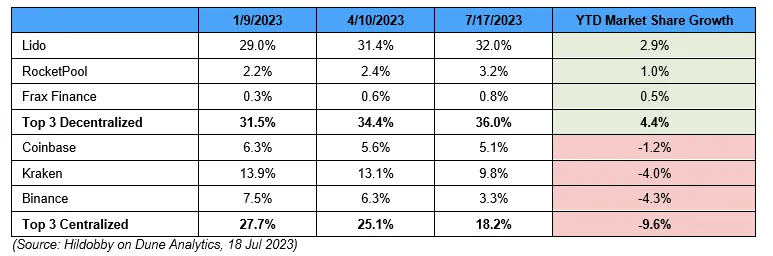
We expect the liquid staking sector to benefit as centralized staking providers face increasing regulatory scrutiny. To date, the top three centralized staking providers have relinquished 9.6% of market share, which has been partially absorbed by their decentralized counterparts. Notably, Lido has been the biggest beneficiary of this trend, gaining 2.9% in market share. We believe this indicates that stETH remains one of the top choices for most stakers due to its liquidity and composability within DeFi.
5. Growth in Lido’s Market Share
Driven by industry trends, we believe Lido will continue to dominate market share, thanks to the unique network effects built around stETH. Currently, Lido holds 86% of the liquid staked ETH market, nearly six times that of the second-largest decentralized competitor (rETH).
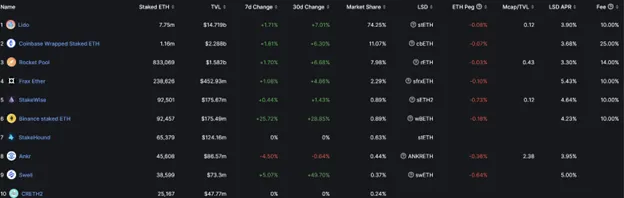
This is due to a power-law dynamic formed around stETH’s liquidity and utility. stETH is the most liquid staked ETH derivative on DEXs. On Ethereum alone, stETH/wstETH liquidity is around $700 million (paired with WETH and ETH), eight times that of rETH. Thus, among all alternatives, Lido best achieves the primary goal of a liquid staking protocol—delivering optimal liquidity to stakers.

With a substantial liquidity base established, stETH’s liquidity moat deepens further as more use cases for the token emerge. One example is using liquid staked ETH as collateral in money market protocols. Liquidity is a critical parameter when assessing an asset’s suitability as collateral—only assets with sufficient depth can efficiently handle liquidations. Unsurprisingly, stETH is the most widely accepted staked ETH derivative as collateral across money market protocols.

6. Lido’s Value Capture
Currently, Lido charges a 5% fee on staking rewards, which flows directly into the DAO treasury managed by $LDO token holders. This allows us to easily estimate Lido’s potential revenue under specific parameters.
Considering all of Lido’s value drivers together, we believe there is significant room for fundamental growth in the medium term. Below, we outline some rough estimates to illustrate Lido’s potential market opportunity.
-
We expect Ethereum’s staking ratio to reach 30% within the next 12 months as users absorb the reduced risk of withdrawals.
-
Under this scenario, staking yield is expected to decline to around 4%.
-
Over time, we also believe liquid staking protocols could capture 50% of the market as users demand capital efficiency for their assets.
-
Furthermore, if ETH returns to its all-time high of $4,000 (a $500 billion market cap), liquid staking on Ethereum alone would imply $3 billion in annual revenue.
-
Assuming Lido’s market share in the Ethereum liquid staking sector increases slightly to 90%, Lido DAO’s annual revenue could reach $135 million at a 5% fee rate.
-
This implies a forward FDV/Revenue multiple of 13.5x given Lido’s current fully diluted valuation of $1.8 billion.

Final Thoughts
Once again, we are optimistic about the outlook for the liquid staking sector, as leading projects deliver unique value propositions to a large and growing market. We have outlined the four key drivers underpinning the sector’s growth and detailed how each metric can expand further.
We have also argued that Lido will continue to dominate market share, driven by the powerful network effects built around stETH, rooted in the token’s liquidity and composability. If our view on the sector’s medium-term growth proves accurate, we have shown that Lido has a fivefold revenue growth opportunity from here.
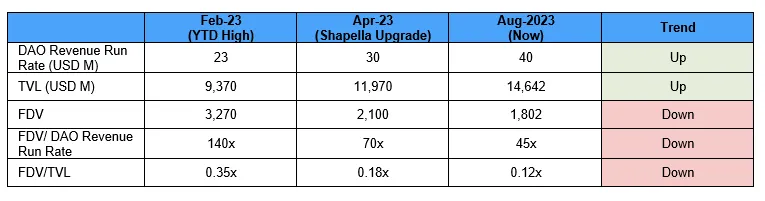
In the short term, the market appears to have moved past the initial hype around Shanghai/Capella. This is evident from Lido’s rising TVL and revenue growth, while valuation multiples have compressed. We believe this divergence between valuation and fundamentals won’t last forever, and LDO now offers some of the best risk-adjusted returns.

Join TechFlow official community to stay tuned
Telegram:https://t.me/TechFlowDaily
X (Twitter):https://x.com/TechFlowPost
X (Twitter) EN:https://x.com/BlockFlow_News
 @DeFianceCapital