








Linea: Backed by ConsenSys, Can It Stand Out in the Competitive L2 Arena?
TechFlow Selected TechFlow Selected
Linea: Backed by ConsenSys, Can It Stand Out in the Competitive L2 Arena?
The Linea zkEVM solution is relatively easier to implement, aiming to improve proof efficiency as much as possible while maintaining EVM compatibility, better supporting Ethereum developers and ecosystem, and rapidly expanding ecosystem traffic.
 Navigating Web3 tides with focused insights
Author: Jill, LD Capital
1. Project Overview
Linea is a Layer2 solution developed by ConsenSys, designed to enhance Ethereum's scalability and efficiency. As a zkEVM, Linea leverages zero-knowledge proofs with EVM equivalence, enabling developers to easily build scalable dapps or migrate existing ones.
1. Team
Linea is a product under ConsenSys, founded in 2014 and headquartered in Brooklyn, New York. The company maintains strong relationships with government institutions (such as the Inter-American Development Bank, European Commission, South African Reserve Bank) and corporate giants (including Microsoft and JPMorgan Chase), and is a leading member of blockchain industry consortia such as the Ethereum Enterprise Alliance.
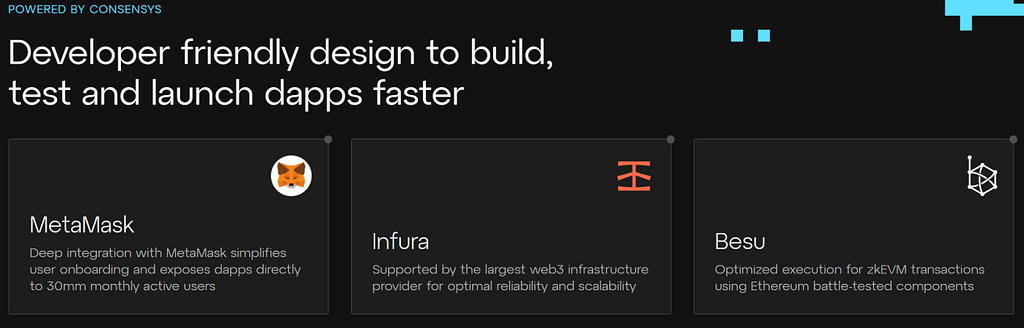
ConsenSys initially operated as a venture capital firm. In 2020, it underwent restructuring, splitting into two entities: ConsenSys Mesh and ConsenSys Software. ConsenSys Mesh focuses on investments, while ConsenSys Software concentrates on blockchain product development. Its flagship products include MetaMask, a native crypto wallet with over 30 million monthly active users—making it the largest crypto traffic gateway in blockchain—and Infura, a blockchain development tool for developers serving more than 400,000 users. This positions ConsenSys as one of the most influential and powerful companies within the Ethereum ecosystem.
MetaMask has since been spun off into an independent entity. However, the Linea team remains part of ConsenSys, which lists 837 employees on LinkedIn. Linea benefits from seamless integration with other ConsenSys products—for example, Linea is pre-configured by default in the MetaMask wallet extension, eliminating the need for users to manually add network settings.
Source:ConsenSys Official Website
2. Funding
Linea itself has not conducted a separate fundraising round. Its parent company, ConsenSys, completed four funding rounds between 2019 and 2022, raising over $700 million. Investors include top-tier crypto-focused firms such as Dragonfly and Coinbase Ventures, as well as traditional financial giants like Microsoft, SoftBank, and Temasek.
Backed by ConsenSys’ rich industry resources and MetaMask’s massive user base, Linea enjoys significant built-in market attention.
2. Technical Implementation
1. SNARK Proof Technology Based on Vortex
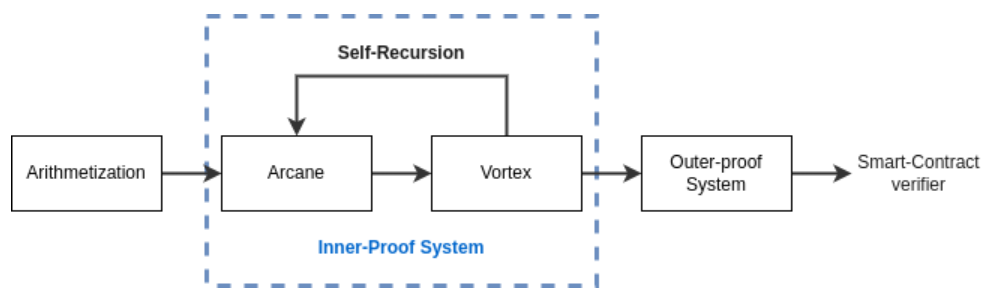
Linea employs SNARK proof technology based on Vortex. Vortex is a polynomial commitment scheme designed specifically for recursive proving systems. It enables batch generation and verification of proofs, significantly improving proving efficiency while ensuring transaction privacy and security.
Source:ethresear.ch
The diagram above illustrates Linea’s internal proving system workflow. To prove transaction validity, Linea begins with Arithmetization—converting computer programs into mathematical expressions understandable by zero-knowledge proofs. This process transforms transactions into execution traces and a set of constraints that verify computational correctness.
Next, Linea uses its internal proving systems—Vortex and Arcane—which recursively reduce proof size through optimized computation and specialized algorithms, continuously enhancing proof efficiency and compactness.
Finally, via recursive optimization within these internal systems, the proof is further compressed into the external proving system gnark, making it verifiable on Ethereum.
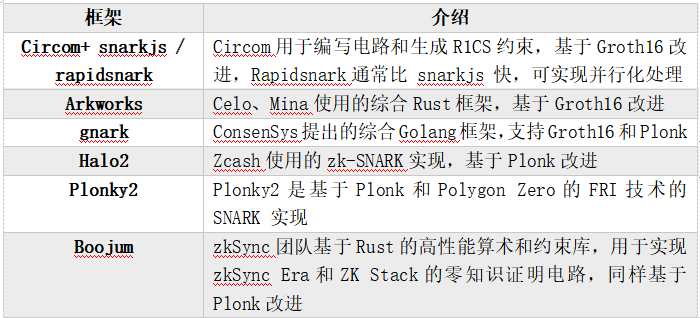
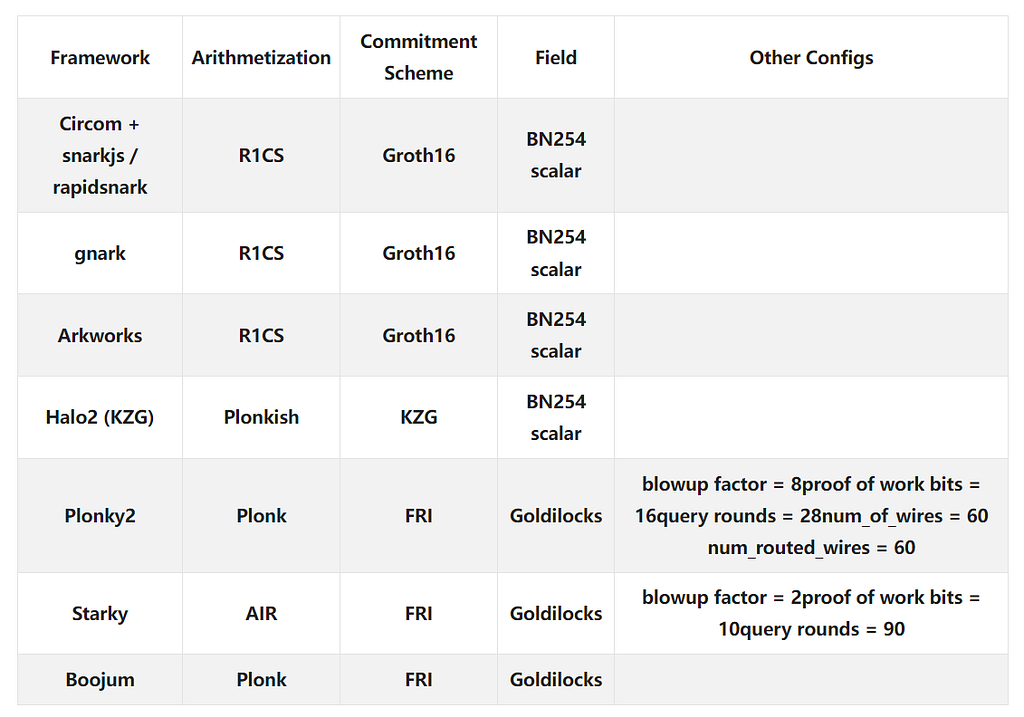
With the surge in zero-knowledge proof projects, key differentiators among SNARK-based projects lie primarily in their choice of Proving Systems. Based on maturity and developer adoption, Pantheon summarizes the following representative frameworks:
Source:Pantheon
Most of the above proving systems are improvements upon Groth16 and Plonk. Pantheon conducted benchmark tests across four metrics—number of constraints, proof generation time, memory load, and CPU utilization—on Linux Server (20-core) and MacBook M1 Pro (10-core) devices. Key findings include:
1) Number of Constraints: The Plonk framework outperforms Groth16; among implementations, gnark has the highest constraint count, while Boojum has the lowest.
2) Proof Generation Time: Groth16 generates proofs faster than Plonk, with gnark being the fastest overall.
3) Memory Load: Differences are negligible.
4) CPU Utilization: gnark and Rapidsnark show the highest CPU utilization on Linux servers, demonstrating excellent parallelization capabilities.
Linea’s use of gnark delivers strong overall performance, particularly excelling in proof generation speed and parallel processing capability.
For full research results, see “The Pantheon of Zero Knowledge Proof Development Frameworks”.
2. zkEVM
zkEVM is a virtual machine compatible with the EVM while also being friendly to zero-knowledge proofs. However, the EVM was not originally designed with ZK-friendliness in mind, so reconstructing Ethereum’s entire state transition using ZK technology is necessary. Greater compatibility with Ethereum specifications makes it easier for developers to build applications and integrate into the broader Ethereum ecosystem. Therefore, achieving better Ethereum compatibility is a primary goal for most zkEVM projects.
Currently, the industry commonly refers to Vitalik Buterin’s classification framework. Linea falls under Type 2, meaning it is fully equivalent to the EVM but not fully equivalent to Ethereum. The goal is complete compatibility with existing applications while optimizing transaction validation times.

It should be noted that these types do not represent a hierarchy of superiority but rather trade-offs between technical implementation complexity and proof generation speed. Types with lower coding difficulty offer better compatibility with existing infrastructure but slower performance; higher-difficulty types sacrifice some compatibility for faster speeds. Types 1 and 2 are easier to implement, though transitions between types are possible.
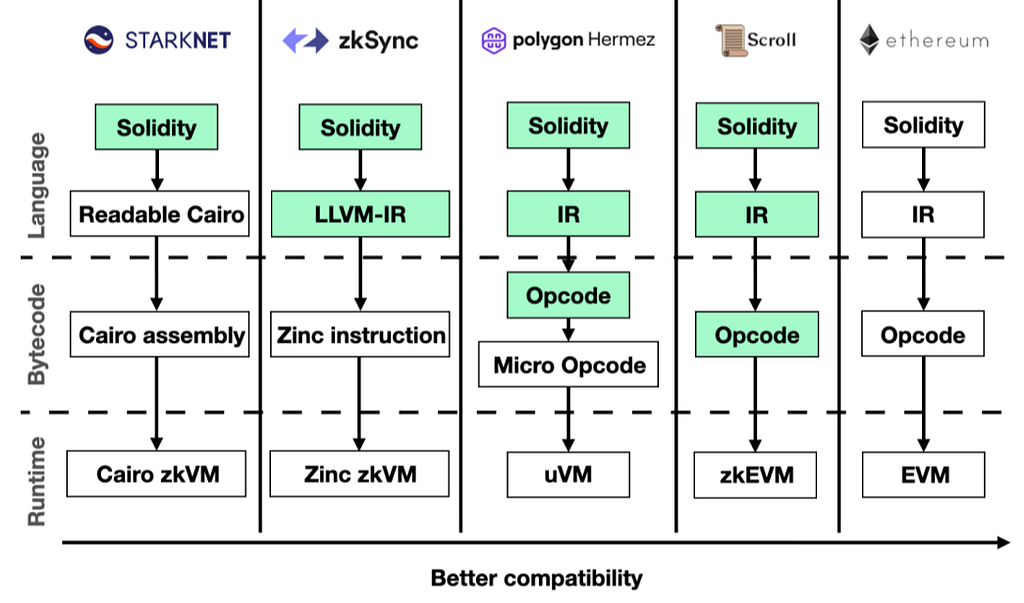
Source:foresightnews

In the above schemes, those further to the right offer better EVM compatibility, allowing developers to use familiar contract languages and tools—but implementing EVM opcodes as circuits becomes increasingly complex.
Linea’s zkEVM implementation is relatively easier, aiming to maximize proving efficiency on top of EVM compatibility, facilitating smoother onboarding for Ethereum developers and rapid ecosystem growth.
3. Operational Data
1. TVL
The ConsenSys team first announced plans for a SNARK-based zkEVM in July 2021. In 2023, the ConsenSys zkEVM public testnet launched and was rebranded as Linea. The Linea mainnet Alpha version officially went live on July 19.
As of now, Linea’s cross-chain bridge holds 17,631 ETH (worth approximately $33 million), with 117,000 transactions and 91,000 unique users recorded on-chain.

Source:Dune Analytics
Compared to other Layer2 projects, Linea has only recently launched its mainnet, so direct data comparisons remain premature. Currently, Optimistic Rollup solutions are advancing faster, while ZK Rollups face slower adoption due to challenges in Ethereum compatibility, proof generation efficiency, and transaction costs. The leading ZK-based Layer2 is zkSync Era, yet its TVL is only 7% of Arbitrum’s, and Linea’s TVL is just 7% of zkSync Era’s.
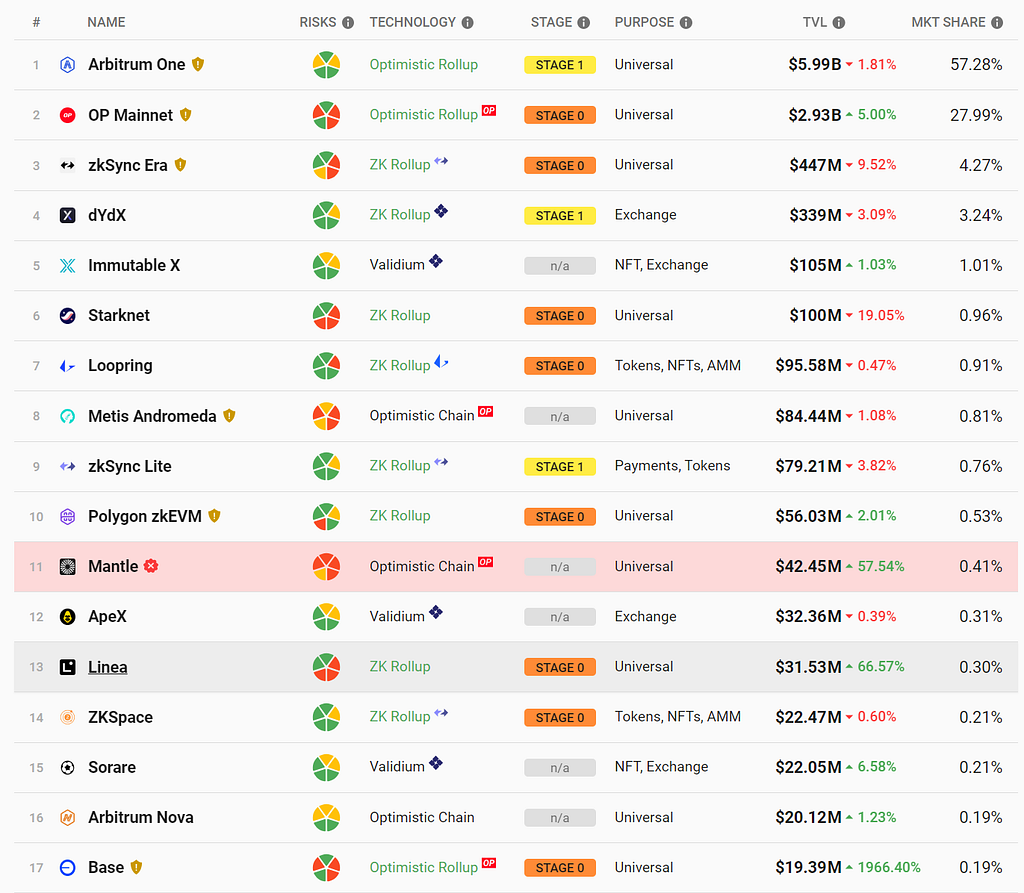
Source:l2beat.com
Previously, some users reported delays when redeeming funds from Linea’s official bridge from Layer2 back to Layer1 (Ethereum). While the interface states the process takes 8–32 hours, multiple users claimed it took up to four days to retrieve their funds.
The team explained that, for security reasons and careful transaction monitoring, they initially implemented a minimum 8-hour withdrawal delay on the Linea Mainnet Alpha. This delay will gradually decrease as the system matures and will eventually be eliminated. Due to the recent spike in bridged assets, withdrawal times on Ethereum have temporarily increased. The team is actively working to accelerate L2-to-L1 asset transfers and expects to restore processing times to the target range of 8–32 hours within the coming days, with all pending transactions eventually settled.
2. Linea Voyage
On May 2, Linea launched its testnet campaign called “Voyage” (Odyssey), lasting nine weeks and attracting over 300,000 addresses. Since the event began, chain activity has surged significantly, driven largely by anticipation of potential token airdrops.
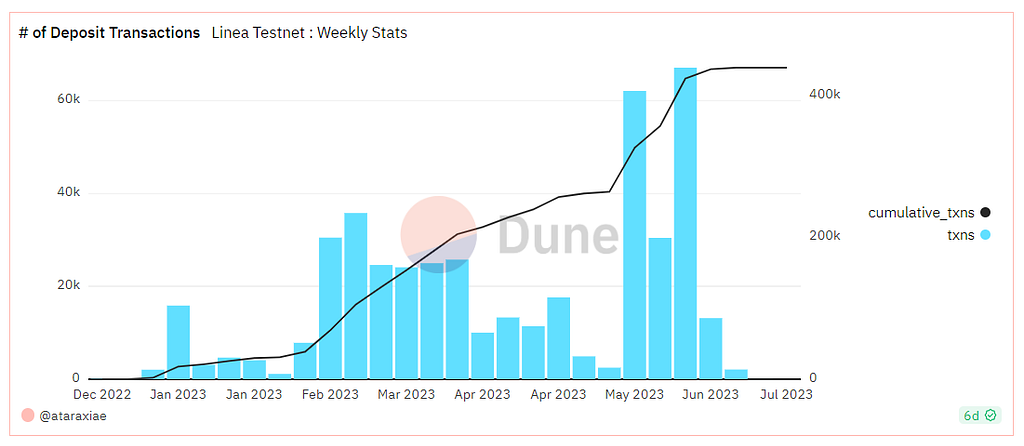
Source:Dune Analytics
On the day of mainnet launch, Linea announced NFT rewards for participants in the Odyssey campaign, distributing 352,000 NFTs. These NFTs are divided into five tiers: the first four were automatically airdropped to users’ wallets, while the fifth requires manual minting, now open for a limited period of one month. Users receive tiered NFTs based on their Odyssey points.
3. Social Media

4. Ecosystem
Currently, 56 projects are integrated into the Linea mainnet, with another 106 expected to join soon. According to DefiLlama data, total TVL stands at $15.04 million. This section provides brief introductions to major native protocols:
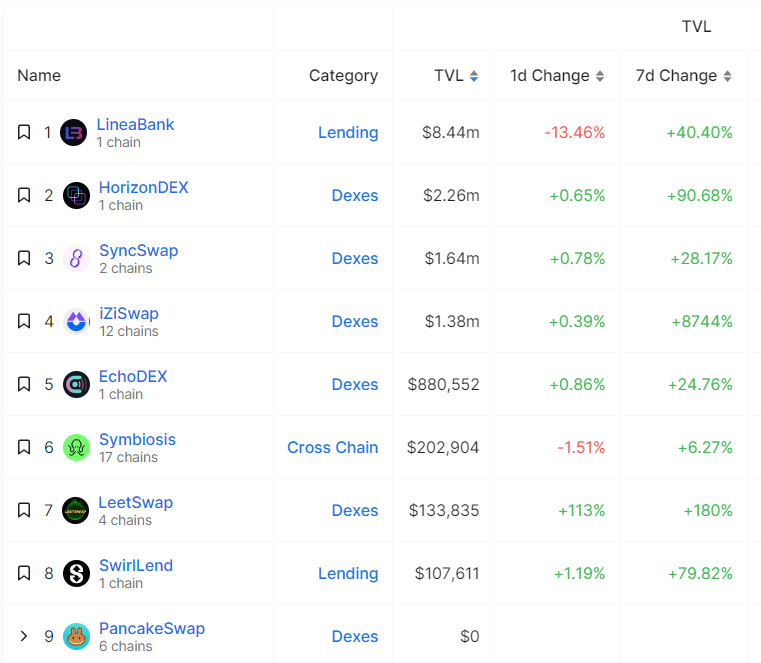
Source:defillama.com
1. LineaBank
LineaBank is a native lending protocol built on Linea, emphasizing privacy protection and scalability. It grants users full control over their assets, removes intermediaries via decentralized markets, and offers competitive interest rates. According to DefiLlama, LineaBank currently leads Linea in TVL, reaching $8.44 million.
Economic Model
The LAB token has a total supply of 100 million. Token distribution is shown below. A portion will be airdropped to the community. Tokens allocated to initial liquidity providers and the IDO will unlock fully at TGE, while those assigned to other recipients have varying vesting periods.
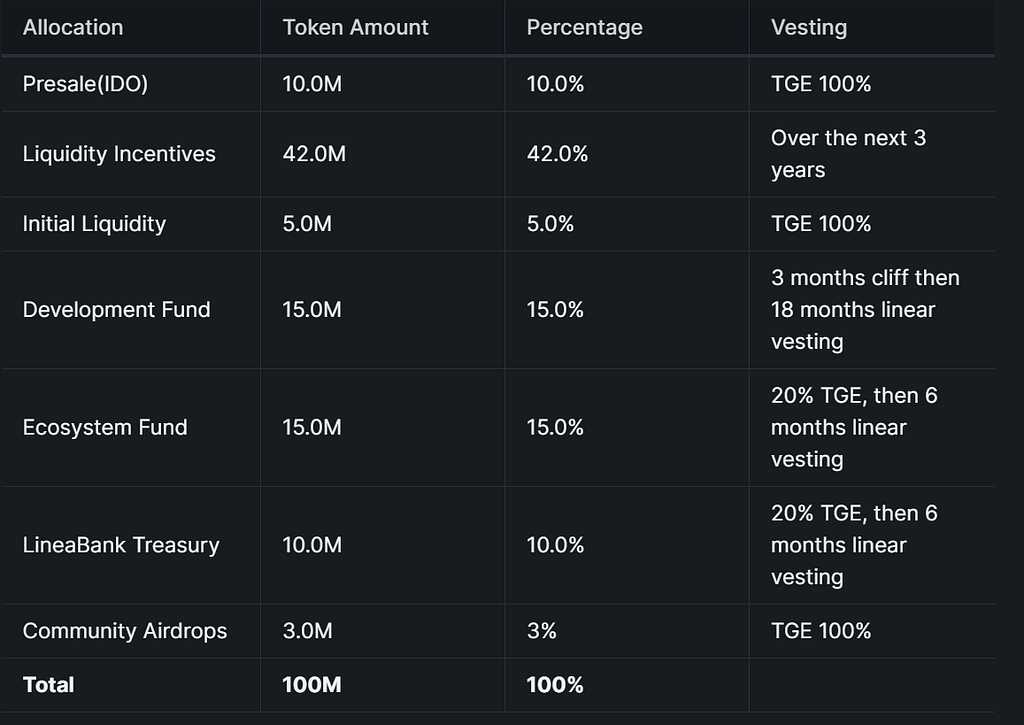
Source:LineaBank Official Documentation
LineaBank reserves 80% of protocol revenue, allocating 20% to liquidity providers. Of the 80% retained by the protocol, 80% (i.e., 64% of total revenue) is distributed weekly to LAB stakers. However, stakers can only claim LAB tokens when claiming their share of revenue, as the protocol automatically repurchases LAB tokens using assets like ETH or USDC and distributes them to users.
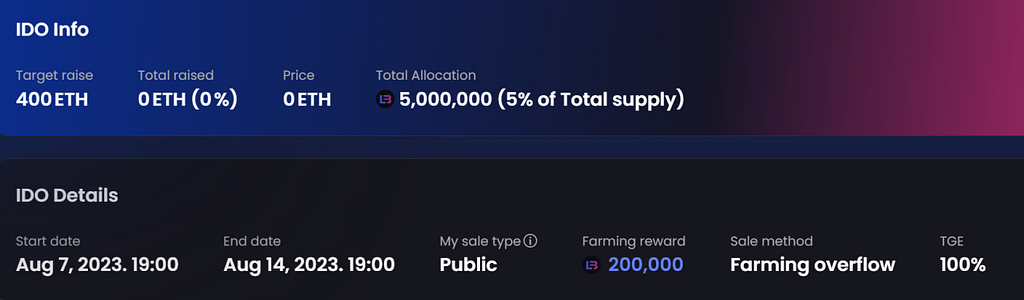
LineaBank will conduct its IDO from August 7 to August 14, distributing 5 million tokens with a fundraising target of 400 ETH. At the current ETH price of $1,864, this implies a price of $0.15 per LAB.
Source:LineaBank Official Website
Following the mainnet launch, LineaBank hosted a “pre-mine” event from July 19 to August 11. Participants can earn 3,000,000 $LAB (3% of total supply, worth ~$450,000), which can be claimed after the IDO.
Source:LineaBank Official Website
2. HorizonDEX
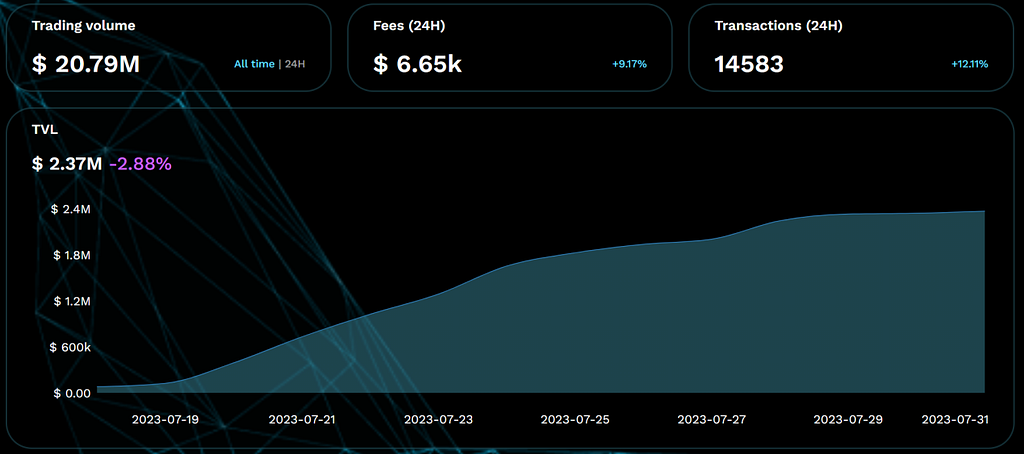
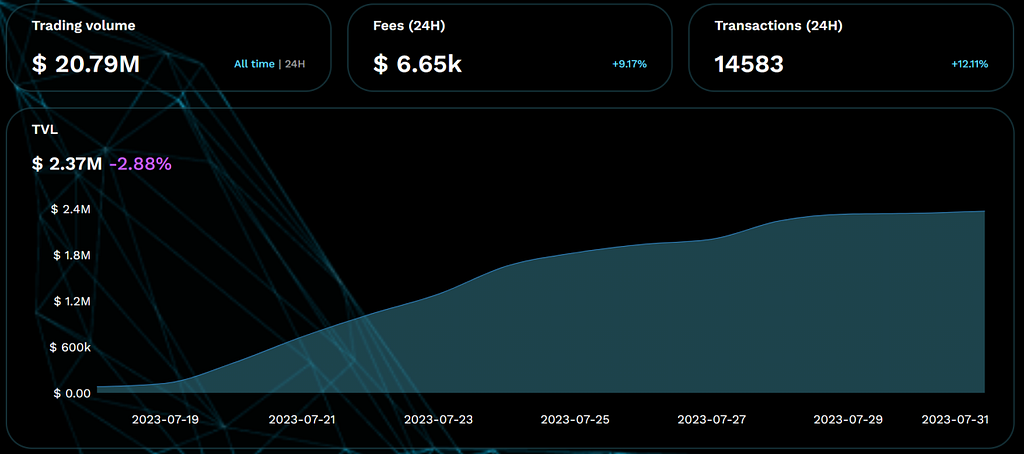
HorizonDEX is a concentrated liquidity decentralized exchange (DEX) that allows users to allocate liquidity within custom price ranges, helping traders maximize capital efficiency and minimize slippage. As a native project on the Linea blockchain, HorizonDEX currently holds a TVL of $2.26 million.
On July 19, HorizonDEX launched a “Loyalty Program” to incentivize trading, offering yHZN point rewards to traders and liquidity providers. The program runs for 14 days, ending on August 2. Participants will share a total of 900,000 HZN tokens based on accumulated points.
According to HorizonDEX’s official website, the DEX has achieved a trading volume of $20.79 million, with $6,650 in cumulative 24-hour fees and approximately 15,000 transactions. Volume has grown steadily since launch, without experiencing any explosive growth phase yet.
Source:HorizonDEX Official Website
Economic Model
The HZN token has a total supply of 100 million. Distribution includes 15% for IDO, 8% for the team, 15% for project development, 12% for marketing, and 35% for liquidity mining. Except for IDO tokens, which unlock fully at TGE, most allocations have either 6-month or 24-month vesting schedules. Total genesis unlock amounts to 42.25 million tokens.
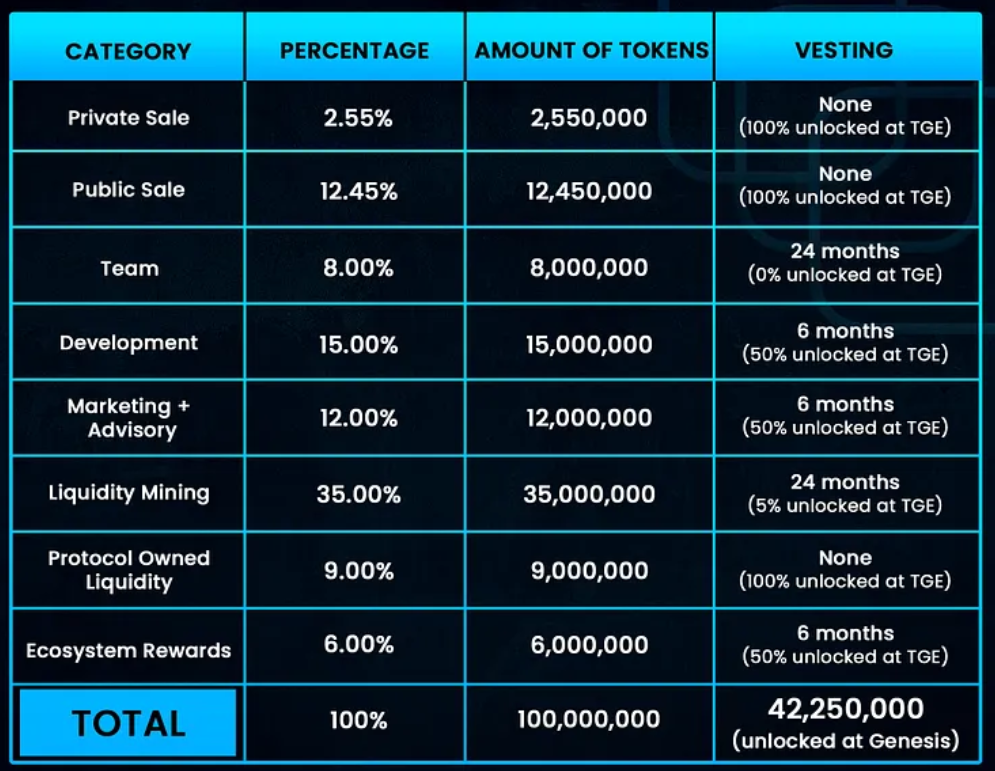
Source:HorizonDEX Official Documentation
HorizonDEX held private and public sales from July 26 to July 31, becoming the first project on Linea to conduct an IDO. The private sale has concluded, targeting 135 ETH and ultimately raising 143.5 ETH, priced at 0.000052942 ETH/HZN. At the current ETH price of $1,864, this equates to $0.099 per HZN.

The public sale targets 870 ETH; as of now, 240.9 ETH has been raised, with a public sale price of 0.000059036 ETH/HZN, approximately $0.11 per HZN.

Source:HorizonDEX Official Website
3. EchoDEX
EchoDEX is a decentralized exchange built on the Linea Consensys network and is a native project on the Linea blockchain. It is also the first decentralized exchange (DEX) to launch on Linea.
Economic Model
The ECP token has a total supply of 100 million, with specific allocations subject to various lock-up periods. Currently, the token supports staking functionality, with a loyalty program即将上线.
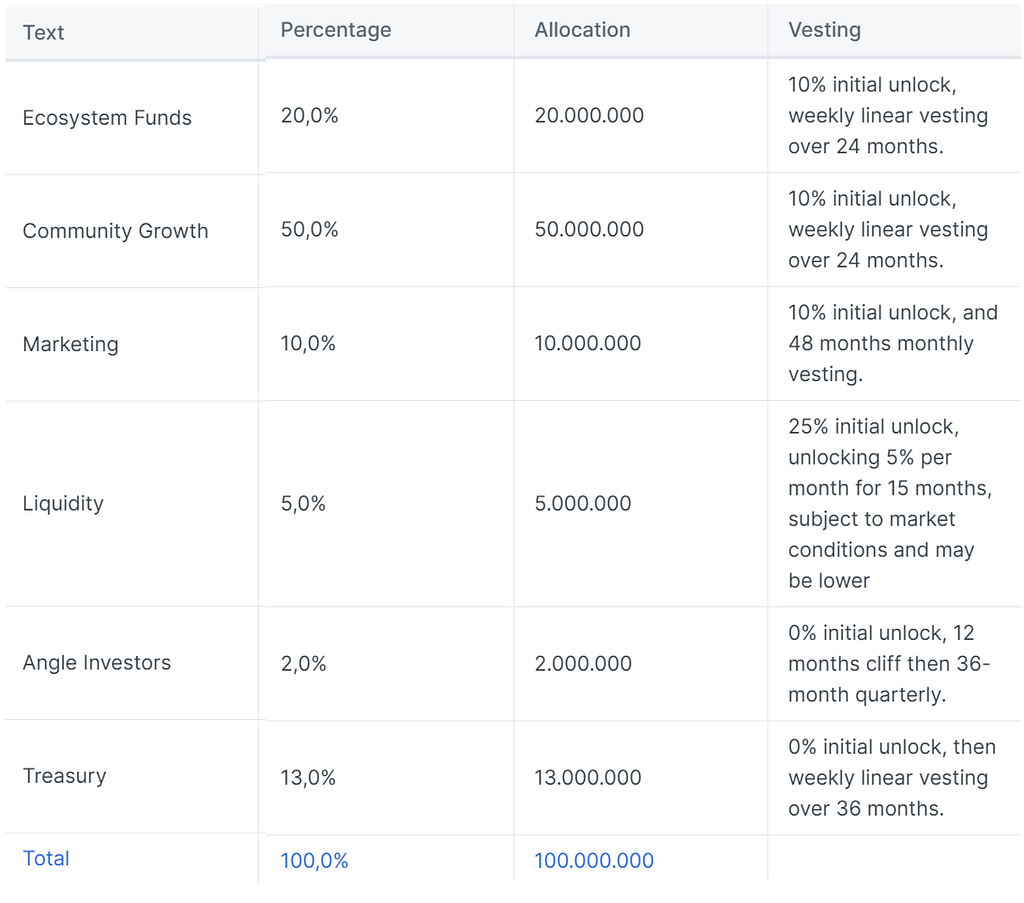
Source:EchoDEX Official Documentation
Native DEXs and lending protocols were prioritized in Linea’s early ecosystem rollout. Their economic models follow similar patterns—relying heavily on token incentives to attract liquidity. Currently, LineaBank’s incentive structure may be more appealing to users, but such liquidity remains speculative. Whether early movers can retain users amid competition from established DeFi players like Aave and Sushi remains uncertain.
Join TechFlow official community to stay tuned
Telegram:https://t.me/TechFlowDaily
X (Twitter):https://x.com/TechFlowPost
X (Twitter) EN:https://x.com/BlockFlow_News
 Cycle Capital Research






