








Binance's Sixth Anniversary: With Great Power Comes Great Responsibility
TechFlow Selected TechFlow Selected
Binance's Sixth Anniversary: With Great Power Comes Great Responsibility
With great power comes great responsibility
 Navigating Web3 tides with focused insights
Author: Chai
On July 14, 2023, Binance celebrated its sixth anniversary.
Looking back six years, on July 14, 2017 at 12:00 PM, Binacne.com officially launched. At that time, perhaps no one could have imagined that the newly founded Binance would become a giant in the crypto world within just a few months.

Today, Binance is no longer merely synonymous with centralized exchanges. As described on its official website, "Our mission is to become a global cryptocurrency infrastructure provider in the future."
From investing in Trust Wallet to acquiring CoinMarketCap, from Binance NFT to Binance Wealth Management, Binance has essentially covered all types of blockchain and crypto asset products.
Looking back over the past year, even during a bear market, the Binance ecosystem has continued to advance aggressively.
In his speech for the fifth anniversary, CZ stated, "One of our most important achievements has been supporting the development and growth of the BNB Chain ecosystem." On the occasion of the sixth anniversary, CZ likely has new material for another speech.
BNB Chain appears to be preparing for the next bull market by expanding in various directions:
A third chain after Beacon Chain and BNB Smart Chain—the centralized storage infrastructure BNB Greenfield;
zkBNB, a zero-knowledge proof-based scaling solution for BNB Chain;
opBNB, a Layer 2 network based on OP Stack.
Today’s BNB Chain integrates Layer 1, Layer 2, and storage infrastructure—a combination poised and “ready to launch.”
In investment, the primary market has been unusually depressed during this bear market, yet Binance Labs remains active, helping projects weather the winter.
According to Rootdata, from the beginning of 2023 to date, Binance Labs has participated in funding for 16 projects, mostly as lead investor, including blockchain game publisher Xterio, smart contract platform Neutron, and blockchain game Fusionist…
Beyond trading itself, on its ecosystem homepage Binance also separately lists “Blockchain Charity.” According to the *Binance Charity 2022 Annual Report*, away from public view, Binance Charity has shone brightly with the light of “blockchain.”
In 2022, Binance donated $15 million worth of cryptocurrency, aiding over 500,000 people across 46 countries;
Binance worked closely with UNICEF and the American Friends of UNRWA to assist 423,358 Ukrainian refugees;
Binance provided scholarships to 71,205 individuals, increasing global access to Web3 education, supporting a total of 293,217 hours of Web3 learning.
However, over the past year, alongside accolades and achievements, Binance has also faced new doubts and challenges.
FUD and 4
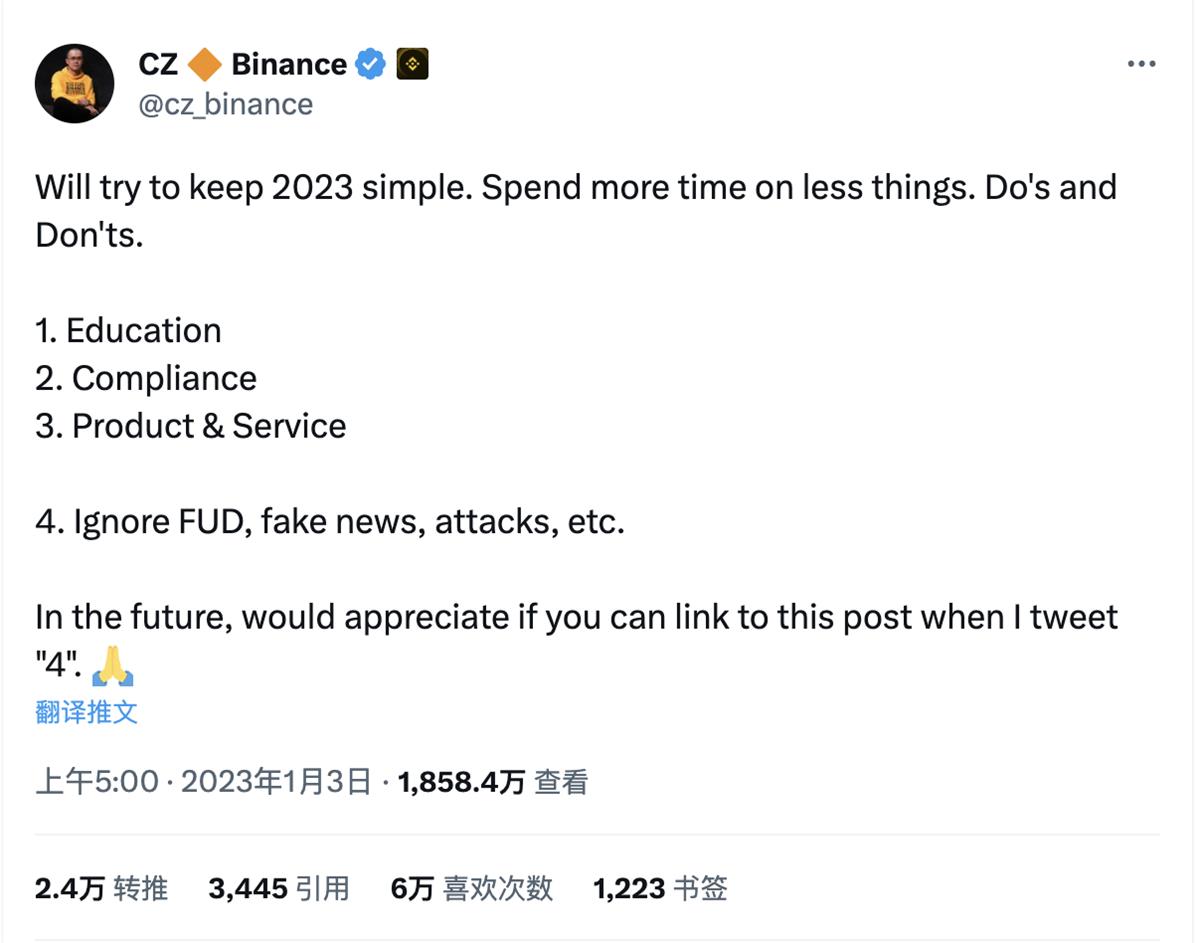
If choosing an annual keyword for Binance, “4” might be an unavoidable number.
Whenever negative news about Binance arises, CZ responds with “4,” symbolizing telling users to ignore fear, uncertainty, and doubt (collectively known as FUD).
From the start of the year until now, Binance has been plagued by regulatory issues.
In March, the U.S. Commodity Futures Trading Commission (CFTC) sued Binance, accusing it and its founder CZ of deliberately evading federal laws and illegally operating a digital asset derivatives exchange.
In June, the U.S. Securities and Exchange Commission (SEC) announced lawsuits against Binance and founder CZ.
So what?
Crypto practitioners and the market seem numb to such regulatory news, having gained clearer understanding of major U.S. regulators.
On Twitter, there's a famous meme: “Which exchanges hasn’t the SEC sued?” The answer: only the already collapsed FTX.
As Binance stands atop the “crest of the wave” in cryptocurrency, it inevitably faces “turbulent storms.” Fundamentally, this may not really be about “Binance” or “CZ.” Even if it were “Cinance,” heavy-handed regulation from U.S. agencies like the SEC would still come down—when you’re out front, you get targeted first. As the U.S. tightens oversight of the crypto industry, some organizations will inevitably stand at the forefront.
From this perspective, Binance to some extent represents the entire cryptocurrency industry negotiating with regulators worldwide, exploring through friction how crypto can sustainably coexist with regulatory bodies. Therefore, during this regulatory storm, Binance received widespread support on Twitter.
It’s foreseeable that more regulatory news will emerge. When headlines like “U.S. XXX announces XX” or “Binance XXXX” appear, don’t be surprised—CZ will keep posting “4” as always. Only when the “4s” stop appearing might we see a new era in the regulatory landscape.
Have these numerous FUDs actually negatively impacted Binance’s balance sheet?
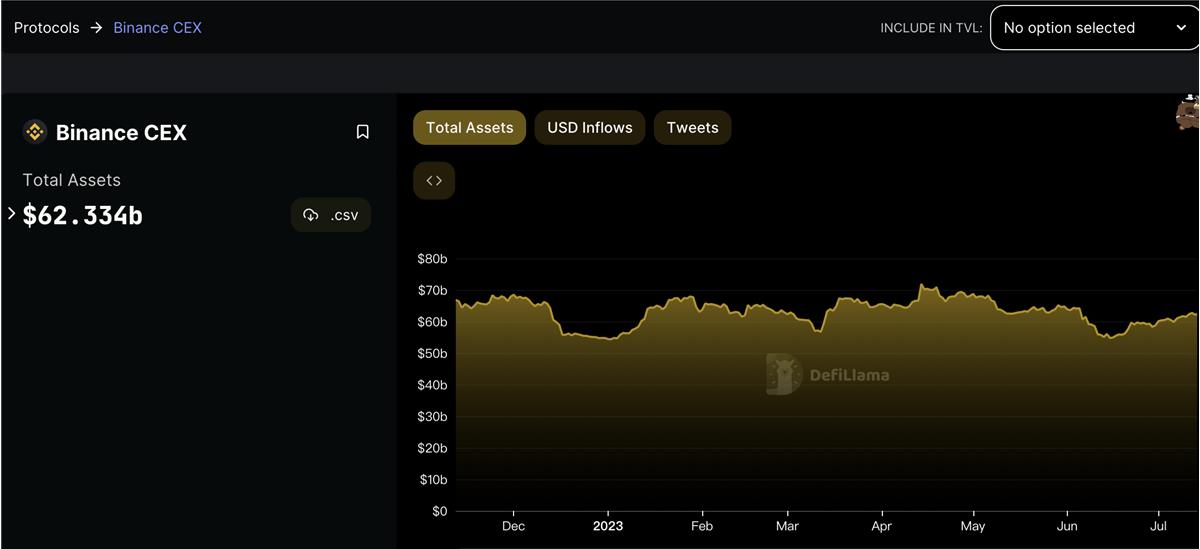
Judging from on-chain data, the answer is no. According to DeFiLlama’s exchange asset transparency data, Binance’s total assets have remained consistently stable. In fact, compared to January 1, 2023, total assets had increased by 14.5% by July 13—an impressive feat during a bear market marked by falling asset prices.
“Bestie Coins”?
Since Binance restarted its IEO program this year, “bestie coins” has become a frequently mocked concept.
The implication is that many new assets listed on Binance may come from “insiders” like friends or close associates—low-quality assets rising due to connections rather than merit.
Accusations of “bestie coins” are superficial; the deeper meaning is: Binance’s wealth effect isn’t as strong as before, and investors aren’t making money like they used to.
Regarding this criticism, Binance co-founder He Yi responded on Twitter:
1. Binance still cares about the wealth effect. You can survey all projects listed today across platforms and compare the percentage that dropped below their listing price—we should still be performing best;
2. Binance has no insider trading, no “relative coins,” and certainly no “bestie coins.” Whose feelings would I need to spare?
In my view, accusations of “bestie coins” are an inevitable phenomenon of a bear market.
On one hand, after FTX’s collapse, Binance became the most critical spot liquidity market. On the other, under bear market pressure, trading volume has consolidated toward top-tier exchanges. In short: a crypto project only gains meaningful spot liquidity once it’s listed on Binance.
Therefore, “To Binance” has become the “main theme” of this bear market cycle.
Entrepreneurs think about creating projects that can be invested in by Binance Labs and listed on Binance; VCs consider how to build good relationships with Binance, co-invest, and recommend listings. Across primary and secondary markets, narratives like “Let me tell you, we have great connections with Binance” are common. Under such conditions, the emergence of the term “bestie coin” is naturally unsurprising.
Setting aside rumors, examining the types of assets Binance has listed since the beginning of the year reveals a clear narrative thread: Does it bring in new crypto users?
During this bear market, Binance is attempting to break out and attract more external traffic.
Whether it’s the Move-to-Earn app STEPN, gamified social learning platform Hooked Protocol, identity platform Space ID, educational content platform Open Campus, or recently announced blockchain data monitoring platform Arkham—all emphasize bringing in new industry users or possessing large-scale real user bases as their core narrative.
Yet even Binance cannot remain untouched by the biting cold winds of a bear market. When BTC/ETH trend downward, altcoins cannot stay immune. Thus, rather than saying Binance has lost its wealth effect, it’s more accurate to say: “This is the power of a bear market.”
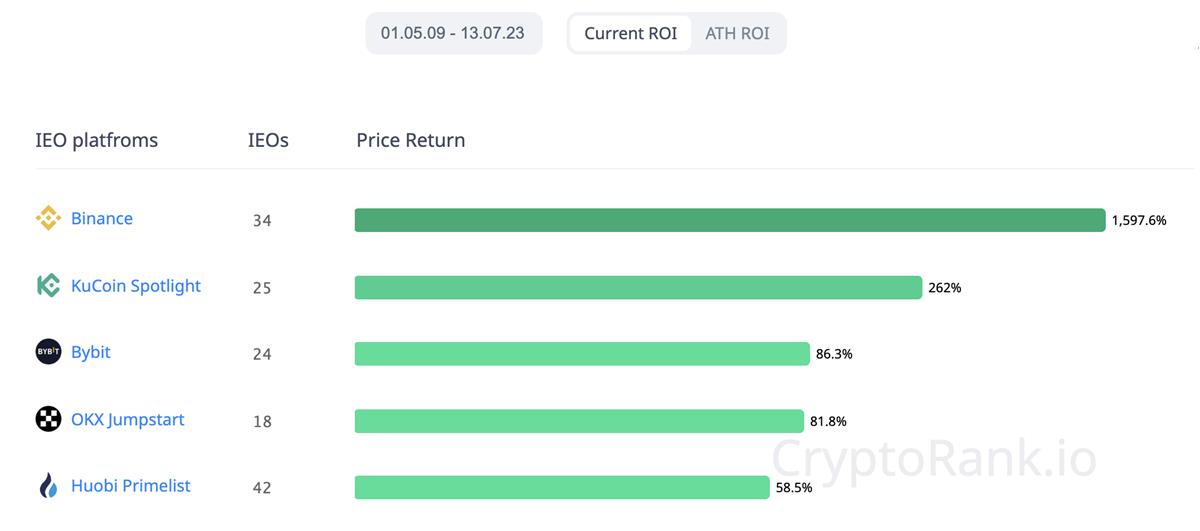
According to CryptoRank data, as of July 13, Binance’s IEO projects still average a return rate of 1597.6%, ranking first in the industry. Binance’s IEOs remain the undisputed leader.
With Great Power Comes Great Responsibility
“With great power comes great responsibility”—this iconic line from *Spider-Man* fits Binance perfectly.
Facing the same Binance, some are harsh, believing it is declining, while others call for leniency. Whether facing relentless attacks from regulators or stringent demands from retail investors, these are all proof of “great power.”
He Yi has a catchphrase: “We aren’t starting a business—we’re making history.”
While making history, moving forward under responsibility may become Binance’s norm. In a way, this means carrying the weight for the entire industry, helping it withstand regulatory and public scrutiny ahead of others.
Through trials and tribulations, Binance may emerge stronger.
At the midpoint of 2023 and on Binance’s sixth anniversary, we look ahead to 2024 and wonder what the landscape will be like for Binance’s seventh anniversary.
Join TechFlow official community to stay tuned
Telegram:https://t.me/TechFlowDaily
X (Twitter):https://x.com/TechFlowPost
X (Twitter) EN:https://x.com/BlockFlow_News
 深潮TechFlow


