








Reserve Protocol: A New Pathway for Synthetic Assets and Decentralized Money Creation
TechFlow Selected TechFlow Selected
Reserve Protocol: A New Pathway for Synthetic Assets and Decentralized Money Creation
The core idea behind the Reserve team when creating Reserve was that more assets will be tokenized in the future, and decentralized governance will need to evolve.
 Navigating Web3 tides with focused insights
Author: Sam Martin
Compiled by: TechFlow

Key Takeaways
-
RTokens are synthetic assets backed by a basket of predefined ERC-20 tokens, which anyone can permissionlessly deploy, mint, or redeem on Ethereum.
-
RSR token holders can opt to over-collateralize specific RTokens in exchange for a share of the yield generated by the underlying basket of tokens, with the proportion depending on their risk tolerance.
-
RPay and Moby represent new approaches to enabling real-world adoption of crypto assets, but limited on-chain usage of RTokens remains a challenge the community must address.
-
The Reserve protocol team has invested $20 million in assets across the Curve, Convex, and Stake DAO ecosystems to increase liquidity and adoption of RTokens by redirecting liquidity provider incentives toward relevant pools.
-
If current or future RToken deployments gain widespread adoption, we expect demand for RSR to rise significantly as investors seek relatively safe forms of passive yield.
The Reserve Protocol aims to empower any entity to easily launch decentralized synthetic assets on Ethereum, backed by predefined ERC-20 tokens. Within the Reserve ecosystem, these assets are known as RTokens, each featuring customizable parameters around governance, revenue sharing, collateral support, and more. Deployments of RTokens are permissionless, allowing market dynamics to determine which RToken model becomes the most efficient form of on-chain money. The core development team’s foundational belief when creating Reserve was that more assets will be tokenized and decentralized governance will need to evolve. The protocol's customizability is intentional, enabling synthetic assets issued as RTokens to adapt to the evolving cryptocurrency landscape.
RTokens
The Reserve Protocol is essentially a smart contract system that enables anyone to generate additional contracts permissionlessly based on a template. The protocol allows users to interact directly on-chain or via third-party frontends like Register to launch synthetic assets that anyone can mint or redeem against the underlying basket of approved collateral.
RTokens inherit the properties of their backing assets, thereby creating synthetic assets with attributes deemed important by the RToken creator—such as fiat-pegged assets, yield-bearing tokens, or highly decentralized tokens.
In previous versions of the protocol, RToken minter had to provide the appropriate weight for each collateral type. However, in the current version, users can deposit any supported collateral, which is then automatically converted behind the scenes into the correct asset mix, offering a more seamless user experience.
Acceptable collateral types are defined by the RToken creator along with governance parameters such as token codes, emergency collateral types, issuance and redemption limits, and revenue sharing. The Reserve Protocol core development team has demonstrated its commitment to security by launching a $5 million bug bounty program and undergoing multiple audits from firms including Halborn, Trail of Bits, and Code4rena.
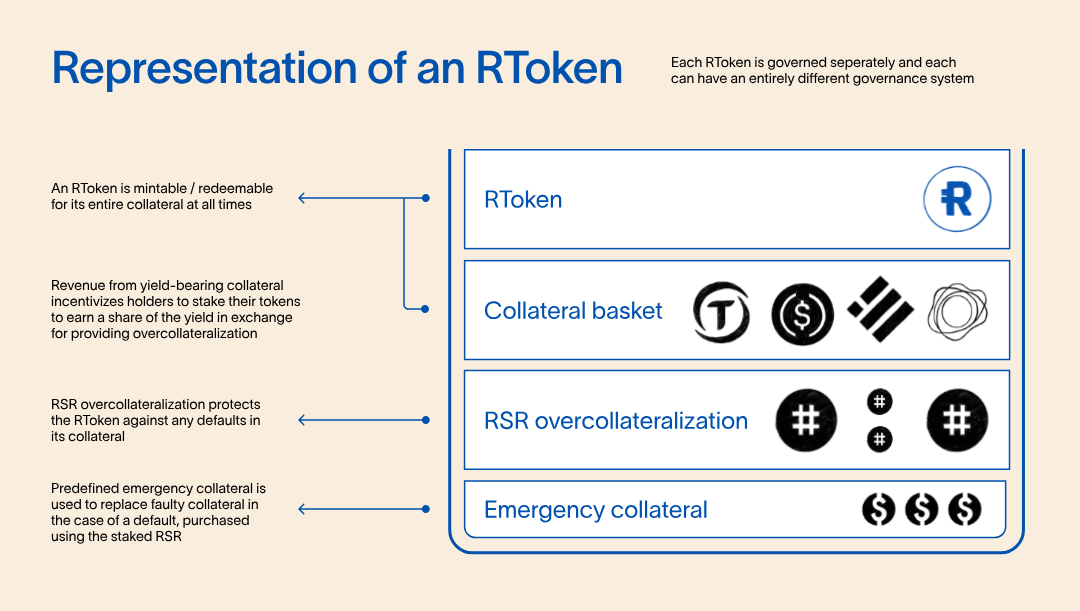
Creators may choose to over-collateralize their RTokens using Reserve’s native RSR token. In the event of collateral default, stakers act as liquidity providers, supporting the system in exchange for a share of the yield earned on the underlying basket of tokens. The higher the quality of the backing assets and the more favorable the returns for RSR stakers, the more likely they are to provide “insurance” for the RToken. This is clearly demonstrated by eUSD currently live on mainnet: it shares 100% of its revenue with RSR stakers and uses high-quality collateral, resulting in nearly $4 million worth of RSR-backed liquidity protection.
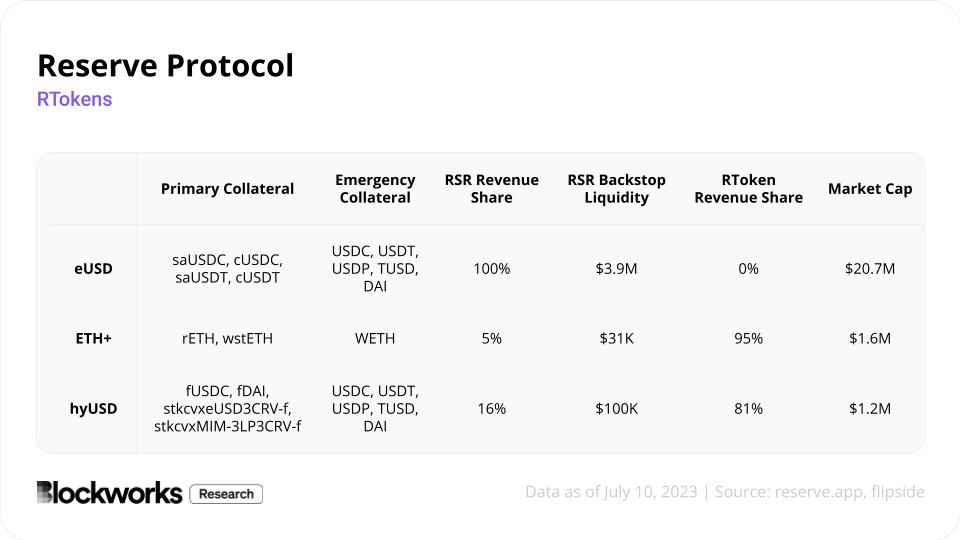
Notably, there is an ongoing governance proposal in the hyUSD forum aiming to shift the risk exposure of MIM/3pool to the Aura-enhanced Aave V3 stable pool on Balancer. The author argues that APY alone does not justify the volatility of MIM, and comparable yields can be achieved through the bb-a-USD composable stable pool composed of DAI, USDC, and USDT. hyUSD was created and is maintained by community members, serving as a typical example of a community-governed RToken developed and sustained by a DAO.
There are some restrictions on acceptable collateral types for RTokens. They must comply with the ERC-20 standard, have a single token contract address, and cannot rebase or charge fees upon transfer. To work around these limitations, RToken creators can use wrapped ERC-20 assets as alternatives. Given the yield potential for RSR stakers, RToken holders, and community treasuries, LP tokens from AMMs or single-sided receipt tokens from lending protocols are ideal examples of plug-in-compatible collateral types. Supported collateral tokens can be found on the Register application interface under "RToken Deployer".
eUSD
Since its founding in 2018, the Reserve Protocol has come a long way. In its early days, the core product was RSV, a stablecoin backed by other stable collateral, without RSR over-collateralization or features promoting decentralization. RSV was integrated into the Reserve mobile app (RPay) and achieved moderate success, but the team eventually pivoted toward a more modular design to enhance decentralization and foster open innovation. RSV has since been replaced by eUSD within the RPay app. On the Ethereum-RPay cross-chain bridge, approximately $6 million worth of eUSD is controlled by a 2-of-4 multi-sig wallet.
Mobilecoin, a blockchain focused on enabling cheap, fast, and private transactions, chose to leverage the Reserve Protocol to deploy eUSD in February 2023. This RToken is issued on Ethereum for maximum security and composability but can be bridged to Mobilecoin for daily payments via the Moby mobile app. The app complies with KYC/AML regulations while preserving user privacy. Mobilecoin eUSD is 1:1 backed by Ethereum-based eUSD, with bridging transactions coordinated by the Reserve team and a whitelist of LPs. Due to transaction privacy, it is difficult to assess the success of eUSD on Mobilecoin, but the lack of minting/burning activity on the bridge and a total supply of only 500,000 suggest limited adoption at best.
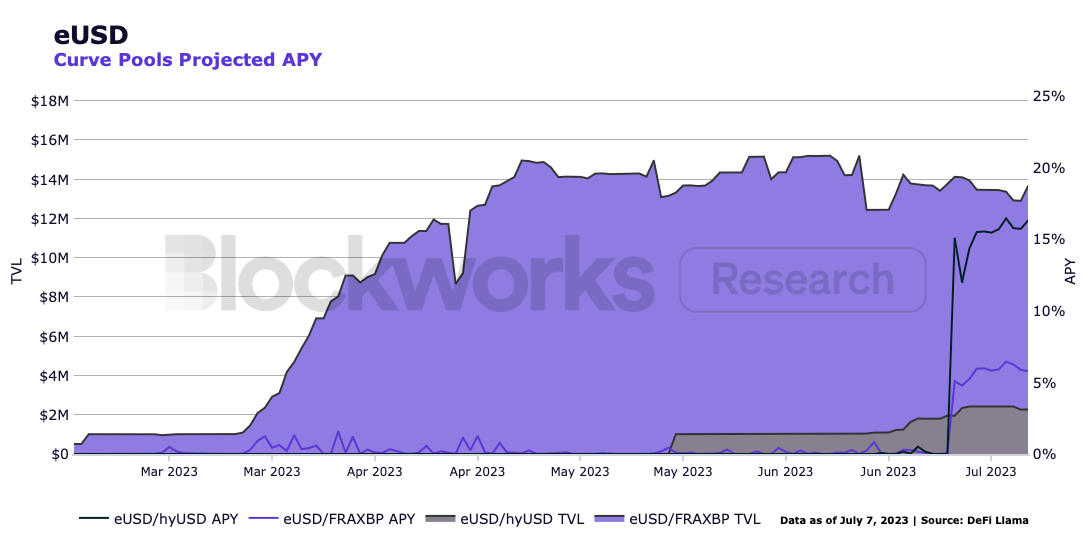
Currently, the Mobilecoin and RPay cross-chain bridges hold about 31% of the total eUSD supply, while seven other Ethereum addresses hold over 1,000 tokens each. One EOA holds approximately 34% of the supply, and another ~33% is held in Curve’s eUSD/hyUSD or eUSD/FRAXBP pools. However, these two pools have only 13 LP token holders combined. The limited on-chain usage of eUSD on Ethereum may explain why the Reserve team decided to invest $20 million in assets related to the Curve, Convex, and Stake DAO ecosystems. By accumulating CRV, CVX, and SDT, the team can redirect incentives to RToken pools, ensuring deeper on-chain liquidity and greater price stability. These purchases have already started showing effects, with LP yields increasing sharply in late June.
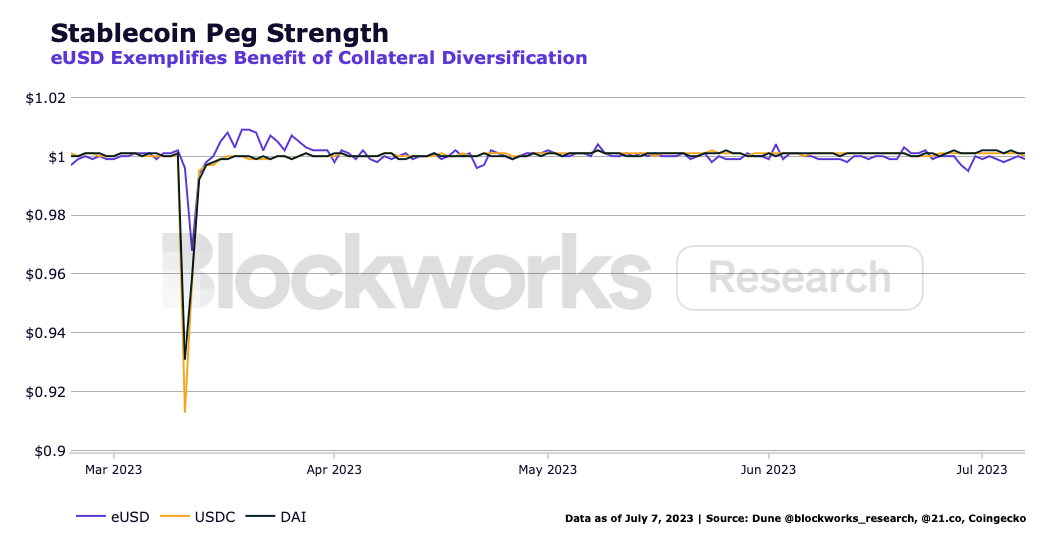
During the USDC depeg event in March 2023, the RSR over-collateralization and secure collateral mechanisms were put to the test, as saUSDC and cUSDC collateral began signaling default after trading below peg for over 24 hours. USDC derivatives (saUSDC and cUSDC) were auctioned off as emergency collateral at around $0.955. This brought eUSD’s collateral ratio down to approximately 98%, with the shortfall covered by confiscating about 8 million RSR tokens and auctioning them for roughly $32,000 in USDT. The depeg occurred before a surge in eUSD supply, allowing the mechanism to be tested without causing significant harm to RSR stakers. The diversified collateral mix combined with RSR over-collateralization—largely attributed to the 100% revenue share offered to RSR stakers—enabled eUSD to re-anchor to $1 faster than either USDC or DAI during the incident.
RSR
Adoption of RTokens has so far been challenging, but it is not hard to envision massive growth potential if RToken designs gain significant traction. Assuming substantial revenue sharing with RSR holders, the incentive to hold RSR increases alongside RToken supply expansion. The total supply cap for RSR is set at 100 billion, with 50.6 billion tokens currently in circulation, representing just 3.95% of total supply. If eUSD, ETH+, or hyUSD begin experiencing meaningful supply growth, demand for RSR could rise sharply as investors seek relatively safe yield sources.
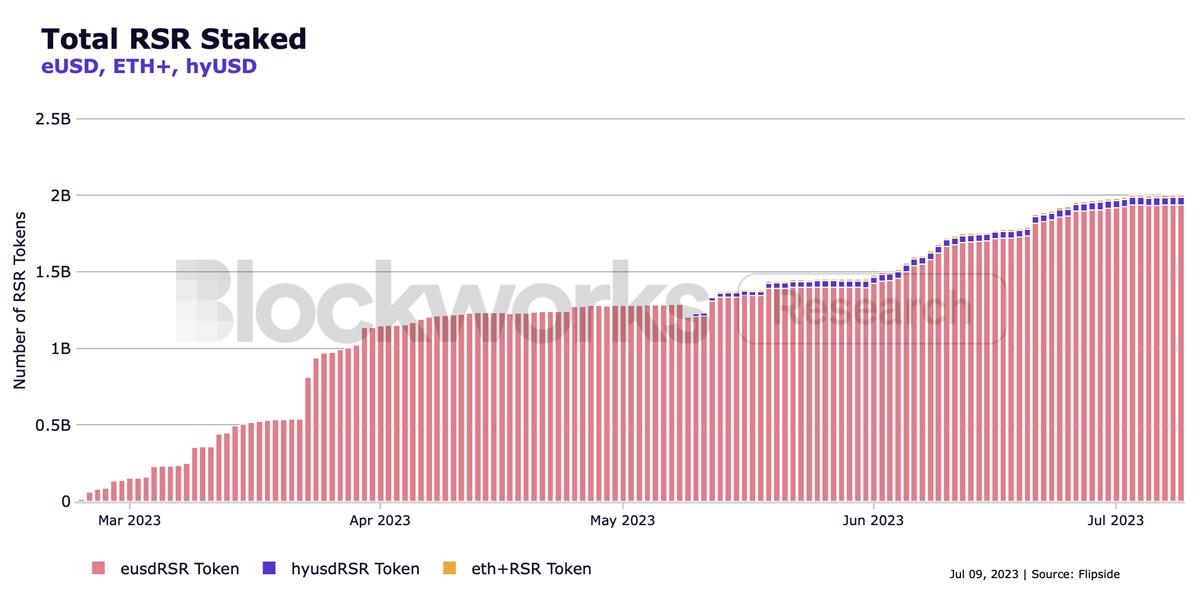
The remaining 49.4 billion RSR tokens are held in a reserve designated by the Reserve team for RToken adoption initiatives. Given the protocol’s track record and the urgency to drive RToken adoption, investors should pay attention to how this remaining supply is managed. With only about $23 million in total RToken market value today, there is considerable room for growth. As RSR’s market cap expands, the insurance pool available to RToken holders will also grow.
Final Thoughts
Supporters of the Reserve Protocol believe that by making synthetic assets easy to deploy and allowing them to inherit the properties of their underlying collateral, rapid experimentation will occur—and ultimately the market will decide which design proves most efficient. As more assets become tokenized, the ideal form of money will continue to evolve. Reserve adds another layer of protection by enabling synthetic assets to share yield generated from the underlying collateral basket with RSR holders who provide insurance. The key lies in ensuring RTokens achieve growth, thereby increasing yield on the underlying collateral, incentivizing RSR holders to stake and provide insurance, which in turn drives up demand for RSR, leading to price appreciation and stronger security assurances for RTokens.
To date, adoption has been modest, with total RToken market value growing to around $23 million since February 2023. RPay and Moby represent interesting pathways for promoting eUSD adoption among everyday users, but on-chain usage of eUSD and other RTokens remains suboptimal. The core Reserve Protocol team is actively working to boost incentives for on-chain RToken usage, as evidenced by their $20 million investment in the Curve, Convex, and Stake DAO ecosystems to redirect liquidity incentives toward RToken pools. Crucially, the Reserve DAO must cultivate a strong community of RToken supporters and even begin forming partnerships with other DAOs to expand RToken adoption and kickstart the flywheel effect.
Join TechFlow official community to stay tuned
Telegram:https://t.me/TechFlowDaily
X (Twitter):https://x.com/TechFlowPost
X (Twitter) EN:https://x.com/BlockFlow_News
 Blockworks


