








Vitalik: DAOs Are Not Companies — Decentralization in Autonomous Organizations Is Crucial
TechFlow Selected TechFlow Selected
Vitalik: DAOs Are Not Companies — Decentralization in Autonomous Organizations Is Crucial
We may only need a few DAOs that resemble political science more than corporate governance structures.
 Navigating Web3 tides with focused insights
Author: Vitalik Buterin
Translation: Guo Qianwen, Chain捕手 (Chain Catcher)
Recently, there has been much discussion around the idea that highly decentralized DAOs cannot function effectively and that DAO governance should gradually resemble traditional corporate governance to remain competitive. These arguments share a common thread: highly decentralized governance is inefficient, while traditional corporate structures—with boards of directors, CEOs, and similar roles—have evolved over centuries to make sound decisions in a changing world and create value for shareholders. Idealists within the DAO community naively believe that egalitarian, decentralized models can outperform these established systems, yet attempts at such models within the traditional corporate sector have achieved at best limited success.
This article will argue why this view is often mistaken and will explore in detail the importance of different types of decentralization in various contexts. I will focus particularly on three cases of decentralization:
- Decentralization for better decision-making in concave environments: where pluralism or even naive compromise tends to outperform the consistency enabled by centralization.
- Censorship-resistant decentralization: applications must operate while resisting attacks from powerful external actors.
- Decentralization as credible fairness: DAOs take on state-like functions, such as providing basic infrastructure, making properties like predictability, robustness, and neutrality more important than efficiency.
Centralization is convex, decentralization is concave
Original post: https://vitalik.ca/general/2020/11/08/concave.html
One way to classify decisions is by whether they are convex or concave. When choosing between A and B, we should first consider not the A versus B question itself, but a higher-order question: would you prefer a compromise between A and B, or would you rather flip a coin? In terms of expected utility, we can illustrate this difference with a diagram:
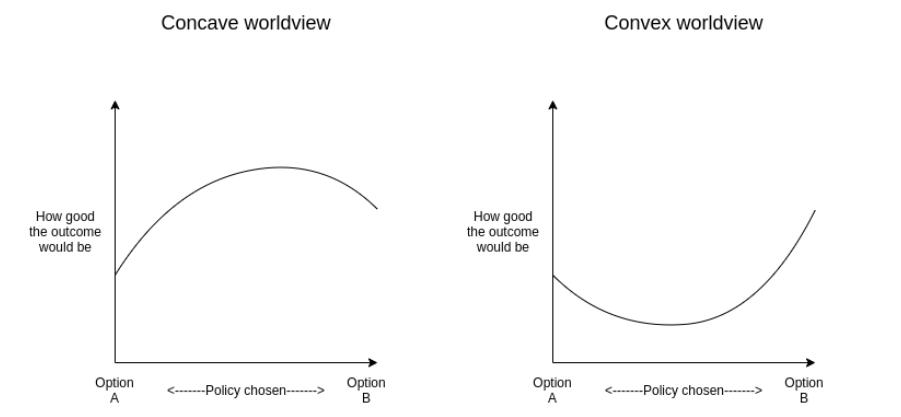
If a decision is concave, we choose compromise; if it's convex, we choose to flip a coin. Often, it’s easier to answer the higher-order question—"compromise" or "flip a coin"—than to resolve the first-order question about A versus B directly.
Examples of convex decisions include:
- Pandemic response: a 100% travel ban might block the virus, 0% causes no inconvenience but fails to stop the virus, whereas a 50% or 90% ban performs poorly on both fronts.
- Military strategy: attacking along line A may make sense, as may attacking along line B. But splitting forces to attack both lines means the enemy can defeat each half individually.
- Technical choices in cryptographic protocols: using technology A may make sense, as may using technology B, but a hybrid often introduces unnecessary complexity and risks interference.
Examples of concave decisions include:
- Judicial decisions: the midpoint between two independent rulings is often fairer and more reasonable than randomly selecting one.
- Public goods funding: typically, giving $X to each of two promising projects is more effective than giving $2X to one and nothing to the other.
- Tax rates: due to quadratic deadweight loss mechanics, an X% tax rate causes only a quarter of the harm of a 2X% rate, while raising more than half the revenue. Thus, moderate taxation is superior to randomizing between low/no tax and high tax.
When decisions are convex, decentralized processes easily lead to chaos and ineffective compromises. When decisions are concave, harnessing the wisdom of crowds yields better outcomes. In such cases, DAO-like structures that aggregate diverse inputs are valuable. Indeed, those who believe the world is overall more concave are more likely to see broader need for decentralization.
Should VitaDAO and Ukraine DAO be DAOs?
Many newer DAOs differ from early ones like MakerDAO, which focused on infrastructural organizations. Newer DAOs execute various tasks around specific themes. VitaDAO funds early-stage longevity research, while UkraineDAO supports humanitarian efforts and defense activities for Ukraine. Do they need to be DAOs?
This is a nuanced question. We can gain insight by examining UkraineDAO’s internal operations. Typical DAOs tend toward “decentralized” pooling of capital, with token holders voting on each allocation. UkraineDAO instead divides its functions into many pods, each operating as independently as possible. The top-level governance body can create new pods (in principle, it could also fund them, though so far funding has gone only to external Ukraine-related organizations). Once created and resourced, a pod operates largely autonomously. Internally, individual pods do have leaders and operate in a more centralized fashion, though still striving to uphold principles of personal autonomy.
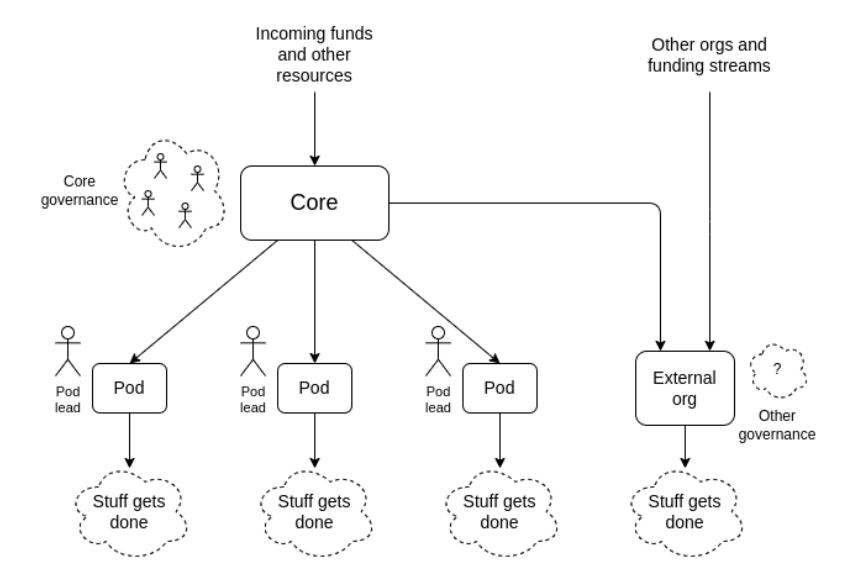
A natural question arises: isn't this “DAO” just a traditional multi-layer hierarchy repackaged? I would say it depends on implementation: adopting this model could indeed devolve into stereotypical corporate authoritarianism, but it could also be implemented very differently.
Two factors help ensure such organizations achieve meaningful decentralization:
- True high autonomy of pods. Pods receive resources from the core and may occasionally be reviewed for alignment and capability if they wish to continue receiving support. Otherwise, they act fully independently and do not “take orders” from the core.
- Highly decentralized and diverse core governance. This doesn’t require a “governance token,” but does require broad and diverse participation at the core level. Such participation usually reduces efficiency—but if (1) is satisfied and pods are highly autonomous, the core makes fewer decisions, so reduced efficiency at the top matters less.
How does this fit the “convex vs. concave” framework? Roughly as follows: the (more decentralized) top layer is concave, while the (more centralized) bottom layer within pods is convex. Giving a pod $X is generally better than randomizing between $0 and $2X. Compromise or inconsistent guiding principles across decisions cause little harm at the top. But within each pod, having clear decision guidance and maintaining coherent, consistent choices is crucial.
Decentralization and Censorship Resistance
In crypto, decentralization is often pursued for censorship resistance: a DAO or protocol must continue operating and defending itself against external attacks, including from large corporations or even governments. This has been widely discussed, so I won’t dwell on it, but some nuances remain.
The two most successful censorship-resistant services today are The Pirate Bay and Sci-Hub. The Pirate Bay is a hybrid system: a search engine for BitTorrent, a highly decentralized network. But the search engine itself is centralized, maintained by a small core team. It uses a whack-a-mole strategy: when hit, it relocates elsewhere. Both frequently change domains, exploit jurisdictional differences, and use other techniques. This strategy is centralized but succeeds in defensive agility and product improvement.
DAOs differ from The Pirate Bay and Sci-Hub; they resemble BitTorrent more closely. And BitTorrent must be decentralized—not just resistant to censorship, but also reliable and capable of long-term investment. If BitTorrent had to shut down annually and all seeders and users migrate to a new provider, the network would rapidly degrade. Censorship-resistant DAOs should be in the same category: they should avoid not only permanent censorship but also mere instability and disruption. MakerDAO (and Reflexer DAO, which manages RAI) exemplify this. You can build a regular search engine and use Sci-Hub-style tactics to survive, but that’s not enough for foundational infrastructure.
Decentralization as Credible Fairness
Sometimes, DAOs must assume some functions of nation-states—often described as “maintaining basic infrastructure.” Because governments have limited oversight over DAOs, DAOs must enforce greater self-governance structurally, which requires decentralization.

Consider three illustrative examples: algorithmic stablecoins, Kleros courts, and Optimism’s retroactive funding mechanism.
- Algorithmic stablecoin DAOs create crypto assets via on-chain financial contracts whose price tracks a stable index, usually (but not always) the US dollar.
- Kleros is a “decentralized court”: as a DAO, it rules on arbitration questions like “Is this GitHub submission acceptable for the on-chain bounty?”
- Optimism’s retroactive funding mechanism is part of the Optimism DAO, rewarding projects that have provided value to the Ethereum and Optimism ecosystems.
In all three cases, subjective judgment is required that cannot be automated by on-chain code. For stablecoins, the goal is a reasonable estimate of a price index. If tracking USD, you only need ETH/USD prices. But if hyperinflation or another crisis necessitates abandoning the dollar, the stablecoin DAO may need to manage a credible on-chain CPI calculation.
Kleros inevitably makes subjective judgments on submitted cases, including whether a case should be rejected as “unethical.” Optimism’s retroactive funding poses one of the most open-ended subjective questions: which projects contributed most to the Ethereum and Optimism ecosystems?
All three cases unavoidably require “governance”—and strong governance at that. In each, governance faces internal and external attacks that could cause serious problems. Thus, governance must not only be strong but also appear strong to a skeptical public.
The Achilles’ Heel of Algorithmic Stablecoins: Oracles
Algorithmic stablecoins depend on oracles. For an on-chain smart contract to know whether to peg DAI’s value at 0.005 ETH or 0.0005 ETH, it needs a mechanism to learn off-chain information about the ETH/USD price. In practice, this “oracle” is the primary attack vector for algorithmic stablecoins.
This creates a security dilemma: an algorithmic stablecoin cannot safely hold more collateral than the market cap of its speculative tokens (e.g., MKR, FLX...), and thus cannot issue more units. If allowed, it could buy half the speculative tokens, control the oracle, provide bad values, liquidate users, and steal their funds.
One alternative oracle design adds indirection. As quoted from ethresear.ch:
“We set up a contract with 13 ‘providers’; the answer to a query is the median of the providers’ responses. Weekly, token holders vote to replace one provider…”
“The security model is simple: if you trust the voting mechanism, you trust the oracle unless 7 providers collude. If you trust current providers, you trust outputs for at least six weeks, even if you distrust voting. So if voting is compromised, dependent apps have time to exit orderly.”
Note this proposal deliberately limits governance’s ability to act quickly, distributing oracle responsibility across many participants. This is valuable for two reasons. First, it makes it harder for outsiders to attack the oracle or for new large token holders to quickly seize control. Second, it makes collusion among oracle participants themselves more difficult. It also reduces extractable value—for example, a provider delaying data release to profit from liquidations (in a multi-provider system, others will publish promptly if one delays).
Kleros’ Fairness
The “decentralized court” system Kleros is a highly valuable piece of infrastructure in the Ethereum ecosystem.
Recently, there has been public concern about the fairness of its decisions. Some participants filed claims attempting to collect payouts from decentralized smart contract insurance platforms. The most notable was Mizu’s report on Case #1170. What began as a minor language dispute became a major scandal, with allegations that Kleros insiders colluded using large token holdings to sway decisions. One participant wrote:
“The court’s incentive-based decision process… is being consumed by devils who hold significant (25%) stakes in the court.”
Of course, this is just one side of a broader debate that the Kleros community must resolve. But more broadly, the key issue is how convincingly Kleros can assure the public it is protected from such centralized manipulation. To earn trust, it seems necessary to prevent individuals from holding 25% stakes in high courts. Whether through broader token distribution or non-token-based governance, a more credibly decentralized governance model could help Kleros avoid such concerns entirely.
Optimism Retroactive Funding
Optimism’s first round of retroactive funding results were selected by four votes from 24 “badge holders.” The second round may involve more badge holders, with the ultimate goal of evolving into a retroactive funding system controlled by a broader citizen body—possibly using multi-tiered mechanisms involving categorization, subcommittees, and/or delegation.
There has been internal debate about whether to have more or fewer citizens: does “citizen” mean closer to “senator”—a deep expert contributor in the Optimism ecosystem—or any visibly active participant, or something in between? My personal stance has consistently favored more citizens, addressing inefficiency through second-layer delegation rather than introducing centralization into governance protocols. My key reason is the risk of insider trading and self-dealing.
Optimism’s retroactive funding mechanism is designed to integrate with a future speculative ecosystem: public-good projects needing funds today can sell “project tokens,” and anyone buying such tokens becomes eligible for substantial future retroactive funding. But for this to work well, retroactive funding must function reliably—and this mechanism is highly vulnerable to corruption:
- If someone knows how they’ll vote on a project, they can buy (or short, if overpriced) its project tokens before the decision is announced.
- If someone knows they’ll later judge a specific project, they can buy its tokens early and then vote to fund it, even if unworthy.
- Funding decision-makers may accept bribes from projects.
There are typically three ways to handle such corruption and insider trading:
- Punish malicious decision-makers retroactively.
- Proactively filter for high-quality decision-makers.
- Add more decision-makers.
The corporate world focuses on the first two: financial regulation and explicit penalties for the first, personal interviews and background checks for the second. The decentralized world relies less on these tools: project tokens may trade anonymously, and DAOs have extremely limited recourse to external legal systems. The remote, online nature of projects and the desire for global inclusivity make background checks and informal face-to-face “screening” harder. Thus, the decentralized world must emphasize the third approach: distributing decision power among more participants, reducing each individual’s power and making collusion more likely to be exposed.
Should DAOs learn more from corporate governance or political science?
Curtis Yarvin, an American philosopher, argues that companies are more efficient and superior to governments, so we should make governments more company-like (e.g., moving away from democracy toward monarchy) to improve them. He recently wrote on how DAO governance should be designed:
“In contrast, the basic design of Anglo-American limited liability joint-stock companies has remained roughly unchanged since the start of the Industrial Revolution—a dissenting historian might call this a ‘corporate revolution.’ If the joint-stock company design isn’t perfect, we can expect it to evolve toward perfection.
While there’s a categorical difference between these two organizational types—we might call them first-order (sovereign) and second-order (contractual) organizations—contemporary society seems to have very effective second-order organizations but lacks effective first-order ones.
Therefore, we likely understand second-order organizations better. Hence, when designing DAOs, we should start from corporate governance, not political science.”
Yarvin correctly identifies the key distinction between “first-order” (sovereign) and “second-order” (contractual) organizations. But he then makes a surprising error by concluding corporate governance is a better starting point for DAOs. This is surprising because the logic of the situation almost directly implies the opposite conclusion. Because there is no sovereignty above DAOs, and because they explicitly engage in services (like money and arbitration) typically provided by sovereigns, DAOs should learn from the design of sovereignty (political science), not corporate governance.
To Yarvin’s credit, the second part of his post does advocate a “hourglass” model—combining decentralized layers of consensus and accountability with centralized management and execution. But this is already a consensus: DAO design must learn from both first-order and second-order institutions.
Sovereign states are inefficient, while companies are efficient—much like how number theory proves many things, but abstract group theory proves only a few: companies face fewer failure modes and achieve more because they can make stronger assumptions and have more powerful tools. Companies rely on local sovereignty for protection and external legal systems to stabilize incentives. But for sovereign states, the biggest challenge is precisely that when incentive structures are attacked or face collapse, there is no external Leviathan ready to step in.
When designing successful governance systems for sovereign states, the biggest issue is what Samo Burja calls the “succession problem”: ensuring continuity when the first generation retires and a new group takes over. As Burja writes, companies often don’t solve this:
“Silicon Valley’s obsession with ‘disruption’ reflects our comfort with succession problems never solved in standalone institutions like companies.”
DAOs will eventually need to solve succession (in fact, given many early crypto adopters follow a ‘get rich and exit’ path, some DAOs already face this). Monarchies and company-like forms often struggle with succession because institutional structure is tightly tied to a particular individual’s habits—making handover either difficult or risky. More decentralized political forms like democracy at least offer theories for smooth transitions. Thus, I believe DAOs can learn far more from freer, more democratic strands of political science than from corporate governance.
Of course, DAOs must sometimes perform specific complex tasks, and using company-like forms for these is sensible. Moreover, DAOs must handle unexpected uncertainty. If a system is designed to operate stably under a fixed set of assumptions, extreme unforeseen changes may require decisive leadership to coordinate response. A classic example: a stablecoin DAO committed to tracking the dollar suddenly finds the dollar unviable and must rapidly switch to a CPI-like index—what then?
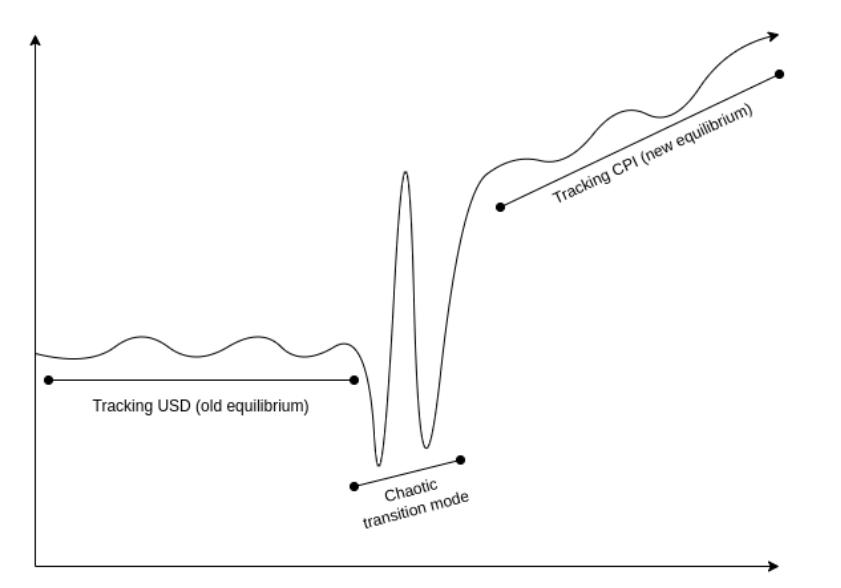
In such cases, corporate governance may offer a heuristic: founders as pivot points. But history also offers political models—including how to return to decentralization after crisis: the Roman Republic had a tradition of electing temporary dictators during emergencies.
In fact, we may need only a few DAOs—those resembling political constructs more than corporate governance—but they are the truly important ones. A stablecoin doesn’t need to be efficient; it must first be stable and decentralized. A decentralized court is the same. Systems funding specific causes—whether Optimism retro-funding, VitaDAO, UkraineDAO, or others—aim not at profit maximization. They need coherence beyond shareholder profit incentives to ensure funds stay aligned with intended purposes.
Most organizations—even in crypto—will remain “contractual” second-order entities ultimately relying on first-order giants. For these, lean, leader-driven, agility-focused governance makes sense. But we must not lose sight of the fact: without some non-corporate decentralized forms maintaining overall stability, the ecosystem cannot exist.
Join TechFlow official community to stay tuned
Telegram:https://t.me/TechFlowDaily
X (Twitter):https://x.com/TechFlowPost
X (Twitter) EN:https://x.com/BlockFlow_News
 @VitalikButerin











