








Polygon 2.0: Becoming the value layer of the internet through infinite scalability and unified liquidity
TechFlow Selected TechFlow Selected
Polygon 2.0: Becoming the value layer of the internet through infinite scalability and unified liquidity
Polygon's true journey to becoming the value layer of the internet begins today.
 Navigating Web3 tides with focused insights
Written by: Polygon (Labs)
Compiled by: TechFlow
Today, the Polygon 2.0 architecture has finally been unveiled, aiming to achieve infinite scalability and unified liquidity, transforming Polygon into the value layer of the internet!
-
Infinite Scalability — powered by ZK-based L2 chains;
-
Unified Liquidity — enabled by a novel interoperability layer introduced in the architecture.
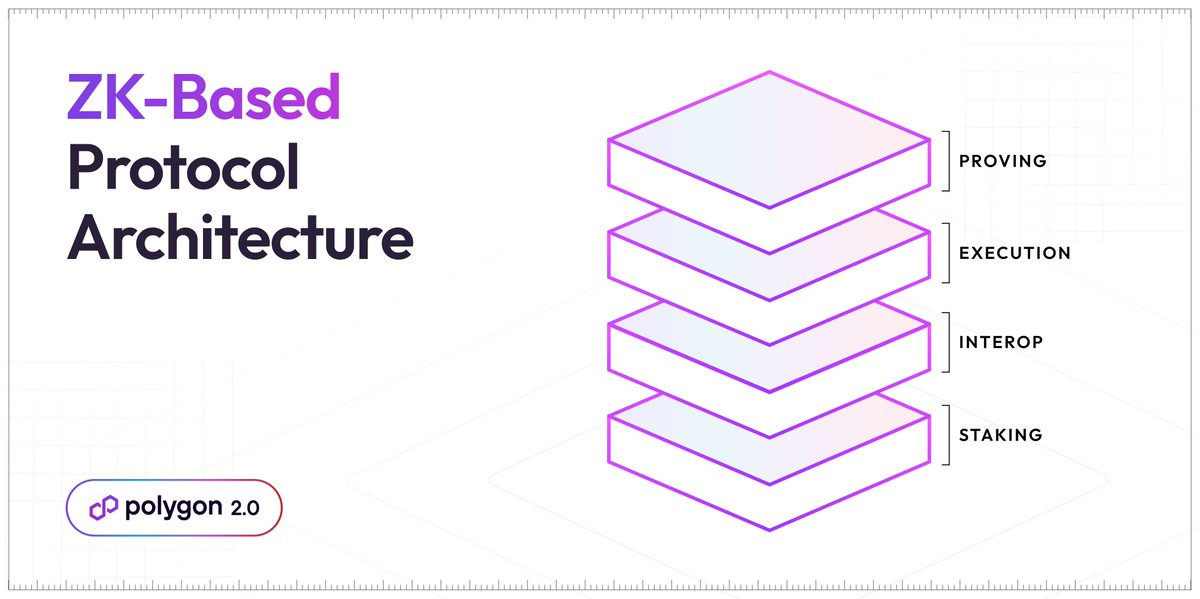 The Polygon 2.0 architecture consists of four protocol layers, each playing a critical role within the network:
→ Staking Layer
→ Interoperability Layer
→ Execution Layer
→ Verification Layer
What are these layers, and what roles do they play? Let's dive in...
 The Staking Layer, based on Proof-of-Stake (PoS), leverages Polygon’s native token to provide “out-of-the-box” decentralization for participating Polygon chains. It achieves this through a shared, highly decentralized validator pool and a built-in restaking model. The restaking model allows users to stake their Polygon tokens just once but participate across multiple layers and earn fees.
This enables Polygon chains to focus on their use cases and communities rather than infrastructure.
For validators, it offers rewards in $MATIC while generating additional income through transaction fees/rewards from the chains they validate.
The Interoperability Layer facilitates cross-chain messaging within the ecosystem. It uses Plonky3’s ultra-fast recursive proofs for proof aggregation, abstracts away the complexity of cross-chain transactions, and makes the entire Polygon network feel like a single chain by enabling:
-
Shared access to native Ethereum assets;
-
Seamless composability.
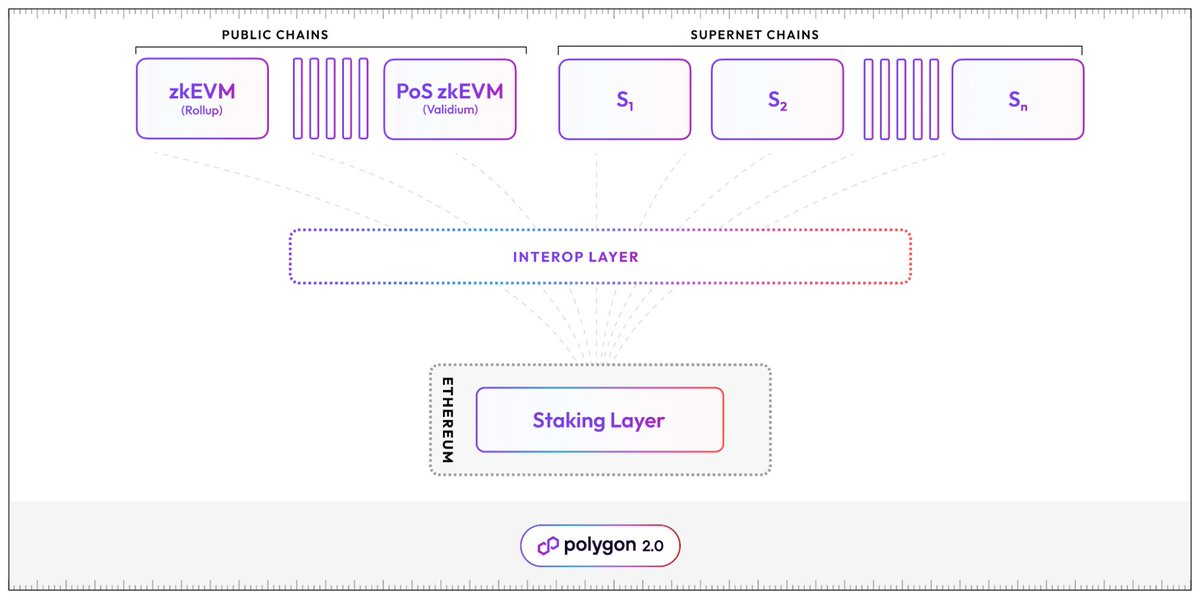
The Interoperability Layer is realized through the LxLy protocol based on Polygon zkEVM, combined with corresponding zero-knowledge proofs to ensure secure message transmission.
The Execution Layer enables any Polygon chain to generate ordered batches of transactions—commonly known as blocks. It includes several components commonly found in most blockchain networks (Bitcoin, Ethereum, etc.):
-
P2P (peer-to-peer);
-
Consensus mechanism;
-
Database;
-
Synchronization;
-
Mempool, etc.
This protocol layer is largely standardized—most blockchain networks use similar formats—but implementation is relatively complex. Therefore, existing efficient implementations (e.g., Erigon) should be reused wherever possible.
The Verification Layer is an efficient and flexible proving protocol that provides proofs for all transactions on every Polygon chain. It consists of three components:
→ Universal Prover — proves transactions
→ State Machine Constructor — defines the state machine
→ State Machine — interprets transactions.
Its novel design brings several key advantages, including:
-
Efficient proof generation and verification;
-
Simple and efficient proof aggregation;
-
Ability to define different zero-knowledge state machines;
-
Secure cross-chain communication between these state machines.
Polygon’s true journey to becoming the value layer of the internet begins today.
Join TechFlow official community to stay tuned
Telegram:https://t.me/TechFlowDaily
X (Twitter):https://x.com/TechFlowPost
X (Twitter) EN:https://x.com/BlockFlow_News
 @0xPolygonLabs


