








Decoding the restaking赛道: How it works, pros and cons, and potential projects?
TechFlow Selected TechFlow Selected
Decoding the restaking赛道: How it works, pros and cons, and potential projects?
ReStaking is not a fleeting narrative, but one of the most important and promising areas in DeFi.
 Navigating Web3 tides with focused insights
Author: Beehive Validator
Compiled by: TechFlow
Currently, staking is one of the largest sectors in the DeFi market, with Lido—the liquid staking protocol—leading in total value locked (TVL). It enables ETH holders to earn greater profits while enhancing Ethereum's decentralization and security.
Since Ethereum's transition to PoS, demand for staking ETH has surged dramatically, driving the development of liquid staking protocols. Today, numerous blockchain platforms—including Ethereum, Near, BNB Chain, Avalanche, Cosmos, Sui, and Aptos—utilize the PoS consensus mechanism. Therefore, we believe the potential of the liquid staking market is immense.
So why use liquid staking?
Liquid staking addresses key issues such as simplifying staking processes, avoiding liquidity lockups, and improving network decentralization. In the DeFi market, we closely monitor liquidity constraints—for example, the Lido protocol allows users to stake ETH and receive an equivalent value of stETH, which can be transferred to exchanges or used across DeFi applications.
ReStaking refers to the practice of reusing liquid staking derivative tokens (such as stETH) by staking them into validators on other networks or blockchain platforms. This concept was first introduced by EigenLayer, maximizing the utility of liquid staked assets and paving the way for the development of numerous other applications.
What is ReStaking?
ReStaking is the act of using liquid staking derivative tokens to stake with validators on other networks or blockchains to earn additional yield, while simultaneously contributing to the security and decentralization of new networks.
ReStaking can also be understood as reinvesting part or all of the rewards earned from staking back into the same node to increase future profits. However, this article primarily focuses on the concept of staking LSD tokens on other networks.
Through ReStaking, investors can earn double yields—from both the original network and the ReStaking network. Although ReStaking enables stakers to achieve higher returns, it also introduces risks such as smart contract vulnerabilities and fraudulent validator behavior.
In addition to accepting native assets, ReStaking networks also accept other assets like LSD tokens and LP tokens, thereby increasing network security. This unlocks an infinite source of liquidity for the DeFi market while still generating real revenue for protocols and their users.
Both ReStaking networks and standard networks generate income from security leasing, fees paid by validators, dApps, protocols, and layers. Participants in the network receive a share of this revenue and may also earn inflationary rewards in the form of the network’s native token.
How ReStaking Works
ReStaking networks are similar to other networks, with the only difference being that they accept more low-volatility, low-risk assets that enhance security. When a network has high staked value, attackers would need to acquire a majority of the staked equity, requiring massive capital. Additionally, ReStaking helps asset holders increase profits.
Each ReStaking project will have different goals and operational mechanisms, though differences between them are generally small.
Pros and Cons of ReStaking
Advantages:
-
Unlocking Liquidity for LSD and LP Tokens: Staking LSD or LP tokens with validators increases the amount of native assets staked on the original network and provides DeFi with more liquid asset options.
-
Enhanced Yield: By enabling the asset to generate returns on two networks, stakers can earn double yields. Moreover, after staking assets on the second network, investors continue to receive representative tokens that can be used as collateral to mint stablecoins and generate profits in DeFi markets.
-
Increased Security for Networks Using Liquid Staking: As more assets are staked, network value rises, making it more resistant to attacks and establishing itself as a trusted foundation for other decentralized applications, protocols, and platforms.
-
Reduced Selling Pressure: ReStaking makes native tokens more useful, helping avoid sell-offs that could lead to significant value loss for the project and its investors.
-
Increased Incentive for Native Asset Holders to Participate in Staking: Encourages greater participation, enhancing network security and decentralization.
Disadvantages:
-
Risk of Asset Loss: If a validator behaves improperly, your assets face slashing or penalties, potentially resulting in partial or complete loss.
-
Smart Contract Risk: If the network is hacked, you risk losing all your assets. However, theoretically, networks using liquid staking are extremely difficult to attack.
-
Asset Bubbles: Market inflation through new wrapped tokens or multiplied token values can cause market prices to diverge from intrinsic value. Continued use of assets representing value locked in validators to mint stablecoins increases systemic risk and exposes underlying assets to liquidity fragility.
-
Excessive Token Proliferation: Too many tokens in the market can confuse newcomers and make them vulnerable to scams. Low-quality projects minting large quantities of worthless tokens will flood the cryptocurrency space.
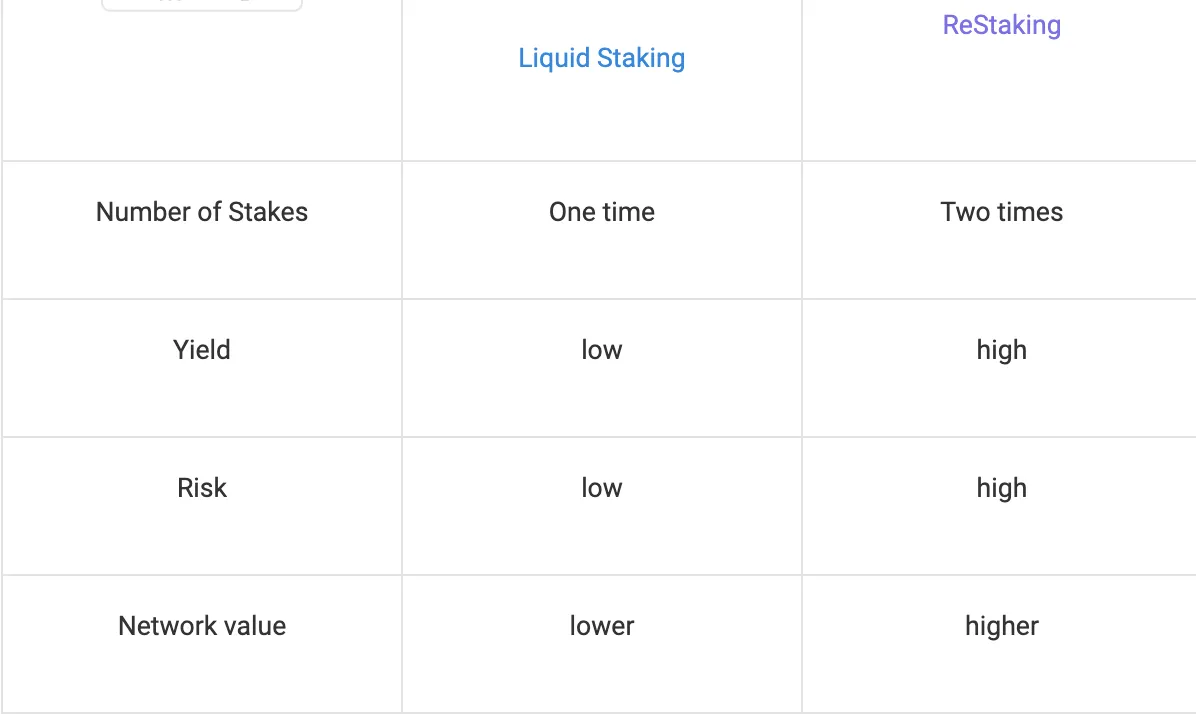
Comparing ReStaking and Liquid Staking
Outstanding Projects in the ReStake Space
EigenLayer
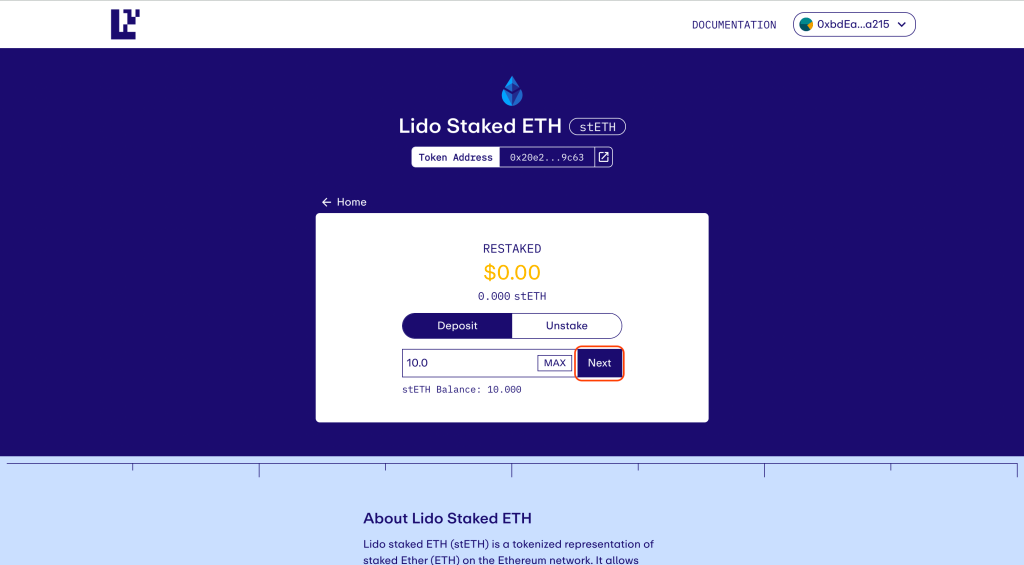
EigenLayer is developed by a highly respected and experienced team in the crypto market. The project has secured $64.5 million in funding, backed by notable investors including Blockchain Capital, Coinbase Ventures, Polychain Capital, and Electric Capital.
EigenLayer was the first team to develop and introduce the ReStake model to the community. The project uses LSD ETH and LP ETH for validator staking. Ethereum network nodes continue to participate in Ethereum validation.
EigenLayer’s core business model revolves around security leasing and validation. Customers can include dApps, Layer 2 protocols, or cross-chain bridge protocols. They can choose validators with high or low security levels depending on their needs. A single validator can serve multiple clients.
Protocols adopting the network generate revenue for EigenLayer, a portion of which is distributed to stakers. Users do not receive a secondary token when staking assets on the EigenLayer network. Additionally, users must select reputable validators to ensure asset safety. If a validator misbehaves, the network imposes penalties that could result in partial or full confiscation of staked assets—meaning those who delegated to the validator would also lose their funds.
Pros and Cons of EigenLayer
Pros:
-
EigenLayer serves as foundational infrastructure for many other dApps, protocols, Layer 2s, Layer 3s, and clients.
-
The architecture of attaching validators to individual layers multiplies network value exponentially. Slashing mechanisms for misbehaving validators minimize hacking risks.
-
Ethereum validators can earn additional income by participating in the EigenLayer network. A single validator can verify multiple clients.
-
Maximizes profitability and utility of holding LSD ETH and LP ETH assets.
-
Attracts many participants due to enhanced Ethereum security and high yields from staking ETH.
Cons:
-
Smart contract risk—if the network is compromised, you could lose all your assets. However, theoretically, ReStaking-based networks are extremely hard to attack.
-
Validators may be penalized for misconduct, putting your assets at risk of confiscation or fines, potentially leading to partial or total permanent loss.
-
Branching or disputes could fragment the Ethereum community. As Vitalik recently noted, EigenLayer reuses ETH assets and validators from Ethereum.
-
EigenLayer must build a sufficiently large ecosystem and customer base. If incentives are issued in project tokens—or if there are no incentives—the returns may no longer be attractive to stakers.
Tenet
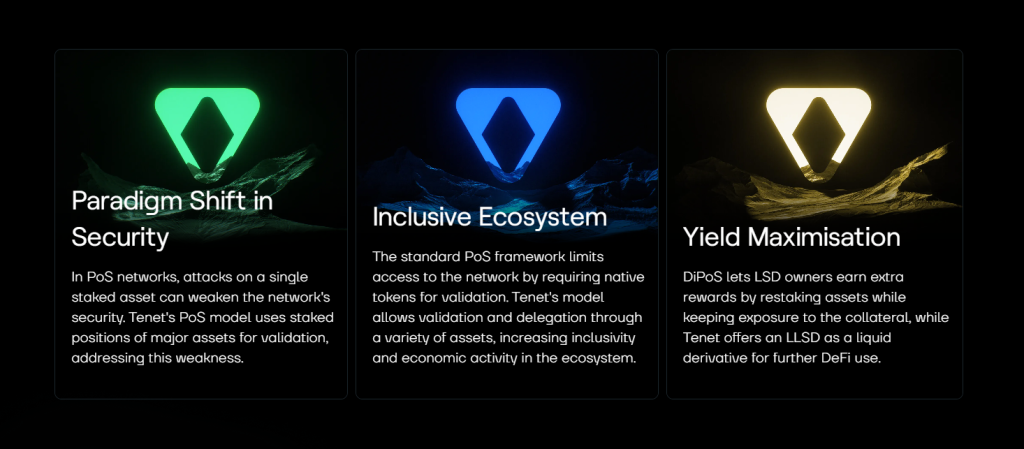
Tenet is a Cosmos-based L1 built using the Cosmos SDK toolkit. The project is developed by the same team behind BNB Chain’s ecosystem and ANKR—the largest liquid staking project in the Cosmos ecosystem.
Tenet and other blockchain platforms adopt the PoS consensus mechanism, integrating governance Stake Tokens into validators to secure the network. Compared to networks like Ethereum, BNB Chain, Cosmos, Cardano, Polygon, Avalanche, and Polkadot—which accept LSD token assets—Tenet is more advanced.
Investors participating in asset staking will receive tLSDToken. This asset can serve as collateral to mint the stablecoin LSDC, allowing continued profit generation within DeFi markets.
Tenet’s business model includes charging network fees and compensating validators. Additionally, the network distributes TENET governance tokens as block rewards. Rewards are distributed proportionally based on staking share. TENET always carries a weight of 1, while DAO determines the weights of other assets, all of which will be less than 1.
When borrowing LSDC, borrowers pay a one-time fee calculated as a percentage of total assets, ranging from 0.5% to 5%. Similarly, converting LSDC on TENET incurs a one-time swap fee between 0.5% and 5%. All these fees depend on network activity—lower activity means cheaper fees, and vice versa—ensuring LSDC maintains its $1 peg.
Staking TENET yields veTENET, which grants access to project governance, revenue sharing, and additional rewards.
Creating a sufficiently large revenue-generating ecosystem to attract investors remains the most critical factor. If network activity is slow and users don’t utilize TENET tokens as block rewards, the network cannot grow.
Pros and Cons of Tenet
Pros:
-
Supports multiple native tokens from other blockchains.
-
Stake to receive tLSDToken as collateral, enabling LSDC minting and participation in DeFi for higher profits.
-
Offers interest-free LSDC loans with a minting fee of 0.5%–5%, based on network activity.
-
Fees rise with high conversion activity and fall during low activity—a mechanism that helps stabilize LSDC’s price.
-
The veToken model using TENET governance tokens is excellent; veTENET holders gain voting power and revenue-sharing rights, helping prevent dumping of TENET tokens.
Cons:
-
Smart contract risk and risk of liquidation of underlying assets when borrowing Stablecoin LSDC exist.
-
TENET tokens are rewarded for every new block, causing inflation.
Outlook on ReStaking
Currently, staking is the largest market in the DeFi industry, with a total value of approximately $20 billion (TVL). With many blockchain platforms under active development and the crypto market continuously expanding, the ReStaking market holds abundant growth opportunities.
As staking and ReStaking contribute to DeFi expansion, underlying blockchains become more secure and investors gain higher passive income. Furthermore, the growth of these two markets will pave the way for other sectors such as AMM, lending, and yield farming.
Under current market conditions, ReStaking has ample room to grow and become an indispensable part of DeFi. Beyond increasing profits, ReStaking also increases participants’ exposure to risk.
Conclusion
By late 2022—about six months after ReStaking emerged—the market began rapidly expanding and becoming a trend. ReStaking is not a fleeting narrative but one of the most important and promising areas in DeFi.
Because ReStaking not only helps users earn profits but also enhances platform security, especially by stimulating growth in other sectors of the industry and driving overall market expansion.
However, it also comes with risks such as asset loss, smart contract vulnerabilities, asset value inflation, and bubble bursts. Therefore, when participating in this market, we must proceed cautiously and be prepared for the risk of capital loss.
Join TechFlow official community to stay tuned
Telegram:https://t.me/TechFlowDaily
X (Twitter):https://x.com/TechFlowPost
X (Twitter) EN:https://x.com/BlockFlow_News
 @Beehive_Vali






