How to evaluate the quality of an X-to-Earn project's economic model?
TechFlow Selected TechFlow Selected
How to evaluate the quality of an X-to-Earn project's economic model?
A good project target isn't necessarily the one using the latest economic model.
 Navigating Web3 tides with focused insights
Author: veDAO Research Institute
How important is an economic model for a Web3 project? Among 10 people, perhaps 8 would say it's important. Yet to some extent, the economic model isn't that crucial—either because most projects follow highly similar economic paradigms, or because the specific token allocation ratios are often not as professionally determined as they appear externally. In reality, most token distribution figures are essentially arbitrary decisions made by founding teams, based on referencing established market solutions.
Now, let’s revisit the earlier question: How important is an economic model for a Web3 project? It is important—but only when integrated with the project’s vision, product quality, and other fundamental elements, rather than merely stacking complex formulas within the economic model as a numbers game.
In fact, a good project doesn’t necessarily adopt the latest economic model, nor does the model need to be particularly complex—it just needs to be the most scientifically sound one, closely aligned with the product’s characteristics.
This article from veDAO aims to provide readers with a foundational understanding of economic model components, enabling more effective project evaluation in the future.
What Is an Economic Model?
First, we must clarify: What exactly is an economic model?
Economic Model (Tokenomics): A portmanteau of "Token" and "Economics," tokenomics refers to the economic mechanisms governing cryptocurrency issued within blockchain ecosystems. Its primary functions include managing token supply, utility, distribution, incentives, governance, monetary policy, and more.
With the rise of DeFi and increasing on-chain participation channels such as interactions, airdrops, staking, and IDOs, users now have greater opportunities to engage with projects during their early growth phases. Consequently, attention toward project tokenomics has intensified. At its core, tokenomics underpins all current on-chain activity. Project teams must use tokens to incentivize various participants and sustain a self-operating economic incentive system; as participants in the decentralized revolution, investors must analyze the strengths and weaknesses of different tokenomic designs when selecting investment targets, since tokens represent the dominant fundraising method in Web3, making tokenomics a key determinant of investment returns.
The Importance of Economic Models
There's a saying: “Going from 0 to 1 relies on the product; going from 1 to 100 relies on the economic model.” A high-quality product first requires solid fundamentals to initiate momentum, after which the economic model helps spin the flywheel forward.
Therefore, economic models hold the following significance for a product:
1. Replacing Traditional User Acquisition
For internet products, economic models offer a new business paradigm. Whereas traditional products survive by offering low user prices—even at a loss—and spending heavily on user acquisition to gain market share before monetizing later, blockchain projects can leverage tokens to compete for users.
With tokens, market capture becomes a native function. Through market cap management, projects create value windows that attract holders and occupy user mindshare. The emergence of such value windows naturally draws more users and market attention, effectively replacing traditional paid user acquisition.
A classic example is the battle between Uniswap and Sushiswap during DeFi Summer. As the pioneering DEX, Uniswap initially refrained from launching a token, but Sushi capitalized by airdropping SUSHI tokens to early Uniswap liquidity providers (LPs). At its peak, Sushi captured 70% of Uniswap’s user base, triggering alarm at Uniswap.
Sushiswap’s cold start and rapid rise were built upon a “vampire attack” against Uniswap. Upon launch, it quickly attracted liquidity by allocating SUSHI tokens to early LPs. With each block, new SUSHI tokens were minted and distributed to LPs. Initially, only LP tokens from specific Uniswap pools were eligible, causing Uniswap’s total value locked (TVL) to surge temporarily.
Two weeks later, Sushiswap initiated liquidity migration, moving all qualifying LP tokens from Uniswap back to its own platform—thereby rapidly siphoning off Uniswap’s liquidity.
2. Reducing Fundraising Difficulty and Shortening Payback Period
As mentioned above, traditional internet products typically need to achieve market dominance before turning profitable—partly explaining why companies like JD.com and Bilibili operated at a loss for years. However, a Web3 product issuing tokens can generate revenue early by front-loading earnings through its economic model. This allows teams to recycle raised capital into development, accelerating the flywheel effect.
It must be acknowledged that, in today’s Web3 context, most projects still primarily profit by selling tokens. If a project qualifies to issue a token but chooses not to, the entire burden of profitability shifts solely onto product quality—essentially reverting to competition under traditional internet business models.
This phenomenon is common in the Web3 industry, especially among teams transitioning game-focused operations to blockchain. Due to the nature of gaming, these teams often include many Web2 veterans who may harbor inherent fears about international regulations or remain constrained by traditional game development mindsets. Despite building blockchain games, they hesitate to launch tokens, significantly increasing operational pressure and reducing startup success rates.
Moreover, even for pure Web3 projects, choosing not to issue a token can result in passivity within the Web3 ecosystem. Take OpenSea, for instance: it once held over 98% of the NFT marketplace share and generated over $350 million in monthly revenue via a 2.5% transaction fee.
However, due to slow iteration speed and a preference for equity financing, OpenSea never launched a token. Competitors like LooksRare, X2Y2, and Blur seized this opportunity by using token airdrops and incentives to lure top users away from OpenSea.
According to DappRadar data, by June this year, Blur—a project with innovative tokenomics—had reached $167.7 million in total value locked, capturing 65% of the NFT market, while former leader OpenSea had dropped to 27%.
Types of Economic Models
Currently, within the industry, X-to-Earn project economic models can be categorized into four types of tokens: governance tokens, utility tokens, special-purpose tokens, and NFTs.
Here, we reference Buidler DAO’s definition from their article “Tokenomics: The Economic Order of the Crypto World” regarding these four token types:
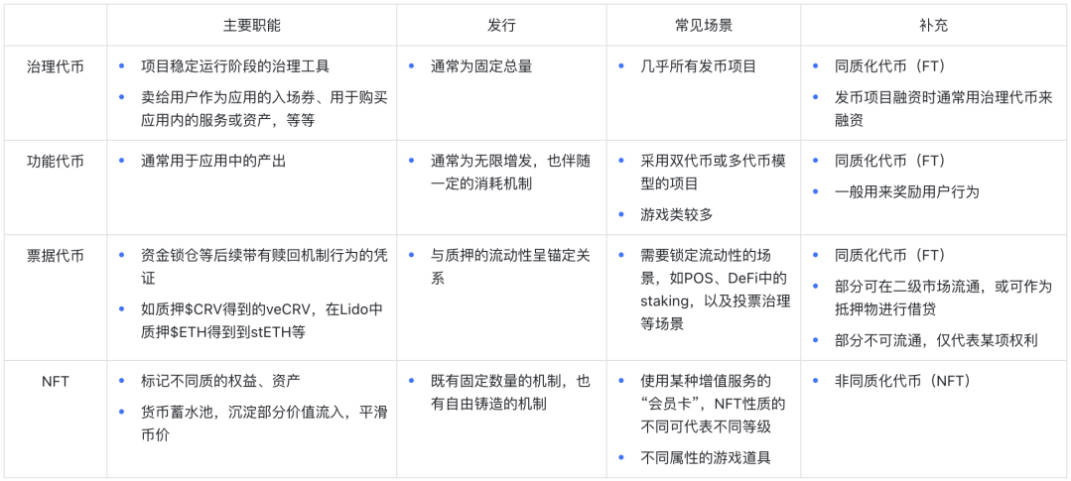
Notably, Buidler DAO classifies voucher tokens directly as a third special category. However, this scope could be broadened further. Today, many blockchain games and social platforms commonly introduce an off-chain points-like token alongside standard dual-token models, convertible to on-chain currency only under specific conditions. These point-based tokens should also be considered part of the special third category.
Based on combinations of these four token types, mainstream approaches today fall into three categories: single-token, dual-token, and triple-token models.
Single-Token Model: Refers to a single token issued based on the ecosystem itself. This type typically serves only governance purposes (e.g., UNI), or combines both governance and utility functions.
However, since most single-token models adopt a fixed supply, if the token serves only governance, its value may struggle to materialize, leading to declining holding incentives as project development slows.
If it combines governance and utility, users accumulate more tokens through various activities, potentially triggering explosive inflation and negatively impacting market valuation during IDO.
Thus, many projects optimize this model by separating governance and utility functions—giving rise to the so-called dual-token model—or by representing utility functions via point systems.
Dual-Token Model: Generally refers to a combination of governance and utility tokens, sometimes including NFTs. NEAR was among the first to propose this: its stablecoin USN acts as a native asset integrated into the protocol layer, used for paying gas and storage fees—considered an early prototype of utility tokens. Later, Axie Infinity popularized this model.
The dual-token model significantly delays the death spiral seen in single-token systems. By linking utility and governance tokens, it redirects and absorbs selling pressure on governance tokens, reducing project failure risk. However, managing a two-token system is far more complex than simply doubling effort. Once multiple tokens exist within a system, fairly allocating value becomes critical. Additionally, since utility tokens are often infinitely minted, they’re prone to inflation. If excessive inflation or other factors cause price drops, more tokens must be issued to maintain sufficient user incentives, further exacerbating inflation.
Triple-Token Model: Not widely adopted in the Web3 market, as it was initially seen as merely patching the dual-token model. However, some innovations have emerged. A well-known example is last year’s VCT model: adding an asset value-capturing token atop the traditional governance + utility structure.
The VCT token is tightly linked to the utility token: in quantity, their ratio remains permanently 1:1 regardless of inflation or deflation; in price, every utility token can always be exercised (redeemed from the project team for one VCT token, which can then be exchanged for an equivalent amount of stablecoins based on current VCT price). Thus, the utility token’s price always stays equal to or higher than the VCT token’s price.
Additionally, the VCT token is invisible to regular players, imposes no additional burden, and does not trade on secondary markets—only activated during redemption. Redemption is one-way and irreversible: each utility token and corresponding VCT token can only be redeemed once, after which both are destroyed.
For example:
-
Game utility token supply = VCT supply = 10,000
-
Total value of VCP (ad revenue, fiat income) = 10,000 USDT
-
Therefore, 1 VCT = 1 USDT
-
If the game’s utility token faces massive sell-offs, dropping from 3 USDT downward
-
Thanks to the redemption mechanism, players feel assured of locking in at least 1 USDT return, preventing panic. Moreover, the deflationary expectation from redemptions helps curb the decline of the utility token.
When introduced, this model sparked intense discussion. Prior to this, many game teams already allocated portions of governance tokens specifically for VCT-like functions. So, under existing functional conditions, is introducing another token necessary? Furthermore, models like VCT represent enhancements applicable only when a game already captures significant value—they’re icing on the cake, not solving the initial liquidity challenge.
Key Elements of Economic Models
After discussing classifications of X-to-Earn economic models, we must examine several key dimensions:
First, the three core elements of an economic model:
-
Supply: Sources of the target token, generally falling into two categories:
-
Public Sale Methods: ICO, IEO, IDO, Launchpad, Fair Launch (BendDAO model—all users pay same cost), ILO (X2Y2 model—Initial Liquidity Offering, now common among small projects).
-
Incentive Mechanisms: Airdrops, TVL investment rewards, staking incentives, volume-based incentives (mainly for exchanges), liquidity provision (DEX-focused), P2E (X-to-Earn models).
Three key terms to understand:
-
TGE: Amount of tokens circulating at launch; Cliff: Duration of lock-up before unlocking begins; Vesting: Time period over which tokens are gradually released.
-
Demand: Use cases for the target token, typically including: value storage, spending, mining, governance, protocol revenue sharing, collateralization, memes, speculative demand (sector rotation).
-
Value Capture: Ultimately addresses how token value is captured: payment of service fees (MV=PY), buybacks & burns (less common since staking became widespread), staking-based protocol revenue, buyback rewards.
Conclusion
In summary, a strong economic model should possess the following traits: low inflation, high incentives, low selling pressure, diverse use cases, ample liquidity, and governance dominated by B2B participants.
Additionally, when investing in public chains or other projects requiring decentralized governance, analyze whether the economic model sufficiently incentivizes network validators and enables token value capture—ensuring sustained, stable services for users while allowing validators to earn value and minimizing their selling pressure.
When investing in DeFi or other capital-intensive projects, focus on how the model balances interests between liquidity providers (LPs) and governance token holders—specifically whether revenues adequately incentivize LPs to maintain liquidity and whether governance token holders receive fair revenue shares.
That said, superior products remain key to user retention. As previously stated, while economic models enable the transition from 1 to 100, the hardest part—from 0 to 1—depends fundamentally on product quality and operational excellence.
Join TechFlow official community to stay tuned
Telegram:https://t.me/TechFlowDaily
X (Twitter):https://x.com/TechFlowPost
X (Twitter) EN:https://x.com/BlockFlow_News
 @TrendX_official