








Uniswap's Evolution: A Brief Analysis of V4's Potential Opportunities and Impact
TechFlow Selected TechFlow Selected
Uniswap's Evolution: A Brief Analysis of V4's Potential Opportunities and Impact
Uniswap V4 is moving toward becoming true infrastructure for DeFi, enabling developers to conduct imaginative and innovative experiments on Uniswap V4.
 Navigating Web3 tides with focused insights
Author: Yilan, LD Capital
Uniswap V0
Uniswap V1 was launched in November 2018. However, a prototype of Uniswap had already taken shape a year earlier. In 2017, founder Hayden left Siemens. A friend from the Ethereum Foundation, Karl, consoled him: "Mechanical engineering is a sunset industry—Ethereum is the future." Guided by Karl, Hayden learned about Ethereum and Solidity, and in November 2017 created his Proof-of-something (Proof of concept AMM as they named it), which became Uniswap V0. This image shows what Uniswap looked like at its very beginning.
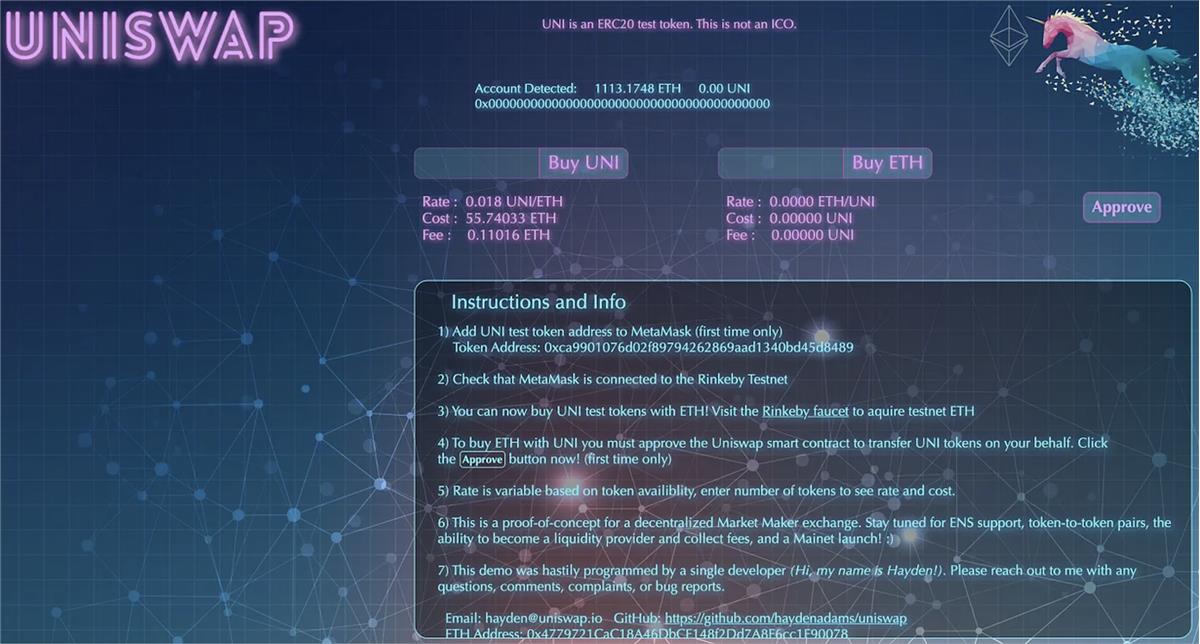
Before the official launch of V1, Hayden worked on V0 using office space from Balance and MakerDAO. At the end of July 2018, Uniswap officially received a grant from the Ethereum Foundation.
Uniswap V1
On November 2, 2018—the final day of Devcon 4—Uniswap’s smart contracts were deployed on the Ethereum mainnet. On that day, only $30,000 in liquidity was deposited as base liquidity for three tokens, allowing for just $100 in trading depth. Shortly after, uniswap.io and app.uniswap.org/# were also launched.
In September 2019, Uniswap V1 launched its first liquidity mining program based on ERC-20 tokens. During the V1 phase, trading volume and user scale were relatively small. As the first version of the Uniswap protocol, V1 used an Automated Market Maker (AMM) mechanism that allowed users to conduct permissionless token trades on the Ethereum blockchain without order books. It adopted the constant product model x*y=k, where x and y represent the balances of two tokens in a trading pair.
The innovative mechanism of Uniswap V1 enabled fast and convenient token trading without relying on traditional centralized exchanges, laying the foundation for subsequent versions and inspiring other AMM protocols. However, the Uniswap V1 version at the time did not attract many users.
Uniswap V2
Uniswap V2 was released in May 2020. Around the same time, in September 2020, SushiSwap emerged in the crypto community, drawing significant attention and users—this is what truly brought Uniswap into the spotlight.
The most significant improvement in Uniswap V2 over V1 was the introduction of multiple token pair trading, increasing flexibility by upgrading from ERC-20/ETH swaps to support direct ERC-20/ERC-20 exchanges. Additionally, Uniswap V2 introduced major improvements to the Time-Weighted Average Price (TWAP) oracle.
The launch of Uniswap V2 solidified its position in the decentralized exchange space. It provided more features and flexibility, enabling users to better manage liquidity and execute various types of trades. Uniswap V2 also contributed significantly to the rapid growth of decentralized finance (DeFi), serving as a crucial source of liquidity.
Uniswap V3
Uniswap V3 was launched in May 2021, introducing the concept of “Concentrated Liquidity.” It allows liquidity providers to define specific price ranges within a trading pair, enabling more precise price control. This increases fee earnings for liquidity providers and reduces opportunities for arbitrageurs to exploit price differences.
Uniswap V3 also expanded upon V2's oracle system, optimizing TWAP calculations and gas efficiency. The V3 oracle can extend data availability up to nine days or longer with a single on-chain call, and through overall TWAP optimization, reduces gas consumption by approximately 50% compared to V2. Simple trades are about 30% cheaper than their V2 equivalents.
Additionally, while Uniswap V2 used a standard 0.3% fee, V3 introduced three distinct fee tiers: 0.05%, 0.3%, and 1%. This allows liquidity providers to choose pools based on their risk tolerance. V3 also introduced the use of NFTs as proof of liquidity provision, meaning liquidity positions are tracked via non-fungible ERC721 tokens.
The release of Uniswap V3 had a major impact on the DeFi ecosystem. It gave liquidity providers more choices and better earning opportunities while improving trading efficiency. Uniswap V3 also drove innovation in decentralized exchanges and led other platforms to improve user experience and reduce transaction costs. However, it has also been criticized for allowing JIT (Just-in-Time) liquidity and professional market makers to crowd out passive LPs from fee revenues.
Uniswap V4 — Hooks Change Everything
Since the draft whitepaper of Uniswap V4 was released, the market has offered extensive analysis. Key enhancements mentioned include Hooks, Singleton, Flash Accounting, and native ETH support, with Hooks being V4’s most important innovation. Uniswap V4’s Hooks could become the most powerful tool for liquidity construction; in the future, building a DeFi platform and integrating liquidity will become significantly cheaper.
Hooks
In simple terms, Hook contracts are smart contracts that invoke other smart contracts—custom logic executed at key points in a transaction lifecycle. These logics are implemented by user-defined contracts and triggered at critical moments.
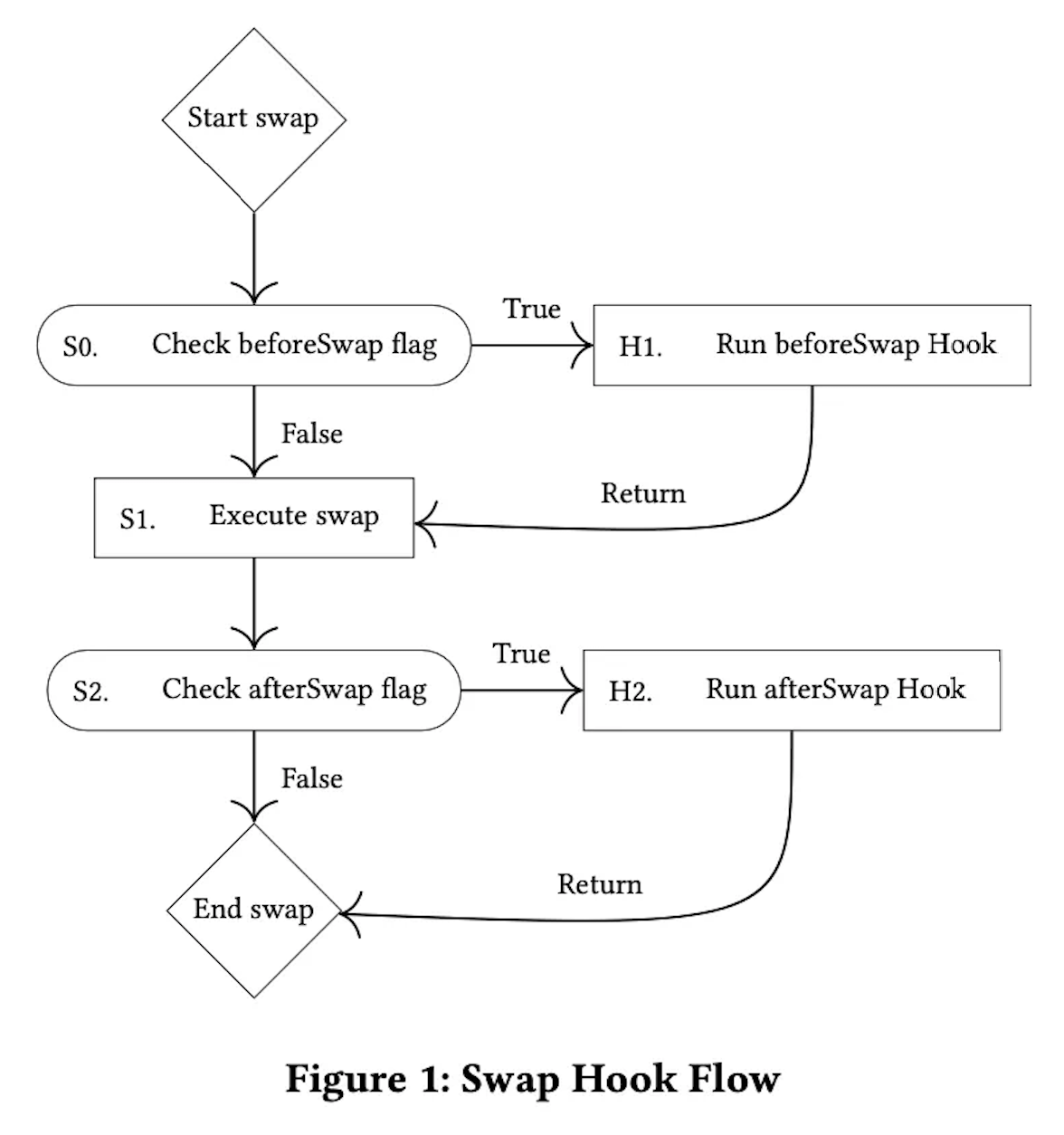
Specifically, Hook contracts can be invoked at the following key points:
· onSwap: Called during a swap, enabling custom logic such as recording trade data, executing specific actions, or modifying fees.
· onMint: Triggered when a liquidity provider adds liquidity to a pool, allowing for custom logic like logging LP details or triggering operations.
· onBurn: Invoked when a liquidity provider withdraws liquidity, supporting custom logic such as tracking withdrawals or executing post-withdrawal actions.
Previously, developers could only customize LP parameters and LP fees; with V4 Hooks, developers can innovate further atop Uniswap’s existing liquidity and security, enabling richer customization. Uniswap Labs demonstrated several possibilities, highlighting unique product capabilities including:
· Time-weighted average market makers (TWAMM)
· Dynamic fees based on volatility or other metrics
· On-chain limit orders
· Depositing out-of-range liquidity into lending protocols
· Custom on-chain oracles, such as geomean oracles
· Auto-compounding LP fees back into LP positions
· Built-in MEV (Miner Extractable Value) profit distribution to LPs
Relationship Between Uniswap V4 Optimizations and Impermanent Loss (IL)
Indeed, these optimizations strengthen Uniswap’s role as liquidity infrastructure and enhance capital efficiency, but the issue of impermanent loss (IL) under concentrated liquidity remains prominent.
IL is an inherent issue in AMMs—any deviation in the prices of two assets relative to their initial ratio results in IL. For Uni V3 and V4’s concentrated liquidity mechanisms (and similar liquidity management protocols), IL is exacerbated by high gamma within narrow price ranges and may become even more pronounced in scenarios such as highly volatile markets or when the correlated assets have low correlation.
Currently, the following approaches exist to address IL, though all only indirectly mitigate the issue:
· Protocol token incentives: Liquidity providers can stake tokens alongside their liquidity. By staking, LPs receive additional rewards or compensation to offset potential IL. These rewards may come in the form of extra tokens or a share of protocol trading fees.
· Dynamic fee structures: Adjusting fees based on market conditions and the level of IL experienced by LPs. Higher fees are charged during periods of significant IL, with the extra revenue distributed to compensate LPs.
· Insurance funds: Platforms can establish insurance funds to reimburse LPs for losses due to IL. These funds are typically financed through various protocol revenues or direct contributions from the platform.
· Hedging mechanisms (e.g., options): LPs can participate in derivative contracts or use financial instruments to hedge against price volatility and reduce IL impact.
· Dynamic asset rebalancing: Continuously adjusting asset allocations based on price movements and market conditions to optimize exposure and minimize potential losses.
· Price oracles and Time-Weighted Average Prices (TWAP): Oracles and TWAP-based pricing reduce the impact of price spikes on LPs. By relying on more stable and reliable price data, LPs can better understand market conditions and adjust positions accordingly.
As evident, Uniswap V4’s dynamic fees, improved oracle pricing, and enhanced LP incentives (MEV rewards, auto-compounded fees, etc.) all indirectly compensate LPs for IL to some extent.
Regarding security and contract complexity, Uniswap V4 maintains the same immutable core logic as V3. While each pool can use its own Hook smart contract, and Hooks enable external calls to enrich functionality and composability, these are restricted to specific permissions set at pool creation. Excessive external contract calls increase gas costs (thus simple swaps on V4 may not be cheaper than on V3/V2), representing a tradeoff between complexity and flexibility.
Singleton
In Uniswap V3, deploying separate contracts for each liquidity pool increased the cost of creating pools and executing multi-pool swaps. In Uniswap V4, a “Singleton” contract stores all liquidity pools, greatly reducing gas costs since token transfers no longer require movement across different contracts. Preliminary estimates suggest V4 reduces pool creation gas costs by up to 99%.
Flash Accounting
Flash accounting complements the Singleton design. In V4, instead of transferring assets into and out of liquidity pools after every swap, transfers occur only on net balances. This design improves efficiency and provides additional gas savings in Uniswap V4.
Native ETH
In previous versions, users effectively traded with WETH, as ETH itself is not a token contract while WETH is. Since ERC20 contracts are easier for Uniswap to integrate, each swap required wrapping ETH into WETH—an extra step that wasted gas. V4 restores support for native ETH, further reducing gas expenses.
Potential Impact and Opportunities for Other Sectors
1) Aggregator Sector
From the aggregator market perspective, Uniswap V4 offers better rates, higher capital efficiency, and massive liquidity pools consolidated via Singleton, attracting more trading volume from the rate-competitive aggregator space (e.g., 1inch, Cowswap).
2) Custom DEXs and Similar Liquidity-Customization Protocols
Features like on-chain limit orders, customized liquidity distribution, and dynamic fees will impact existing DEXs with similar functionalities. It's foreseeable that LP yield-enhancing vault protocols built on Uni V3 may see their liquidity drained. These protocols may face a "join rather than fight" scenario, eventually becoming part of the Uniswap V4 ecosystem. For future DEXs or DeFi protocols, Uniswap V4’s Hooks could fundamentally change how liquidity is constructed, drastically lowering the cost of building and combining liquidity in DeFi platforms.
3) CEX
For centralized exchanges, Uniswap V4 may gain market share from weakened CEXs due to its limit-order functionality and decentralized legitimacy. However, compared to CEXs, DEXs still face major barriers: slower speed, lower efficiency, and higher entry thresholds. Moreover, users often bear significant costs due to sacrificing contract security and assuming other risks for decentralization. In short, poor efficiency and usability remain challenges requiring better DeFi infrastructure—issues that V4 alone cannot resolve. Only after solving these problems will the path for DEXs to replace CEXs become smoother.
4) MEV Sector
When MEV does not benefit the platform’s core stakeholders (LPs and swappers), it stands in opposition to the protocol.
In earlier versions, Uniswap V1 lacked built-in mechanisms to prevent or mitigate MEV (Miner Extractable Value), allowing miners or validators to profit by manipulating transaction ordering on the blockchain, harming users.
Uniswap V2 introduced a “price oracle” feature to help mitigate MEV. Price oracles are tamper-resistant external sources providing reliable asset prices. By relying on them, Uniswap V2 aimed to prevent front-running attacks, where traders exploit confirmation delays to manipulate prices.
Uniswap V3 introduced several MEV-mitigating features, including concentrated liquidity and non-fungible liquidity positions (NFT LP stakes). Concentrated liquidity lets LPs set price ranges, reducing price manipulation risks. Non-fungible stakes give LPs fine-grained control, lowering risks of being drained or exploited by arbitrageurs.
In Uniswap V4, internalized MEV distribution mechanisms present opportunities for MEV developers seeking advantageous roles within V4 pools.
5) Oracle Sector
Uniswap V2’s TWAP serves as an on-chain oracle, usable for fetching prices of any token listed on Uniswap. Its main drawback is the need for off-chain programs to periodically trigger price updates, incurring maintenance costs.
Uniswap V3’s TWAP solved this flaw—the storage update is no longer dependent on periodic off-chain triggers but automatically activated whenever a trade occurs on Uniswap. Regarding data sources, V2 stored only three values: price0CumulativeLast, price1CumulativeLast, and blockTimestampLast. In contrast, V3 supports multiple price observers, aggregating data from diverse sources, enhancing fault tolerance and price reliability. For example, V3 selects the target pool among different fee-tier pools for the same trading pair—choosing the one with highest liquidity and non-empty reserves—and uses its price as the oracle source.
Uniswap V4’s built-in oracles will be even more customizable—for instance, using different pricing methodologies for deep, high-volume pools (like ETH-BTC) versus illiquid token pairs (e.g., Geomean Oracles).
Regarding impact on the oracle sector, the cost of manipulating Uniswap’s TWAP oracle involves controlling a token’s average price over time. In contrast, manipulating Chainlink requires compromising enough nodes and distorting exchange prices. Therefore, Chainlink remains an off-chain oracle, and Uniswap V4’s on-chain oracles currently do not threaten Chainlink. For projects in Uniswap’s ecosystem (e.g., lending, stablecoins, synthetic assets), Chainlink-like off-chain oracles will still be necessary.
Conclusion
Overall, Uniswap V4 is moving toward becoming true DeFi infrastructure, opening vast experimental possibilities for developers.
For LPs, adding liquidity will become more customizable and convenient. For users, creating trading pools will be cheaper, and trading options will expand. For example, each version—V2, V3, V4—has its strengths: V2’s simplicity makes single-pool trades inexpensive; V4’s complex architecture saves substantial gas when multiple pools are involved.
The continuous evolution of DeFi will drive ongoing optimization in liquidity management. For project teams, Uniswap V4’s Donate() function enables targeted liquidity incentives to achieve desired liquidity goals. Moreover, Uniswap V4’s Hooks could become the most powerful tool for liquidity construction, drastically reducing the cost of building and integrating liquidity into DeFi platforms.
The DeFi landscape will undergo significant changes due to V4. The code is not yet finalized or audited, so there remains time before public release—providing a window for many protocols to develop their own liquidity strategies and adjust directions accordingly.
Join TechFlow official community to stay tuned
Telegram:https://t.me/TechFlowDaily
X (Twitter):https://x.com/TechFlowPost
X (Twitter) EN:https://x.com/BlockFlow_News
 Cycle Capital Research


