








Artificial Intelligence and the Fifth Industrial Revolution: Will It Liberate or Enslave Humanity?
TechFlow Selected TechFlow Selected
Artificial Intelligence and the Fifth Industrial Revolution: Will It Liberate or Enslave Humanity?
Could the emergence of AI be defined as the fifth technological revolution?
 Navigating Web3 tides with focused insights
Preface: This piece contains no wealth secrets, nor any project case studies. After finishing it, I wasn't even sure which category it belonged to. Then I remembered an old, idle article I once wrote called "The Evolution of Blockchain Games"—same loose, anecdotal style based on real stories, whatever comes to mind gets written down. Let's just call this Part N. Please bear with it.
(1) The Old Classmates in Moscow
One snowy weekend in early 1926, two couples wandered across Red Square in Moscow, laughing joyfully under the falling snow. These were two pairs of lovers from an ancient Eastern civilization, having just stepped out of the National Hotel. Both young men were around twenty years old—similar in build, short but sturdy, their eyes shining with unwavering determination. They had been drinking Russian vodka and their faces were flushed as they passionately debated, tossing around poorly pronounced Russian words like “ideology,” “class,” “revolution,” and “Bolshevik.” Their beautiful companions, hand-in-hand beside them, watched with tender smiles, clearly in love.
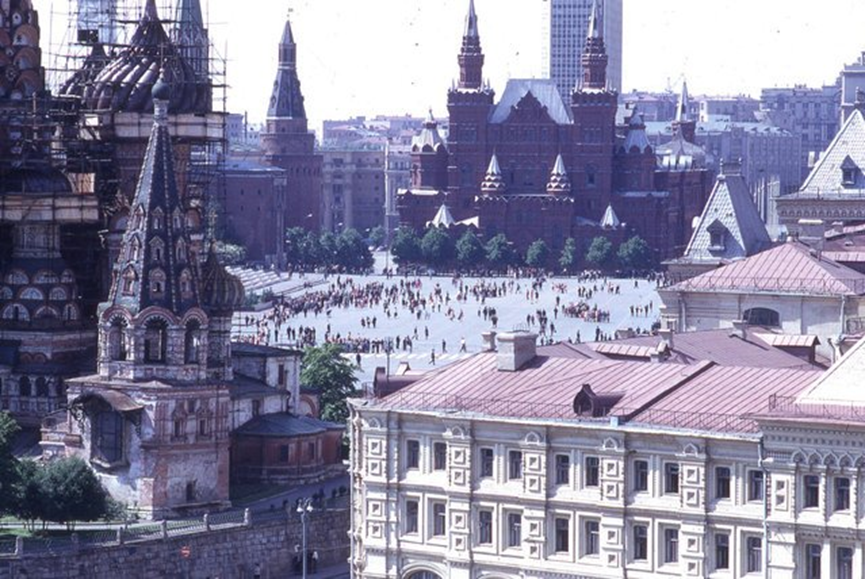
Their youthful passion melted the thick snowflakes landing on them. What a wonderful thing, youth. All four were classmates at Sun Yat-sen University in Moscow. The two women were Zhang Xiyuan and Feng Funeng (daughter of Feng Yuxiang), while the two young men passionately debating were none other than Deng Xiaoping and Chiang Ching-kuo.
Who could have imagined that half a century later, after decades of tumultuous history, these two bright-eyed youths would each rise to leadership on opposite sides of the Taiwan Strait, actually fulfilling their youthful dreams of national salvation and prosperity? Though fifty years of trials and tribulations led them to vastly different ideological paths, one thing remained constant: both were pragmatic leaders who sincerely wished for the people of China to live better lives.
In the early 1980s, Deng Xiaoping’s advocacy of reform and opening-up, along with market economics, allowed Chinese citizens—long accustomed to over a century of hardship—to finally experience material abundance. Socialism, after all, is not synonymous with poverty. Subsequent leadership teams steadily advanced this proven model of “national strength and popular prosperity.” Today, China ranks second globally in GDP, and its core principle aligns with Marx’s theoretical framework: production relations must adapt to the development of productive forces. When the productive potential of a billion people begins to surge, clinging to ideology-first or class-struggle-centric models is like applying a Ponzi economic framework to a game theory system—it simply doesn’t fit.
What happened afterward is well known: the establishment of a market economy energized private enterprises, sparking massive commercial vitality from grassroots Chinese towns. Meanwhile, central-level reforms—including SOE restructuring, fiscal decentralization, and financial reform—appeared in time, bringing the entire system to life.
Chiang Ching-kuo, six years younger than Deng, also achieved remarkable success in Taiwan. Known as Jianfeng (a nickname), he had previously governed a region in Jiangxi on the mainland and delivered the so-called “Ganzhou Miracle.” His approachability and diligence were unmatched within the Kuomintang (KMT). Starting in 1975, the Ten Major Construction Projects laid the foundation for Taiwan’s infrastructure. He traveled to every township across the island, and even today, public opinion polls consistently rank him first among all past and present presidents in terms of approval.
By 1986, average household income in Taiwan reached $5,000, marking entry into a moderately prosperous society. Unexpectedly, Chiang took even more radical steps toward transforming production relations by lifting bans on new political parties and newspapers, venturing deep into political reform. Sensing his time was limited, he was laying the groundwork for future productivity growth. In response to resistance from conservative factions within the KMT, he declared: “Times are changing, environments are changing, and trends are changing. It’s easy to wield power; the hard part is knowing when not to use it.” To solidify consensus, he unhesitatingly exiled Wang Sheng—the island’s second most powerful figure and leader of the conservatives—to overseas posts. Wang had served Chiang for forty-five years, overseeing intelligence and secret operations. As Wang left in sorrow and anger, Chiang said a final, profound line: “A person who never enters the pool will never learn to swim.”
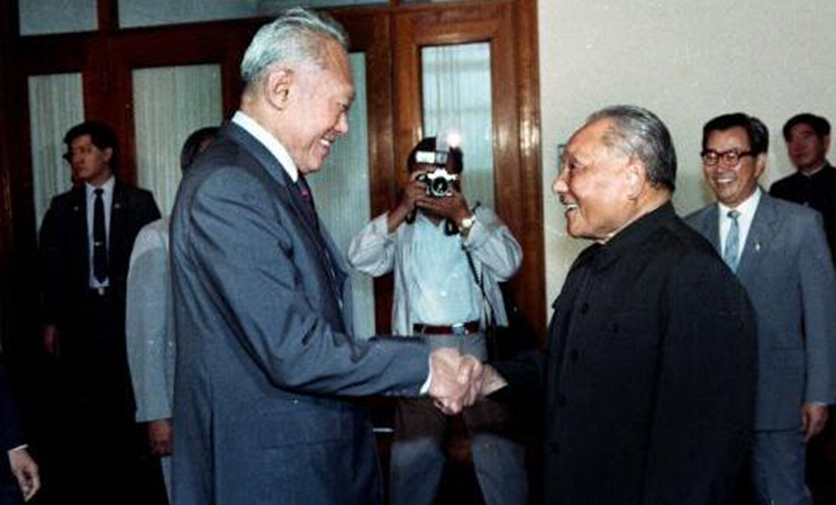
Meanwhile, in Beijing, Deng Xiaoping sent greetings through their mutual friend, Singapore’s Prime Minister Lee Kuan Yew (the third outstanding ethnic Chinese statesman of that era—see photo below of Deng meeting Lee), addressing Chiang as “my old classmate from Moscow.” Two men who hadn’t seen each other in over sixty years now both yearned for cross-strait reunification. Yet how could a simple greeting dissolve nearly a century of complex love-hate history between the KMT and the Communist Party?
In 1987, sensing his end approaching, Chiang outlined three final wishes—the last being “cross-strait unification must be pursued.” In 1988, Chiang passed away in Taipei. Upon hearing the news, Deng in Beijing fell silent for a long time before quietly saying, “I still believe there will be a third collaboration between the KMT and the CCP—but alas, Ching-kuo died too soon.” Indeed, a great misfortune for the Chinese nation.
Whether regarding political reform or cross-strait relations, Chiang Ching-kuo was far-sighted in building the superstructure necessary for Taiwan’s future economic and social development—one capable of supporting the next leap in productive forces. On the productive side, he also set a strategic direction centered on electronic manufacturing, modeling after Silicon Valley to establish the Hsinchu Science Park—the now-famous “Silicon Valley of Asia.” This incubated global semiconductor giants like TSMC and World Advanced Semiconductor Manufacturing Company (WASMC), the predecessor of SMIC, mainland China’s largest chipmaker. With such a strong R&D base and application market, tech titans born in Taiwan have since dazzled on the world stage—including current AMD CEO Lisa Su and Jensen Huang, founder of Nvidia, who has recently captured global attention.
(2) Nvidia’s Trillion-Dollar Market Cap and the Industrial Revolution
I won’t elaborate much on Nvidia’s story here; those interested can read another long-form series from Guatian Lab: Part 3 of “The AI Revolution in Blockchain Games”: Video Games, the Hidden Engine of Technological Progress.
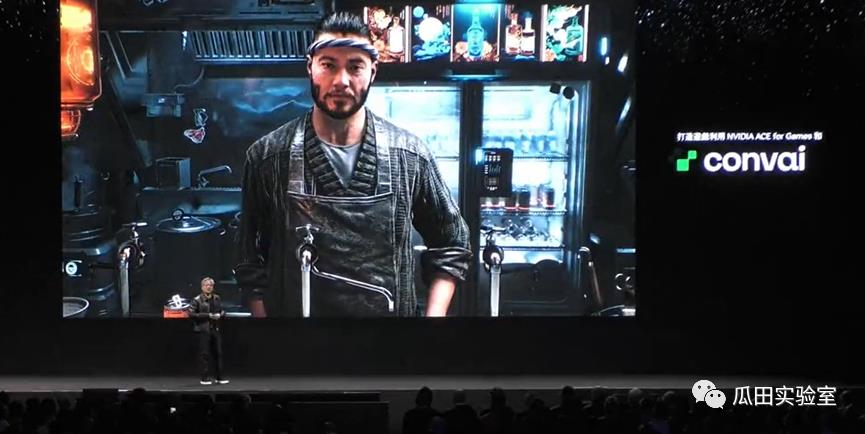
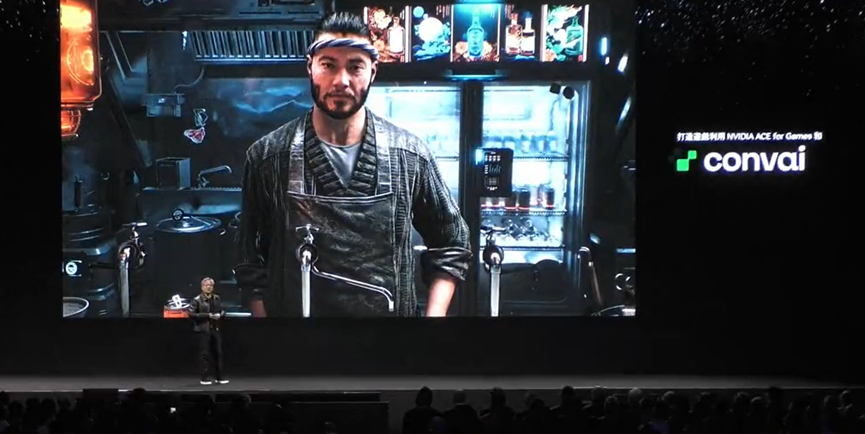
On May 30, 2023, Nvidia’s stock hit $418, making it the sixth tech company to surpass a trillion-dollar market cap. The surge was largely driven by renewed excitement around artificial intelligence (AI) this year. Particularly on May 29 (see image below), during a product showcase, Jensen Huang played a video demonstrating an AI-powered NPC in a cloud game engaging in smooth voice conversations with players. As someone who’s played games for 30 years, I felt my throat tighten and palms sweat—excited, yet faintly fearful. Decades of Hollywood sci-fi films like *Terminator* and *The Matrix* have implanted a deep-seated idea in our minds: Could this be the final wave of human productivity? Will AI robots develop self-awareness and become the planet’s new masters, replacing carbon-based humans just as dinosaurs were replaced by mammals?
Such fears stem from the past three centuries of hyper-accelerated technological advancement—almost too fast to process. Take a look at the chart below depicting 16,000 years of Eastern and Western civilizational development. For 99% of that time, progress was essentially flat—until 1776, when Watt invented the steam engine, launching humanity into the First Industrial Revolution. From then on, technological progress exploded upward at a near-vertical angle.
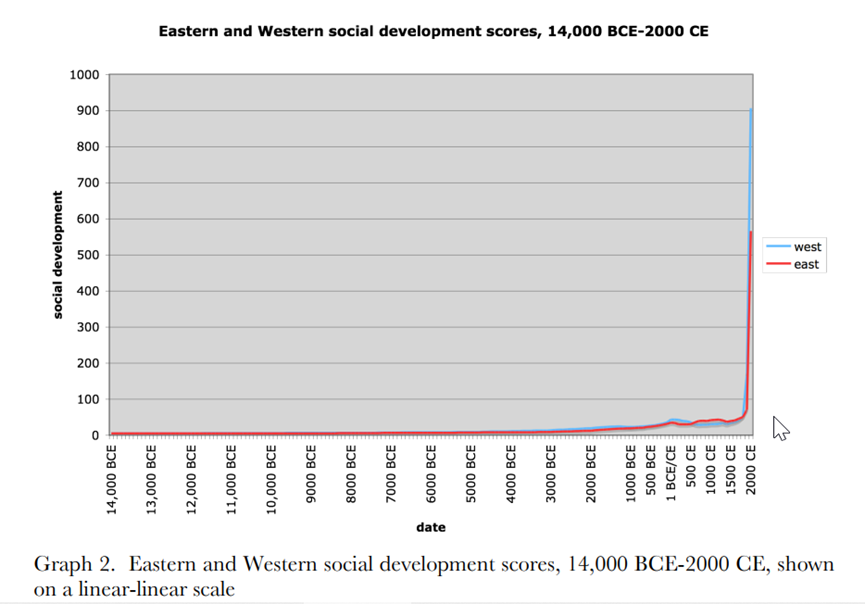
Crucially, we must remember that 1776 also witnessed two other epoch-defining events: the publication of the U.S. Declaration of Independence and Adam Smith’s The Wealth of Nations.
This trio laid the foundation for modern technological civilization: the steam engine symbolized mechanical power replacing human labor, geometrically unleashing productivity; The Wealth of Nations provided the theoretical basis for applying this explosive productivity—free-market economics; and the Declaration of Independence established a new form of governance: democratic constitutionalism with separation of powers and a limited government, ensuring that the fruits of productivity largely benefit those who contribute. All three are indispensable—the latter two represent the actual manifestation of production relations that complement and co-evolve with productive forces.
In my view, productive forces are like a fine sword, while production relations are the scabbard—protecting the blade and preventing it from harming others. When properly matched, the sword can be drawn swiftly and effectively, effortlessly slicing through challenges—far superior to Master Baoguo Ma’s “lightning five punches.”
Textbooks say that after the First Industrial Revolution, three more industrial revolutions followed: the Second (starting around 1850), marked by internal combustion engines and electrical systems; the Third (starting around 1950), defined by biotechnology and aerospace; and the Fourth (starting around 1975), characterized by new energy, information technology, the internet, and so on. We are currently still within the Fourth Industrial Revolution.
However, I’ve always believed that only the first two truly qualify as “industrial revolutions,” while the third and fourth should be termed “technological revolutions.” From a productivity standpoint, the first two industrial revolutions used efficient machines to liberate human hands and feet, satisfying basic material needs and ushering in mass production, giving rise to the industrial working class. Marx keenly observed this shift and predicted that the growing working class would inevitably clash with capitalists over the ownership of surplus value—a conflict destined to escalate. Revolutionary leader Lenin applied Marx’s theories to conduct a social experiment on Russian soil, founding the Soviet Union, the world’s first socialist state. To differentiate from Western capitalist market economies, Lenin adopted a planned economy as the production relationship to drive productivity.
The Soviet planned economy emphasized public ownership of all property, enabling centralized control and resource allocation. When an economy is poised to rebound from a low base, this “concentrate resources to accomplish major tasks” model of production relations clearly benefits productivity growth. Even within Western economic schools, Keynesianism advocates greater government involvement in markets. Roosevelt’s New Deal in post-WWII America and Nobusuke Kishi’s reforms in Japan were essentially copying the Soviet playbook, effectively boosting productivity at the time.
Thus, during the first two industrial revolutions, aided by machinery, productivity surged from the bottom, and various production relations could effectively promote development—leading to the coexistence of two superpowers with opposing ideologies: the United States and the Soviet Union.
The Fourth Technological Revolution we’re experiencing today uses technology to liberate human eyes and ears, further satisfying spiritual and psychological needs—addressing higher levels of Maslow’s hierarchy. Diverse fields like artificial intelligence, clean energy, robotics, quantum computing, virtual reality, and biotech are flourishing. In this context, the planned economy model is no longer applicable.
A key reason for the Soviet Union’s collapse was the breakdown of its planned economy—top planners could no longer manage the flow of production materials across countless emerging industries using spreadsheets alone, much like designing a game economy: adding a few nested numerical loops may keep token flows stable, but throw in a hundred layers, and even the designer might lose track of the dynamics.
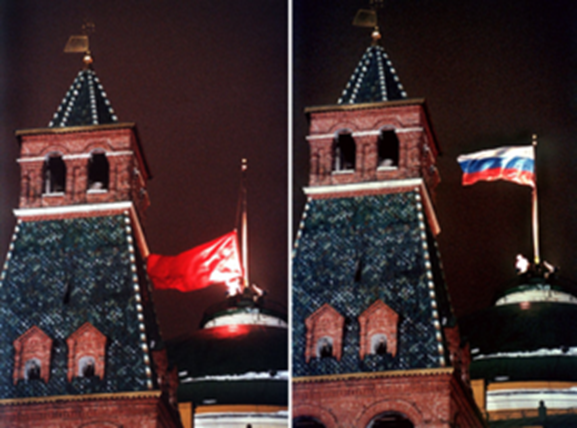
Another downside of planned economies became evident: over time, more and more control nodes (privileged departments) emerged, each requiring management teams and decision-making bodies. Decision-making grew increasingly fragmented, and the number of people to support ballooned. Rent-seeking and bureaucratic inertia crept into the economic cycle, and eventually, even production resources weren’t enough to go around: the rate of cake production couldn’t keep up with the hiring of new bakers—so all the cakes ended up as salaries for the bakers. What’s left for the diners? China’s two strongest historical dynasties—the Tang and Song—collapsed respectively due to overproduction of military governors leading to warlordism, and the “three redundancies”: redundant troops, officials, and expenditures. These are vivid warnings from history.
Thus, the planned economy’s greatest strengths—simplicity, directness, and efficiency—gradually vanished. In contrast, Western free-market economics emphasizes the market’s self-correcting mechanisms and the “invisible hand” subtly guiding equilibrium without overcorrection. Over the past decades of the Fourth Technological Revolution, free-market economies have triumphed. We should remain grateful for Deng Xiaoping’s insight and vision—when initiating reform in 1980, he declared, “Market economy is also part of socialism,” and “It doesn’t matter if a cat is black or white, as long as it catches mice.”
What many don’t realize is that China’s reform and opening-up didn’t start with a clear blueprint or roadmap. It was, in fact, a social experiment. Initially, China attempted to emulate Eastern European countries’ “birdcage model”—keeping all enterprises state-owned, retaining central control while granting minor operational autonomy to improve performance (advocated by Chen Yun, another top leader at the time). But results from Eastern Europe proved this ineffective.
So what now? The more pragmatic Deng Xiaoping made the decisive call to take an unprecedented path: He announced the reform had no timetable, no detailed roadmap—only a direction: enriching the people. And he made clear it would be “crossing the river by feeling for stones,” “do first, correct later.” Thus began the sail of China’s unique socialist market economy. Once the supporting production relations were established, private enterprises surged, liberating hundreds of millions of farmers long bound to primitive farming methods. China’s productive forces exploded. By 1987, Deng himself remarked: “The rise of township enterprises was something I personally didn’t foresee—nor did many comrades. It wasn’t credit to our central leadership.”
If previous industrial revolutions were defined by progressively liberating human capabilities—machines freeing hands and feet to meet material needs, high-tech products freeing eyes and ears to satisfy spiritual demands—could the emergence of AI mark a Fifth Technological Revolution? Could Artificial General Intelligence liberate the human brain, freeing mental labor from repetitive tasks so we can pursue higher scientific theories, art, or creativity? Or will we become slaves to AI? And is there a suitable production-relations “scabbard” capable of housing this new, sharp blade of AI-driven productive force?
To be continued.
Join TechFlow official community to stay tuned
Telegram:https://t.me/TechFlowDaily
X (Twitter):https://x.com/TechFlowPost
X (Twitter) EN:https://x.com/BlockFlow_News
 瓜田实验室W Labs











