








Exploring Panoptic Protocol: A Permanent, Oracle-Free, Instant-Settlement Options Protocol
TechFlow Selected TechFlow Selected
Exploring Panoptic Protocol: A Permanent, Oracle-Free, Instant-Settlement Options Protocol
Panoptic Protocol is an efficient, low-cost, and highly liquid options trading protocol with significant potential and advantages.
 Navigating Web3 tides with focused insights
Panoptic Protocol is a permanent, oracle-free, instantly settled options trading protocol built on the Ethereum blockchain. Panoptic Protocol is the world's first protocol that enables permissionless options trading for any asset pool within the Uniswap v3 ecosystem. Panoptic aims to develop a trustless, permissionless, and composable options product, overcoming the challenging task of building an options trading protocol on the Ethereum blockchain.
Options
Options are among the most widely used and heavily traded instruments in traditional finance, granting the holder the right—but not the obligation—to buy or sell an asset at a specific price on or before a certain date.
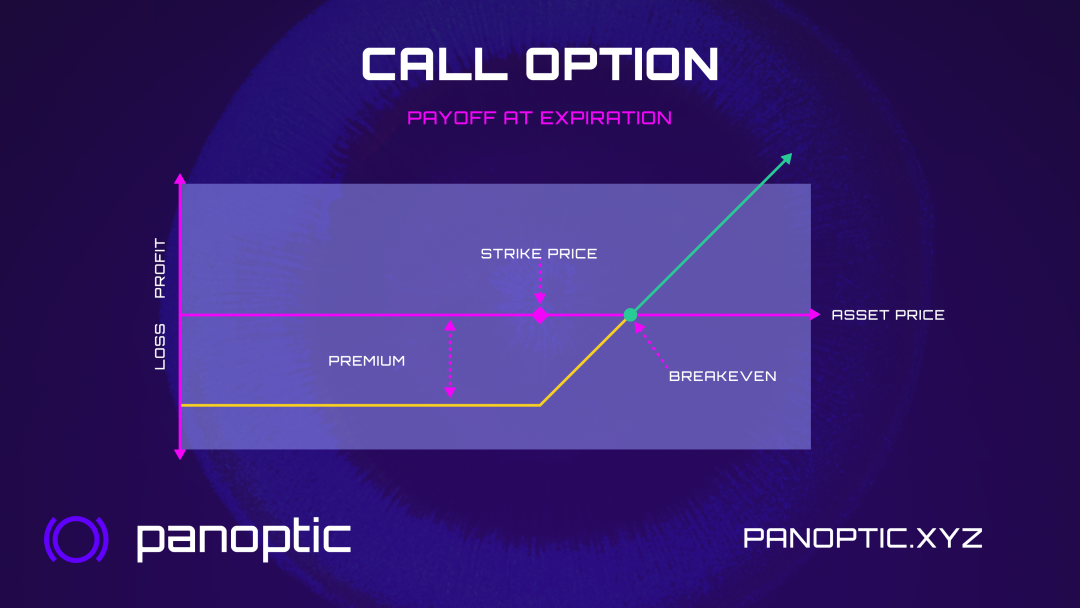
Options can be used to hedge portfolios, speculate on asset prices, and create synthetic positions in a capital-efficient manner. In traditional finance, options are widely used for hedging and speculation. In the cryptocurrency space, they can help protect against default risks in lending protocols, manage DAO treasury risks, and more. In short, options are a versatile tool that allows traders to manage risk and generate profits.
-
By buying or selling options, traders can speculate on the price movements of securities in a capital-efficient way—by taking long or short positions without owning the underlying asset.
-
Options can also be used to manage portfolio risk by hedging against potential losses in other investments.
-
Income can be generated by writing (selling) options contracts.
Decentralized options markets allow users to trade options contracts without relying on centralized institutions. The development of such markets dates back to 2017, when DApps on Ethereum began gaining popularity. To date, decentralized options markets remain in their early stages but have become an area of growing interest, playing an essential role in providing diversified income opportunities for users. Currently, major decentralized exchanges such as Uniswap and Balancer have started supporting options trading. Compared to centralized options markets, decentralized ones offer advantages in decentralization, transparency, and security. However, they also face challenges such as low liquidity, poor user experience, and smart contract vulnerabilities.
Related Protocols
Hegic
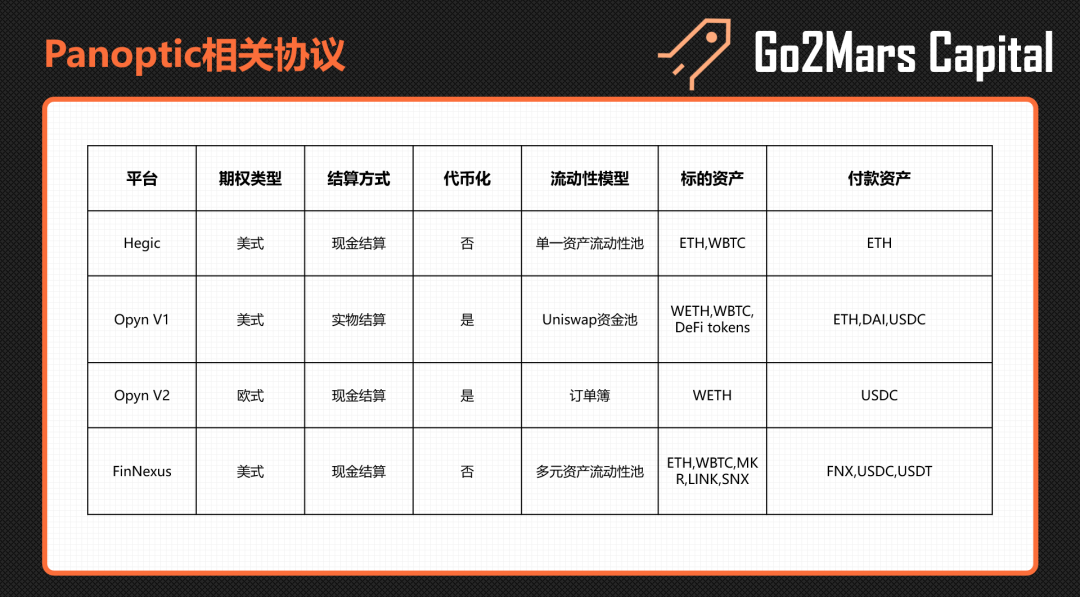
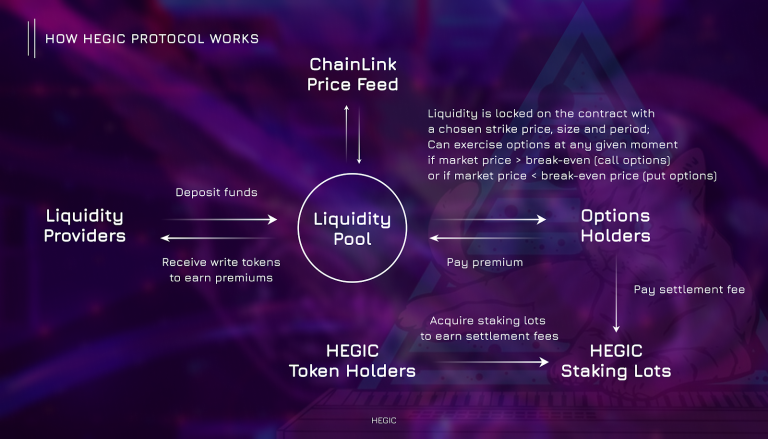
Hegic is an on-chain options trading protocol on Ethereum, offering American-style options for ETH and WBTC. The ETH and WBTC pools collateralize both call and put options. The protocol’s native token is HEGIC, and Hegic does not require users to trade puts and calls directly on its platform.
Incentives
Liquidity providers receive liquidity mining rewards over two years (80% of total supply, or 963,847,200 HEGIC), distributed proportionally based on total liquidity in the pool.
Option holders who keep their positions active and use Hegic during the two-year period will receive utilization rewards (20% of total supply, or 240,961,800 HEGIC), allocated based on the value and duration of purchased options.
Rewards are also indirectly distributed through HEGIC staking. LP rewards from IBC contributions are passed on to stakers.
Advantages
User-friendly interface.
Simplified pricing model.
Exercise only when in-the-money (ITM).
Earn HEGIC for creating options contracts.
Earn HEGIC for providing liquidity to option buyers.
Disadvantages
If your option is out-of-the-money (OTM), it cannot be exercised due to negative intrinsic value.
Maximum contract duration is 28 days, with accelerated time decay.
No options chain pricing view available.
Does not support multi-leg strategies.
Opyn
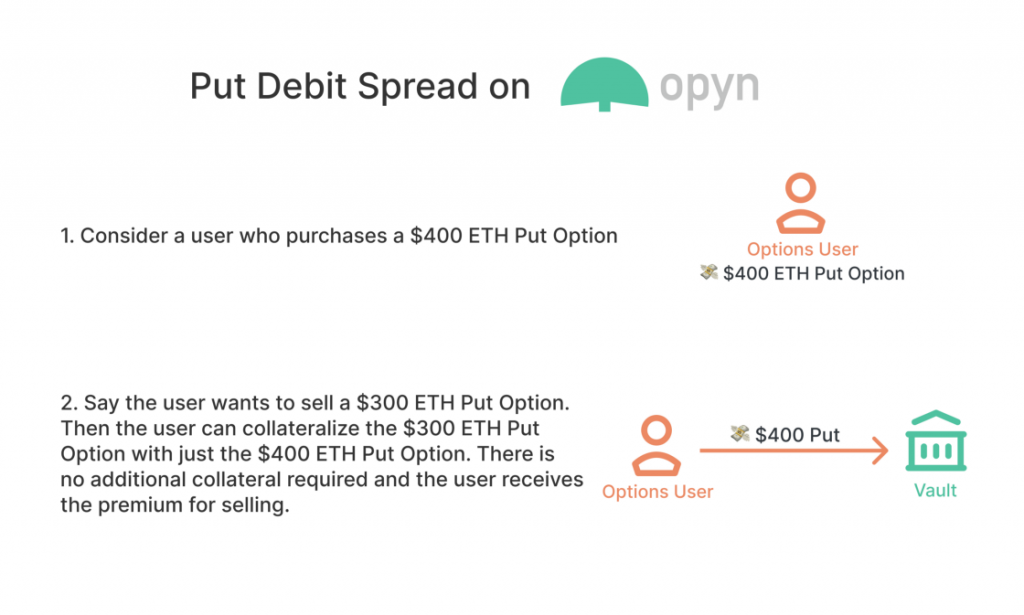
Opyn is a decentralized options platform enabling users to hedge risk or earn premiums by trading DeFi options on ETH and ERC-20 tokens using data feeds from Compound and Chainlink. Unlike Hegic, which uses a point-to-pool model for liquidity, Opyn relies on AMM liquidity from Uniswap. Opyn options, known as oTokens, are ERC-20 compatible and tradable on any DEX. An oToken’s name and symbol are determined by the underlying asset, strike price, collateral type, and expiration date.
The protocol’s first version (V1) allowed users to buy and sell American-style options, exercisable at any time before expiry. Users sold options by locking the underlying asset as collateral and minting tokenized options in the form of oTokens. On December 29, 2020, Opyn launched V2, introducing features like automatic exercise and fast minting—a novel adaptation of Aave’s “flash loan” concept. This version offers European-style options via an orderbook system, serving as a decentralized alternative to Deribit, currently the most popular centralized options platform.
Incentives
Earn yield and governance tokens using collateral such as Aave’s aTokens and Compound’s cTokens.
Higher capital efficiency and reduced margin requirements through the use of options spreads to lower collateral needs.
Advantages
Traditional options chain view (UI).
Ability to create multi-leg strategies.
European-style, cash-settled options automatically exercised at expiry.
Intrinsic value paid in the series’ collateral asset (e.g., USDC for puts, underlying asset for calls).
Disadvantages
Options cannot be exercised prior to expiry.
Only one tradable instrument: WETH-USDC.
Limited selection of strike prices and expiration dates.
Gas price for buy/sell transactions cannot be adjusted on Opyn’s UI.
FinNexus
FinNexus is a decentralized cross-chain DeFi protocol offering options products to users on Ethereum and Wanchain. Through FinNexus, minted option tokens can be directly sold to capture premium. The protocol’s native token FNX serves as the "network token for the entire FinNexus protocol cluster." Like its competitor Hegic, pooled liquidity offers advantages by automatically aggregating liquidity from all market participants. Anyone can become an option writer by depositing sufficient collateral into the contract.
Advantages
Long-term options available across multiple underlying assets.
Options settled in USDT, USDC, and FNX.
Reduced risk for option writers (i.e., sellers) thanks to the multi-asset single pool (MASP) design.
Option contracts are created by depositing sufficient collateral into the contract to mint FPO tokens.
Options are traded and settled in stablecoins via the USDC pool, aligning better with trader habits and making integration with yield-generating strategies easier, especially since financial performance is typically measured in USD.
Basic call and put options introduced in V1 lay the foundation for many other strategies such as straddles and strangles.
Disadvantages
MASP is the sole counterparty for writing, exercising, and trading options. To minimize concentration risk, the option pool should consist of a large number of diverse options.
In-the-money (ITM) options must be manually exercised to realize gains.
FinNexus option tokens can be traded up until five hours before expiry, after which trading halts.
No options offered with expirations beyond 30 days.
To ensure all options are fully collateralized, the protocol enforces a minimum collateral ratio (MCR). Once the pool is full, all withdrawals are paused.
How Panoptic Options Differ from Traditional Options
As a novel and promising protocol, Panoptic aims to overcome the limitations of existing platforms and deliver a more flexible and efficient decentralized options trading experience. Rather than using a clearinghouse to settle options contracts, Panoptic uses Uniswap v3 liquidity provider (LP) positions as the fundamental building blocks for trading long and short options.
Panoptic unlocks new and improved functionalities for options trading:
-
Panoptic options never expire—they are perpetual.
-
Anyone can deploy an options market on any asset in a permissionless manner.
-
Panoptic enables anyone to act as a liquidity provider, lending capital to options traders.
-
Options have unique characteristics such as width, a new concept of monetary significance, and user-defined units of measurement.
-
Pricing is path-dependent and does not involve counterparties (e.g., market makers).
-
Open position premiums are unaffected by volatility expansion.
-
Margin requirements and purchasing power adjust dynamically in response to market activity.
-
Purchasing power requirements do not change over time.
-
Fees are paid only once upon position creation.
-
Undercollateralized accounts can be liquidated by external users.
-
External users may force-exercise deeply out-of-the-money long positions.
Panoptic Protocol Design
Core Concepts
Perpetual Options
Perpetual options (also known as XPOs) are financial derivatives that grant investors the right—but not the obligation—to buy or sell an asset at a specified price at any time. This contrasts with traditional options, which have a predetermined expiration date. Perpetual options give investors the flexibility to exercise their rights at any moment. Intuitively, perpetual options are (traditional) options with very short durations that continuously roll over before expiry. While uncommon on traditional financial exchanges, perpetual options can be traded over-the-counter (OTC).
Mechanism: Driven by streaming premiums, where the buyer incurs no upfront cost to open a position but pays fees incrementally on a per-block basis to maintain it. This is the model adopted by Panoptic. These flow-driven perpetual options (“Panoptions”) do not require price oracles.
Advantages:
-
Flexibility: Perpetual options provide investors with flexibility, allowing them to exercise at any time to capitalize on market volatility and manage risk more effectively.
-
Portfolio Diversification: Adding perpetual options to a portfolio can improve diversification and potentially enhance returns.
-
Leverage: Perpetual options enable investors to gain exposure to underlying assets with relatively little upfront capital, offering the potential for higher returns.
-
Reduced Counterparty Risk: Traded on decentralized exchanges, perpetual options are less exposed to counterparty risk compared to traditional options on centralized exchanges.
Oracle-Free
A key difference between traditional finance and Panoptic lies in how premiums are calculated. Instead of requiring users to pay an upfront fee, Panoptic options use a path-dependent pricing model where fees accrue block-by-block based on how close the spot price is to the strike price. While this may introduce some uncertainty for buyers, a benefit of the path-dependent model is that certain options may incur zero fees even after being held for several days.
Instant Settlement
Panoptic Protocol employs instant settlement, meaning options trades are settled immediately upon execution, making options trading more efficient and convenient.
Uniswap v3 Integration
What is the relationship between Panoptic and Uniswap v3?
The core idea behind Perpetual Options is that Uniswap v3 liquidity provider positions can be viewed as tokenized short-term put options. This insight stems from the simple observation that providing concentrated liquidity on Uniswap v3 yields returns equivalent to selling put options.
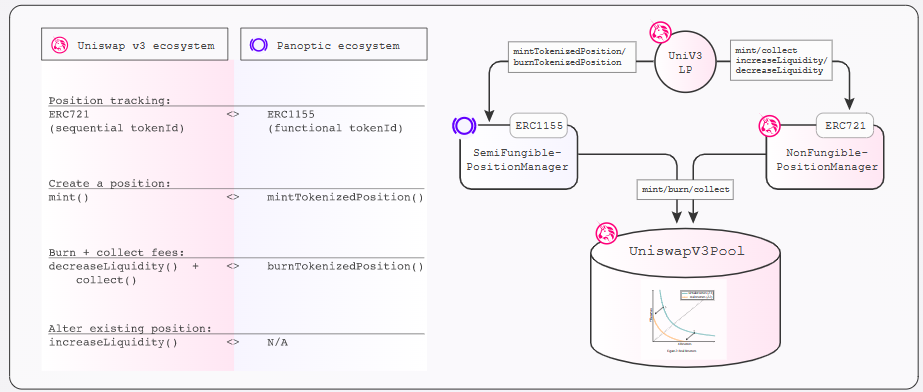
This means Uniswap v3 LP tokens can serve as foundational components for options contracts. While users can already sell options by providing liquidity in Uniswap v3 pool smart contracts, Panoptic facilitates capital-efficient, peer-to-peer options minting by enabling LP tokens to be repurposed as long/short puts and calls.
Main Participants
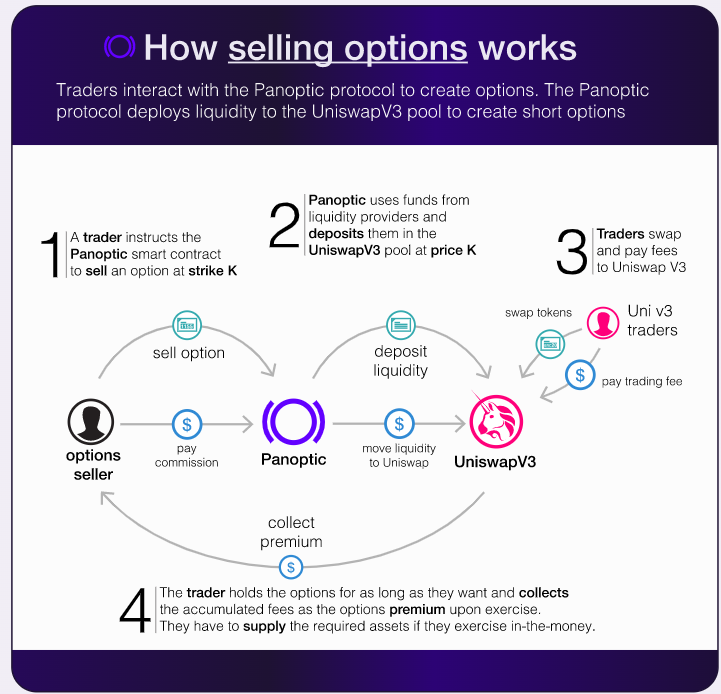
Panoptic Liquidity Providers (PLPs): Supply fungible liquidity to options markets. This liquidity is lent to options traders, enabling leveraged trading. Funds can be deposited into the Panoptic pool in any ratio.
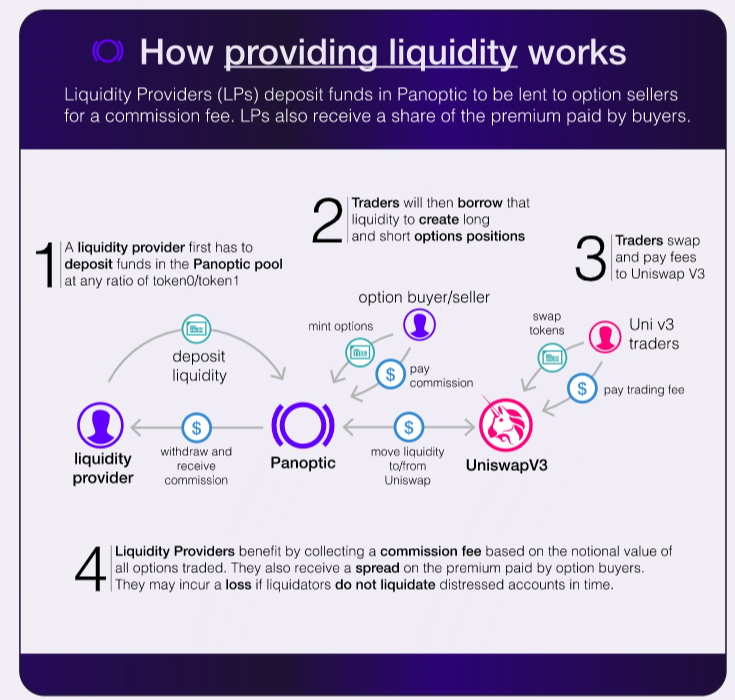
Option Sellers: Sell options by borrowing liquidity at a fixed fee and reallocating it to a Uniswap v3 pool. Sellers must post collateral and can sell options with a notional value up to five times their collateral balance.
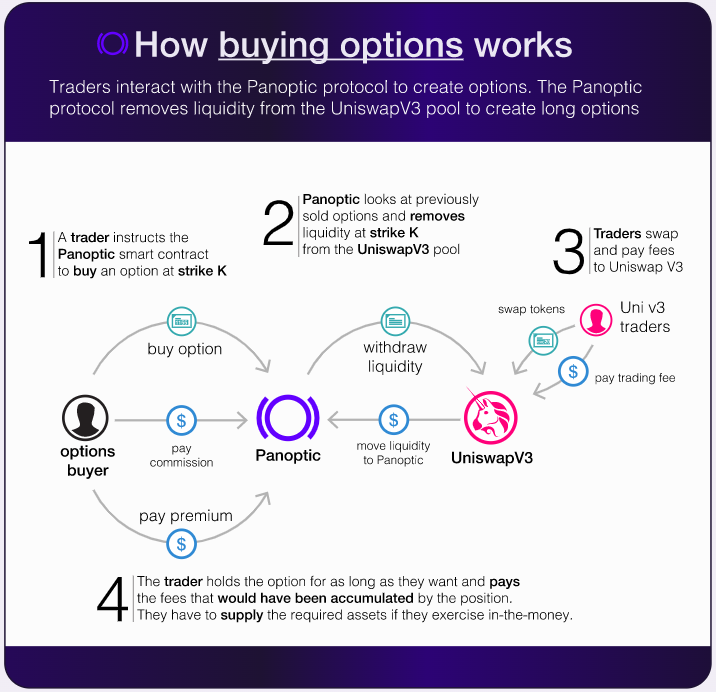
Option Buyers: Buy options by moving liquidity back from the Uniswap v3 pool to the Panoptic smart contract and paying a fixed fee. Buyers must also post collateral (10% of the option’s notional value) to cover potential premium payments to sellers.
Keepers (Liquidators): Ensure protocol health by liquidating accounts whose collateral falls below margin requirements. Keepers receive a bonus proportional to the amount needed to cover the undercollateralized position.
Option Attributes
Strike Price: Determined at purchase, this is the price at which the option holder can buy or sell the underlying asset. Higher strike prices generally mean higher option value but also higher risk.
Exercise Ratio: The proportion of the underlying asset the holder can buy or sell when exercising the option.
Leverage Ratio: The ratio between the capital used by the option holder and the notional value of the option.
Fee Model
Margin Requirements
In traditional finance, certain account types (e.g., IRA or Level 1 trading accounts) require all options to be fully collateralized. For example, IRA account holders can only sell cash-covered calls or covered puts, meaning they must fully collateralize the underlying position in cash (for calls) or own the underlying stock (for puts). Under-collateralized positions are managed by reducing purchasing power requirements. Level 4 trading accounts in traditional firms allow users to sell naked puts and calls with only 1/5th the collateral required by Level 1 accounts. Portfolio margin accounts may require even less collateral—roughly 10–15 times less than Level 1 accounts.
Panoptic uses built-in leverage similar to Level 4 accounts to mint under-collateralized options. Margin requirements follow guidelines outlined by CBOE and FINRA. For selling puts, these can be summarized as follows:

Commission Rate
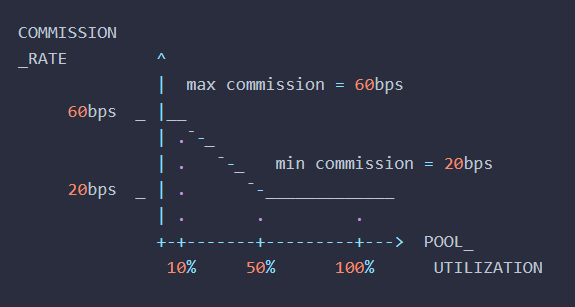
Fee Structure: In traditional brokerages, a fixed commission is charged when opening and closing a position. For options, no commission is charged if the user lets the option expire. In Panoptic, since options never expire, commissions are paid only once when a new position is created.
The commission amount equals the commission rate multiplied by the number of options. The rate starts at 60 bps when pool utilization is below 10%. It decreases linearly to 20 bps when utilization reaches 50%, and remains at 20 bps beyond that. Higher rates at low utilization ensure Panoptic liquidity providers earn reasonable returns even during periods of low trading activity.
Mechanism Analysis
Technical Details
Smart Contracts
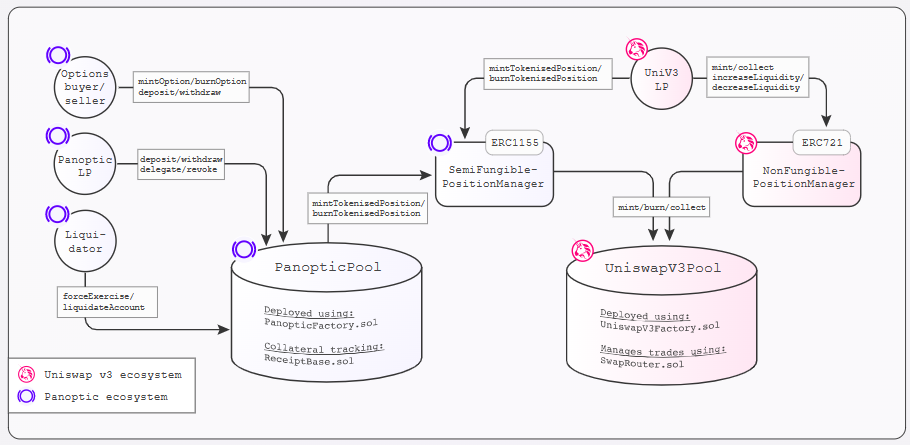
Panoptic smart contracts interface directly with Uniswap v3 core contracts to create options markets.
The Panoptic protocol has been audited by leading blockchain security firms according to the highest standards.
Performance Metrics
Trading Speed: Panoptic Protocol uses instant settlement, ensuring trades are settled immediately after execution, thereby improving trading speed.
Transaction Cost: Panoptic’s transaction costs include option premiums and liquidity provider fees. Premiums are paid by option holders, while LP fees are shared by both parties. Compared to traditional options protocols, Panoptic offers lower transaction costs.
Trade Scale: Panoptic’s trade scale depends on Uniswap v3 liquidity provider (LP) positions. Since Uniswap v3 LPs can provide large positions, Panoptic supports relatively large trade sizes.
Limits and Risks
While Panoptic Protocol offers advantages such as permanence, oracle-free operation, instant settlement, and Uniswap v3 integration, it still faces certain limitations and risks. Although prices are derived from Uniswap’s real-time updates—making them immune to oracle manipulation—the behavior of LPs within the pool could still impact protocol pricing.
Roadmap
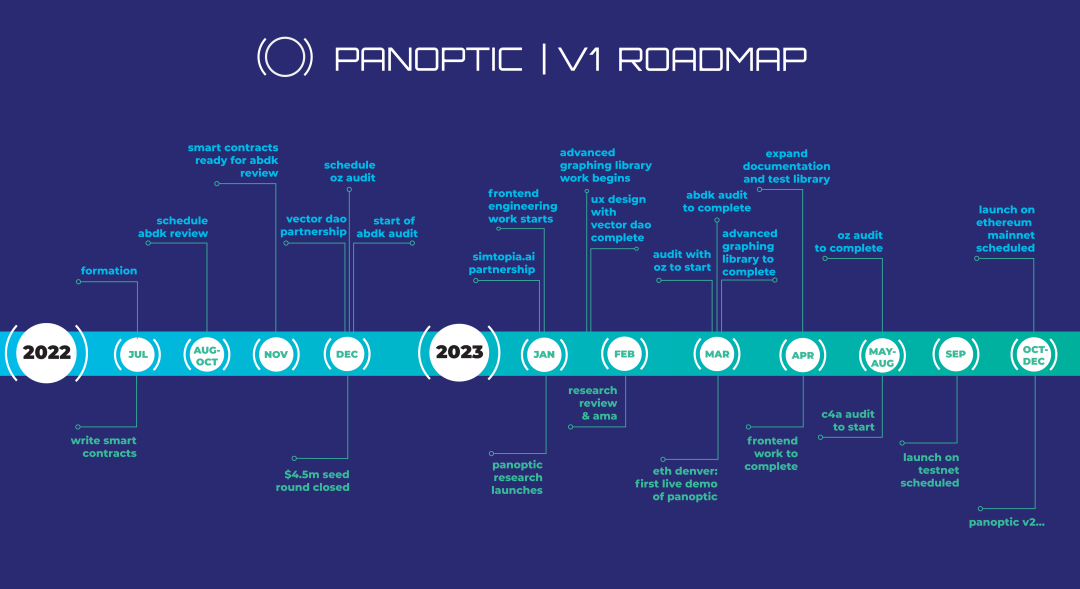
Currently in its early stages, Panoptic Protocol is scheduled to launch on mainnet in September according to its official roadmap. The team is currently conducting security audits using OpenZeppelin.
Summary
Panoptic addresses the issue of insufficient on-chain options liquidity by leveraging the Uniswap v3 ecosystem, while optimizing trading speed and cost. For any existing Uniswap v3 trading pair, Panoptic allows users to create long and short put or call options. Beyond buyers and sellers, Panoptic introduces a new role—"liquidity provider." Both parties must reallocate liquidity within Uniswap pools to generate new options, and Panoptic incentivizes liquidity provision through commissions, significantly enhancing capital efficiency.
Overall, Panoptic Protocol is an efficient, low-cost, high-liquidity options trading platform with significant potential and advantages. It offers valuable insights for other DeFi protocols and contributes to the growth and development of the broader decentralized financial market, fostering a fairer competitive environment.
Join TechFlow official community to stay tuned
Telegram:https://t.me/TechFlowDaily
X (Twitter):https://x.com/TechFlowPost
X (Twitter) EN:https://x.com/BlockFlow_News
 Go2Mars Capital






