









Uniswap V4: Breaking the Traditional DEX Model to Become the Foundational Liquidity Infrastructure
TechFlow Selected TechFlow Selected
Uniswap V4: Breaking the Traditional DEX Model to Become the Foundational Liquidity Infrastructure
Uniswap V4 raises a question: Can DEXs surpass CEXs?
 Navigating Web3 tides with focused insights
Author: Lanhu
The emergence of Uniswap V4 raises a question: Can DEXs surpass CEXs? This is no longer an unattainable vision.
Unlike previous efforts by Uniswap to improve liquidity and capital efficiency, Uniswap V4 aims to become a platform—a foundational infrastructure for true crypto finance.
This iteration has two key aspects: Hooks and Singleton.
Hooks
With Hooks, developers can customize interactions with liquidity pools, trades, fees, and LP positions. The essence of Hooks is enabling customizable liquidity pools. Developers can deploy Hooks (or "hooks") to build DEXs tailored to specific use cases, leveraging Uniswap V4's large underlying liquidity pools.
In other words, Uniswap V4 becomes a foundational platform where developers can build various new features—such as limit orders (a feature previously unique to CEXs), dynamic fee structures based on volatility or other conditions (unlocking greater incentive possibilities), TWAMM (Time-Weighted Average Market Maker, enabling smoother execution of large-sized trades), depositing out-of-range liquidity into lending protocols, custom on-chain oracles, automatic compounding of LP fees into LP positions, and more. As developers deepen their understanding, they will continue creating new Hook-based applications based on their own and community needs.
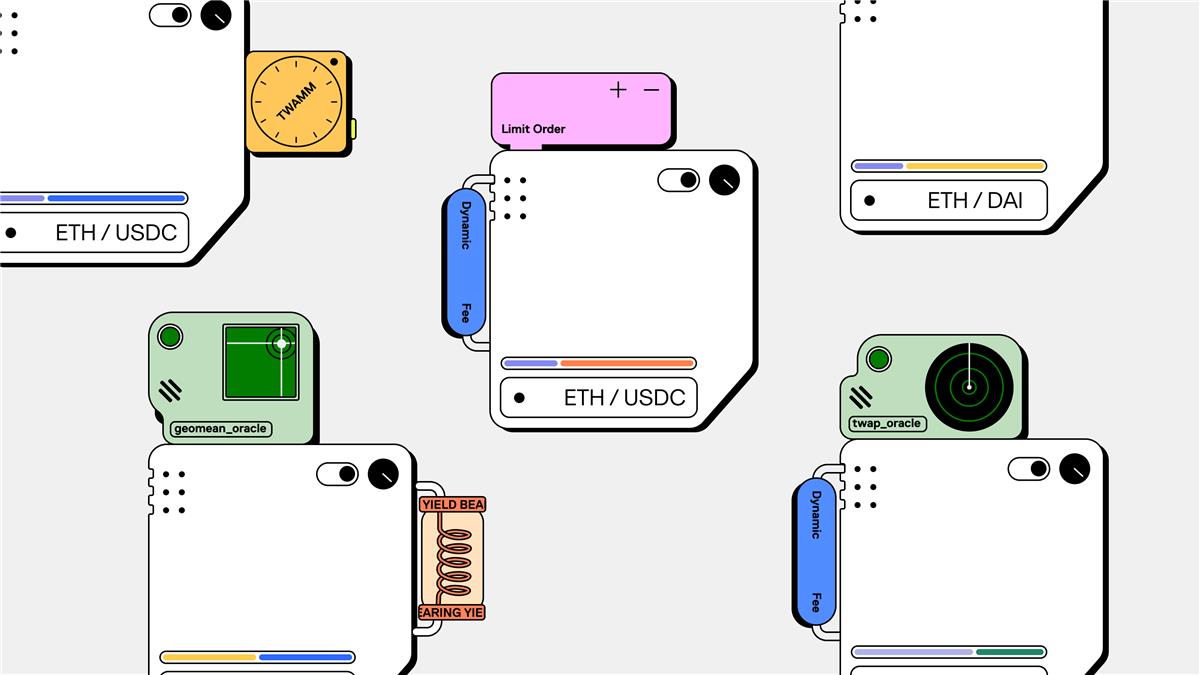
Customizability driven by user needs empowers developers to launch novel liquidity pools that cater to diverse trading scenarios, creating deeper alignment between liquidity, communities, and project development—something CEXs simply cannot achieve.
Based on Uniswap V4, developers gain a blank canvas, greatly stimulating imagination and creativity within the developer and user communities. This leads to unprecedented levels of integration between capital efficiency and project-specific development. At the same time, it’s foreseeable that incentives for liquidity providers will reach new heights.
As more Hooks are developed and new functions emerge, Uniswap has the potential to become the underlying liquidity infrastructure. Uniswap V4 will be embedded across more DeFi ecosystems, significantly amplifying its network effects and ultimately becoming foundational infrastructure for all of DeFi.
Singleton
Previously, Uniswap used a factory/pool model, where each liquidity pool had its own contract—essentially a multi-token, multi-contract architecture. Now, it introduces a single large contract architecture (Singleton, or “single instance” contract), housing all liquidity pools within one unified smart contract.
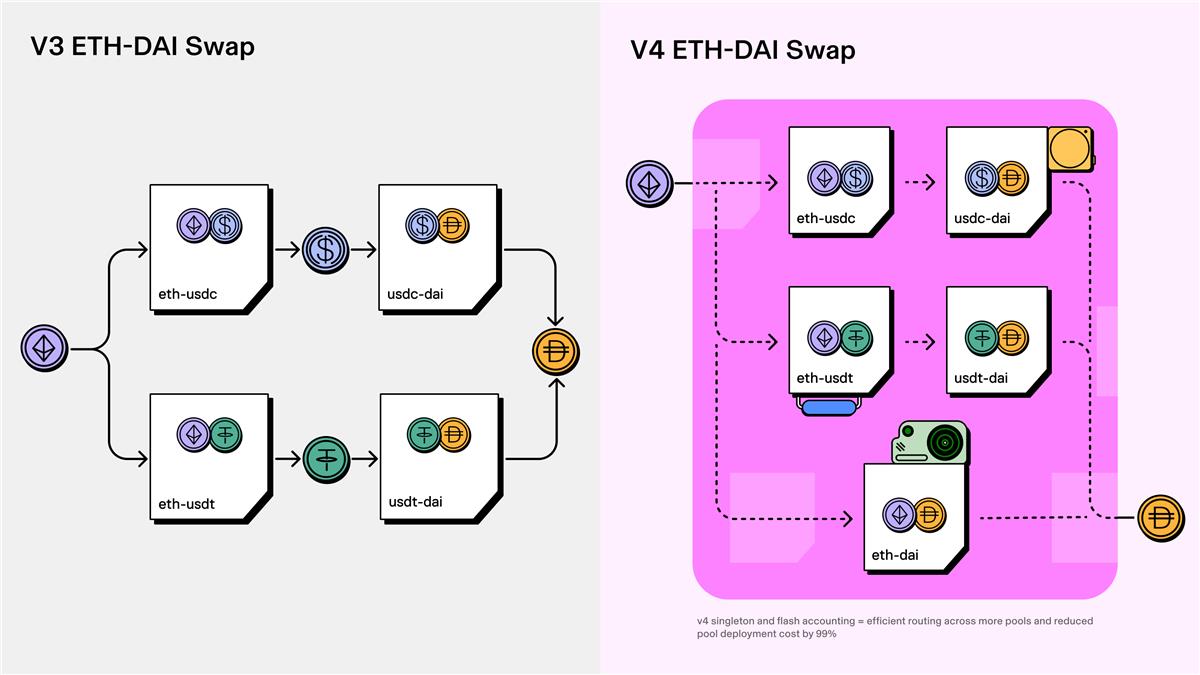
The original architecture incurred high costs when creating liquidity pools or executing cross-pool swaps. The Singleton contract architecture in V4 reduces gas costs by eliminating the need to transfer assets between different contracts for different pools. According to the Uniswap team, this design could reduce the gas cost of creating liquidity pools by up to 99%.
Additionally, the Singleton architecture introduces a "flash accounting" system. Unlike V3, which required transferring assets in and out after every swap, V4 only settles net balances. Furthermore, EIP-1153’s "transient storage" introduced in the Cancun upgrade benefits this system and further enhances cost optimization.
Finally, native ETH reappears in trading pairs in V4 (it was removed in V2), which also contributes to some gas cost reductions.
Conclusion
Judging from current Uniswap V4 developments, it is not only aiming to become the largest DEX but also a DEX platform—one that enables more developers and projects to build customized solutions atop its liquidity foundation. This open architecture unlocks vastly greater possibilities.
As more developers deploy Hooks, introduce new features, and create composable use cases, Uniswap’s network effects and irreplaceability will steadily grow stronger. From Lanhu Notes’ perspective, these efforts will drive Uniswap’s liquidity even higher, making it one of the most influential foundational infrastructures in the space.
The arrival of Uniswap V4 accelerates DEXs' pursuit of CEXs. Uniswap has the potential to become the true infrastructure of crypto DeFi—and may even match or surpass CEX market share within the next five to ten years.
Join TechFlow official community to stay tuned
Telegram:https://t.me/TechFlowDaily
X (Twitter):https://x.com/TechFlowPost
X (Twitter) EN:https://x.com/BlockFlow_News
 蓝狐笔记
蓝狐笔记






