a16z: The 7 Fundamental Elements Defining the Metaverse
TechFlow Selected TechFlow Selected
a16z: The 7 Fundamental Elements Defining the Metaverse
Achieving a "true" virtual world—a virtual world that is both open and closed—requires seven fundamental elements as intrinsic conditions to reach this desired state.
 Navigating Web3 tides with focused insights
Written by: Elizabeth Harkavy, Eddy Lazzarin, Arianna Simpson
Translated by: TechFlow
Since the last bull market, the term "metaverse" has attracted widespread attention—especially during the pandemic, when online activities surged—and even more so after Facebook rebranded itself as Meta.
Is this just opaque marketing jargon? What exactly is the metaverse? How should we define the term, and where do we draw the line between one virtual world and another? These are common questions people have about the metaverse, so we believe it's important to outline our perspective on it and its intersection with Web3.
In many ways, the metaverse is simply another name for the evolution of the internet: more social, more immersive, and economically more complex than what exists today. Broadly speaking, there are two competing visions for how to achieve this: one that is decentralized, generous with property rights, new frontiers, interoperable, open, and owned by the communities who build and maintain it; and another vision—far too familiar to many today—that is centralized, closed, subject to corporate whims, and frequently extracts painful economic rents from its creators, contributors, and residents.
The key dimension differentiating these two visions is openness versus closure, and their differences can be conceptualized as follows:
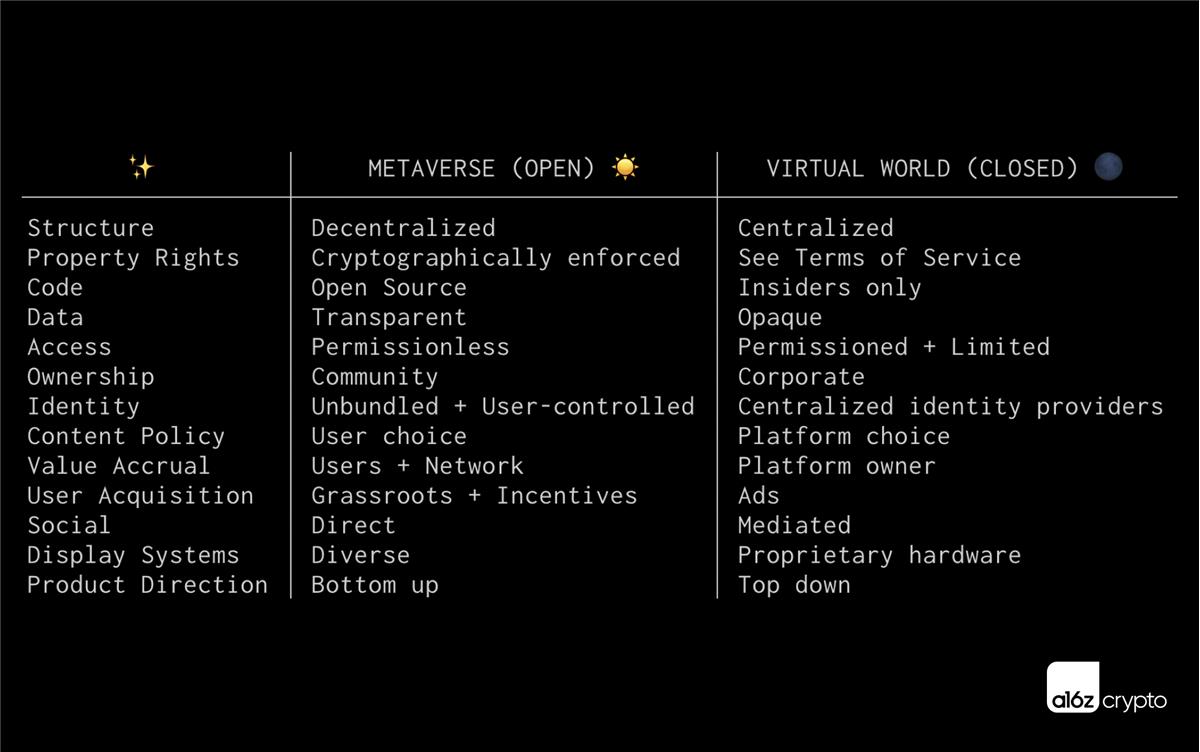
An open metaverse is decentralized, allowing users to control identity, establish property rights, align incentives, and ensure value flows to users rather than platforms. An open metaverse is also transparent, permissionless, interoperable, composable (others can freely build within or across it), and meets other such criteria.
Achieving a “true” virtual world—one that is open rather than closed—requires seven fundamental elements as intrinsic conditions for reaching this aspirational state. We consider these to be the minimum requirements for a metaverse. Our goal is to dispel misconceptions among builders and potential participants about what constitutes a genuine metaverse and what does not, and to provide a framework for evaluating early metaverse attempts.
1. Decentralization
Decentralization is the primary, overarching principle of a metaverse, upon which many subsequent characteristics depend or from which they derive.
By decentralization, we mean not being owned or operated by a single entity, nor dominated by a small group of power brokers. Centralized platforms often start out friendly to attract users and developers, but once growth slows, they turn aggressive, exploitative, and zero-sum toward users. These powerful intermediaries frequently abuse user rights, deplatform residents, and impose aggressive revenue shares. In contrast, decentralized systems demonstrate fairer ownership distribution, less censorship, and greater diversity.
Decentralization is critical. Without it, anyone could be “rugged” at any time—a volatile situation that discourages innovation and long-term investment. Because centralized platforms cannot make commitments of the same reliability as those enforced by blockchain code, their promises can be revoked or altered by various leaders or organizations. Protection against such abuses and ensuring decentralized control is the strongest way to safeguard the metaverse.
2. Property Rights
Most successful video games today profit by selling in-game items such as “skins,” “emotes,” and other digital goods. But currently, people purchasing in-game items aren’t actually buying them—they’re merely renting. Once someone leaves a game—or if the game unilaterally decides to shut down or change rules—the player loses access.
People have become so accustomed to renting from centralized Web2 services that the idea of truly owning things—digital objects you can sell, trade, or take elsewhere—often feels strange. But digital worlds should follow the same logic as the physical world: when you buy something, you own it. It’s yours. Just as courts enforce these rights in the physical world, code should enforce them online. Indeed, true digital property rights were impossible before the advent of cryptography, blockchain technology, and related innovations like NFTs. In short, the metaverse transforms digital serfs into landowners.
3. Self-Sovereign Identity
Identity is closely tied to property rights. If you don’t own yourself, you can’t own anything. People’s identities must persist in the metaverse without full dependence on a small number of centralized identity providers.
Authentication involves identity: proving who you are, what you can access, and what information you share. On today’s web, this requires agents representing users to authenticate via popular one-click login methods such as social logins or single sign-on (SSO). Large tech platforms like Meta and Google use this method to collect data and build their businesses—monitoring user behavior to develop models for delivering more relevant ads. Moreover, since these platforms have full control, innovating on authentication depends entirely on the honesty and willingness of the platform’s parent company.
Core cryptographic technologies in Web3 enable people to authenticate without relying on these intermediaries, allowing individuals to directly control their identities or use services of their choice. Wallets (like Metamask and Phantom) offer ways for people to verify themselves. Standards like EIP-4361 (Sign in with Ethereum) and ENS allow projects to coordinate around open-source protocols and independently contribute to a richer, more secure, and evolving concept of digital identity.
4. Composability
Composability is a system design principle referring specifically to the ability to mix and match software components like Lego bricks. Each software component needs to be written only once and can then be reused simply and repeatedly. It resembles compound interest in finance or Moore’s Law in computing—some of the most powerful known economic forces—because it unleashes exponential potential.
To achieve composability—a concept tightly linked to interoperability—the metaverse must be built on high-quality, open technical standards. In games like Minecraft and Roblox, you can build digital goods and new experiences using basic components provided by the system, but it’s difficult to move them outside that environment or modify their internal workings. Companies offering embeddable services, such as Stripe for payments or Twilio for communications, work across websites and apps—but they don’t allow external developers to alter or remix their black-box code.
In its strongest form, composability and interoperability allow unrestricted adaptation, reuse, modification, or importation of existing code across broad layers of the software stack. Decentralized Finance (DeFi) is a prime example of this powerful form. Anyone can adapt, reuse, modify, or import existing code. Furthermore, developers can freely run active programs side-by-side in the memory of a shared virtual computer (Ethereum)—such as Compound’s lending protocol or Uniswap’s automated market maker exchange. By combining powerful new primitives like property rights, identity, and ownership, builders can create entirely new experiences.
5. Openness / Open Source
True composability is impossible without open source. Open source refers to making code freely available and permitting free redistribution and modification. Regardless of degree or type, open source as a principle is crucial to metaverse development—even though it overlaps with composability above, we treat it as a separate element.
What does open source mean at the level of metaverse development? The best programmers and creators—not platforms—need full control to innovate fully. Open source and openness help ensure this. When codebases, algorithms, markets, and protocols are transparent public goods, builders can pursue their visions and ambitions to create more complex, trustworthy experiences.
Openness can lead to more secure software, better-informed participants regarding economic terms, and reduced information asymmetry. These traits can create fairer, more equitable systems that actually align network participants. They might even render obsolete outdated U.S. securities laws designed decades ago to reconcile principal-agent problems and information asymmetries within corporations.
The power of composability in Web3 stems largely from its open-source ethos.
6. Community Ownership
In the metaverse, all stakeholders should have a voice in governance proportional to their participation. People shouldn’t just follow orders handed down by a team of product managers at a tech company. If any single entity owns or controls this virtual world, it may offer a specific kind of ivory tower experience—like Disneyland—but will never reach its full potential.
Community ownership is part of the puzzle that aligns network participants—builders, creators, investors, and users—toward shared benefit. This coordination miracle—difficult or impossible to harness without the emergence of crypto and blockchain—is enabled through token ownership (the network’s native assets).
Beyond the technological advances brought by decentralization, the philosophical significance of community-owned spaces is vital to the success of the metaverse. In Web3, participants in decentralized autonomous organizations (DAOs) embody this principle. They abandon the formal rigidity of corporate structures in favor of more flexible, diverse experiments in democracy and informal governance. This allows communities to be managed, built, and driven by their users rather than a single entity.
7. Social
Big tech companies want you to believe that high-performance virtual reality or augmented reality (VR/AR) hardware is an essential—or even the most important—component of the metaverse. This is because these devices serve as containers. Companies see them as gateways to becoming primary computing interface providers for 3D virtual worlds, and thus bottlenecks through which people experience the metaverse.
The metaverse does not need to exist within VR/AR. All the metaverse requires is a broad sense of social immersion. More important than hardware is the type of activity the metaverse enables. It should allow people to gather remotely, collaborate, socialize, and be entertained—just as they do today using Discord, Twitter Spaces, or Clubhouse.
The pandemic highlighted the need for more immersive experiences beyond traditional text-based communication platforms like email, as usage of remote meeting and attendance tools like Zoom surged. Additionally, due to the previously outlined economic factors—property rights, self-sovereignty, community ownership—the metaverse allows people to earn a living, conduct business, and gain status. In a typical knowledge worker’s workplace, people use tools like Slack to collaborate; in the bottom-up organizational movements of DAOs, Discord and Telegram dominate.
The metaverse has nothing to do with the "view" modality—the tool you use to view the metaverse. For those controlling hardware manufacturing, this is merely a convenient meme.
While many companies have begun building different parts of the metaverse, in our view, no virtual world lacking any of the above components can be considered a fully formed metaverse. We believe—as this framework shows—that the metaverse cannot exist without the foundational underpinnings of Web3 technology.
Openness and decentralization are the pillars of the entire structure. Property rights depend on decentralization—they must withstand powerful adversaries. Community ownership prevents unilateral control of the system. This approach also reinforces open standards, which support decentralization and composability—interoperability’s closely related downstream attribute.
The ideal multidimensional virtual world will emerge gradually. Many issues remain to be solved to avoid ending up with some dystopian version of IOI-mediated Oasis from *Ready Player One*. However, if builders adhere to the principles outlined above, such dystopias are far less likely.
When the metaverse arrives, it should fully embody these principles—with decentralization at its core.
Join TechFlow official community to stay tuned
Telegram:https://t.me/TechFlowDaily
X (Twitter):https://x.com/TechFlowPost
X (Twitter) EN:https://x.com/BlockFlow_News
 a16z
a16z