June Crypto Market Outlook: Cancun Upgrade, LSD, Computing Power, and AI...
TechFlow Selected TechFlow Selected
June Crypto Market Outlook: Cancun Upgrade, LSD, Computing Power, and AI...
This article presents an outlook on the June cryptocurrency market regarding the Cancun upgrade, LSD, computing power, and AI.
 Navigating Web3 tides with focused insights
By Yu Zhong Kuang Shui
Time is like a wild donkey—once it starts running, it never stops. Before we know it, we're already halfway through the year. Below is my outlook for June, and this time I might ramble on about quite a few things.
Cancun Upgrade
The Ethereum Cancun upgrade is tentatively scheduled for October, but speculation around it might begin as early as June. From what I recall, there was an interesting pattern: the Ethereum 2.0 upgrade started gaining hype two months in advance, while the Shanghai upgrade began three months prior. Could the Cancun upgrade start seeing speculation four months ahead?
I think that’s quite possible. Just as GameFi projects are getting shorter lifespans, the hype cycles for major anticipated events are also accelerating, especially given the current market environment.
As for investment targets, these include $ARB, $OP, and other Layer2 tokens (there are many more, so I won’t list them all). Arbitrum currently has strong fundamentals, while Optimism is facing two major upcoming events: the cliff unlock on May 31 and the Bedrock upgrade on June 6.
LSD & LSDFi
Why focus on LSD? I’d like to emphasize again that LSD is a long-term business. With withdrawal pressures now easing, ETH LSD products are currently experiencing net inflows.
Meanwhile, the LSDFi sector is entering a period of rapid growth—we’ve already seen numerous LSDFi protocols emerge recently. However, most of these are short-term projects aiming solely to attract liquidity through generous token emissions.
On my watchlist, PENDLE, AURA, Lybra, and Prisma are the four projects I’ll be closely monitoring lately.
I’ve already written detailed analyses before and won’t repeat them here—they’re all archived on my Substack. I’ll actively follow Lybra’s v2 testnet launch in mid-June and monitor its token price. Prisma has a more coherent and simpler logic, which I find particularly promising.
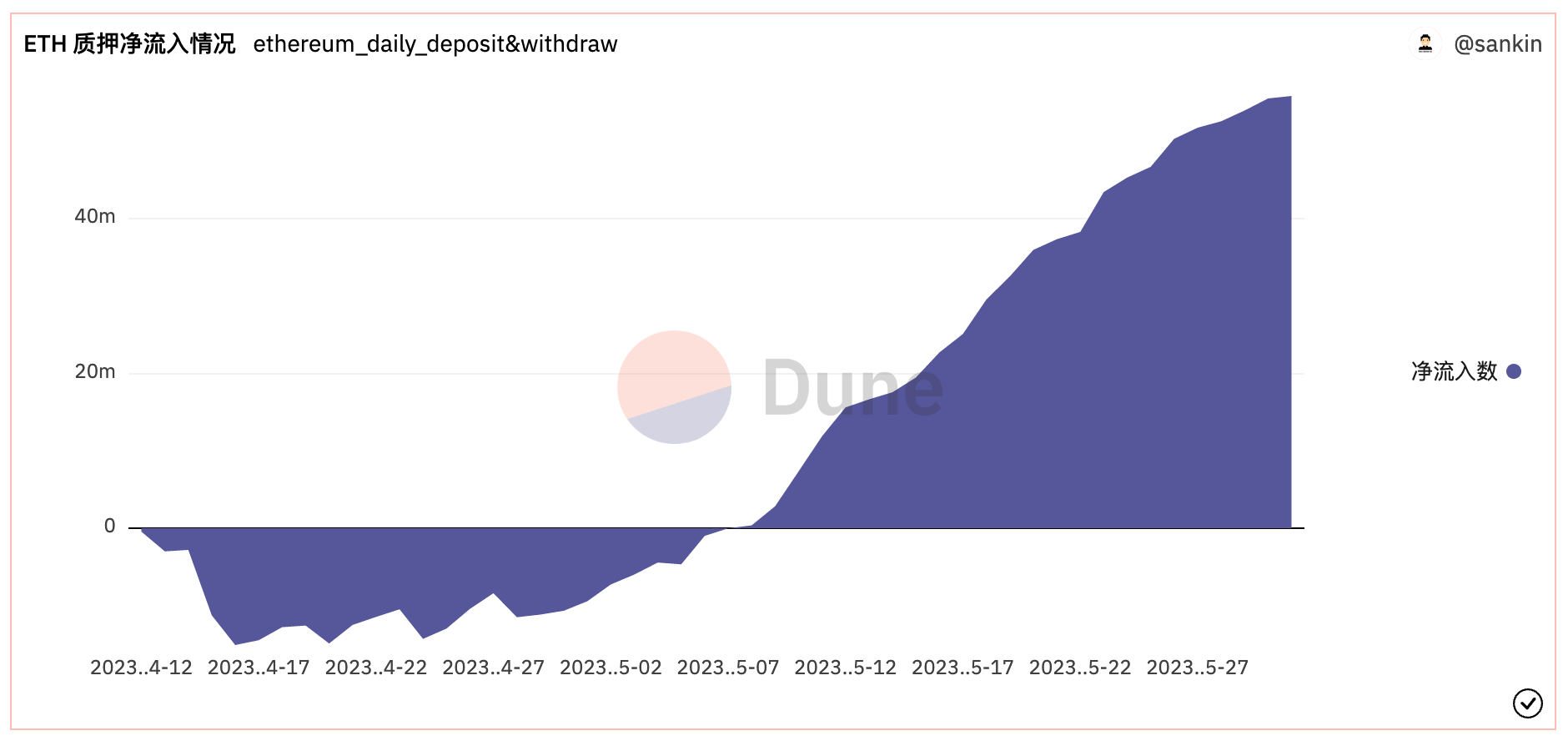
Returning to the LSD sector, aside from Lido's continued dominant position, Frax has shown clear momentum, increasing its market share from 0.72% at the beginning of the year to 2.46% today.
Rocket Pool has also grown its share from 5.24% to 7.7% since the start of the year. Judging by growth rate alone, Frax has delivered solid performance.
Another point worth noting: FRAX (the stablecoin) is expected to reach a 100% collateralization ratio around mid-June, and Frax v3 will be launched shortly thereafter. This update will likely include a lending market designed specifically for FRAX liquidity (this feature may be part of v3, possibly rolling out in Q3/Q4).
Additionally, Lido’s dominant status has raised concerns about staking centralization. Beyond architectural improvements at the base layer (like DVT), unshETH aims to balance relationships among various LSD protocols. However, unshETH encountered some security issues yesterday.
Meanwhile, ssv network, which uses DVT technology, is also nearing launch—the team mentioned “Soon” on Discord, so I reasonably guess it could go live in June.
Hong Kong
June 1st—today—is when the "Guidelines for Virtual Asset Trading Platform Operators" take effect. This will involve certain tokens that could ride the news cycle. But given the current market sentiment, I believe most people will opt to sell on the news.
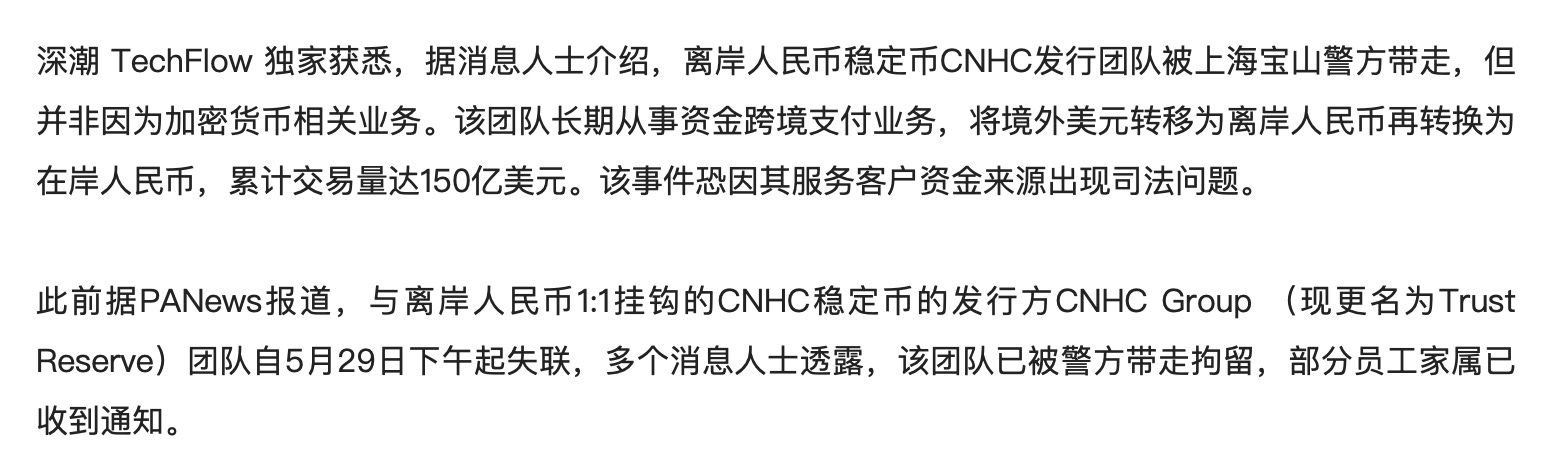
For example, CFX was hottest in April and has cooled down since. In fact, after yesterday’s CNHC incident, CFX began to decline.
Therefore, from my perspective, the implementation of these guidelines will mostly trigger selling pressure. I’ll reduce my attention toward Hong Kong-themed tokens.
One more note on Cocos’ rebranding: starting June 2nd at 8:00 UTC, I personally find it difficult to make definitive trades based on this event. Trying to predict GFT’s outcome would be unwise, as the level of uncertainty here is exponentially higher than previous rebrandings. If you do trade, entering at open might be fine, but chasing highs like BNX would require caution.
Computing Power & Metaverse & AI
$RNDR has already had a run-up. As I mentioned in previous articles, I believe computing power will become a core narrative in the future world—Nvidia’s surge is a perfect example.
While $RNDR isn't fundamentally tied to AI computing power, it can still benefit from the trend. Another catalyst for $RNDR is Apple’s upcoming product launch. The headset will be a key part of Apple’s future, and $RNDR’s parent company is a partner with Apple.
My stance is clear: if Apple’s June 5th product launch doesn’t mention or feature $RNDR’s parent company (e.g., no “powered by” label), I won’t buy $RNDR. If it does, I’ll consider adding $RNDR to my portfolio.

Regarding AI, I personally feel that crypto-native AI applications haven’t yet produced anything compelling. The impact of the broader AI wave on Crypto AI hype is likely to weaken over time.
That said, I do see emerging trends—such as Web2-based AI tools empowering crypto activities, like helping users develop trading strategies.
I’ll keep an eye on these developments, but I won’t invest in Crypto AI for now.
Gaming
Layer2 provides fertile ground for gaming, but so far few games have broken out of the old Play-to-Earn framework to deliver truly enjoyable Web3 gaming experiences combining fun gameplay, economic incentives, and true ownership.
Mobox has launched a Dragon Egg game, which began mining rewards on June 1st, offering $MBOX and MEC gems. Its artwork is impressive, and it’s built on Arbitrum. We don’t yet know what the gems will be used for.
This year, Mobox plans to burn 135 million tokens and expand token utility. Judging from their roadmap, the main goal appears to be boosting the $MBOX token price. While we don’t yet know the full use cases for $MBOX, they should tie into the four games Mobox plans to release this year.
Another game I’m watching is Pixels, currently ranked third in active users and up significantly over the past 30 days. The main driver? The imminent launch of its native token.
The current market is essentially a popularity contest—only those maintaining high visibility can capture attention.
Therefore, narrative > fundamentals. The higher the热度, the better the token price performs.

Also worth mentioning is $MAGIC. As Arbitrum’s TVL and transaction volume grow, more developers may choose to deploy games there, making $MAGIC a potential beneficiary. That said, I haven’t seen any clear catalysts or new game launches yet.
Abyss World, launching its IDO on Sui/Polygon, has a strong game background, secured funding, and partnered with cloud service providers. I hope it can boost on-chain activity on Sui—personally, I believe Sui’s technical advantages can greatly support Web3 game development.
Then there’s BladeDAO, the ZKsync gaming platform I mentioned earlier. However, I won’t consider investing in its token until actual games are released.
Spartadex will launch in the coming weeks—I hold its NFT, so I’ll continue following it closely.
Oh, and BAYC might have some new moves in June. I suggest staying alert, especially since $APE’s token price has been in a continuous downtrend.
One caveat: unless a Web3 game genuinely breaks away from traditional Ponzi-like mechanics and is actually fun to play, I recommend treating it as a short-term speculative play—or just spend your money on something like *Tears of the Kingdom* instead.
BRC20
Although BRC20’s热度 has cooled somewhat, there’s still room for further upside—especially if Binance decides to list BRC20 tokens.
Personally, I’m not particularly interested in BRC20 and haven’t participated much—it’s still, at its core, a热度-driven game. Once the热度 fades, token prices naturally suffer.
However, potential support from Binance could spark another rally, which we can’t afford to ignore.
Competition Among Derivatives DEXs
According to a research report by LD Capital, Kwenta and Level have surpassed GMX in weekly trading volume, primarily driven by more aggressive incentive programs. Still, my focus remains on GMX and dYdX.
With GMX v2 and its win-win collaboration with Chainlink, ChainLink will provide low-latency oracle services to GMX, while GMX will return 1.2% of its revenue to Chainlink. GMX v2 improves upon existing products and enables derivative trading with lower risk, higher capacity, and support for more assets.
dYdX, on the other hand, will launch its v4 version later this year. Key updates will include a decentralized order book, DYDX validator revenue, and revised fee distribution mechanisms.
Join TechFlow official community to stay tuned
Telegram:https://t.me/TechFlowDaily
X (Twitter):https://x.com/TechFlowPost
X (Twitter) EN:https://x.com/BlockFlow_News
 雨中狂睡Sleeping in the Rain