Sun Yuchen and the TRON team make a major appearance on Benzinga, detailing TRON's global cryptocurrency use cases
TechFlow Selected TechFlow Selected
Sun Yuchen and the TRON team make a major appearance on Benzinga, detailing TRON's global cryptocurrency use cases
Sun Yuchen and members of the TRON team appeared on the latest episode of Crypto Unlocked, hosted by mainstream U.S. financial news outlet Benzinga, discussing "real-world global crypto use cases." Sun Yuchen stated that TRON has a global vision and extensive international presence, and has now become a provider of industry infrastructure.
 Navigating Web3 tides with focused insights
On May 11, Justin Sun, founder of TRON and member of Huobi Global Advisory Board, along with members of the TRON team, appeared on a new episode of Crypto Unlocked hosted by Benzinga, a major U.S. financial news outlet, to discuss "real-world global crypto use cases." As the opening speaker, Justin Sun highlighted blockchain's most attractive feature—its openness—emphasizing that users can obtain accounts for free. He stated that TRON has always maintained a global vision and extensive international presence, establishing itself today as a key infrastructure provider in the industry.
Additionally, Feroz Lakhani, Head of Enterprise Affairs; Agustin Cortes, Head of Education; and Jason Dukes, Head of Content at TRON, participated in detailed discussions on related topics.
Observers in the crypto industry noted that Justin Sun and the TRON team’s participation in such events showcases their achievements in the field. Furthermore, engaging in dialogue with other professionals helps explore the authenticity and feasibility of real-world global crypto applications, advancing the development of cryptocurrency and blockchain technology. This also enhances TRON’s reputation and further attracts developers and investors worldwide.
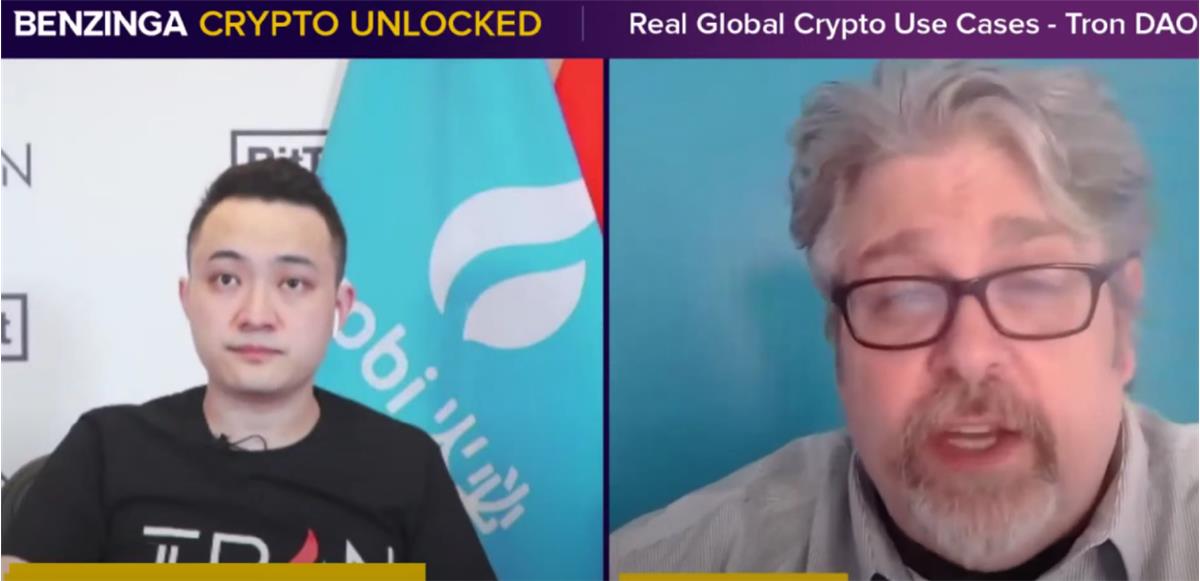
Justin Sun: The Most Attractive Feature of Blockchain Is Its Openness
Today, TRON’s achievements in stablecoins have become one of the most watched areas in the industry. With over 46 billion USDT in circulation, TRON has emerged as an undisputed heavyweight in the crypto space. Accordingly, the host posed a pivotal question to Justin Sun: “What does it mean for TRON to be the top network for USDT?”
Justin Sun explained, “In most countries around the world, accessing U.S. dollars in real life is extremely difficult. In underdeveloped regions outside the U.S., about 90% of people lack bank accounts. Yet the U.S. dollar—one of the world’s most valuable currencies—is something they desperately need. Some regions suffer from severe inflation, causing their local currencies to lose value rapidly. As a result, USDT has become an alternative for storing value.”
Justin Sun believes TRON has evolved into a perfect global payment network used by millions. Driven by strong real-world demand, TRON has achieved astonishing results. “Since its inception, the TRON network has processed $7 trillion in transactions. Today, TRON sees 2.5 to 3 million daily active users and generates 9 to 10 million transactions per day—a roughly 30% increase compared to last year,” said Justin Sun.
Justin Sun emphasized that due to growing demand—especially outside the United States—TRON will continue expanding and strive to become one of the most important global infrastructures for Web3 and blockchain.
Moreover, Justin Sun reiterated that blockchain’s greatest appeal lies in its openness: even without access to traditional banking resources, users can still get a free account on TRON.
“We know many impoverished regions suffer due to lack of food or water. But I believe another critical factor is actually the lack of financial services,” he said.
Justin Sun further explained that for people in Africa, the biggest barrier to progress is the inability to store value. Even if they grow food and stockpile supplies, they cannot open bank accounts. Without institutions to safeguard their assets, they could be robbed overnight. Blockchain offers them an excellent solution.
“They can use these crypto accounts just like bank accounts, at nearly zero cost. They can receive money and store value. Thanks to blockchain’s anonymity, no one in the world knows they hold funds in these accounts, which protects their assets,” said Justin Sun.
According to Justin Sun, stablecoins—particularly USD-pegged ones—have their most significant use cases outside the United States. For people in developing countries, the ability to freely access accounts and use U.S. dollars is highly appealing.
Regarding TRON’s future development, Justin Sun stated that it must maintain a global perspective. His vision is to provide affordable and efficient asset transfer solutions accessible to everyone worldwide.
Finally, Justin Sun shared his views on U.S. crypto regulatory policies.
“In fact, the United States became the world’s leading power because it cared about global developments and offered the best solutions to the world. But now, U.S. regulators are trying to push crypto out of the country—an unmistakably wrong direction,” said Justin Sun.
TRON Core Team Members Detail Real-World Global Crypto Use Cases
In the final segment of the live event, Feroz Lakhani (Head of Enterprise Affairs), Agustin Cortes (Head of Education), and Jason Dukes (Head of Content) provided detailed explanations of TRON’s real-world global crypto applications.
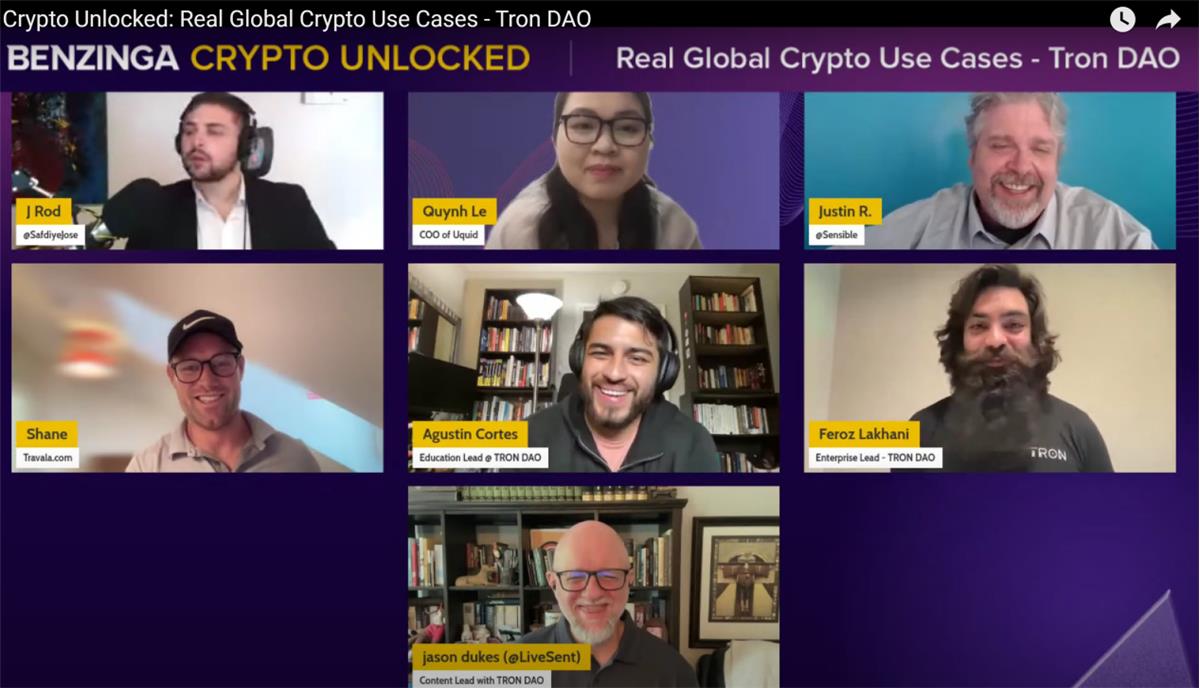
Feroz Lakhani stated that the stablecoin USDT first enabled people in many impoverished nations to access dollar-backed assets. The U.S. dollar is the most widely recognized currency globally. Through collaboration between USDT and the TRON blockchain, they created the first method for global asset transfers that doesn’t rely on banks or other unreliable infrastructure.
“Therefore, TRON’s development across global markets will become increasingly important in the coming years, whether in South America, Africa, or Europe.”
Feroz also pointed out that TRON became the national public blockchain of Dominica last year. Sint Maarten (Dutch side) has also begun advancing the adoption of TRON-based tokens as domestic currency. “We’re closely collaborating with several other countries to promote our infrastructure and tokens as widely as possible,” said Feroz.
Agustin Cortes, Head of Education, explained the current operational logic behind the TRON blockchain.
“I see blockchain as an operating system. For example, smartphones run on iOS or Android. Similarly, blockchain functions as an ecosystem. Once an ecosystem grows rapidly, it must develop its own applications and platforms—that’s the trend. That’s why TRON began rising and gradually becoming part of this operating layer, introducing its own apps and platforms,” said Agustin.
Lastly, Jason Dukes elaborated on the essence of cryptocurrency. He noted that most people focus on crypto solely in terms of ‘how to make money,’ but its fundamental purpose goes far beyond that.
“DeFi and commercial activities on the TRON platform—especially those involving stablecoins—are compelling topics. These serve as mechanisms for capital flow, value storage, savings, payments, salary disbursements, and more,” he said.
Jason added that he has almost entirely shifted away from viewing crypto as an investment and now truly understands its monetary properties. It was designed for peer-to-peer transactions and embodies the concept of decentralized finance.
“When my daughter participates in volleyball tournaments, I use my crypto debit card to pay for travel, food, and tickets. I’ve used crypto payments multiple times—even to cover our mortgage. It’s fascinating because I also use it to buy other things, like shopping at watch stores or buying a latte. This shows us that at its core, cryptocurrency is a form of money, and people need to understand and accept this reality,” Jason emphasized in conclusion.
Join TechFlow official community to stay tuned
Telegram:https://t.me/TechFlowDaily
X (Twitter):https://x.com/TechFlowPost
X (Twitter) EN:https://x.com/BlockFlow_News
 TRON DAO