Space Recap | How Does B.AI Bridge the “Last Mile” for AI Trading Implementation?
TechFlow Selected TechFlow Selected
Space Recap | How Does B.AI Bridge the “Last Mile” for AI Trading Implementation?
B.AI builds agent identities and payment infrastructure to close the “strategy-as-a-service” loop, leading the new cycle.
 Navigating Web3 tides with focused insights
Recently, the crypto market has experienced a degree of recovery and warming, with on-chain transaction activity also rising. Amid this mild market rebound, AI Trading—an emerging variable—is rapidly gaining prominence, driving the evolution of trading models from “manual operation” to “AI-powered automated execution.”
AI Agent infrastructure platforms such as B.AI are embedding powerful AI capabilities deeply into core trading functions—including market analysis, strategy formulation, and trade execution. This evolution not only significantly lowers the barrier to entry for high-frequency and complex trading but also strives to build a more automated and intelligent on-chain financial system—transforming users from mere “operators” into “ecosystem participants.”
When AI is deeply integrated into every gear of trading, could it truly become the genesis point for the next market cycle? This edition of X Space focuses closely on the central theme of “AI Trading and AI Infrastructure” for an in-depth analysis. Below is a distilled recap of the roundtable discussion.

A New Variable in the Cyclical Recovery: A Comprehensive Breakdown of AI Trading’s Growth Logic and Market Restructuring
With liquidity returning and trading activity picking up, AI Trading is emerging as a highly explosive new variable. Multiple speakers unanimously agreed that its current breakthrough is not short-term hype—but rather the inevitable outcome of converging forces: increasingly complex trading demands and maturing AI technologies.
Both Niuxiaowang (Ox King) and Crypto.0824 pointed out that current market demand for AI stems from profound structural shifts in market behavior. The present recovery is characterized by frequent volatility and repeated washouts. Crypto.0824 noted that under such complex, structural conditions, traditional manual monitoring and order execution are not only extremely labor-intensive but also highly susceptible to emotional interference—leading to unnecessary capital erosion. Niuxiaowang similarly emphasized that AI enables seamless integration—from semi-automation to full automation—perfectly compensating for human limitations in speed and risk control.
Second, beyond catalyzing real-world pain points, technical accumulation during the bear market forms the foundational support for AI Trading’s breakout. Wang Feng Anc and Mr. Mis stressed that during periods of depleted liquidity and market indifference, genuine AI teams never paused—they instead focused intently on product refinement. Wang Feng Anc believes that when market recovery drives sharp increases in trading frequency and capital volume, systems refined through prolonged technical incubation naturally align with the market’s pursuit of ultimate efficiency.
However, even amid widespread adoption of AI, it is essential to clarify its actual role in trading today. Speakers underscored that current AI Trading sits at a transitional stage—evolving from “efficiency assistant” to “core participant”—with final decision-making authority still firmly held by humans. Web3 Monkey incisively observed that if a trader’s underlying strategy logic is flawed, deploying an AI Agent will only accelerate losses. Thus, AI does not alter trading logic itself—it elevates the strategic game played by humans to a higher dimension.
Even so, this higher-dimensional intervention has already begun subtly reshaping market mechanics. Crypto.0824 pointed out that AI Trading has entered its second phase: moving beyond simple market summarization assistance toward a closed-loop system where AI autonomously captures information, generates strategies, and executes trades. This shift dramatically accelerates market responsiveness and gradually transforms trading behavior—from emotion-driven actions in the past to model-, strategy-, and data-structured drivers today. Mr. Mis emphasized that AI Trading stands at the very beginning of its development trajectory—and will inevitably evolve toward a future of smarter, more autonomous, and increasingly dominant automated trading.
Granting Financial Sovereignty to AI Agents: Decoding B.AI’s Breakthrough in “Strategy-as-a-Service”
Following the logic that “AI is evolving from an auxiliary tool to a core participant,” Crypto.0824 further articulated AI Trading’s end-state: viewing it merely as an “automated buy/sell tool” severely limits its ceiling. Yet positioned within the broader on-chain financial ecosystem, AI will inevitably mature into a new generation of foundational infrastructure.
Based on this trend, Crypto.0824 outlined three core functions AI will assume in the future: First, as a trading gateway—users need not manually analyze vast amounts of information but simply convey intent (e.g., “stable returns” or “trend-following”) to the AI. Second, as a strategy-generation hub—the AI formulates real-time, customized strategies based on on-chain data and fund flows. Third, as an execution and risk-control layer—the AI automatically rebalances positions, triggers stop-losses, and generates post-trade reports—all within predefined authorization boundaries. This closed loop of “Strategy-as-a-Service + Automated Execution” represents the embryonic form of next-generation financial infrastructure.
Yet realizing this vision of “Strategy-as-a-Service + Automated Execution” requires far more than leaps in large-model intelligence and computing power. When AI attempts to independently manage on-chain fund flows and serve as a genuine “risk-control layer,” it still lacks a compatible on-chain credit identity and native payment & settlement system. Against this backdrop, next-generation AI infrastructure platforms like B.AI have emerged. B.AI is dedicated to bridging the final mile—from “computational reasoning” to “on-chain execution”—and truly empowering AI with the core capability to execute sophisticated financial strategies independently.
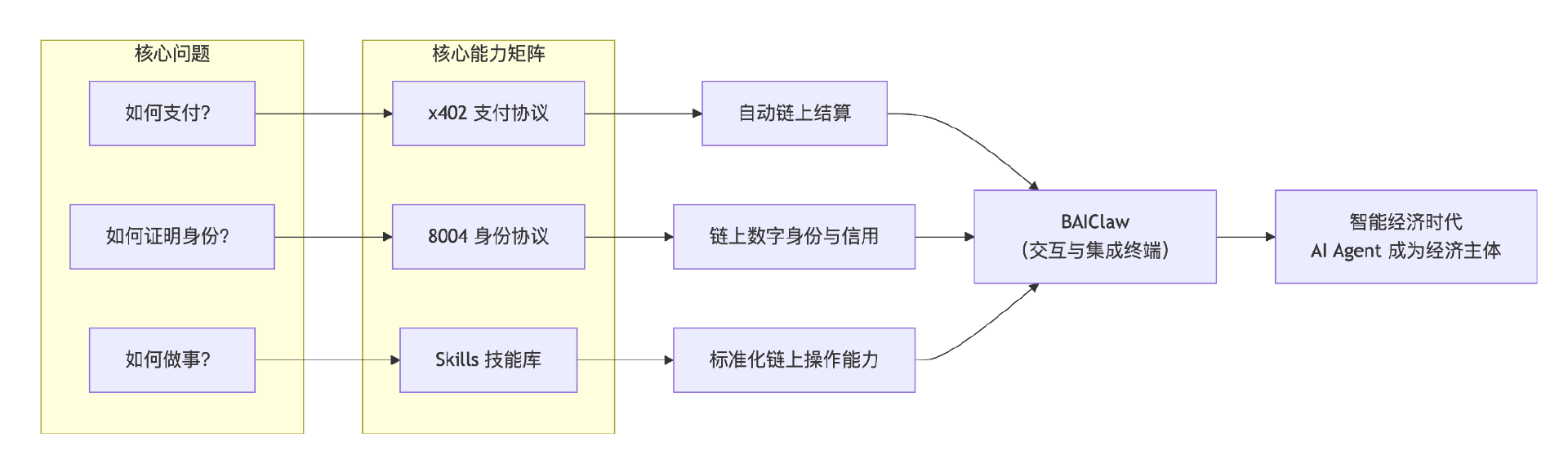
Specifically, B.AI demonstrates the following three core product values and innovations in addressing industry pain points and empowering AI trading:
Reconstructing On-Chain Identity and Credit Systems for AI Agents: In traditional models, AI is merely low-level code executing commands—lacking any basis for establishing trust. B.AI introduces the 8004 Identity Authentication Protocol, assigning each AI Agent a unique, verifiable identity. This protocol tightly binds blockchain addresses with agent reputation, authentically recording historical trading activity, execution feedback, and credit credentials. As a result, AI Agents can establish trust in the market as “independent economic entities,” enabling safer and more compliant delegation of user risk-control and strategy-execution authority.
Enabling Native Payment Channels to Eliminate System Friction: Historically, integrating AI Agents into real-world commercial environments has been hindered by conventional fiat payment channels—burdened by cumbersome account registration, credit card binding, and geographic restrictions. Leveraging the x402 Payment Protocol and on-chain native financial infrastructure, B.AI empowers AI Agents to directly access on-chain liquidity and payment networks—achieving a seamless closed loop from “strategy generation → order placement → fund settlement.” This makes 7×24 fully automated on-chain arbitrage and high-frequency trading a practical reality.
Realizing “Strategy-as-a-Service” and Democratizing Financial Sovereignty: Built upon B.AI’s underlying architecture—including its MCP Server and Skills framework—and powered by its application-layer AI assistant BAIclaw, users no longer need to understand complex code logic. They simply input clear investment intent to the AI Agent, which—backed by a verified identity and native settlement capability—autonomously fetches on-chain data, formulates personalized strategies, and executes them automatically within strictly defined risk thresholds.
By returning identity, payment, and execution rights to the intelligent agent system, B.AI breaks past the early limitations of AI Trading—which remained stuck at the “assisted analysis” level—and achieves true evolution into next-generation financial infrastructure. This not only dramatically enhances the operational efficiency of on-chain capital but also opens an entirely new, low-barrier gateway for ordinary users to embrace the Web3 era of intelligent finance.
Join TechFlow official community to stay tuned
Telegram:https://t.me/TechFlowDaily
X (Twitter):https://x.com/TechFlowPost
X (Twitter) EN:https://x.com/BlockFlow_News