








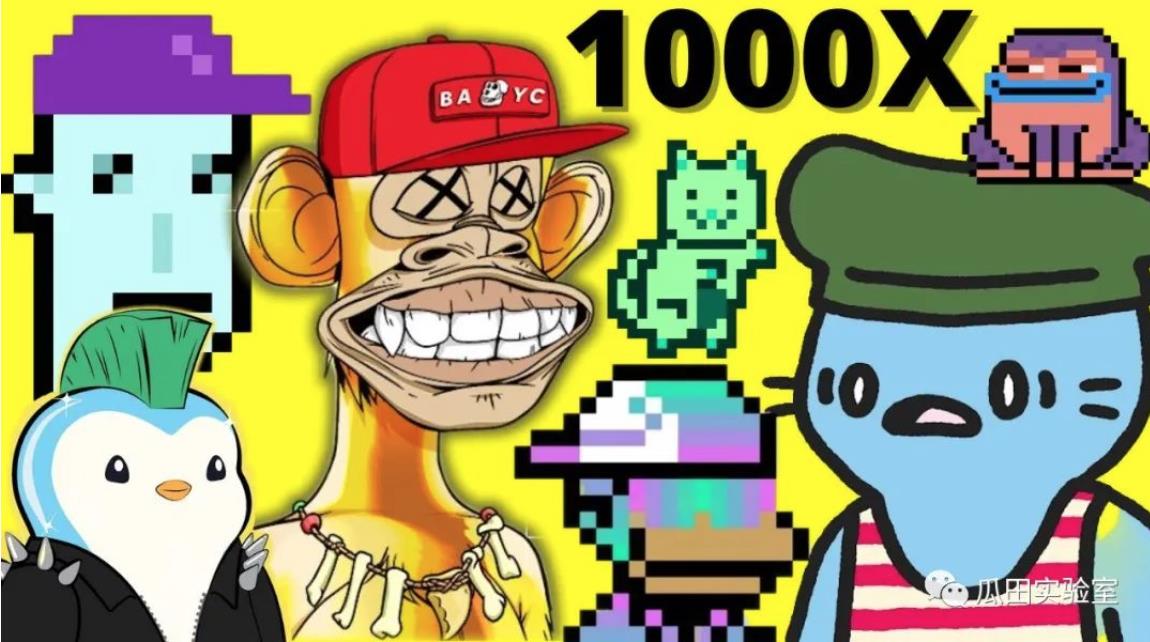
NFT and blockchain gaming convergence trend becomes increasingly evident: analyzing three major cases—Otherside, Flappy Moonbird, and Mobaverse
TechFlow Selected TechFlow Selected
NFT and blockchain gaming convergence trend becomes increasingly evident: analyzing three major cases—Otherside, Flappy Moonbird, and Mobaverse
This article discusses the relationship between NFTs and blockchain gaming, analyzing three cases—Otherside, Flappy Moonbird, and Mobaverse—to explore different integration approaches and development paths. It argues that the convergence of NFTs (IP) and blockchain games will intensify, driving the integration of multiple Web3 sectors.
 Navigating Web3 tides with focused insights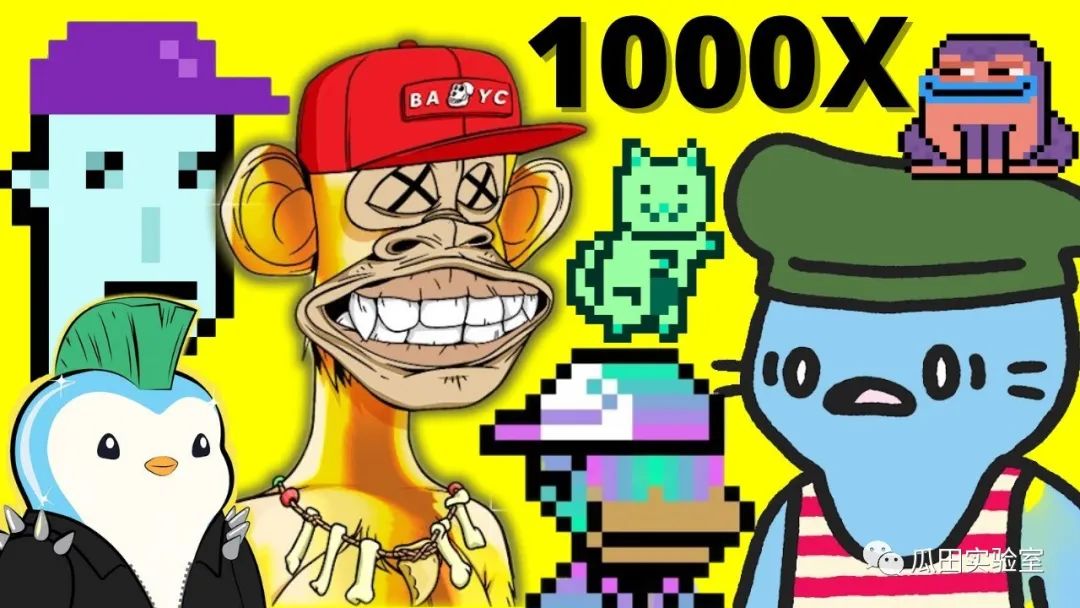
Original by Guatian
[Introduction] This article discusses the relationship between NFTs and blockchain games and their development trends, analyzing three cases—Otherside, Flappy Moonbird, and Mobaverse—to explore different integration approaches. It argues that the convergence of NFTs (IPs) and blockchain gaming will intensify, driving cross-sector integration across Web3.
Recently I came across an article mentioning how several once-high-flying blue-chip PFP NFTs have plummeted during this bear market, with some losing up to 99% of their value—causing fresh blood who entered over the past two years to bleed emotionally. The PFP NFT sector was likely the first type of project newcomers encountered in the last bull run—simple, direct, and driven purely by consensus. These new entrants are young, enthusiastic, freshly onboarded into crypto, seeing communities, DAOs, and consensus—and most importantly, realizing money could be made easily without needing to understand code, finance, or research like old-timers. Just create images and claim they're worth thousands of dollars. Why wait? Charge in! First battle: big win. Second: small victory. Final battle: defeat...
As an observer, I never quite grasped the logic behind long-term value retention for PFP NFTs without continuous utility, even for well-funded and professionally managed projects like Yuga Labs’ Bored Ape Yacht Club (BAYC), which had to quickly launch a blockchain game, Otherside, to reinforce community consensus. Of course, as one crypto guru said: “Dumb money’s consensus is still consensus.” But just like love, consensus needs nurturing and maintenance. And in a bear market, even the “dumb” evolve. Truly clueless participants were never numerous, and those remaining now say, “Even the landlord has run out of grain.” Life gets harder for PFP NFT projects.
How to break free? The most straightforward way is to make PFP NFTs usable. As their social炫耀value fades, can we add practical utilities to help them survive? Like real estate—once investment attributes erode, enhance livability instead.
In the blockchain and Web3 world, NFTs and blockchain games have always been inseparable partners. From Dieter Shirley creating the ERC-721 standard in 2017, to Axiom Zen launching CryptoKitties that congested Ethereum, to Axie Infinity sparking global GameFi fever during the last bull market, then StepN enriching the X-to-Earn (X2E) space last year—NFTs have given games soul, enabling player ownership of assets and full tokenization of characters and gear. Meanwhile, games have expanded NFT use cases, giving them more functionality and real-world applications. In this article, we’ll analyze how PFP NFTs can integrate with blockchain games—what’s possible, what’s practical, and review existing examples.
Although cross-domain development between NFTs and blockchain games continues, depth and breadth remain far from perfect integration. The mainstream classification of NFTs includes six types: profile pictures (PFP), art, gaming assets, tickets/passports, virtual land, and domain names. Among these, PFPs dominate, accounting for 78.7% of total trading volume. Having mentioned PFP NFTs so much, let’s formally define them: PFP NFTs are avatar-based NFTs. Beyond serving as profile pictures, they can function as membership passes, reflect social status online, and rapidly build community consensus among like-minded groups, widely accepted by many. Clearly, PFPs transcend mere images—they represent a new paradigm of IP, while the true narrative lies in the story behind the PFP.
PFP NFT communities centered on IP exhibit strong cohesion, high NFT value and liquidity, and seamless integration with art and social activities, bringing built-in traffic. Yet their limitations are obvious—limited use cases, insufficient utility, and lack of second-layer narratives, i.e., genuine functional applications. PFP NFT projects thrive in bull markets: prices soar, and you can stare at a squinting ugly monkey all day feeling euphoric, adrenaline pumping. With enough consensus, you can erect a billion-dollar image empire overnight. But does this model hold up in a bear market?
In contrast, most NFTs in blockchain games originate from gameplay content. These NFTs have clear use cases—typically access cards, heroes, or equipment—but suffer from weak consensus, limited influence, and evident traffic bottlenecks. Especially for cold-start GameFi projects, teams must invest heavily in producing and promoting game NFTs, inadvertently increasing user learning curves.
Given the clear complementarity between PFP NFTs and blockchain games, let's examine strategies for cross-sector integration:
In terms of embedding NFTs into games, several approaches exist:
1. Direct access: PFP NFT holders receive game passcards or valuable in-game NFTs. Simplest and most direct, but risks feeling forced or artificial if poorly executed—this is the beginner stage.
2. Special perks within gameplay: Certain PFP NFT holders gain bonuses or privileges in specific game scenarios or dungeons, where plotlines and environments tie back to the NFT project’s lore—such as map design or NPCs. This represents intermediate integration.
3. Cultural and narrative fusion: The advanced stage. Requires deeply integrating the long-established themes, spirit, and culture of the NFT community into the game—not just reskinning an existing game. We’ve seen PFP NFT-supported games incorporate early development stories and key figures directly into game quests.
Regarding implementation models, two main strategies emerge:
1. From PFP NFT to blockchain game: Establish IP first, then expand into gaming use cases. Representative examples include Yuga Labs’ Otherside and the recently popular Flappy Moonbird.
2. Build a game platform first: Offer a Gameplay-as-a-Service (GaaS) toolkit for IP owners, encouraging more IPs to join. The leading example here is Mobaverse.
Let’s now dive into each of these three cases.
01Otherside
Yuga Labs shines brightly in the PFP NFT space—multiple airdrops, celebrity endorsements, acquisition of CryptoPunks and Meebits, and the announcement of a game called Otherside culminated in a frenzy during its land NFT sale, triggering a gas war unseen in years. Positioned as a MetaRPG, Otherside aims to become a gamified, decentralized, interoperable world—not only integrating Bored Ape holders but also welcoming NFTs from other projects. Its ambition is vast.
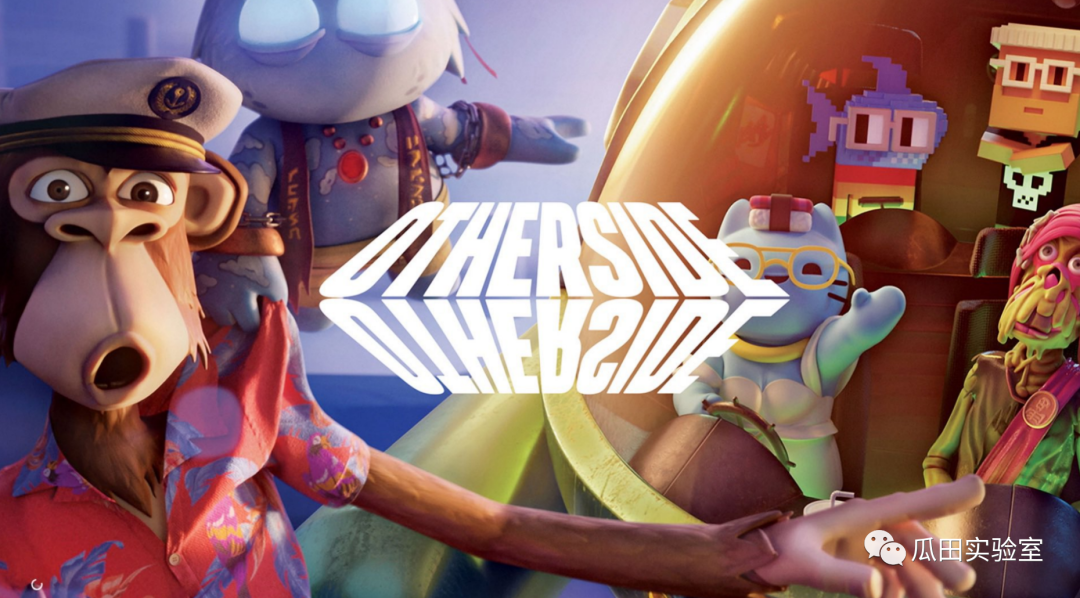
What kind of metaverse is Otherside? Although glimpses emerged during the first Voyager voyage in July last year and through *Legends of the Mara* released in March, the full picture remains under wraps due to limited playable content. According to official statements, Otherside follows three core principles:
1. Co-created with the community: Voyagers not only participate in closed testing but can also develop kits and use building tools;
2. Ownership and interoperability: Otherdeeds aren’t just images—they represent land ownership within the game world, with events affecting land properties;
3. Incentives: Deep engagement with players, creator rewards, aiming to build an open, interoperable metaverse.
There’s no denying Otherside’s strategy is brilliant. In terms of integration, BAYC holders seamlessly obtain game access, and the game’s cultural backdrop is tailor-made for the BAYC community—the transition is nearly flawless. In terms of execution, leveraging BAYC’s IP power, moving from NFTs to gaming exploded demand for Otherdeed land sales, creating a phenomenon akin to mass ape-hunting. Through Otherside, Yuga Labs links BAYC NFTs, land NFTs, and the APE token into a cohesive ecosystem, while collaborating with top-tier IPs to form a BAYC-centric IP matrix. Additionally, the game offers SDKs for developers to build atop the platform. Otherside redefines both gaming and the metaverse concept, establishing a universe rooted in strong identity and connection—an advantage few competitors match. All of this rests on the foundation of Yuga Labs’ BAYC community.
02Flappy Moonbird
A recent headline—"Flappy Moonbird raises $2M at a $60M valuation"—appeared across Web3 media. My first thought: Is the blue-chip PFP NFT Moonbirds entering gaming? Further investigation revealed Flappy Moonbird differs slightly from Otherside—it’s not developed by the official Moonbirds team, but rather licensed to a third-party independent team that claims experience developing over 100 casual games.
Here’s what we found: Flappy Moonbird gained massive traction early this year. Checking DappBay data, it leads in user growth and weekly active users, contributing 11.1% of active users among the top 20 BNB Chain games—making it a flagship title in the BNB ecosystem. Much of this success stems from effectively leveraging the Moonbirds IP’s existing traffic, combined with extremely accessible gameplay—one of Web3 gaming’s key traits: progression can be hard, but entry must be easy!
The project has solid backing: angel funding came from Moonbirds NFT holders; it raised $6M last December led by LinkVC, and another $2M in April’s Pre-B round led by FBG Capital.
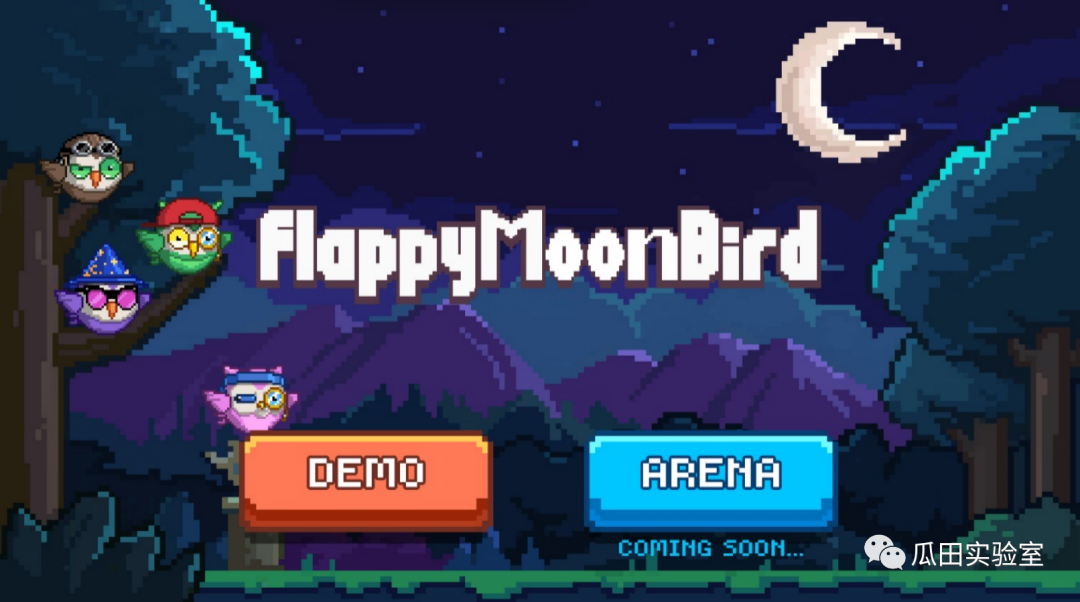
According to its website, Flappy Moonbird consists of four components: the Flappy Bird-inspired *Flappy Moonbird*, racing game *Racing Birds*, AI-powered Monopoly-style *AI Birdnopoly*, and a casual game metaverse. Together, they form a layered nesting structure:
First, *Flappy Moonbird* acts as a free gateway game, lowering entry barriers to attract maximum users and allow accumulation of initial assets and in-game currency;
Next, *Racing Birds* introduces competitive and betting elements, allowing players to multiply wealth earned in the first game;
Finally, combining *AI Birdnopoly* and the casual metaverse to create a rich, engaging universe using AI technology.
These three layers progress logically, forming a closed-loop economic model that quickly captures users, increases stickiness, and ultimately builds a complete gaming ecosystem to retain players. Theoretically sound—it extends the "nested module" approach used within single-game economies into interconnected games, elongating value transmission chains.
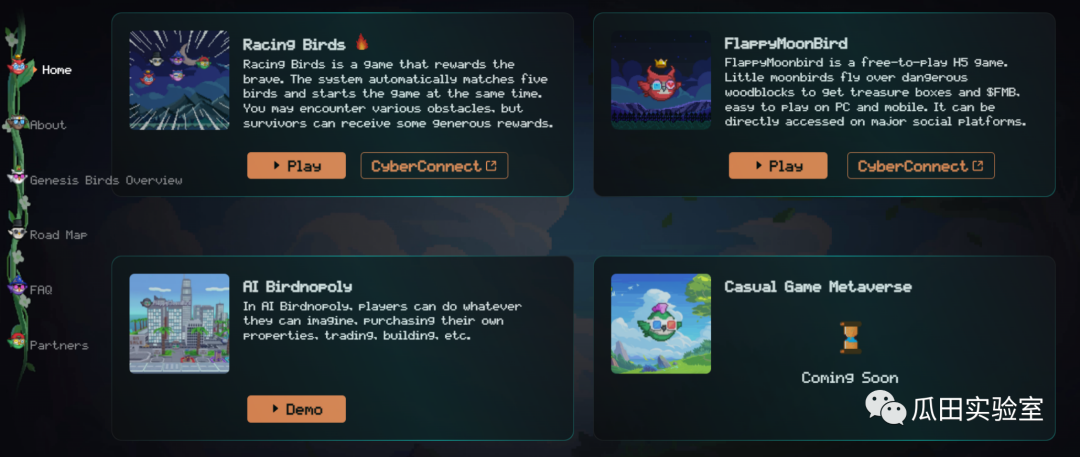
Now, how does it embed PFP NFTs? Moonbird NFT holders benefit primarily through the first and third integration models described earlier: early supporters received Genesis Bird airdrops, and the entire game’s setting and culture align closely with the Moonbirds project, offering instant familiarity upon entry. In terms of execution, it mirrors Otherside—building games atop an NFT community—but differs in that the NFT and game operate more independently, with separate decision-making processes.
Based on the roadmap, upcoming features include NFT passcard minting (launching May 9, 2023), token airdrops, rare bird NFTs, and land NFTs. We can infer the team ultimately aims to present a Moonbirds IP-centered metaverse platform, allowing NFT holders and gamers alike to deepen their understanding of Moonbirds culture through various casual games.
03Mobaverse
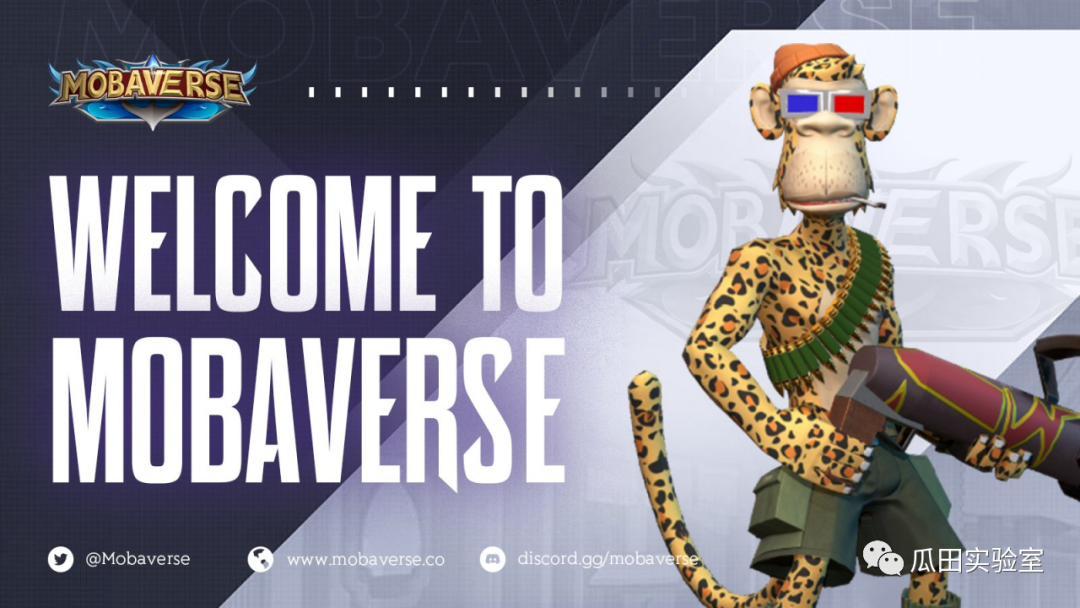
Mobaverse is a recently discovered project—a game platform compatible with various PFP NFTs, featuring a MOBA-style flagship game. It welcomes PFP NFT projects and holders to join, turning their NFT IPs into playable heroes and generating customized content, enabling effortless commercialization of IPs within the Mobaverse ecosystem. Going forward, UGC will be central, further incubating IP spin-offs and new content.
Analyzing its NFT integration model, Mobaverse focuses on the second category: providing hero roles and custom content for NFT IP holders, achieving moderate fusion between platform and NFTs. In terms of execution, unlike Otherside and Flappy Moonbird, Mobaverse builds the game first, then integrates NFT IPs.
Conclusion
From these three cases, we observe three distinct integration strategies:
Yuga Labs took a relatively traditional, capital-intensive path—centering on PFP NFTs, expanding horizontally into new application scenarios, with deep team involvement in crafting the Otherside game. This tight control enables full mutual empowerment between game and NFT, shared resources, and a holistic ecosystem. However, 3A-level game development comes with long R&D cycles, massive resource demands, complex mechanics, and economic models—constraints that increase risk.
In contrast, Flappy Moonbird pursued a lighter approach—licensing IP to an independent game studio. The game leveraged NFT hype for market entry and user acquisition. Easy gameplay gave Moonbird NFT holders early advantages, while rapid iteration allowed adjustments based on feedback. Here, game and NFT support each other more collaboratively.
Mobaverse takes a game-first approach—aggregating influential existing NFT IPs into its platform, leveraging mature IP equity while focusing exclusively on gameplay and content creation.
While differing slightly, Otherside and Flappy Moonbird follow the same general trajectory: IP first, then game. Mobaverse reverses it: game first, then IP incubation. These two paths represent current mainstream models for NFT-game convergence—akin to actors becoming singers or vice versa. Neither is superior; they simply differ in direction, yet both are viable.
But disruption often comes from outside. Just as internet celebrities have crossed into acting and singing, could other Web3 sectors—like SocialFi—expand into PFP NFT (IP) and blockchain gaming, carving a more successful path?
As Binance CEO CZ once noted, GameFi’s greatest contribution is presenting financial products through gamification—e.g., boosting yields via NFTs, increasing outputs. Compared to traditional liquidity mining, GameFi offers stronger interactivity, better user acceptance, and monetizable game algorithms. These are advantages of gaming NFTs over traditional PFP NFTs. In the coming years, the convergence of NFTs (IPs) and blockchain gaming will accelerate, further fueling growth in NFTFi, SocialFi, and other Web3 verticals, driving broader cross-sector integration across Web3. Let’s look forward to more high-quality, NFT-centric games launching soon, pushing the industry forward together.
Join TechFlow official community to stay tuned
Telegram:https://t.me/TechFlowDaily
X (Twitter):https://x.com/TechFlowPost
X (Twitter) EN:https://x.com/BlockFlow_News
 瓜田实验室W Labs






