HKEX Report Insights | The Development of ETFs and the Virtual Asset Ecosystem in Global Financial Markets
TechFlow Selected TechFlow Selected
HKEX Report Insights | The Development of ETFs and the Virtual Asset Ecosystem in Global Financial Markets
In April 2023, the Hong Kong Exchanges and Clearing Limited (HKEX) officially released a research report titled "The Development of ETFs and the Virtual Asset Ecosystem in Global Financial Markets."
 Navigating Web3 tides with focused insights
In April 2023, Hong Kong Exchanges and Clearing Limited (HKEX) officially released a research report titled "The Development of ETFs and the Virtual Asset Ecosystem in Global Financial Markets."
As one of the most influential securities exchanges both within China and globally, HKEX's research and practical initiatives regarding virtual assets carry strong representativeness and reference value. To some extent, they even reflect traditional finance’s stance toward the crypto world and outline viable, compliant ways to participate.
Exchange-traded funds (ETFs), which track changes in an underlying index and are listed on stock exchanges, can also use virtual assets as their underlying assets—enabling the compliant launch of “virtual asset ETFs.” This has become one of the key ways HKEX is currently engaging with digital currencies.
This report goes beyond just explaining the concept of ETF products; it covers broader topics including global developments in virtual assets and their regulatory frameworks, market performance of virtual asset ETFs around the world, the evolution of Hong Kong's crypto policies, and the current state of ETF products in Hong Kong. The comprehensiveness and depth of its data suggest that Hong Kong is preparing itself for full engagement with the crypto ecosystem.
TechFlow Research has appropriately streamlined, reorganized, and interpreted this report, distilling its core insights for your reference and learning.
I. A New Chapter: From Geek Experiment to Alternative Asset – Size, Volatility, and Policy Overview
*Editor’s note: The original report devotes significant space to introducing Web3.0 concepts and classifications of crypto assets. We have omitted that section and moved directly into the market insights.
Overall Scale: Growth in crypto market capitalization over the past three years may be why HKEX is paying attention:
-
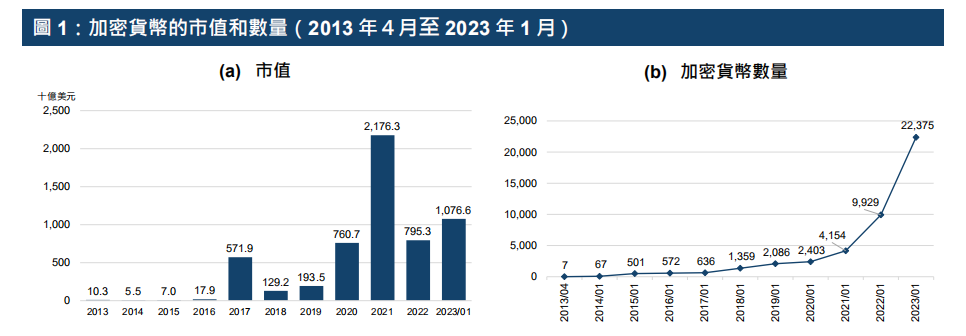
The market capitalization of virtual assets has grown from $10.3 billion in 2013 to $1.0766 trillion in January 2023;
-
The number of cryptocurrencies has surged from 7 in April 2013 to 22,375 by the end of January 2023;
-
The global number of people holding virtual assets increased from 306 million in January 2022 to 425 million in December 2022.
In structure: More holders of crypto assets and growing proportion of derivatives in trading activity:
-
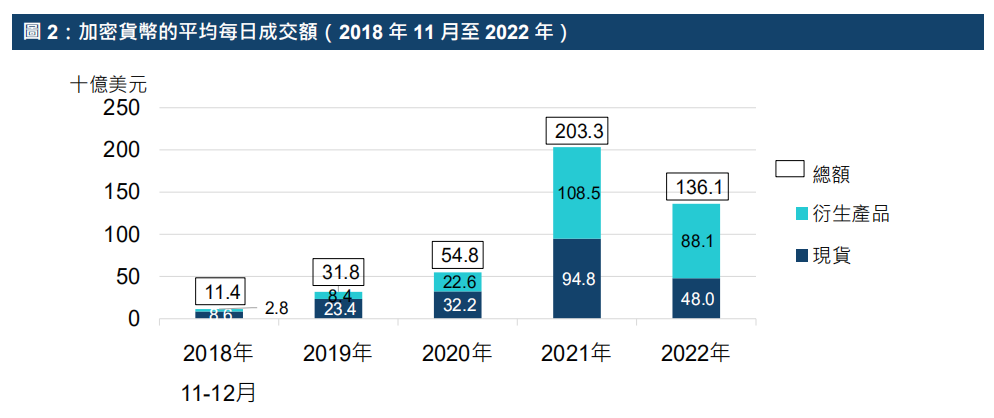
Average daily trading volume (including spot and derivatives) rose from $31.8 billion in 2019 to $136.1 billion in 2022;
-
Spot average daily trading volume grew 105% during the same period—from $23.4 billion to $48 billion—equivalent to about 21% of the combined average daily trading volume of stocks listed on the NYSE and NASDAQ during the same period;
-
Crypto derivatives trading exceeded spot trading in 2021, and in 2022, derivatives trading was nearly double that of spot trading.
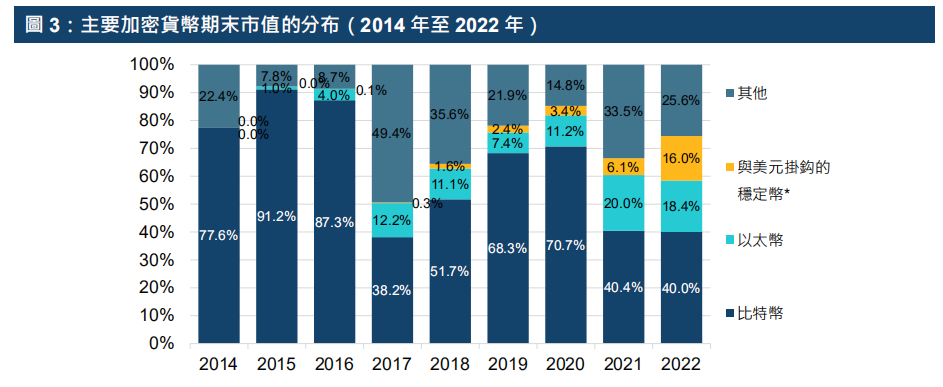
Market cap structure shifts among Bitcoin, Ethereum, stablecoins, and other crypto assets:
-
Bitcoin's market share shows a shrinking trend but remains the cornerstone;
-
Ethereum's market share has gradually expanded, a trend mirrored by stablecoins;
-
Trends become clearer when viewed year-by-year.
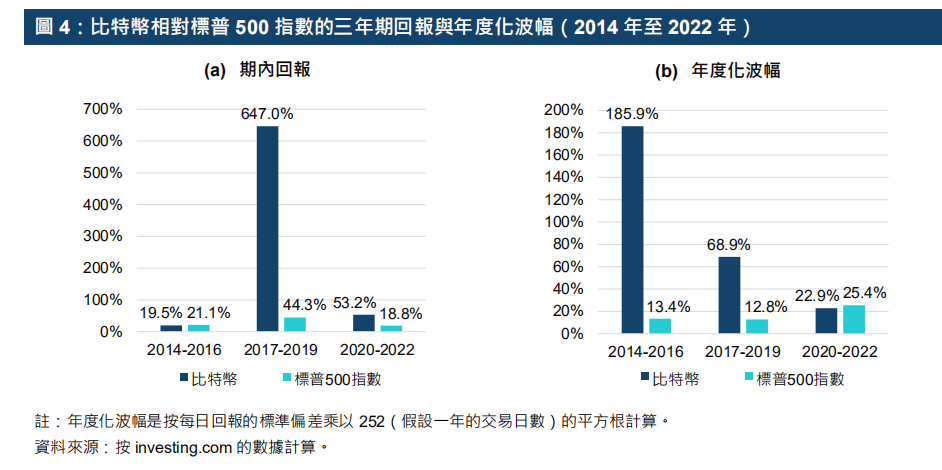
Crypto assets are increasingly seen as “alternative” investments—highly volatile compared to mainstream assets, with unstable returns:
-
Annualized price volatility of Bitcoin ranged between 22.9% (2020–2022) and 185.9% (2014–2016);
-
For the S&P 500 Index, the range was 12.8% to 25.4%;
-
Over time, Bitcoin’s annualized volatility shows a downward trend.
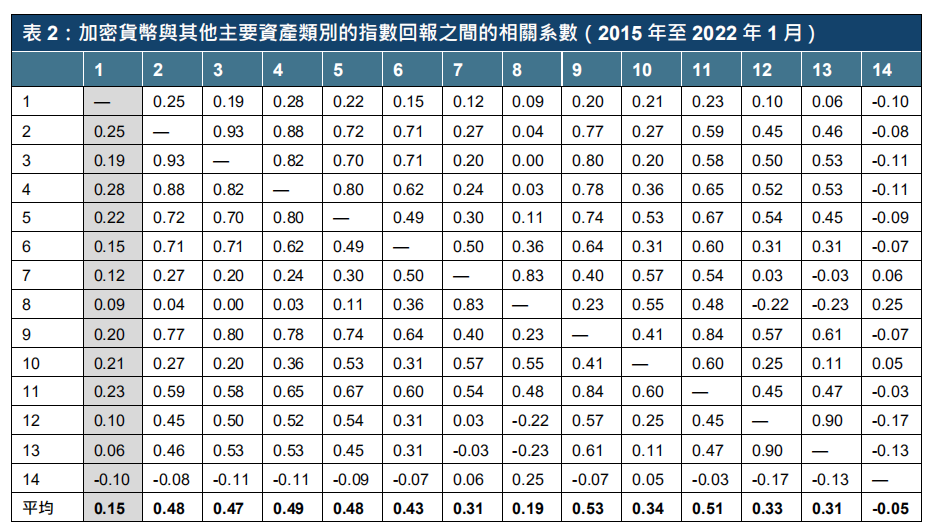
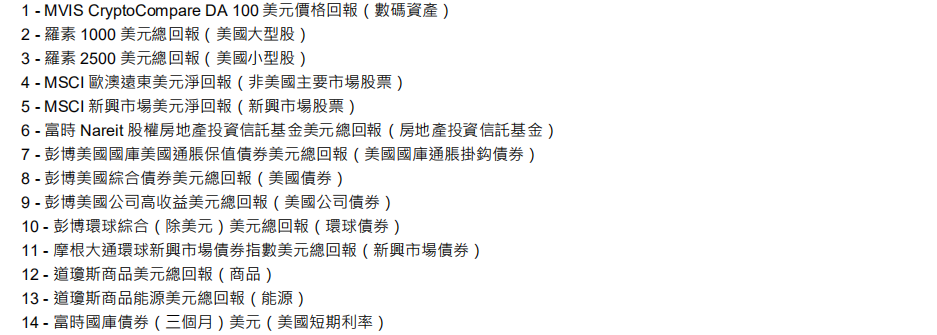
How correlated are “alternative” and “mainstream” assets?
-
From 2015 to January 2022, the average correlation coefficient between virtual assets and returns of other major asset classes was 0.15%;
-
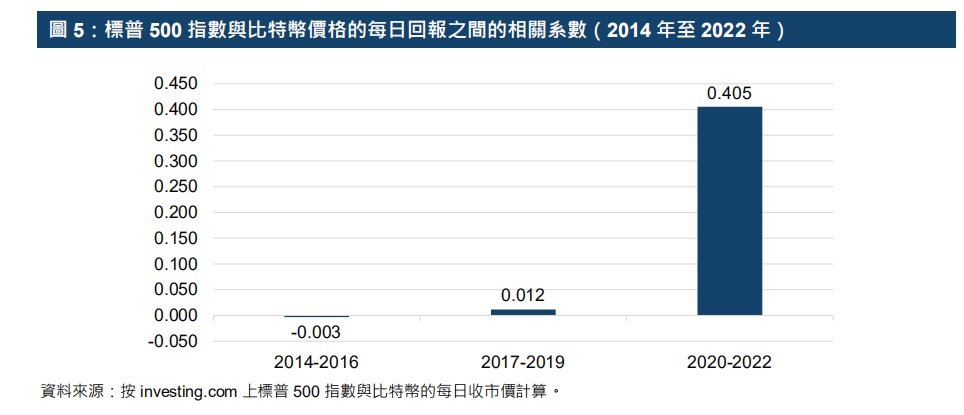
Correlation may change over time: The correlation coefficient between daily returns of the S&P 500 and Bitcoin rose from 0.012 (2017–2019) to 0.405 (2020–2022);
-
This could be due to increasing institutional investment in virtual assets, driving higher correlation.
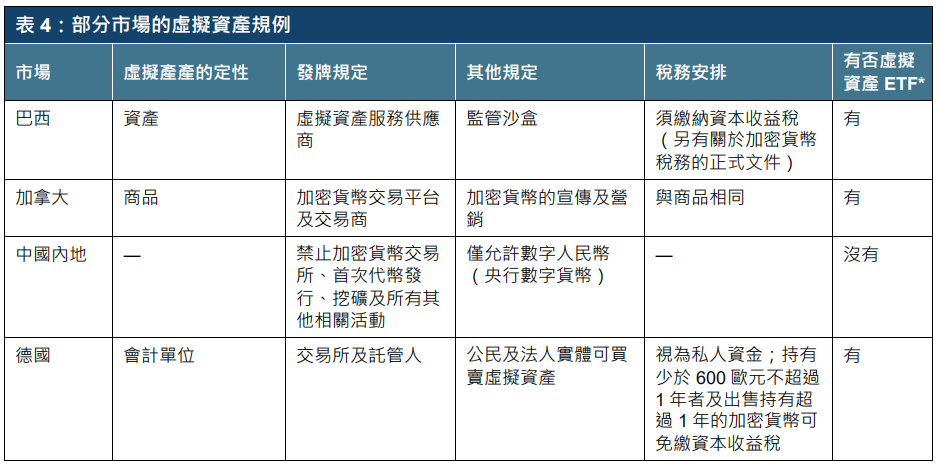
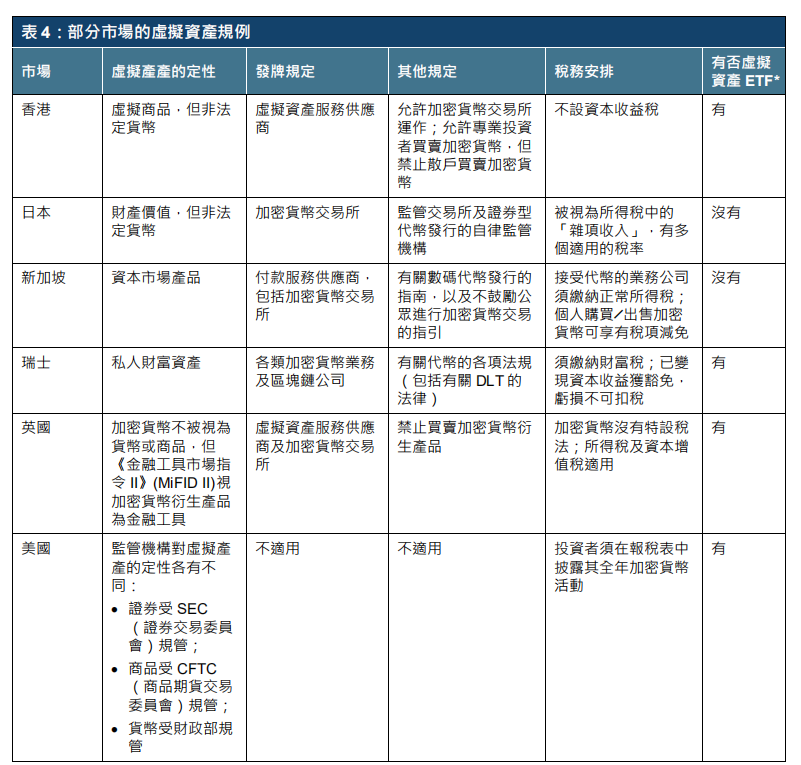
Global regulations vary, but some regions have established compliant ETFs for investing in virtual assets:
II. The Path to Compliance: Global Trends, Correlations, and Market Performance of Virtual Asset ETFs
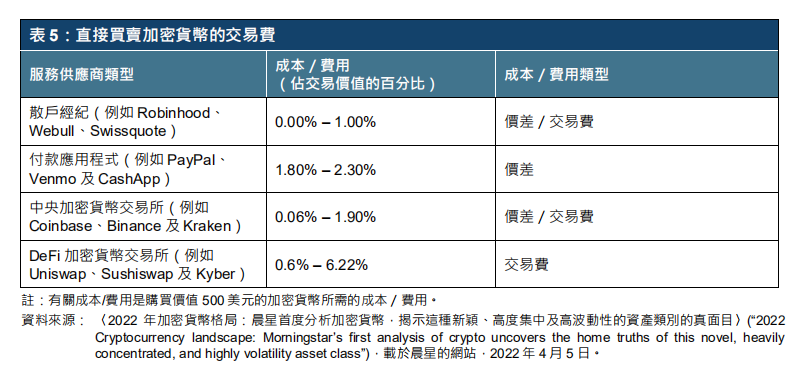
All channels to enter the virtual asset market have been fully categorized by HKEX:
-
Direct channels: Buying/selling cryptocurrencies via crypto brokers or exchanges, or participating in ICOs;
-
Indirect channels: Investing in blockchain company stocks, cryptocurrency futures + ETFs, and other funds.
-
HKEX believes indirect routes—especially ETFs—are safer, more compliant, and risk-controllable.
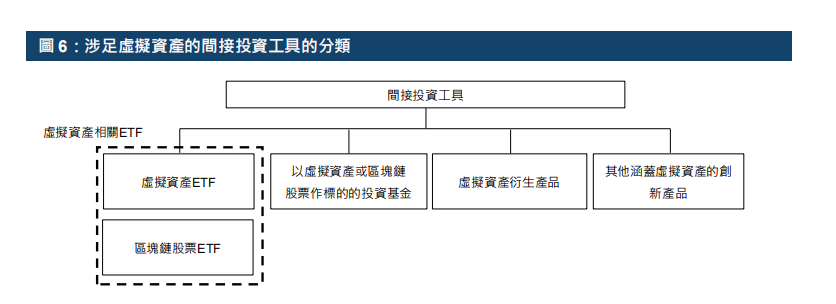
Existing virtual asset ETFs across global capital markets and their performance:
-
By the end of November 2022, there were 40 virtual asset ETFs across markets in Canada, Brazil, the U.S., and Australia, managing a total of $2.4 billion in assets;
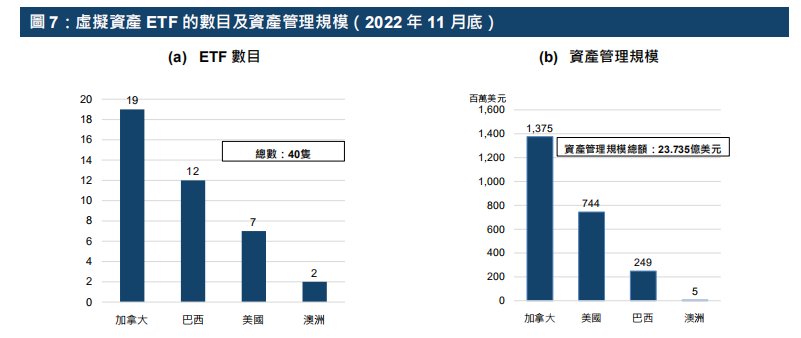
Characteristics and current market size of virtual asset ETFs:
-
Product types: Physical ETFs—holding actual virtual assets; Synthetic ETFs—holding futures contracts;
-
Underlying types: BTC and ETH dominate, with some DeFi index-based offerings;
-
Management strategies: “Long-only,” “options portfolios,” “inverse (short) strategies,” “crypto index tracking”;
-
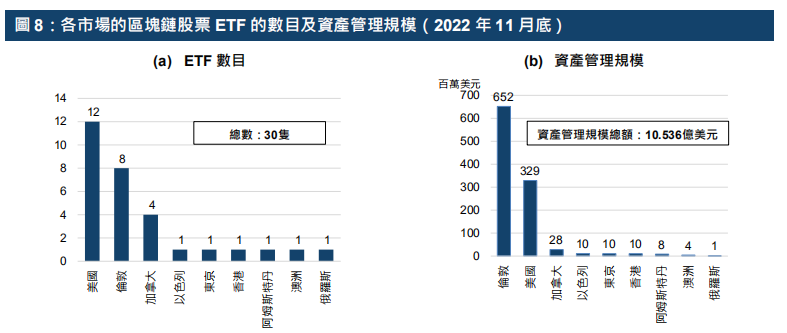
In terms of scale and quantity, North America and the UK lead the way.
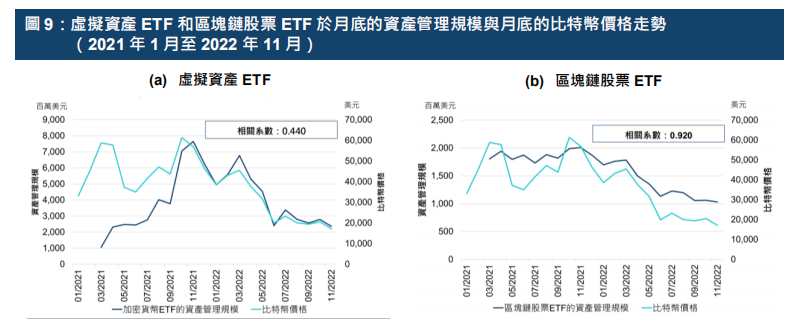
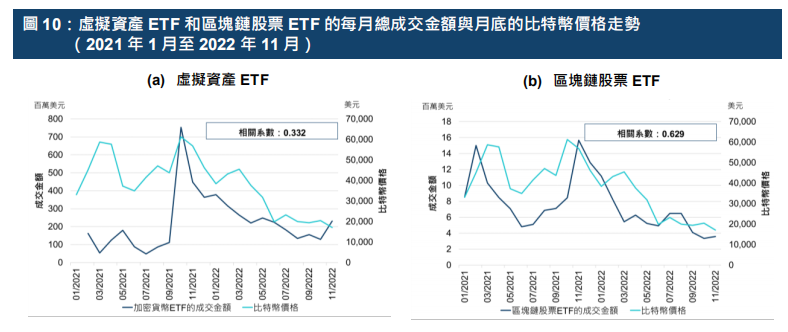
As expected—ETFs show a certain correlation with Bitcoin prices:
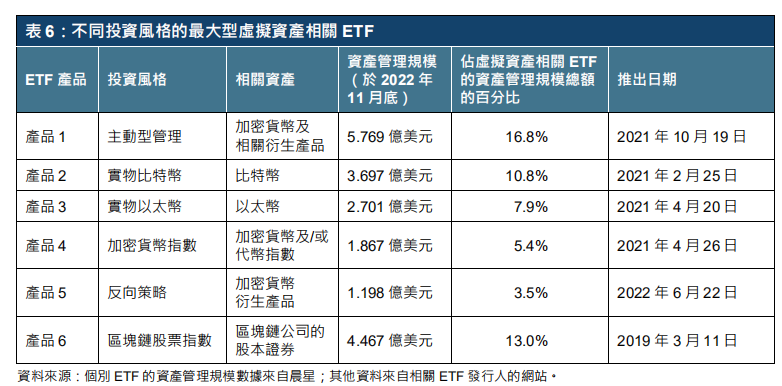
Representative ETFs by management strategy:
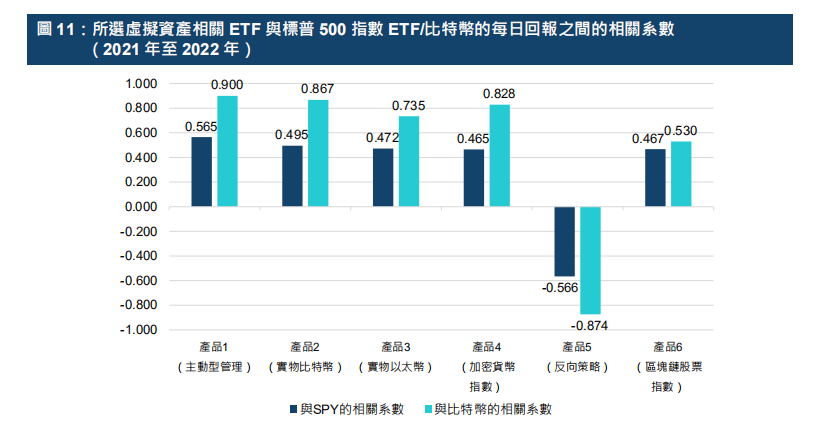
Conclusions on correlations between ETF returns, traditional securities markets, and BTC:
-
Virtual asset ETFs (Products 1–5) show high daily return correlation with Bitcoin, but only moderate correlation with the SPDR S&P 500 ETF (ticker: SPY);
-
Blockchain stock ETFs (Product 6) show moderate correlation with both SPY and Bitcoin, with slightly higher correlation to Bitcoin;
-
Conclusion: Compared to traditional equity investments, virtual asset ETFs can help diversify portfolios. Blockchain stock index ETFs offer similar benefits, albeit to a lesser degree.
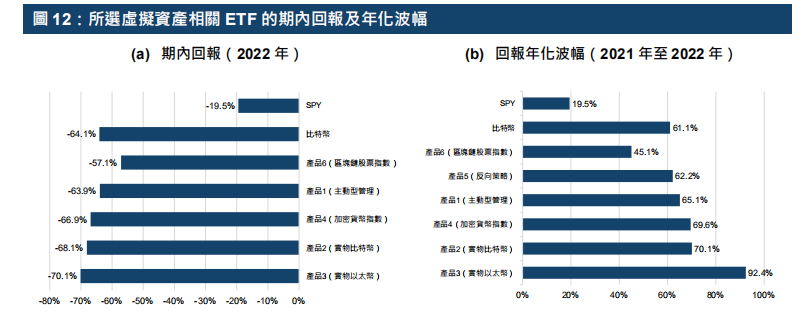
Volatility of virtual asset ETFs: Higher waves mean bigger fish—but can you withstand the storm?
ETF vs. Non-listed Funds:
-
Compared to non-listed funds, ETFs are generally more cost-effective;
-
ETFs offer higher liquidity and transparency than non-listed funds;
-
ETFs can be bought or sold at any time during exchange trading hours;
-
ETF holdings are typically updated daily, whereas non-listed funds rarely disclose such information.
III. Hong Kong’s Stance: Local ETF Regulation, Practice, and Future Determination
1. Major progress in Hong Kong’s market structure and policy:
-
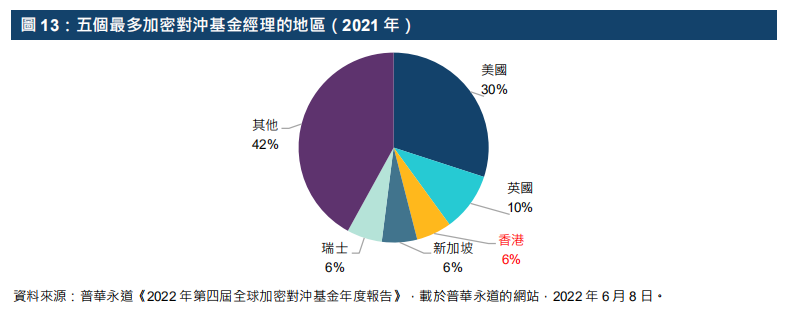
In 2021, investors in Hong Kong purchased HK$10 billion worth of virtual asset funds through overseas platforms—an increase from HK$8 million in 2020;
-
Hong Kong ranks third globally in fund managers, hosting 6% of the world’s crypto hedge fund managers.
2. Historical development of the regulatory framework:
-
2018: The Securities and Futures Commission (SFC) introduced its virtual asset regulatory framework, limiting clients to professional investors only. These include licensed trading platforms, STOs (security token offerings), and virtual asset fund clients.
-
January 2022: The SFC and the Hong Kong Monetary Authority (HKMA) issued a Joint Circular on Virtual Asset-Related Activities of Intermediaries, allowing securities brokers and banks to provide virtual asset trading services to clients.
-
October 2022: The then Deputy Chief Executive of the SFC delivered a speech providing guidance on launching virtual asset futures ETFs and STOs. The Financial Services and Treasury Bureau published a Policy Statement on the Development of Virtual Assets in Hong Kong, outlining several pilot programs:
(1) Issuance of NFTs for the 2022 Hong Kong FinTech Week
(2) Green Bond Tokenization — tokenizing government green bonds for subscription by institutional investors
(3) Digital Hong Kong Dollar
-
February 2023: The SFC released a consultation paper detailing a new licensing regime for virtual asset service providers, including product types and conditions under which retail investors may trade virtual assets—such as requirements on market cap, liquidity, and other criteria—indicating Hong Kong’s financial sector may soon extend virtual asset services to retail investors.
-
June 2023: Implementation of the new licensing regime for virtual asset service providers.
*Editor’s note: See the original report for further details on regulations.
3. Hong Kong launches Asia’s first virtual asset ETFs:
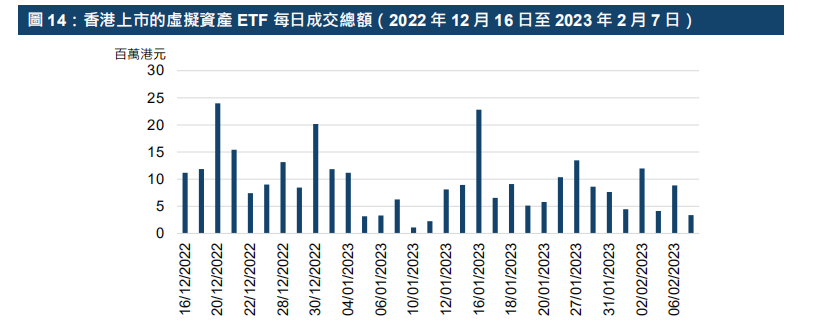
On December 16, 2022, two ETFs were listed on the Hong Kong Stock Exchange: a Bitcoin Futures ETF and an Ethereum Futures ETF;
In January 2023, a third virtual asset ETF was launched in the Hong Kong market;
These ETFs adopt active management strategies, with underlying assets being standardized, cash-settled futures contracts traded on CME;
The average daily trading volume of these ETFs is approximately HK$9.3 million.
Investors find it convenient to access the market through virtual asset ETFs, avoiding the need for a dedicated trading account and crypto wallet required for direct crypto trading.
This reflects the authorities’ determination to develop Hong Kong’s virtual asset ecosystem and demonstrates market demand for such products. Looking ahead, more thematic virtual asset ETFs and other virtual asset products are expected to emerge in Hong Kong.
IV. Conclusion
Driven by the development of Web3.0 and blockchain technology, virtual assets are becoming an increasingly important part of the financial system. Regulatory regimes targeting virtual assets continue to evolve, aiming to balance market growth with financial stability.
Currently, investors can directly trade virtual assets via crypto exchanges or brokers, or gain exposure indirectly through investment funds—including ETFs.
A wide variety of virtual asset ETFs have already been launched globally, enabling investors to capture opportunities in cryptocurrencies and publicly listed blockchain companies.
As a well-regulated international financial center, Hong Kong appears fully prepared to seize the potential opportunities brought by the rise of virtual assets. With foundational regulatory frameworks now in place, Hong Kong is fostering healthy growth of its virtual asset ecosystem. The listing of its first batch of virtual asset ETFs marks the beginning of product innovation. Ongoing improvements in regulation are expected to further support the development of Hong Kong’s virtual asset ecosystem.
Full versions of the report in Chinese and English, sourced from HKEX’s official website:
Join TechFlow official community to stay tuned
Telegram:https://t.me/TechFlowDaily
X (Twitter):https://x.com/TechFlowPost
X (Twitter) EN:https://x.com/BlockFlow_News
 深潮TechFlow