Defining Real and Fake DAOs: Why Can't Every Organization Be Called a DAO?
TechFlow Selected TechFlow Selected
Defining Real and Fake DAOs: Why Can't Every Organization Be Called a DAO?
There may be many reasons why an organization is not worthy of being granted the title "DAO."
 Navigating Web3 tides with focused insights
Author: Gabriel Shapiro
Compiled by: TechFlow
TLDR
In its purest form, a "DAO" refers to an unregistered association of individuals ("organization") that uses censorship-resistant technology to engage in non-hierarchical, widely distributed ("decentralized") governance over shared resources and goals without requiring permission ("autonomous").
Organizations that do not meet this definition cannot be considered "DAOs".
Therefore, there may be many reasons why an organization does not deserve the title of "DAO":
-
Because the organization is centralized (e.g., a Delaware corporation managed by a board);
-
Because it requires government permission (e.g., a member-managed Delaware LLC);
-
Because it is easily censorable (e.g., a Telegram chat group).
I will further explain the essence of DAOs below.
Problem: The Term "DAO" Has Lost Its Clear Meaning
The term "DAO" has been applied to so many different organizations that it has nearly become meaningless. I want to correct this.
Minimum Standards
I believe that whatever a DAO is, it must fall into three clear and distinct conceptual categories:
- Decentralization;
- Autonomy;
- Organization.
My mind shouts each word—"decentralized," "autonomous," and "organized"—each having its own reason for existence, none redundant with another.
Thus, "decentralized" cannot mean the same as "autonomous"—otherwise we would call them "DOs" (Decentralized Organizations) or "AOs" (Autonomous Organizations).
We don't call them that.
We call them "DAOs." This means that when evaluating whether something qualifies as a "DAO," we must examine these three aspects separately to conclude: Yes, this thing is a "DAO," and not something else.
"Organization"
Webster's most relevant definition of "organization" is as follows:
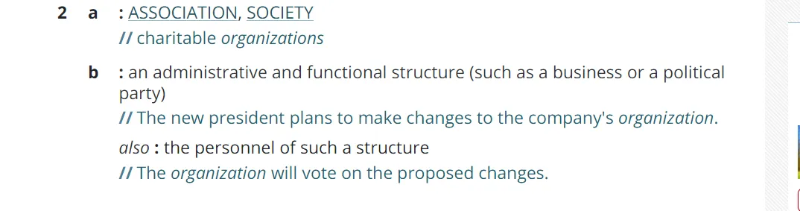
"Association" is defined in the relevant part as follows:

And "Society" is further defined in the relevant part as follows:
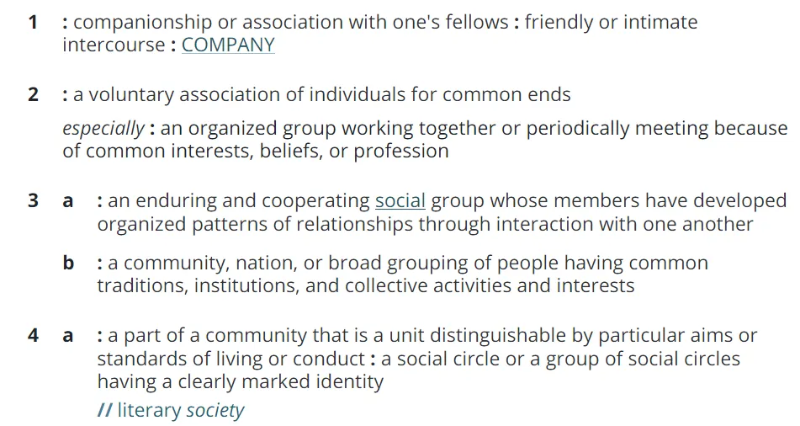
Therefore, a DAO is some kind of association of individuals united by a common purpose or regularly interacting with one another. For those familiar with corporate law, we know associations come in two main types: unincorporated and incorporated.
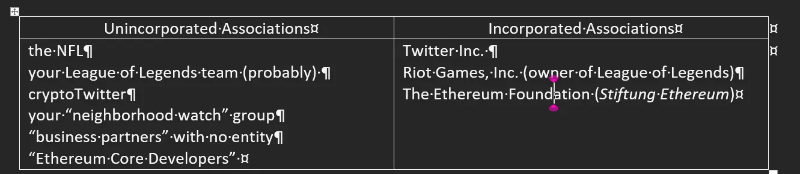
Basically, we all understand what an "organization" is—it’s an unregistered or registered association composed of natural persons or legal entities. I intentionally use the term "natural person" because associations can also consist of legal persons. Thus, there could be associations made up of other associations or combinations of associations and individuals.
I believe it is uncontroversial that organizations can be either centralized or decentralized, autonomous or non-autonomous. For example, Twitter Inc. is centralized (its ultimate decision-making power lies with its board) and relatively non-autonomous (it aims to generate profits for shareholders who can freely appoint and remove the board). The Ethereum Foundation is similar to Twitter Inc. in being centralized (having a board or similar governing body), but unlike Twitter Inc., it is relatively autonomous (it only follows its charter, which can be modified by its governing body, which is not elected by any external authority or beneficiaries).
*Note: Neither of these entities meets the stricter concept of "autonomy" that I believe should apply to "DAOs," as described below.

"Decentralization"
"Decentralization" is harder to define than "organization," but not by much. Webster defines "decentralization" in the relevant part as follows:
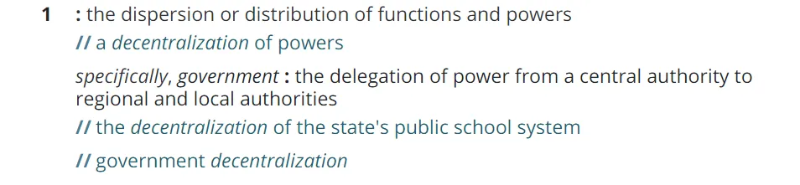
Decentralization occurs when power is widely dispersed or distributed.
This can be achieved in many different ways: for instance, all organizational decisions could be determined by token-holder voting, where token ownership and voter turnout are widely spread among many "small fish" (each holding a small fraction of total token supply/total voting power). Alternatively, different types of decisions could be delegated to different groups of people, and coordination between these groups could be informal and non-hierarchical.
A good example of the latter form of decentralization is Bitcoin. Beyond the consensus protocol itself, there are no formal governance rules among mining nodes, non-mining nodes, users, exchanges, and core developers, yet these groups exert different kinds of influence over Bitcoin, governed essentially on an emergent basis through "rough social consensus." Checks and balances imposed among these representative groups determine power conflicts and shape the fate of Bitcoin as an entity. (If you doubt this and believe otherwise—for example, that Bitcoin is "run by miners"—just review the convoluted history of the "block size wars" and how they were resolved.)
"Autonomy"
"Autonomy" is the hardest to define and the most overlooked element in constituting a "DAO." Webster defines "autonomous" in the relevant part as follows:
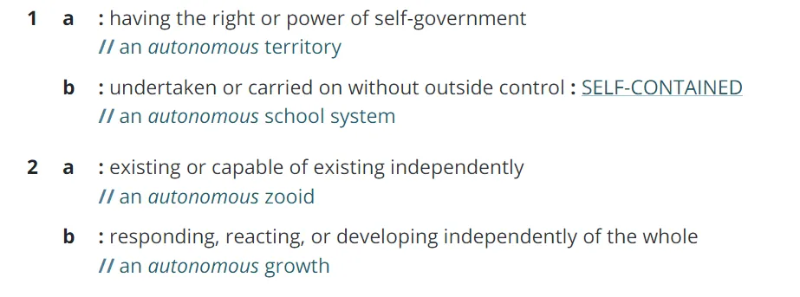
I believe many people misunderstand and incorrectly define the term "autonomy," often due to misconceptions about "smart contracts."
A widespread misunderstanding of smart contract technology is that smart contracts can work "automatically" without human intervention—they are seen as some sort of "non-human agents" participating in the "algorithmic governance" of organizations. In reality, smart contracts are merely passive pieces of code stored on a blockchain. When a user requests their execution, miners/validators run the code and are paid fees to include the results in a new block. In other words, unless specifically and manually triggered by a human (or a human agent—such as a "bot"), a smart contract never does anything. Smart contracts are the least automatic or autonomous—they are slaves to external inputs.
Hence, someone might mistakenly interpret the term "autonomous" in "DAO" as meaning "an organization that uses smart contracts." This misunderstanding creates a major "scam," allowing many arrangements that are not "autonomous" in the Websterian sense to be labeled as "DAOs" simply because they involve so-called "automatic" technology—smart contracts. However, "autonomous" does not mean "automatic," and even if it did, smart contracts are not automatic. Smart contracts are clearly not autonomous either, since they are unconscious and inert rather than spontaneous and self-controlled.
Therefore, the term "autonomous" in "DAO" does not refer to a specific technology (smart contracts), but to a certain organizational form. In other words, both "decentralized" and "autonomous" in "DAO" are adjectives modifying the noun "organization." Thus, a "DAO" is a decentralized and autonomous organization.
Remember how we said earlier that an "organization" means an "association of individuals"? That means "autonomous" cannot be a property of a smart contract—it must be a quality of the people—the individuals who make up the organization using smart contracts.
So, what does "autonomous" truly mean? Well, Webster's definition is quite accurate:
-
Having the right or power of self-government;
-
Conducted or operated without external control;
-
(Capable of) independent existence.
This definition clearly reveals the role of "censorship-resistant" or "dissident technologies" in enabling autonomy—and thus in forming a "DAO." For example:
-
Facebook groups, Telegram chats, Slack workspaces, Discord servers, etc., are not "autonomous" (and therefore cannot be DAOs), because the companies owning these platforms can shut down the group at any time, add or remove members, or change, add, or delete content with almost no resistance;
-
A group of Google employees researching and developing AI under employment contracts are not "autonomous" (and therefore cannot be a DAO), because Google automatically acquires all resulting intellectual property under signed assignment agreements, controls all funding for the group, and has non-compete agreements with each member—it can arbitrarily remove or replace members, dissolve the group, cut funding, or even prohibit them from ever working on AI-related ideas again;
-
A neighborhood watch group is not "autonomous" (and therefore cannot be a DAO), because it is only authorized to observe issues and report them to police/government, not conduct its own law enforcement or adjudicate violations; if members exceed these limits, authorities will treat them as criminals and suppress their private activities.
Importantly, all the above examples are associations of individuals (thus organizations), and (at least potentially) decentralized (e.g., through lack of hierarchy and one-person-one-vote decision systems). Yet they still aren't DAOs. This is because they are not autonomous; the technologies, methods of association, and resources they rely on are subject to too much arbitrary external control, making these groups dependent on "the goodwill of strangers."
In contrast, any of the following would more likely qualify as autonomous—and thus potentially as a DAO:
-
A chat group operating on the open-source federated Matrix protocol;
-
Bitcoin Core or Ethereum Core developer communities;
-
A sci-fi cult living on yachts floating in international waters; or
-
A darknet market operating on Tor.
Many good historical, current, and/or fictional examples of autonomous organizations include Hassan i Sabbah's Order of Assassins, The Pirate Bay, WikiLeaks, Bitcoin, Anonymous, Peoples Temple, the Seasteading Institute, the Fremen in Dune, the Avengers before the Sokovia Accords, and the fictional F. Society in Mr. Robot. Needless to say, nation-states are also autonomous (especially superpowers).
Ironically, the original "theDAO" was not very autonomous. The way the Ethereum hard fork altered the outcome of theDAO's operations showed that theDAO could be externally censored by a small group of influential Ethereum developers and miners. However, today's DAOs on Ethereum are more autonomous than the original "theDAO," because coordinating a controversial Ethereum hard fork today is far more difficult and costly than in 2016.
Likewise, many so-called "DAOs using smart contracts" are not truly "autonomous." The Gnosis multisig wallet is indeed a smart contract, but the organization it manages is hardly "autonomous." Smart contracts are tools—they increase or decrease autonomy depending on their design and usage.
*Note: I am not saying the 2016 hard fork constituted censorship of theDAO. The fact that the hard fork changed theDAO's state logic using external capabilities distinct from theDAO token holders' voting rights and theDAO's state transition engine merely indicates that theDAO was more susceptible to censorship (and thus less autonomous) than originally claimed.
Conclusion
Alright, stop using the term "DAO" to describe organizations that make little attempt at autonomy (such as Wyoming LLCs). While decentralization and autonomy exist on continua, the term "DAO" should be reserved for organizations that, within current technological constraints, approach relative decentralization and relative autonomy across as many dimensions as possible—and at minimum aspire to become increasingly decentralized and autonomous across as many dimensions as possible by advancing dissident technologies.
Merely using blockchain or smart contracts in some superficial way is insufficient for an organization to qualify as a "DAO." For organizations that use smart contracts but are not DAOs, I prefer the term "cyber-enhanced organizations" ("cybOrgs"). Consider using that term or similar alternatives instead of polluting the meaning of "DAO" just for hype.
Now let's build better DAOs.
Join TechFlow official community to stay tuned
Telegram:https://t.me/TechFlowDaily
X (Twitter):https://x.com/TechFlowPost
X (Twitter) EN:https://x.com/BlockFlow_News