The value of cutting-edge technological integration and innovation between AI and Web3
TechFlow Selected TechFlow Selected
The value of cutting-edge technological integration and innovation between AI and Web3
As early as 2020, Fourth Revolution Capital (4RC), an investment firm focused on blockchain technology, proposed that "blockchain and artificial intelligence (AI) would become the core emerging technologies of the fourth industrial revolution."
 Navigating Web3 tides with focused insights
As early as 2020, Fourth Revolution Capital (4RC), an investment firm focused on blockchain technology, proposed the view that "blockchain and artificial intelligence (AI) will become the core emerging technologies of the Fourth Industrial Revolution."
The Fourth Industrial Revolution has only just begun, as its core technologies—including blockchain and AI—have so far reached only a small fraction of their full potential. Just as each previous revolution reshaped the world and altered the course of human destiny, we believe blockchain technology combined with AI will disrupt existing industries by decentralizing global sectors such as finance, healthcare, e-commerce, and entertainment.
— 4RC
Do blockchain and AI truly possess such transformative power? The future is full of uncertainties, and no one can make definitive claims. To explore this question, let us look for clues in history and current developments. First, let’s revisit the evolution of industrial revolutions:
- Steam Revolution: From the 1760s to the mid-19th century, the improvement and widespread application of steam engines enabled mechanized production powered by steam in industries like metallurgy and mining, accelerating the rapid development of capitalist cities;
- Electrical Revolution: From the mid-19th century to the early 20th century, the invention and application of electricity and internal combustion engines advanced new energy sources, machinery, and long-distance communication, ultimately forming a global capitalist market;
- Information Revolution: In the mid-20th century, the computer-driven Third Industrial Revolution gave rise to the internet, enabling information democratization and the emergence of digital business models;
 Image
Image
Summarizing these industrial revolutions, it is clear that science and technology have played an increasingly crucial role in advancing productivity, and the transformation of scientific advancements into direct productive forces continues to accelerate. Next, let us cut through the noise of public discourse and analyze how blockchain and AI generate productivity, exploring what benefits their integration could bring to industry development. We will also highlight existing crypto-AI projects, hoping to provide some inspiration and insights.
The Value of Blockchain and AI Technologies
Blockchain Technology
What is blockchain technology? Blockchain is a decentralized distributed ledger database with distinct technical advantages such as data privacy protection, tamper resistance, traceability, and data consistency across multiple nodes. When discussing blockchain today, two main aspects often arise: digital assets (Crypto Currency) and trustless platforms. From a productivity standpoint, trustless platforms serve as real-world testing grounds where blockchain transitions from theory to practice, delivering tangible benefits to participants. Therefore, we will focus on the productivity contributions of these platforms.
- Tool Value: Enhancing Production Efficiency
Blockchain enables secure information exchange and operational management among parties in a decentralized environment. Taking Ethereum as an example, deploying smart contract applications on this public blockchain allows predefined programs—functioning like virtual agents—to handle funds and data in a decentralized manner, dramatically reducing transaction costs and increasing efficiency, thereby creating new forms of productivity.
- Application Value: Returning Ownership of the Network
Blockchain technology returns data ownership in the digital age back to data producers, making production relationships more equitable. For instance, in the Decentralized Identity (DID) space, distributed infrastructure changes the traditional model where apps control users' digital identities, allowing individuals to manage and control their own digital identity and data rights—fundamentally addressing privacy concerns in the digital era.
- Ecosystem Value: Creating Genuine Value Networks
Blockchain can be applied across various industries including finance, sports, tourism, and social networks, empowering diverse sectors through its technological strengths. In the crypto-sports ecosystem, for example, digital NFTs enhance fan engagement by offering diversified products, services, and experiences, attracting new customers and retaining existing ones. This synergy demonstrates how crypto ecosystems can integrate with traditional industries to create vibrant, dynamic networks.
 Image
Image
Image source: SHUTTERSTOCK
In summary, blockchain enables peer-to-peer transactions and collaboration based on decentralized trust within systems that don’t require mutual trust, not only solving common issues of centralized institutions—such as high costs, inefficiency, and insecure data storage—but also continuously generating new productivity.
AI Technology
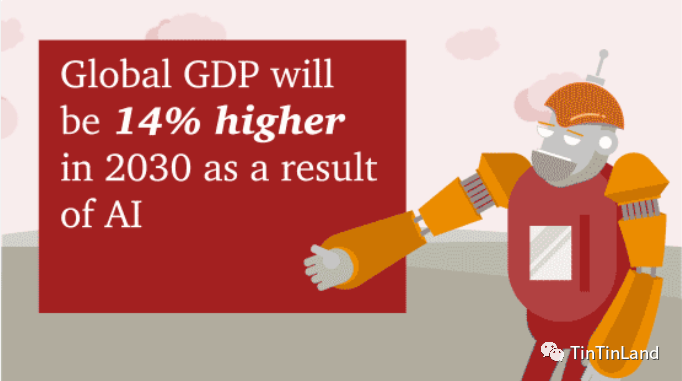
The recent breakout of ChatGPT has reignited discussions around AI. According to PwC Global Artificial Intelligence Study, the total market value of the AI industry is expected to grow from $5 billion in 2022 to $1.4 trillion by 2029. By 2045, 20–30% of total economic gains will come from AI-integrated products, meaning AI will drive the creation of more personalized and appealing product categories, stimulating consumer demand. Notably, the study finds that China (with a projected 26% GDP increase by 2030) and North America (14.5% growth) will reap the largest economic benefits from AI, amounting to $10.7 trillion—nearly 70% of the global impact.
 Image
Image
Image source: PwC
Artificial Intelligence (AI) is a branch of computer science aimed at building intelligent machines. AI research focuses on how to create computers capable of intelligent behavior. Below, we further examine how AI drives productivity transformation.
- Improved Production Efficiency
It's undeniable that AI, as an advanced new productive force, will inevitably replace certain human labor tasks in the near or distant future. For example, content generated by ChatGPT—after inputting keywords—already meets basic requirements for articles and campaign proposals. Although AI lacks creativity, it excels at handling repetitive production tasks, potentially sparking a new productivity revolution.
- Transformation in Content Creation
At the content level, generative AI, digital avatars, and machine learning models are driving a transformation in content creation, known as AIGC (Artificial Intelligence Generated Content). Next-generation AIGC models can generate text, speech, code, images, videos, and even robotic actions, making VR/AR and the metaverse viable and exciting prospects for the future internet. Interested readers may refer to the article "How Can AIGC Team Up Powerfully with Web3 Under the ChatGPT Boom?" for detailed use cases and challenges. Overall, both blockchain and AI have made significant strides in enhancing productivity, earning widespread attention and recognition. So what kind of sparks will emerge when Web3 and AI converge?
The Convergence of AI and Web3
As more industry builders pay attention to Web3 and AI, innovative applications and use cases arising from their integration are likely to grow. Currently, the synergies between AI and Web3 include, but are not limited to, the following:
Increased Efficiency
AI can help improve the accuracy and efficiency of Web3 applications by automating tasks previously performed manually. This is especially beneficial for credit assessment systems in DeFi, helping reduce risks and enhance application quality.
Enhanced Scalability
By integrating AI, applications gain automation capabilities, enabling more effective scaling of operations while saving time and money.
Improved Security
Security is critical for Web3 applications. Integrating AI adds an extra layer of defense against threats such as data breaches and cyberattacks.
Personalization
By processing vast amounts of data, AI delivers more relevant and personalized results, helping Web3 applications achieve higher usability and improved user-friendliness.
Better Decision-Making
Through complex computations, AI provides insights and conclusions previously unattainable, enabling applications to make better decisions, including understanding customer behavior, identifying trends, and forecasting future outcomes.
AI Projects in the Web3 Space
AI is permeating every aspect of daily life and entering the Web3 industry. Below are some notable AI projects currently active in the sector.
Stability AI
Stability AI is an open-source artificial intelligence company. Backed by one of the world’s top ten supercomputers (reportedly surpassing NASA’s computing power), Stability AI is recognized as the world’s first decentralized AI company. Its mission is to equip individuals, nations, companies, and cultures with intelligent tools—"AI for the people, by the people."
Last year, the project launched Stable Diffusion, a text-to-image generation tool similar to OpenAI’s DALL·E 2. The application already features a Photoshop plugin, but aims to become a metaverse AI, enabling game developers to build entire worlds from text, voice, or reference materials—significantly optimizing development cost and timelines.
 Image
Image
Utiliti.AI
To promote development at the application layer, Utiliti.AI is building an intelligent Web3 enterprise development platform. Through enterprise-grade APIs and SDKs, it connects any tech stack to blockchain networks. By training ML models to recognize and classify smart contract frameworks for minting, staking, and other standard use cases, it aims to provide developers with everything needed to easily build and scale decentralized applications. Utiliti offers developers a library of templates, security scores, gas efficiency ratings, and other key data to optimize and accelerate development.
 Image
Image
Mirror World
Mirror World is an AI-powered blockchain gaming project. As an interconnected blockchain-based metaverse, it is a platform featuring a rich matrix of games. After creating a character, players can move freely across different game spaces within the platform, using equipment and items earned in one game across others. The in-game virtual beings, called "Mirrors," are driven by AI. Moreover, adhering to the design principle of "gaming first, crypto second," Mirror World is collaborating with Republic Crypto’s brokerage team to co-design its DAO while prioritizing gameplay.
 Image
Image
Potential and Future Outlook
Just as history cannot be replayed, we cannot accurately predict the future. All we can do is seize the present. Judging from the popularity of ChatGPT, AI is already transforming how we use the internet—and similar AI-powered products will continue to emerge, deeply penetrating every corner of work and life. Similarly, Web3 as the next-generation internet, when combined with crypto, represents innovation upon innovation. If Web3 can harness the productivity revolution brought by AI, we can look forward to even more astonishing innovations arising from their deeper integration. Outstanding solutions from builders across the industry may well become the next breakthrough domain to ignite the crypto market.
References
The Role of Artificial Intelligence in Web3
https://www.linkedin.com/pulse/role-artificial-intelligence-web3-yosef-raz-onpassive-?trk=pulse-article_more-articles_related-content-card
Web3 x Artificial
Intelligencehttps://medium.com/@4RCapital/web3-x-artificial-intelligence-c1331392e21a
Join TechFlow official community to stay tuned
Telegram:https://t.me/TechFlowDaily
X (Twitter):https://x.com/TechFlowPost
X (Twitter) EN:https://x.com/BlockFlow_News
 @OurTinTinLand