AI Redefining Web3? In-Depth Analysis of How AI + Blockchain Is Leading the Next Generation Internet
TechFlow Selected TechFlow Selected
AI Redefining Web3? In-Depth Analysis of How AI + Blockchain Is Leading the Next Generation Internet
The AI craze sparked by ChatGPT continues to grow, while "blockchain + AI" projects have already experienced a rapid surge and subsequent crash within a short period.
 Navigating Web3 tides with focused insights
Author: Zelda, R3PO
Web 3.0, also known as the Semantic Web, represents the next stage in internet evolution. Web 3.0 applications aim to eliminate reliance on centralized servers by building decentralized infrastructure that operates across distributed blockchain and cloud networks, thereby achieving higher security and interoperability. Blockchain has long been considered the foundation of Web3, poised to redefine future business and social models. However, this view has come under debate following the explosive rise of ChatGPT.
Who will define the next-generation internet? R3PO believes the convergence of blockchain technology and AI will redefine Web3. The technological revolution will shift from the mobile internet era to an artificial intelligence internet era, with blockchain reshaping how value, ownership, and asset pricing are defined in the next-generation internet.
In Web2, users can create their own content, but the data and assets remain under platform control. Web3 returns data and assets to ordinary users, enabling them to create, control, and trade their own digital assets without relying on intermediaries or third parties. For example, recently Blur captured over 40% market share within five months, becoming a leading NFT aggregator and challenging OpenSea's dominance in the NFT marketplace. The key reason lies in "decentralization"—returning data value to users. Unlike OpenSea’s founder, who aims to go public on U.S. stock exchanges to benefit major shareholders, projects like Blur and Dydx choose to return value to their communities, rewarding loyal users. Through such decentralization and self-governance, they redefine value and ownership—better embodying the true spirit of Web3.0.
How Blockchain and Artificial Intelligence Will Drive Web3 Development
Blockchain and artificial intelligence are fundamentally different technologies serving entirely distinct roles. At its core, blockchain is a distributed ledger capable of storing data in blocks. Data stored on the blockchain is immutable and secured through cryptography, ensuring data integrity without third-party oversight.
Artificial intelligence, by contrast, relies on machine learning algorithms that leverage computing power and big data to mimic human problem-solving capabilities. It streamlines decision-making processes, rationalizes actions, and selects those most likely to achieve specific outcomes. AI learns from the data it receives and becomes smarter over time.
Let us examine the synergies created when these two technologies converge at the application layer.
On one hand, blockchain can help explain AI behavior. By providing an immutable record of the data and processes used by AI during decision-making, blockchain enables greater transparency and auditability of AI algorithms, fostering deeper trust.
On the other hand, AI can enhance blockchain efficiency. Wang Yuehua, partner at Draper Dragon, recently stated in an interview: “In all Web3 use cases, data goes through algorithmic processing—the stronger the AI, the better the user experience.” Indeed, blockchain transactions require verification and computation, demanding powerful hardware and consuming significant energy. AI can optimize calculations and workflows, reduce miners’ computational load, and improve latency—accelerating transaction speeds and reducing blockchain’s carbon footprint.
The integration of AI and blockchain may unlock new business models and opportunities. For instance:
1. Smarter dApps and Intelligent NFTs
As blockchain developers integrate AI and machine learning algorithms, Web3 may introduce more intelligent decentralized applications (dApps) with advanced real-world utility.
A compelling early example is Alethea AI’s Alice—the first non-fungible token (NFT) with self-learning capabilities. Alice evolves her interaction style by learning from every new engagement. As the first intelligent NFT (iNFT), Alice possesses her own personality, engages in detailed conversations with internet users, and learns from them. With advancements in AI algorithms, next-generation dApps and NFTs could greatly benefit—gaining enhanced data management and analytical capabilities, while future NFTs may exhibit human-like behaviors.
2. Realizing the Value of Personal Data
Although social media giants and marketing firms already collect our browsing data to deliver targeted ads, this practice often does not align with users' best interests. The decentralized ethos of Web 3.0 aims to empower individuals by returning control of their data—allowing users to selectively share data with service providers who directly compensate them.
By applying AI algorithms, service providers can analyze vast datasets and consider more factors when personalizing user experiences. Web 3.0 users will receive increasingly customized services while simultaneously monetizing their personal data.
Analysis of Core AI + Blockchain Projects
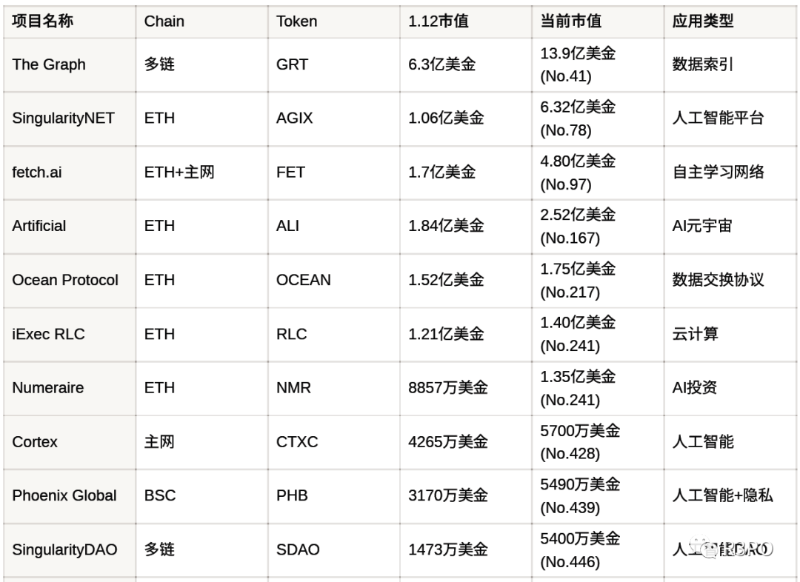
Below is an overview of the top 10 projects by market capitalization in the AI + blockchain sector, with data sourced from CoinGecko.
1. FET
Project Overview
Fetch.ai Network is an artificial intelligence laboratory based in Cambridge that combines machine learning, AI, and distributed ledger technology to build an open economic framework offering high-performance, low-cost transaction environments for decentralized digital economies.
Use Cases
-
Smart Recognition: Hospitals utilize Fetch.ai’s federated learning functionality to train robotic learning algorithms for identifying X-ray images such as chest scans, locating patient lesions. Statistics show the trained AI model achieves a 90% accuracy rate in diagnosing cases.
-
Cancer Cell Detection: Through collaboration with Poznań Supercomputing and Networking Center (PSNC) using collective learning, Fetch.ai and PSNC will jointly train algorithms for detecting circulating cancer cells in blood or tissue biopsies globally across hospitals and research centers.
-
Predictive Maintenance: Predictive maintenance identifies potential equipment failures before they occur. Bosch uses Fetch.ai’s collective learning to predict possible malfunctions in its machinery while preserving data privacy. Recently, Bosch and Fetch.ai announced a new partnership to establish a Web3 Foundation—Fetch.ai Foundation—dedicated to researching, developing, and leveraging Web3 technologies for practical applications across mobility, industrial, and consumer sectors.
-
Supply Chain Integration: The partnership between Fetch.ai Network and LiquidChefs leverages autonomous economic agents on Fetch.ai’s network integrated with search and discovery frameworks to build local, transparent supply chains, enabling LiquidChefs to locate and connect with nearby sustainable suppliers.
2. OCEAN
Project Overview
Ocean Protocol is a toolset for the Web3 data economy, providing developers with tools to build data markets, manage data NFTs, and DeFi data tokens. Data owners and consumers can securely and privately publish, discover, and use data via the Ocean Market application.
Project Advantages
-
Experienced Team: Deep expertise in blockchain, data processing, and AI.
-
Promising Sector: Enables fair, transparent, and secure data sharing through decentralization, unlocking immense potential in the AI market—positioning itself as a core data layer for future AI developments.
-
Rich Ecosystem: Established partnerships with institutions including the Singapore government, SingularityNET, Mattereum, and IBM Watson AI XPRIZE.
-
Strong Iteration Capability: Continuously evolving from V1 to V4. Key features in V4 include single-sided staking to prevent rug pulls, introducing data NFTs (ERC-721) for flexible data IP management, and community monetization mechanisms.
3. AGIX
Project Overview
SingularityNET is a decentralized AI platform and marketplace. Agents operating on SingularityNET can flexibly outsource tasks to each other—exchanging information, negotiating payments, and rating performance affecting agent reputation. On this open-source marketplace, every provider contributing AI and machine learning services earns tokens as rewards.
Project Advantages
-
AI Marketplace: Offers numerous AI-powered services available for purchase;
-
AI Publisher: Allows AI developers to publish their products on the platform and monetize them;
4. NMR
Project Overview
Numerai is a novel hedge fund built and operated by a global network of data scientists using artificial intelligence techniques.
At the heart of the Numerai Tournament is a free dataset composed of high-quality financial data that has been cleaned, normalized, and obfuscated. The platform’s primary goal is to bring decentralization into data science, allowing developers to compete in creating effective machine learning prediction models.
Use Cases
-
Numerai Tournament: A hedge fund that trades stocks based on aggregated predictions made by a global network of competing data scientists. Numerai receives approximately 100 million predictions daily from users, which are then compiled into a meta-model for investment decisions.
-
Numerai Signals: An ongoing tournament collecting stock predictions for the Russell 3000 index.
-
Erasure Bay: A marketplace for exchanging any type of information, including valuation models and product feedback.
Challenges Facing AI + Blockchain Technology
R3PO believes blockchain and AI are two of the most disruptive technologies since the invention of the internet. Decentralized blockchain provides AI with robust data foundations, while AI brings mature modules and algorithmic resources.
Current technological applications represent only the tip of the iceberg. Their convergence will shape societal development trajectories and progress over the coming decades, potentially creating a more efficient, secure, and personalized digital economy—unlocking new business models and opportunities for individuals and enterprises alike. Nevertheless, integrating blockchain and AI inevitably faces several challenges.
1. Security Concerns
AI requires access to large volumes of data to function effectively, yet blockchain encrypts data to protect against hackers. To analyze and process this encrypted data, decryption is necessary—making it more vulnerable to malicious attacks.
Web3.0 has yet to establish a comprehensive security framework, necessitating further development of unified security standards and protocols.
2. Cost and Efficiency Constraints
While AI enhances blockchain efficiency, there are inherent limitations. Current distributed technologies involve large-scale computing and storage systems. Hardware constraints, and even physical limitations related to energy generation, transmission, and storage for operational devices, hinder the practical deployment of AI and blockchain integrations.
Considering current blockchain limitations such as low TPS (transactions per second) and high gas fees, the operational cost of running AI-based commercial applications on blockchain would be prohibitively high, while actual efficiency would be unacceptably low.
Thus, the integration of blockchain and AI remains in its early exploratory phase.
Conclusion
The AI hype sparked by ChatGPT continues to grow, while "blockchain + AI" projects have already experienced a rapid surge followed by a sharp decline. Data shows the total market cap of AI-related crypto projects once exceeded $5 billion, with SingularityNET rising over 290.53% in early February. However, these projects have since quickly retreated.
Short-term FOMO sentiment may boost visibility for AI + blockchain projects, but ultimately, their long-term success depends on intrinsic value. Projects offering only superficial AI features cannot carry the banner of Web3.0. No one can definitively predict where this Web3.0 transformation journey will lead—will it redefine value? Will decentralization triumph over centralization? What we do know is that the fusion of AI and blockchain will undoubtedly unlock extraordinary possibilities. Let us wait and see.
Join TechFlow official community to stay tuned
Telegram:https://t.me/TechFlowDaily
X (Twitter):https://x.com/TechFlowPost
X (Twitter) EN:https://x.com/BlockFlow_News