With the Shanghai upgrade approaching, what preparations should POS service providers make?
TechFlow Selected TechFlow Selected
With the Shanghai upgrade approaching, what preparations should POS service providers make?
After the launch of the Beacon Chain and the Merge, Ethereum 2.0 is about to undergo another major upgrade—Shanghai upgrade—in March (according to the latest information, expected to be postponed to early April).
 Navigating Web3 tides with focused insights
After the launch of the Beacon Chain and The Merge, Ethereum 2.0 is approaching another major upgrade—Shanghai Upgrade—in March (according to recent updates, expected to be postponed to early April). One of the core issues to be addressed in this upgrade is the withdrawal of staked ETH assets.
With the Shanghai Upgrade drawing near, Ethereum staking products have recently gained significant market attention. Huobi POS's head Xi Jiazhen (commonly known as Token in the industry) shared the preparatory work that PoS service providers need to complete ahead of time, stating that as an important participant in ETH2.0, Huobi has already prepared for the Shanghai Upgrade.
Stakers Should Prepare Withdrawal Settings in Advance
Once the Shanghai Upgrade goes live, users will be able to withdraw their principal or rewards previously staked on the Beacon Chain to designated addresses, enabling full control over these assets. Withdrawals are divided into full withdrawals and reward-only withdrawals, both requiring a withdrawal address to be set beforehand. Once set, the withdrawal address cannot be modified. For full withdrawals, users must first initiate a validator exit request and wait in queue for confirmation; after confirmation, they can retrieve all funds. Reward withdrawals will be automatically distributed approximately every few days. Neither type of withdrawal incurs gas fees.
For both full withdrawals and reward withdrawals, users must set a withdrawal address in advance. Before the Shanghai Upgrade, users could only set the withdrawal address when initially creating a validator, with no option to set it afterward. Since the Beacon Chain does not enforce setting a withdrawal address, many validators currently lack one. As of February 13, among a total of 517,052 validators network-wide, only 205,178 have set a withdrawal address, leaving 311,874 unset—accounting for 60.3%.
After the Shanghai Upgrade, users will be able to submit requests to set withdrawal addresses for validators that currently lack them, but modification of an already-set address will not be allowed. At a theoretical rate of 16 withdrawal addresses per block, all 311,874 missing addresses could be set within about 3 days (311,874 / 115,200 ≈ 2.7).
For full withdrawals, users need to first initiate the validator exit process. Refer to this link for detailed instructions.
On average, 225 validators can exit per day (number of epochs per day) × 7 (current number of exiting validators per epoch), totaling 1,575 per day. In the extreme scenario where all current validators attempt to exit simultaneously, the theoretical maximum waiting time would be 517,052 / 1,575 ≈ 328 days. However, since the number of validators allowed to exit per epoch depends on the total number of active validators, the actual full exit duration would likely be longer.
The final step involves reward distribution or full withdrawal. Withdrawal eligibility varies based on different conditions:
-
Partial withdrawal: The validator must have a withdrawal address set, be in "active" status, and have a balance exceeding 32 ETH (including unclaimed rewards).
-
Full withdrawal: The validator must have a withdrawal address set and be in "withdrawable" status (typically indicated as successful validator exit).
Eligible validatorswill enter the withdrawal queue, and ETH will be automatically sent to the designated withdrawal address without any further user action required. The current withdrawal cycle is approximately 5 days (517,052 / 115,200).
POW Service Providers’ TO-DO LIST
Currently, PoS service providers come in various forms, including traditional decentralized LSD products, CEX (centralized exchange) PoS offerings, and SaaS (Staking as a Service) platforms. These differ significantly in product design and thus have varying preparations for the Shanghai Upgrade, though several key considerations apply universally.
First, service providers must meet users' withdrawal demands by developing corresponding product features.
The typical withdrawal process includes:
-
Provide a product interface to receive user withdrawal requests.
-
Set the withdrawal address in preparation for fund retrieval.
-
Determine how many validator nodes need to exit based on the volume of user withdrawal requests.
-
Submit validator exit requests.
-
Distribute received withdrawals to respective users.
Second, mitigate financial risks.
Beacon Chain staking began as early as December 2020, meaning some funds have been locked for over two years. With Ethereum’s withdrawal function previously disabled, users were unable to reclaim staked assets or change validator addresses, increasing the risk of credential leakage over time. Moreover, without withdrawal capability, even if credentials had already been compromised, such breaches would remain undetectable. This exposes staked assets to significant risk, necessitating proactive mitigation. Key preparatory steps for PoS providers include:
1) On-chain staked asset audit
Service providers should verify that the amount of staked assets on-chain matches users’ principal plus accrued rewards; confirm that their controlled credentials correspond exactly to on-chain holdings; ensure withdrawal addresses are set and that private keys are securely held. If no withdrawal address is set, one must be established immediately after the Shanghai Upgrade.
2) Data security verification
Verify the security of withdrawal credentials and the safety of private keys associated with withdrawal addresses.
3) Risk prevention
Given the long staking period, credentials may have been exposed. It is recommended that, upon activation of the Shanghai Upgrade, providers rotate through rebuilding existing validators: exiting current validators, withdrawing funds, rotating credentials, and redeploying.
Third, enhance product appeal through improved user experience, higher APY, and increased liquidity of LSD tokens.
While meeting withdrawal needs, providers should optimize product details—including implementing liquidity reserve mechanisms for seamless withdrawals and shorter queues, and offering预约 withdrawal functionality to reduce wait times.
-
After the Shanghai Upgrade, staking rewards can be withdrawn and then (automatically) reinvested, significantly boosting overall returns—with expected APY increases of over 10%.
-
Prior to the upgrade, due to non-withdrawable status, ETH-pegged tokens from various LSD products (e.g., stETH) traded at a discount relative to ETH. After the upgrade, this discount will quickly converge, leading to broader market acceptance of these tokens. Providers can expand use cases for ETH-pegged tokens across CeFi and DeFi applications, enhancing liquidity and user yields.
Huobi POS Is Ready for the Shanghai Upgrade
As a major participant in Eth2.0, Huobi POS has fully prepared for the upcoming Shanghai Upgrade. It is reported that Huobi POS’s core functionalities are already ready and awaiting新一轮 testnet validation.
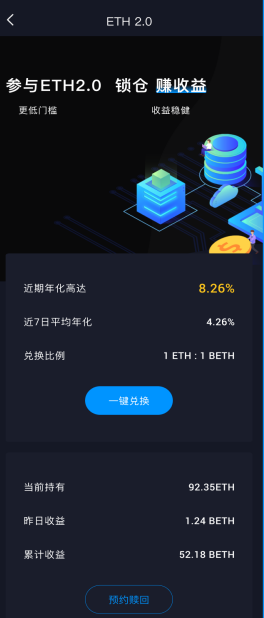
Huobi POS has now completed end-to-end development of its withdrawal-related product features, including user预约 redemption, redemption history tracking, on-chain validator exits, automatic reinvestment of staking rewards, and provision of withdrawal liquidity reserves. These functions have been tested on the Zhejiang testnet and will undergo regression testing alongside Ethereum’s ongoing testnet and mainnet upgrades to ensure immediate availability of withdrawal services post-upgrade.
Over its nine-year history, Huobi has always prioritized user asset security as its top mission. To address potential risks related to ETH2.0 assets, Huobi has proactively conducted comprehensive risk assessments, including:
- Auditing consistency between user assets and on-chain holdings
By verifying the linkage between credentials and on-chain assets, Huobi has confirmed alignment between user权益 and locked on-chain assets.
- Ensuring security of withdrawal credentials
Withdrawal credentials are encrypted and stored using hardware signers, eliminating risks associated with manual custody.
- Eliminating potential asset risks
Through the above measures, asset security has been ensured. As a precaution, Huobi will rebuild all validators shortly after the Shanghai Upgrade takes effect, with relevant logic already implemented.
Huobi has also enhanced transparency of on-chain assets. While maintaining the security advantages of a centralized exchange, Huobi POS strives for greater transparency compared to decentralized Eth2.0 solutions. Currently, Huobi POS's ETH2.0 staking addresses are Address 1 and Address 2, collectively staking over 100,000 ETH, with real-time asset information accessible to users.
In anticipation of the Shanghai Upgrade, Huobi offers users real-time visibility into current on-chain staking status, queue positions, and withdrawal progress, further enhancing asset transparency.
Join TechFlow official community to stay tuned
Telegram:https://t.me/TechFlowDaily
X (Twitter):https://x.com/TechFlowPost
X (Twitter) EN:https://x.com/BlockFlow_News