AI Gems in the Crypto World: Generative Art, Collective Computing, Logical AI, and the Metaverse
TechFlow Selected TechFlow Selected
AI Gems in the Crypto World: Generative Art, Collective Computing, Logical AI, and the Metaverse
An elder said that as 2024 ushers in the Li Fire great cycle, technology will be the industry with the most "prosperity" potential.
 Navigating Web3 tides with focused insights
Written by: 0xbun, TechFlow
Elders say that 2024 marks the beginning of the "Li" fire era, and technology will be the most financially promising industry. While people are still reeling from the pains of economic recession, AI narratives have stepped forward—first with Microsoft's multi-billion dollar investment in ChatGPT, followed by Google’s belated entry into generative AI with its Bard AI assistant.
Blockchain, another key player in the tech sector and one that complements AI, has also seen a surge of AI-related projects emerge. Now, let's explore which cryptocurrency projects could ride this wave of AI innovation.
1. Botto

Launched in October 2021, Botto promises community coordination through a token-based DAO, aiming to pioneer explorations at the frontier of AI-generated art and human collaboration.
As a decentralized artist DAO, Botto DAO uses community voting to determine the creation of AI artworks. Each week, the most popular AI-generated image is minted as an NFT and auctioned on SuperRare. Botto leverages AI deep learning algorithms such as Stable Diffusion, VQGAN + CLIP, GPT-3, along with some custom enhancements, for NFT creation.
Botto’s art engine has been trained on millions of images and can generate over 4,000 unique, unaltered artworks per week.

Botto is not just another AI-themed project; it has established a complete economic model—earning revenue by selling AI-generated art. Holders of Botto tokens can influence artistic direction or select representative pieces, using the AI engine to fine-tune personalized creations. The most community-favored artwork each week is sent to SuperRare for auction, with proceeds reinvested into the ecosystem and rewarded to creators.
By the end of last year, Botto had sold artworks worth $2.3 million, ranking among the top 15 artists in SuperRare's history.
2. Bittensor
Bittensor is an open-source protocol focused on AI and machine learning (ML), supporting scalable, globally distributed, and decentralized neural networks. Bittensor models can transfer value and learn data from other AI models, eliminating AI information silos.
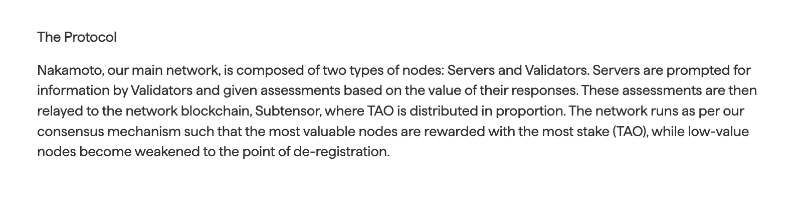
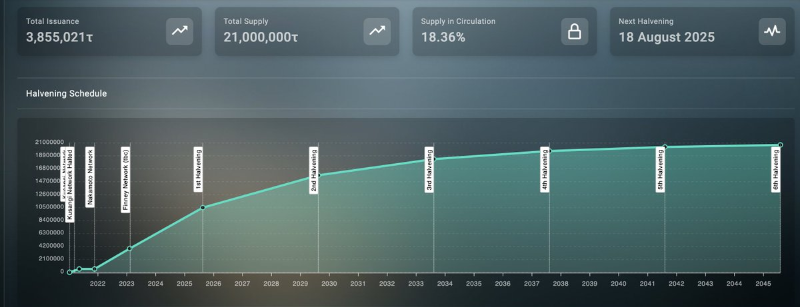
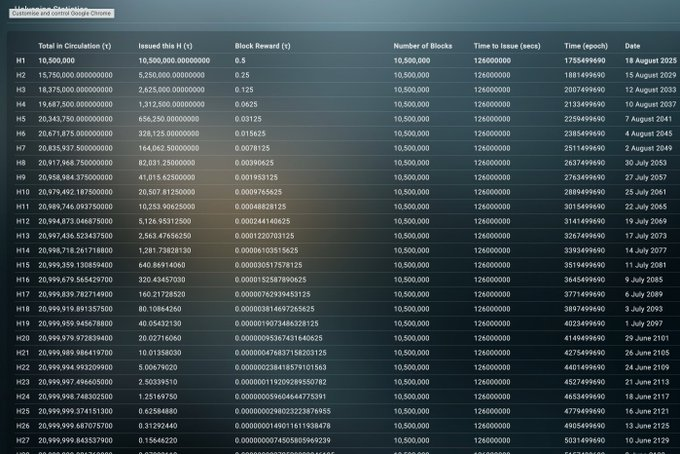
Bittensor’s token $TAO shares similar tokenomics with $BTC. It operates a massive network secured by Proof of Intelligence consensus, enabling machine learning and decentralized AI mining. Total token supply: 21,000,000.
Interestingly, $TAO also features halving cycles. Its current circulating supply is 3,854,721 $TAO. It won't reach full issuance of 21 million until 2213. Given historical parallels, there may be arbitrage opportunities here—you know what we mean.
Bittensor is a product of collective labor. If every computer runs $TAO and participates in the Bittensor network, then $TAO harnesses all users’ computing power and machine learning capabilities via collective computation to solve problems. Ultimately, rewards and network ownership are distributed proportionally to the value each user contributes.
Today, ChatGPT’s capabilities already spark fears about job displacement. However, Bittensor plans to use even more parameters than ChatGPT and is launching its first product: Chattensor—an AI chatbot assistant. It offers:
An open API;
Integration available for anyone to embed into their business;
And perhaps even more possibilities?
3. Tau
Tau is a universe built from your ideas, suggestions, and knowledge. It is the first-ever decentralized blockchain social network capable of reaching user consensus and updating its software in real time, giving full control over the software to its users.
In short, Tau aggregates users’ thoughts, proposals, and knowledge, continuously upgrading its own code in real time, bridging the gap between humans and machines through logical artificial intelligence.
Notice the difference? If you've recently interacted with AI or used ChatGPT, you’ll know most AI relies on machine learning, which depends heavily on vast internet datasets and struggles to grasp the precise meaning and context of human communication.
So how about logic-based AI? It outperforms machine learning in the following aspects:
1. Explainability: Logic-based AI provides clear, transparent reasoning behind decisions, crucial in fields like law or medical diagnosis where accountability and interpretability matter.
2. Predictability: Logic-based systems are deterministic—given the same input, they always produce the same output.
3. Efficiency: For simple tasks, logic-based AI can make faster decisions than machine learning algorithms, as it doesn’t require training and operates based on a small set of well-defined rules.
4. Adaptability: Logic-based AI can be easily modified and updated to incorporate new knowledge or adapt to changing environments.
These advantages form Tau’s moat. By leveraging logical AI, Tau innovatively creates a new mode of human-to-human communication mediated by machines.
Since 2015, a team of PhDs and professors with expertise in AI, logic, and mathematics has been working on Tau. Founder and CEO Ohad Asor is a software developer and machine learning expert with a background in mathematics, formerly working at GE Healthcare.
Backed by a unique niche and an exceptional team, Tau stands out as one of the most exciting logical AI projects in the crypto space.
4. XANA
What does VR + AI equal? If I had to pick one concept in today’s landscape that truly embodies this fusion, it would undoubtedly be the metaverse. But is there a metaverse project that isn’t just chasing AI hype? That’s when XANA caught my attention.
XANA is designed as metaverse infrastructure targeting billions of users. It is an EVM-based blockchain infrastructure and a DApps platform tailored for the metaverse. It bridges all major blockchains, supports all popular wallets, and has already been adopted by leading institutions and global brands.
From the outset, XANA was designed for mobile devices, giving it mature technical foundations for mobile deployment. Given that current standalone VR devices share similar specs with mid-range smartphones, XANA seamlessly integrates VR into its ecosystem. Moreover, being natively mobile-first, XANA is soon to launch its AR functionality—a significant advantage.
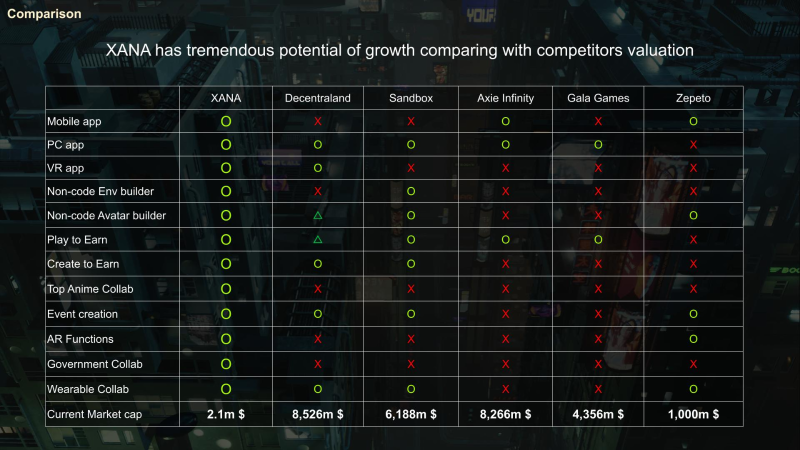
AI technology is primarily featured in XANA's product “XANA: Genesis”. Inspired by *Blade Runner 2049*, XANA launched this NFT collection under the concept of “AI x NFT.” Built upon an AI engine called “Prophet,” the XANA metaverse platform is compatible with XANA: Genesis NFTs. NFT holders can use their NFT avatars to experience various blockchain games and entertainment within the ecosystem.
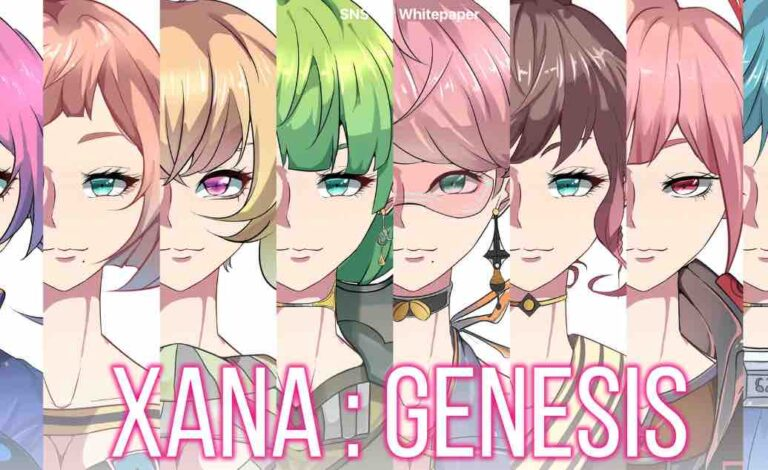
XANA GENESIS NFTs come embedded with AI code, allowing personalization, and grant commercial rights to their owners.
Looking ahead, AI is expected to unlock even more functionalities in XANA—such as AI conversations and interactive gameplay companions, transforming NFTs from static images into true partners. With the Prophet AI engine and continuous advancements in AI technology, this future may be closer than we think. Add VR and AR into the mix, enabling genuine interaction across different dimensions—will you really choose to miss out?
Join TechFlow official community to stay tuned
Telegram:https://t.me/TechFlowDaily
X (Twitter):https://x.com/TechFlowPost
X (Twitter) EN:https://x.com/BlockFlow_News
 Bun 黄馒头