








Delphi Digital: Web3 infrastructure will experience explosive growth in 2023
TechFlow Selected TechFlow Selected
Delphi Digital: Web3 infrastructure will experience explosive growth in 2023
The biggest opportunity for cryptocurrency lies in our weakest spots—welcome to the year of infrastructure.
 Navigating Web3 tides with focused insights
Written by: Delphi Digital
Compiled by: TechFlow
FTX's collapse resulted in $9 billion in liabilities. Despite this, centralized exchanges continue to attract substantial capital.
The greatest opportunity for cryptocurrency lies in our weakest areas—welcome to the year of infrastructure.
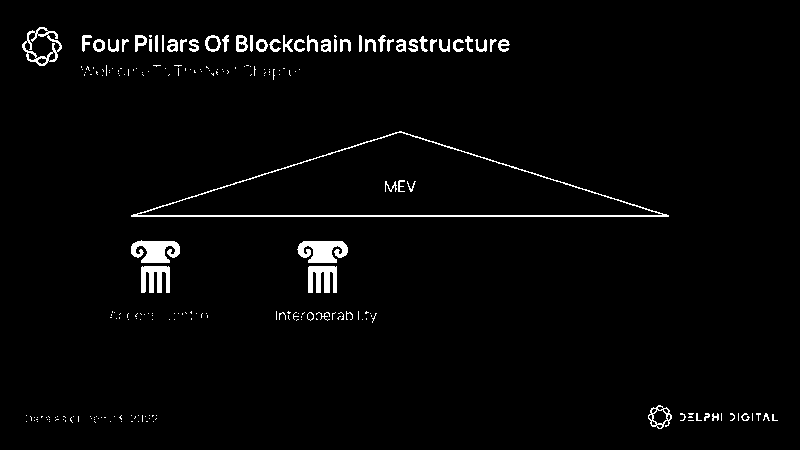
We will explore four main pillars:
🔹 Access Control
🔹 Interoperability
🔹 Scalability
🔹 Privacy
And one emerging vertical still central to blockchain operations: MEV.
Pillar 1: Access Control
Today, access control is static and binary. Users either have complete and exclusive control over their funds or they do not.
Two solutions exist: smart contract wallets and MPC.
For smart contract wallets, permissions for externally owned accounts and smart contract accounts are entirely separate—this is by design for security.
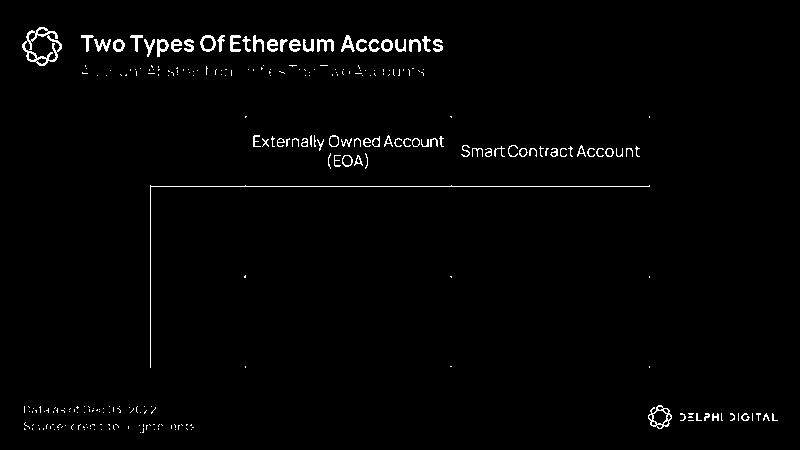
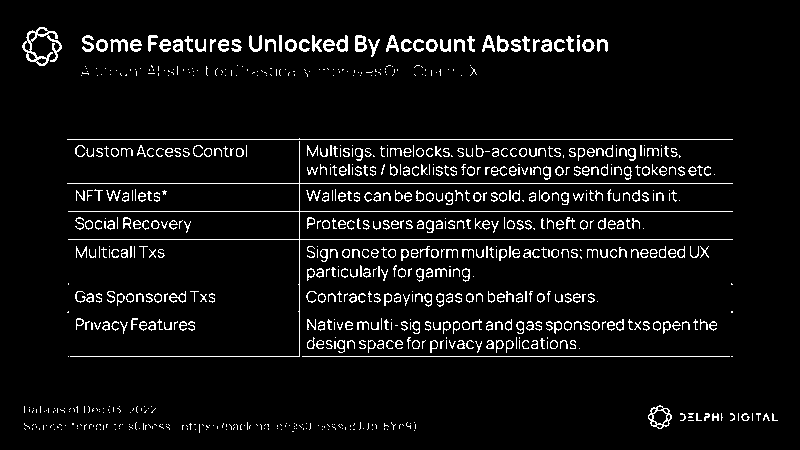
Account Abstraction (AA) merges these two and unlocks functionality.The main issues with AA are security, coordination, and breaking backward compatibility with existing applications. The solution here is L2s with native account abstraction: zkSync, StarkWare, and Fuel.
MPC (Multi-Party Computation) wallets are another solution. Two examples here are entropy and odsy. With these, user keys are split and shared between validators on the chain and the user.
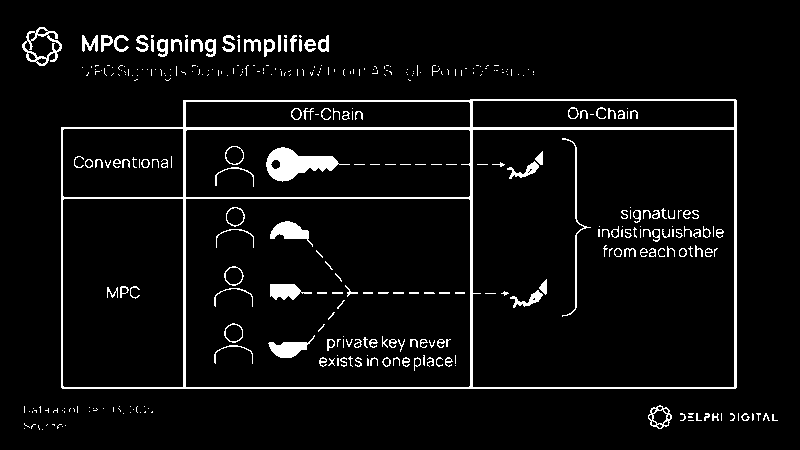
Users sign their secret shares to form a valid signature. When conditions in a smart contract are met, users instruct validators to sign the share.
This opens up a design space for programmable and dynamic access control, such as conditional payments, whitelisting, etc.An interesting protocol within this design space is Lit Protocol.
Lit has a pair of private and public keys. When a user mints an NFT on-chain, key generation and distribution occur among Lit nodes. NFT holders can instruct nodes to sign transactions using the generated key pair.
In summary, we believe smart contract wallets combined with native account abstraction offer the safest, cleanest, and most flexible self-custody experience on-chain.However, they will take more time to mature, and progress across chains/VMs will vary significantly.
Decentralized MPC solutions could provide a faster path to achieving similar goals. While they cannot deliver the full flexibility and security promised by account abstraction, their potential use cases remain unknown and could span all chains—or even extend into new Web2 applications.
Pillar 2: Interoperability
The multi-chain world we live in today is living proof that no single chain can meet everyone’s needs. Therefore, cross-chain interoperability is at the core of scalability.
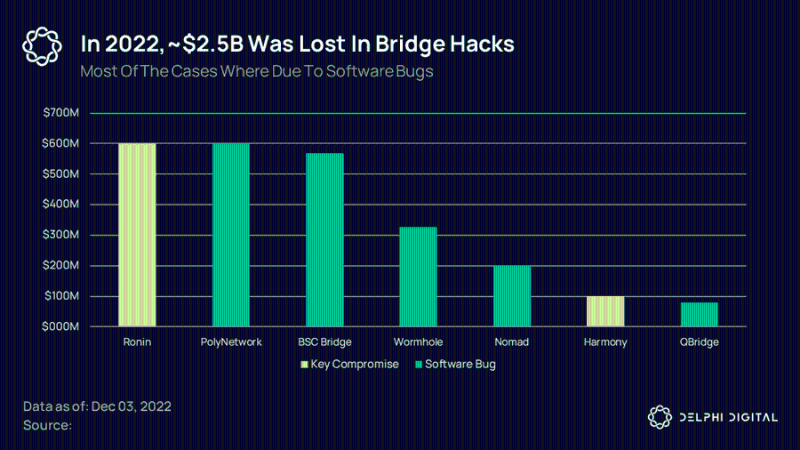
Cross-chain bridge security remains a major pain point and fundamental issue for the industry, with over $2.5 billion lost to bridge hacks in 2022.
Cross-chain bridge designs fall into three categories: third-party, light client, and Rollup bridges.(Third-party bridges rely on external validation; light client and Rollup-based bridges use native validation.)
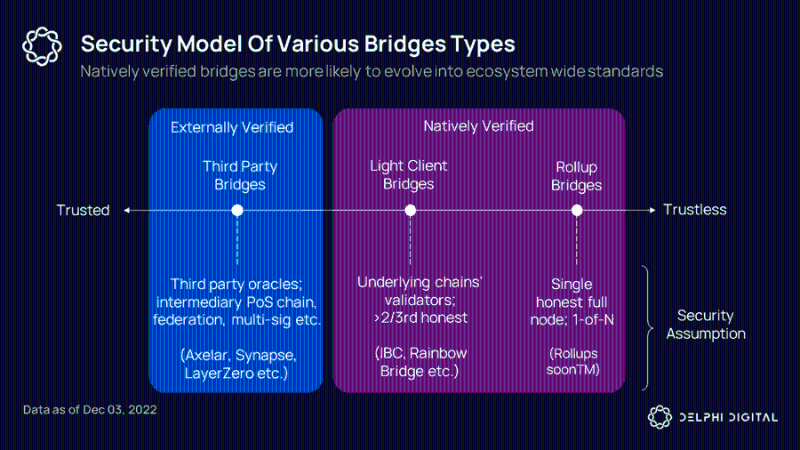
Externally validated bridges are prime targets for hackers because teams don’t coordinate with each other.
Natively validated bridges can serve not only as general message-passing protocols but also fulfill other essential needs and primitives such as mobile wallets, fast syncing, and reducing reliance on centralized RPC services.
We believe cross-chain bridges need standardization.
Natively validated bridges are ecosystem-centric, enabling large-scale scrutiny from developers and teams within each community. Their roadmaps focus on developing ecosystem-wide standards that maximize mutual benefit among participants.The most successful example of this is IBC.IBC has already had significant impact, with 53 chains now relying on it to exchange information.
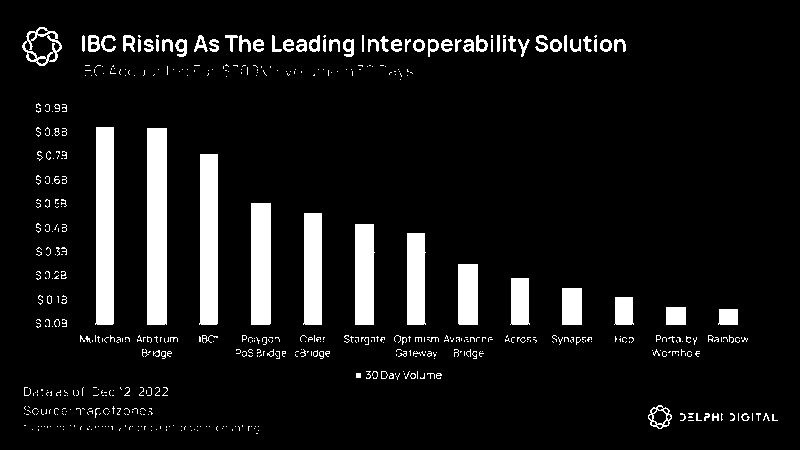
The main challenge in bringing IBC to Ethereum is the high verification cost of lightweight bridges. A solution here is zk-IBC.
Consensus proofs reduce the cost of verifying consensus by validating headers off-chain without introducing new assumptions. Then, provers generate succinct validity proofs that can be cheaply verified via Ethereum smart contracts.
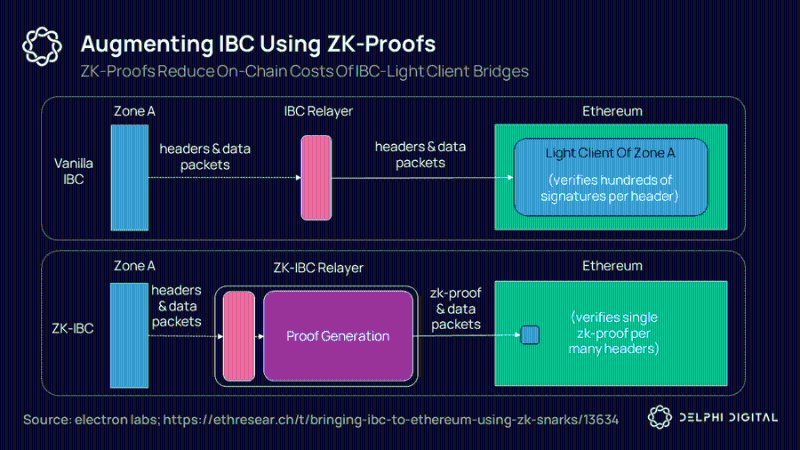
Enhancing IBC bridges with zk-proofs can bring IBC to any smart contract blockchain. In the future, consensus from multiple chains could be aggregated into a single proof using zk-proofs. This would further drive down the cost of cross-chain messaging.
One trend we expect to see next year is cross-chain applications. Today, the application layer is multi-chain, but it isn't truly cross-chain yet.
We see this unfolding in several ways:
🔹 Chainlink CCIP is ready to help blue-chip projects already relying on it for price feeds go multi-chain.
🔹 THORChain continues forging new integrations with existing CEXs and DEXs.
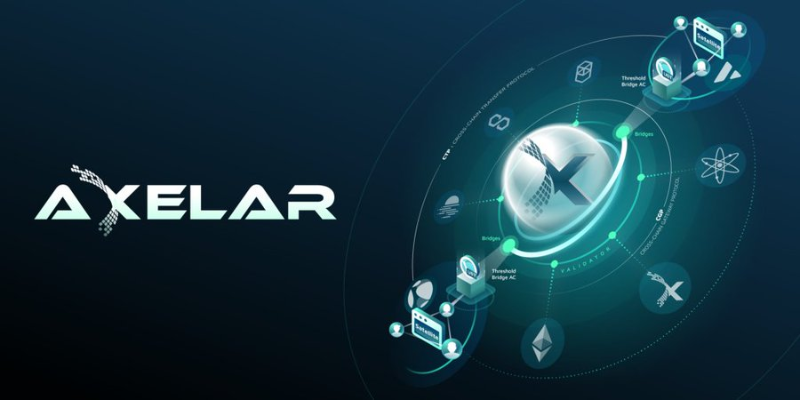
🔹 Axelar holds a unique position as it supports Ethereum, other EVM chains, and IBC. So far, it has served as a direct hub between Ethereum and numerous Cosmos app chains, making it a key contributor to the Cosmos ecosystem. Axelar has also been selected as Osmosis’ canonical cross-chain bridge.
New applications are now going cross-chain from day one. Ultimately, interoperability is central to scalability.
Pillar 3: Scalability
Scalability solutions take different forms depending on varying user demands.
Today, various blockchain architectures coexist to handle current user loads. These can be categorized into four types.
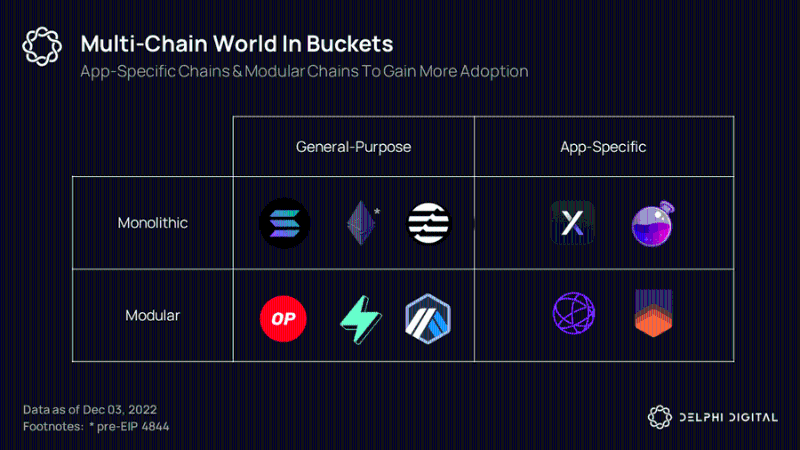
We envision modular chains as the ultimate architectural state for blockchain mainstream adoption.
Monolithic chains won’t disappear; we recognize their benefits, such as synchronous composability and permissionless innovation.
We expect both designs to coexist long-term.
For general-purpose monolithic chains, we still view Solana as the biggest contender.
While we consider Solana monolithic, it is on a path toward becoming a modular ecosystem, as Sealevel VM becomes the standard for rollups via Eclipse + Nitro.
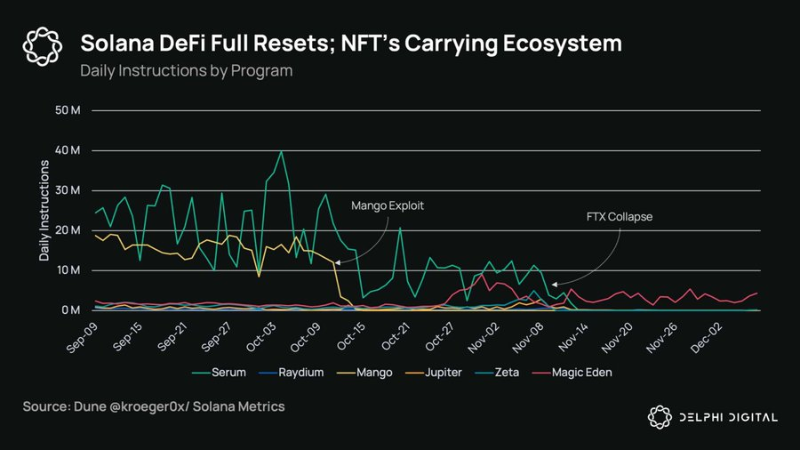
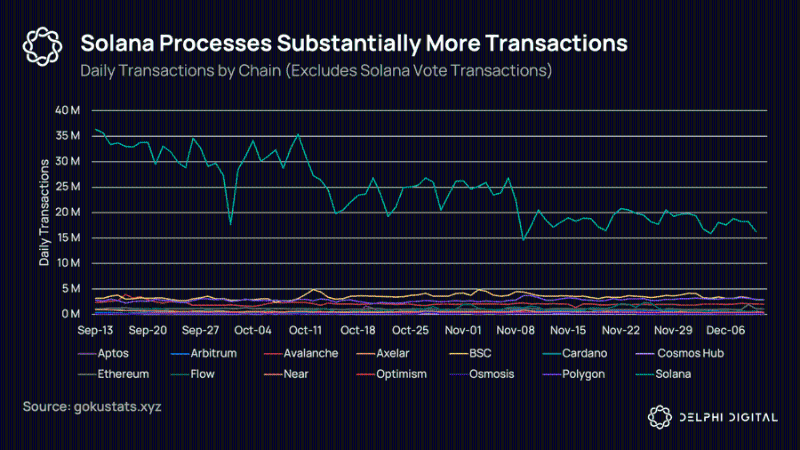
Outside of Ethereum, the Solana Web3 SDK is the most widely adopted. Block times have significantly decreased. It boasts the highest number of L1 transactions and the second-largest NFT ecosystem.
It has a new, independent validator client developed by Jump. FireDancer will help diversify Solana’s clients and reduce the risk of network outages due to client or execution-layer bugs.
Past NFT minting/spam issues that caused Solana downtime no longer affect the chain to the same degree. In theory, the new fee market will isolate peak network fees to the areas of highest demand on Solana.
Overall, network stability is improving, TPS is clearly higher than other chains, new DeFi protocols are launching, and more are planned.
While general-purpose chains allow anyone to launch new apps permissionlessly, app chains use social coordination to decide which applications they run.
They lose the agility of permissionless innovation but gain sovereignty over their applications, delivering more reliable user experiences.
-
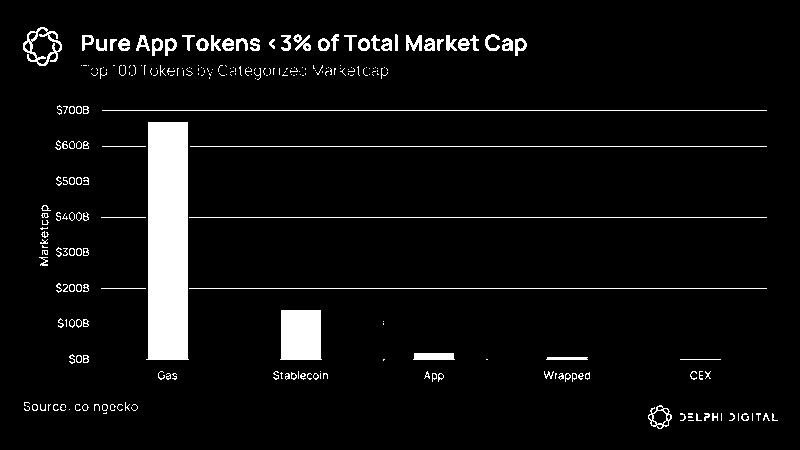
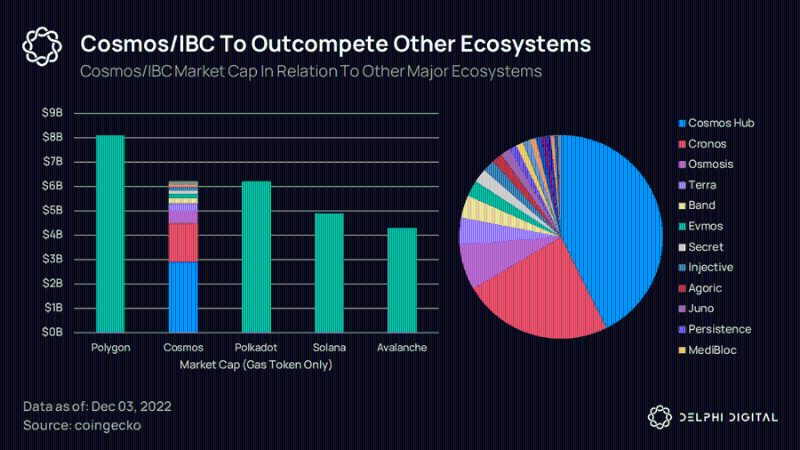
For general-purpose chains, revenue typically flows to the underlying gas token. Nevertheless, app chains still account for <3% of total crypto market cap.
-
For app chains, we think of Cosmos, as the Cosmos SDK is the most production-ready toolkit for building new chains from scratch.
Let’s look at eight interesting app chains in the Cosmos ecosystem:
🔹 dYdX
🔹 Osmosis
🔹 SeiNetwork
🔹 Injective
🔹 Interchain Security
🔹 Neutron
🔹 Asset Issuance Chain
🔹 Duality
dYdX
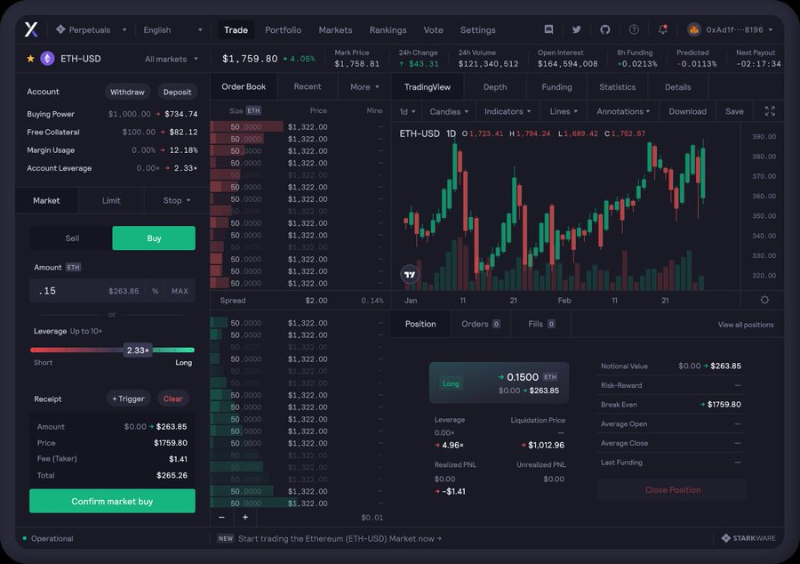
dYdX is a DEX app chain currently live on StarkEx as an Ethereum L2, but will transition to Cosmos as a standalone chain in 2023.dYdX’s development and integration into the Cosmos ecosystem will benefit USDC growth on Cosmos.
Osmosis
Osmosis is the liquidity hub of Cosmos.
Superfluid staking allows base OSMO in liquidity pools to simultaneously act as LP tokens and staked assets. Its latest upgrade added stableswap AMMs, IBC rate limiting, and multi-hop routing, with more coming in 2023.

SeiNetwork and Injective
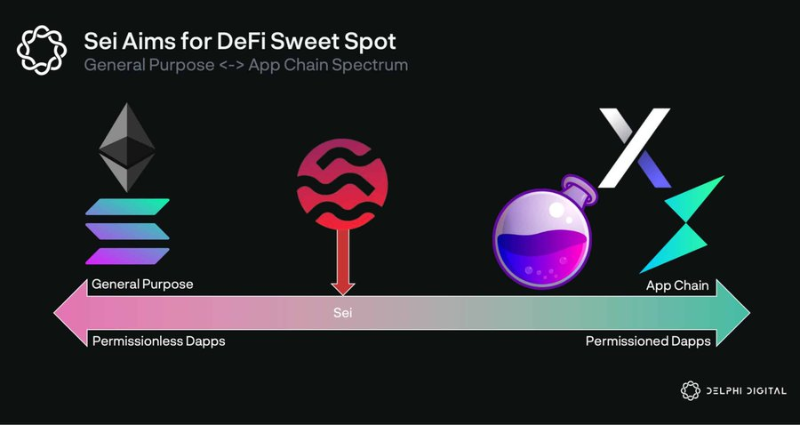
SeiNetwork and Injective sit between pure "app chains" and general-purpose chains.
These chains embed order logic at the base layer while running permissioned applications on top. They serve as infrastructure layers for perpetuals, options, and stablecoins.
Interchain Security
Interchain Security is an infrastructure allowing app chains to launch without bootstrapping an entire validator set.
New chains simply rent security from ATOM validators and stakers in exchange for a portion of tokens and fees generated on their chain.
Neutron
Neutron is a smart contract chain protected by the Hub, offering Cosmos a platform to experiment with new developments.
Lido was one of the first notable projects to launch, issuing its ATOM liquid staking derivative on Neutron.
Asset Issuance Chain
The Asset Issuance Chain is a Hub-protected chain for general asset issuance.
This is where Circle will issue USDC to bootstrap native USDC volume across Interchain—an element previously missing from Cosmos and IBC.
Duality
Duality is a DEX app chain designed to be a hybrid of AMM and CLOB.
It enables creation of AMM pools allowing swaps at constant prices, and also allows placing liquidity at specific prices, similar to limit orders on an order book.
With upcoming developments in 2023, the Cosmos ecosystem is poised to grow its market share.
Rollup
Now let’s turn to Ethereum’s vision centered around Rollups.
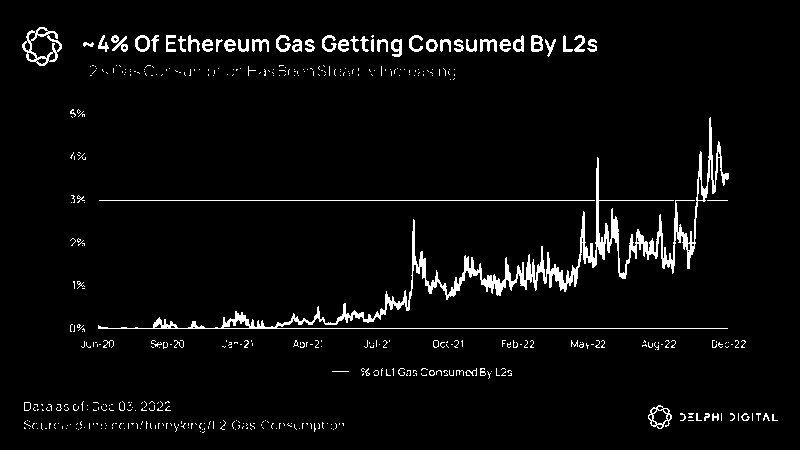
Over the past year, L2 adoption on Ethereum has been impressive. Their share of L1 gas consumption has grown from under 1% at the start of the year to 4%.
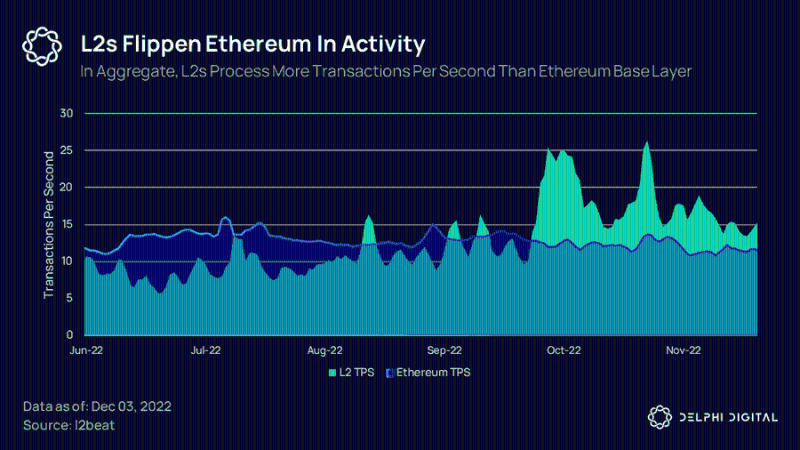
As L2 gas consumption increases, so does their TPS. This year, L2s have already surpassed Ethereum’s base layer in TPS.
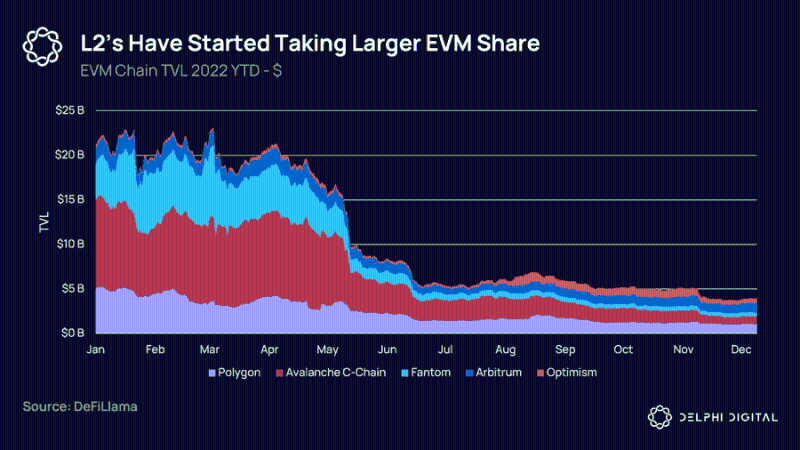
In contrast to major EVM L1s like Avalanche and Polygon—which have lost significant liquidity since the beginning of the year…
Arbitrum and Optimism have seen continuous TVL growth.
EIP-4844 will be a major milestone for ETH L2s, as it reduces rollup transaction fees.
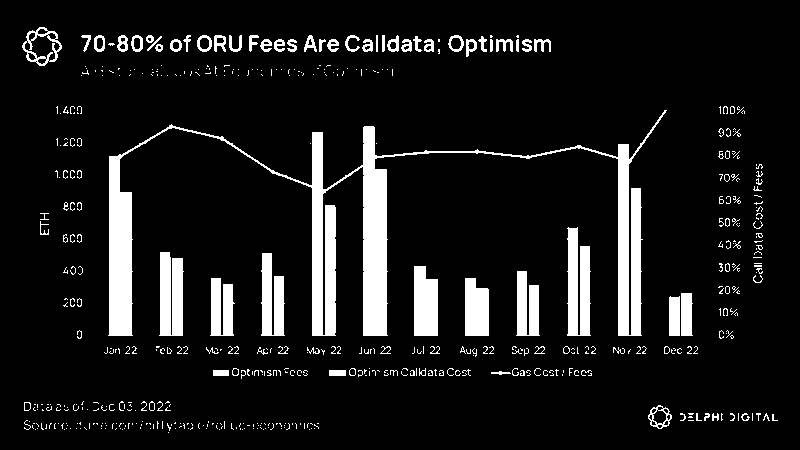
Rollups have two distinct costs—execution on L2 + data publication on L1. EIP-4844 increases Ethereum’s data capacity by an order of magnitude, reducing data publishing costs for rollups.
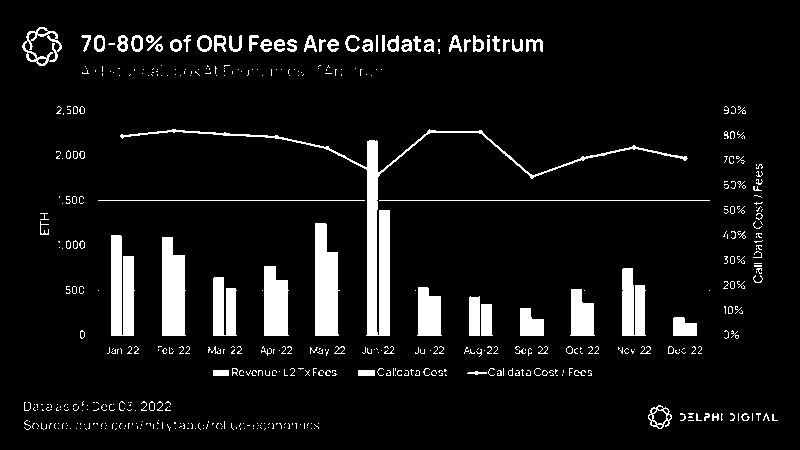
Currently, rollup-published data is permanently stored on L1. EIP-4844 relaxes data requirements on Ethereum L1, reducing rollup fees by an order of magnitude.
An interesting project with potential significance for Ethereum is EigenLayer.
EigenLayer can be seen as Ethereum’s take on interchain security. It will allow Ethereum validators to re-stake their ETH to provide additional services.
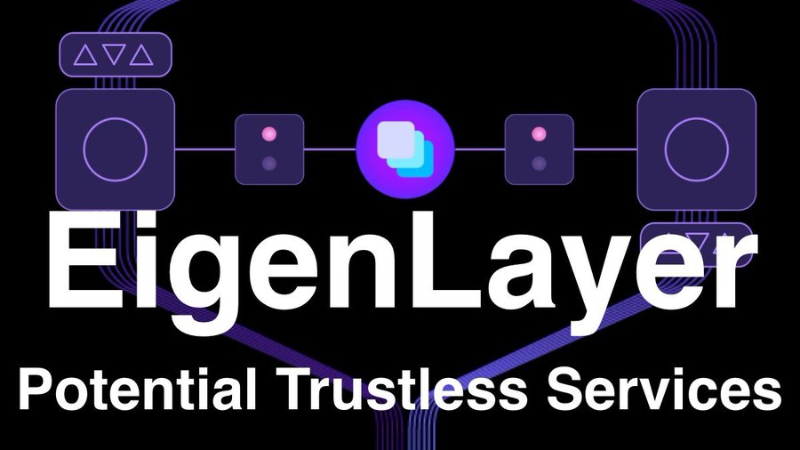
Validators expose themselves to slashing for malicious behavior but can earn rewards from the services they provide. EigenLayer can accelerate innovation at the protocol level.
Ethereum’s rollup-centric vision has been the biggest catalyst for smart contract rollup development. Last year, Celestia expanded the definition of rollups by introducing sovereign execution/settlement rollups and Celestiums.
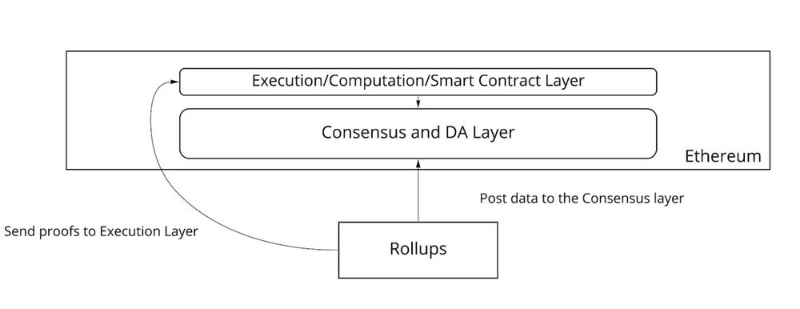
A modular blockchain is defined as one that outsources at least one critical function (execution, settlement, consensus, data availability) to another blockchain.
Celestia is poised to become the first truly modular blockchain network.
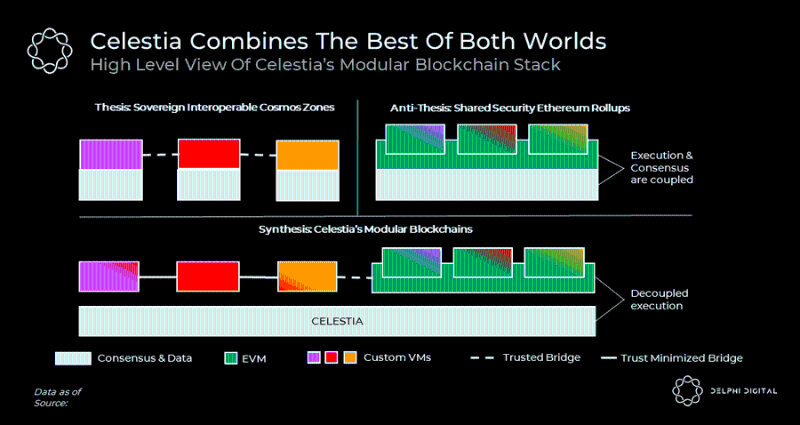
After launching its base data availability layer, there will be modular settlement and execution layers launching user-facing applications. One such project is Fuel.
The Fuel team has been building FuelVM from scratch to create modular execution layers.
Fuel may have multiple instances, including a PoS sidechain to Ethereum, a smart contract rollup on Ethereum, and a sovereign rollup on Celestia.
While these developments are exciting, it's important to remember rollups are still in early stages: almost no optimistic rollups have permissionless fraud proofs, and all rollups have critical upgradability clauses in their contracts, minimizing trustlessness across bridges.
Pillar 4: Privacy
The openness of public blockchains is a double-edged sword. From solvency and transparency perspectives, openness is a feature—and one of blockchain’s greatest advantages.
Being able to audit protocols in real-time and verify solvency within seconds solves the opacity issues we saw in centralized institutions—a painful lesson in 2022.
One-click audits of full reserve holdings for DeFi protocols are something CeFi can never achieve, regardless of how robust the proof-of-reserves process or how diligent and reputable the auditing firms are.
However, a 100% transparent financial network comes at a cost. Having your history fully on-chain not only leaks profitable trading strategies but can also be dangerous from a personal security standpoint.
Thus, several interesting privacy developments are underway, including:
🔹 Penumbra
🔹 Aztec
🔹 Aleo
Penumbra
Penumbra: As a fully private DEX, Penumbra acts as a shielded pool within the Cosmos/IBC ecosystem.
Its shielded swaps prevent certain MEV-like front-running and sandwich attacks, using sealed-bid batch execution to clear orders at a single price.

Penumbra’s V1 AMM uses concentrated liquidity design, allowing market makers to privately deploy strategies without leakage.
Aztec
Aztec Connect is unique compared to other rollups. It doesn’t have its own smart contracts/dApps/liquidity, but instead functions like a VPN for accessing Ethereum L1.
Ethereum protocols can integrate with the Connect SDK, enabling Aztec users to privately access their protocols from Aztec.

Aleo
is a default-private smart contract platform.
Developers building dApps on Aleo don’t need to think about privacy—it’s provided by default. They retain control over which aspects of their applications to make publicly visible.
A thoughtful aspect of Aleo is its hybrid use of PoW/PoS; PoS for instant finality, PoW for scaling proof generation performance.
Aleo allocates part of block rewards to decentralize and open proof generation to an open network of SNARK provers.
We expect privacy to regain focus as a major theme—the battle being not just technological, but regulatory as well. Privacy matters.
MEV
The most important topic, and our final emerging vertical at the center of blockchain operations: MEV.
We’ll cover MEV on ETH, Solana, Cosmos, MEV-Boost adoption, relays, builders, censorship issues, and Flashbots developments.
Ethereum blocks can be built locally or externally.
Local block building is the default process: validators receive public mempool transactions, bundle them into a block, and broadcast it to other validators in the network.
In external block building, validators outsource the block-building process by running MEV-Boost, a “sidecar” software that allows validators to profit from MEV without needing knowledge, complex systems, or relationships with builders.
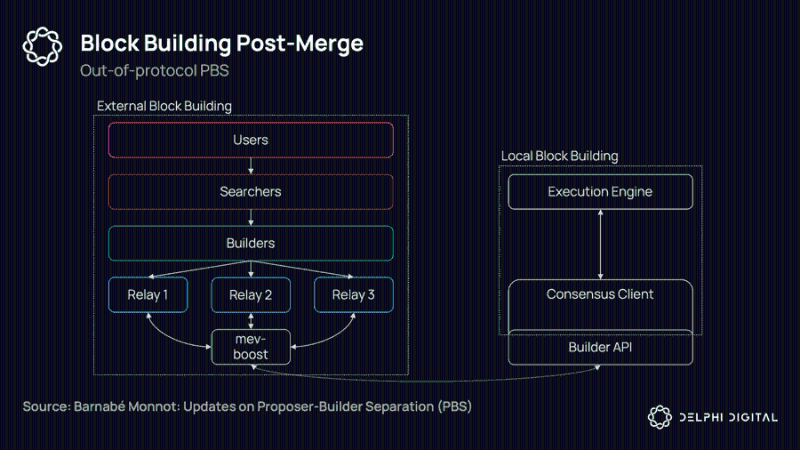
MEV-Boost is merely an aggregator of relays, selecting the highest-bidding (i.e., most profitable) block from relays connected to the validator. Key stakeholders in this supply chain are searchers, builders, and relayers.
-
Searchers: Run MEV strategies and send bundles (transaction sequences) to builders.
-
Builders: Aggregate transactions from searchers and other sources to construct blocks.
-
Relayers: Receive blocks from builders and forward them to proposers.
MEV-Boost allows validators to maximize staking returns by selling their block space to an open, competitive market of block builders.
This means consistently higher staking yields and increased execution-layer rewards for large staking providers like Lido Finance.
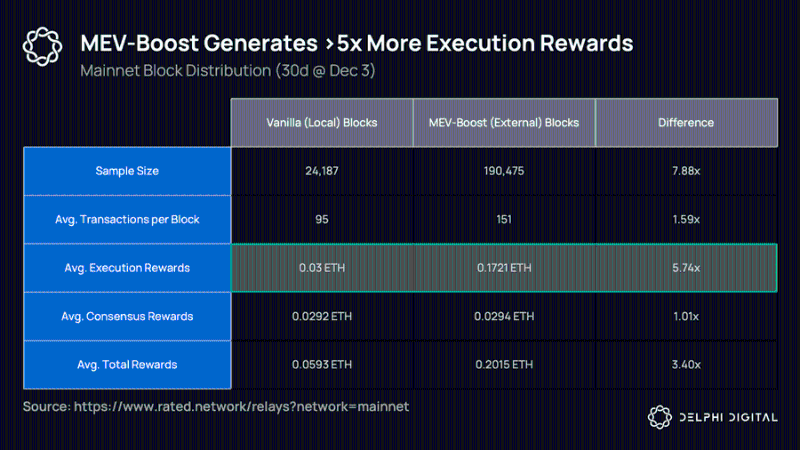
MEV is inherent to blockchains—the question is how profits are shared.
A competitive builder market leads to more equitable MEV distribution, as builders compete on execution guarantees, profit-sharing with users, and rebates for order flow.
Conversely, monopolies allow a single builder to retain more profits, as users have nowhere else to go.
Encouraging signs are emerging as Flashbots’ builder market share drops from 75% to 25%.
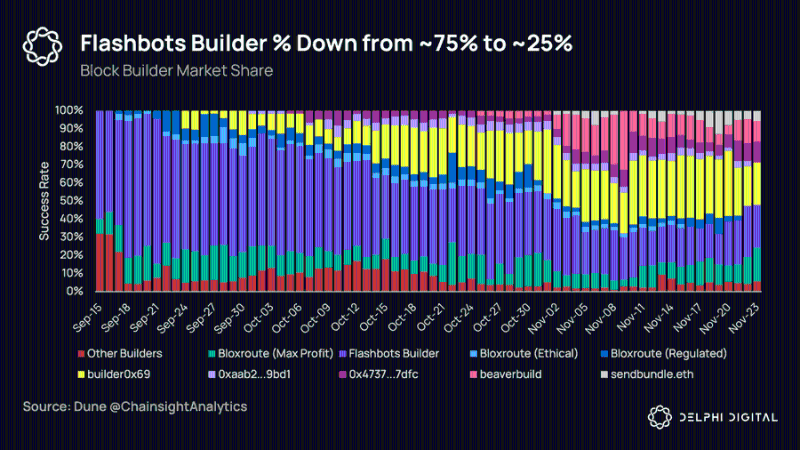
The builder market started highly concentrated but has diversified over time.
On the other hand, the relay market remains dominated by Flashbots, which is concerning given relays’ role in censorship.
Due to Flashbots’ dominance, censorship-resistant blocks are increasing, as most MEV-Boost transactions (63% of payloads) pass through the Flashbots relay.
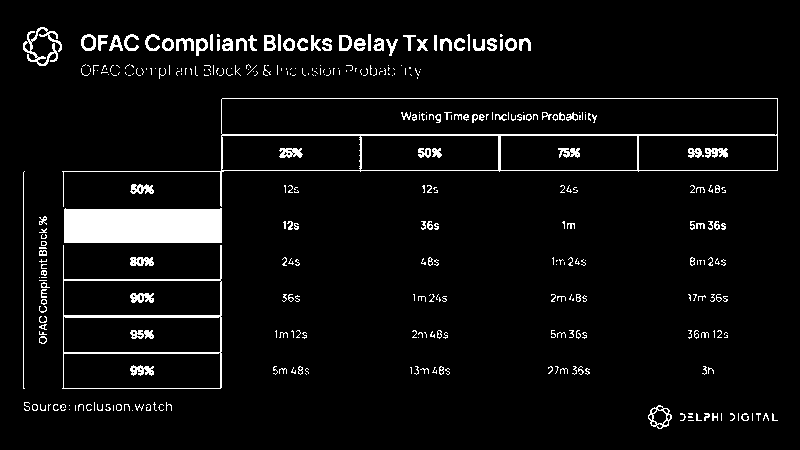
MEV-Boost adoption and base-layer censorship/OFAC compliance rates are essentially 1:1.
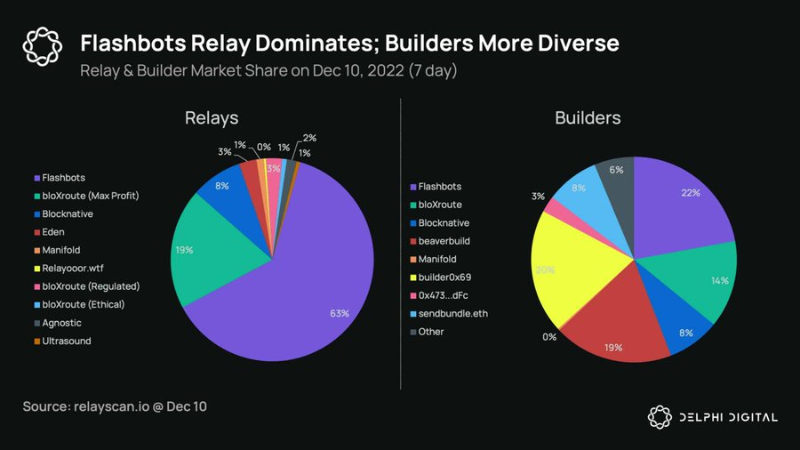
Currently, about 67% of blocks comply with OFAC standards. This doesn’t mean censored transactions never get included—they’re just delayed. At 67% censorship rate / 50% inclusion probability, delay averages ~24 seconds.
At 99% compliance, this delay increases to over 13 minutes.
Flashbots’ next (and more important) announcement is their new application chain SUAVE.
SUAVE’s primary goal is to foster a competitive builder market—where builders bid openly without exclusive PFOF agreements.
SUAVE has three main components:
1. Universal Preference Environment: Displays and aggregates transactions from all users and searchers into a centralized encrypted mempool.
2. Best Execution Market: "Executors" listen to the SUAVE mempool and compete to provide users with optimal execution.
3. Decentralized Block Building: Builders use encrypted preferences from the network to compete in constructing partial or full blocks.
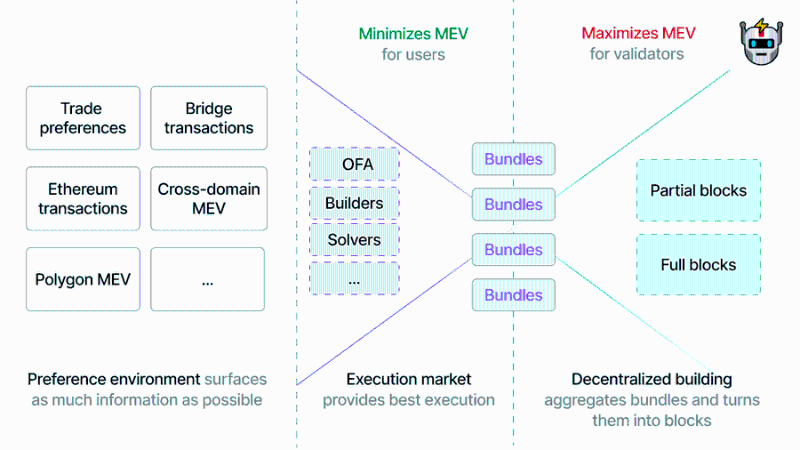
SUAVE could not only make the builder market more open and decentralized but itself become a decentralized block builder—where various builders independently build partial blocks and combine them.
Turning to Solana MEV, Jito Labs is the leader. Jito-Solana validators are a fork of Solana validators that enable packing as a primitive.
Jito solves two major problems for Solana:
1. It fosters an open MEV market, optimally distributing profits to validators.
2. Reduces spam and improves network efficiency.
Jito effectively creates an off-chain fee market for a network that wasn’t designed for one.
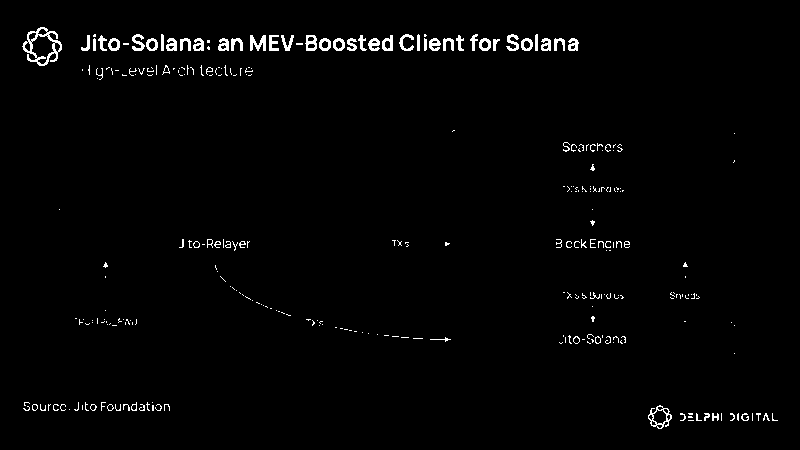
Solana MEV is still in its infancy, but if Solana’s overall vision succeeds, a massive economy will emerge, facing unique challenges.
Currently, there is no real MEV within the Cosmos ecosystem.
As an ecosystem primarily composed of app chains, Cosmos MEV differs from others in two main ways:
-
First, app chains can theoretically internalize MEV.This means MEV from these app chains can directly accrue to their token holders instead of leaking to another token. For example, MEV on Uniswap doesn’t flow to UNI.
-
Second, Cosmos opens up a relatively untapped domain: interchain MEV.While non-atomic cross-chain MEV exists in other ecosystems, it’s naturally higher in Cosmos due to greater interchain activity.
App chains can still develop off-chain markets where validators bypass internalized MEV and don’t share with stakers. Some Cosmos chains have begun governance/social coordination efforts to prevent such off-chain markets.
Finally, a promising idea from Cosmos Hub—still likely years away.
The Interchain Scheduler, focused on consumer chains, could become a futures market for blockspace.
MEV started as a niche idea on Ethereum but has recently taken center stage as one of the most critical problems blockchains must solve.
At a high level, blockchains generate economic activity, thus creating MEV—this will be the primary value accrual mechanism for every chain, just sliced differently.
MEV will always be inherent to blockchains—the distribution method remains undecided.
Conclusion
2022 may have been a rough year for the industry, with negative externalities from MEV, bridge exploits, and the FTX collapse taking center stage.
On the other hand, tremendous progress is being made across all major aspects of infrastructure, including user experience, scalability, interoperability, privacy, and censorship resistance.
Today’s crypto infrastructure isn’t ready for mass adoption—but 2023 will still be a year of resurgence. We believe 2023 will be a return to fundamentals, with renewed focus on the
Join TechFlow official community to stay tuned
Telegram:https://t.me/TechFlowDaily
X (Twitter):https://x.com/TechFlowPost
X (Twitter) EN:https://x.com/BlockFlow_News
 Delphi Digital

![Axe Compute [NASDAQ: AGPU] completes corporate restructuring (formerly POAI), enterprise-grade decentralized GPU computing power Aethir officially enters the mainstream market](https://upload.techflowpost.com/upload/images/20251212/2025121221124297058230.png?x-oss-process=image/resize,p_50/quality,q_80)






