Tokenization and Digital Securitization of Real-World Assets: How to Further Enhance Financial Efficiency?
TechFlow Selected TechFlow Selected
Tokenization and Digital Securitization of Real-World Assets: How to Further Enhance Financial Efficiency?
The effective use of blockchain technology is expected to reduce transaction costs, enhance liquidity, and improve transparency, thereby streamlining legal compliance through faster peer-to-peer payment rails.
 Navigating Web3 tides with focused insights
Author: Chí Phan
Compiled by: TechFlow
Securitization brought centralization to equity and fixed-income assets. During the 2022 crypto bear market, tokenization of real-world assets emerged as a trending topic, offering the potential to leverage public blockchain technology to grow capital market share in alternative asset classes.
Public blockchains and security tokenization could represent the next technological step toward achieving deeper liquidity and lower transaction costs, thereby improving capital efficiency and enabling broader global investor participation.
The Emergence and Success of Securitization
Modern concepts of equity and debt—representing claims on corporate cash flows or fixed payments—trace back to the development of modern corporations in the 17th and 18th centuries. Before securities were invented, two effective methods existed for business financing:
– Borrowing money from acquaintances (debt).
– Establishing business partnerships or investor relationships with acquaintances (equity).
However, these informal and unstructured practices imposed significant social and geographic access barriers for both investors and businesses. Then, securitization mechanisms and infrastructure began to take effect, elevating capital market efficiency to a new level.
Securities—whether equity or debt instruments—centralize assets and package them into tradable products. Securities are typically standardized and offered within highly regulated secondary markets to enhance liquidity and reduce transaction costs.
Over time, standardized securities have become a cornerstone of the modern financial system, accounting for over 80% of capital markets, far surpassing alternative asset classes such as real estate, private equity, and commodities.
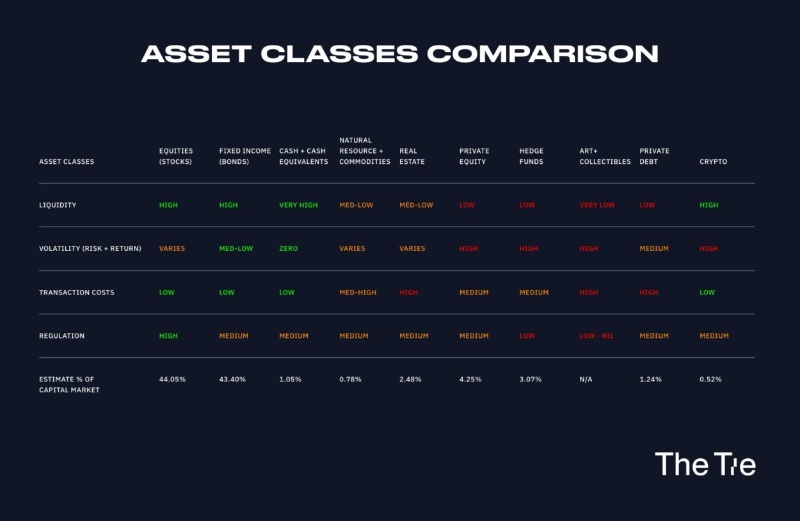
Technological advances in standardized securities and trading infrastructure have greatly contributed to the success of equity and fixed-income markets. However, other asset classes could emulate this growth and expand their capital market share if innovation can (1) significantly increase their liquidity or (2) reduce transaction costs associated with buying and selling.
Liquidity
By definition, liquidity refers to the efficiency or ease with which an asset can be converted without affecting its market price.
Factors influencing the liquidity of an asset class include transparency, investor confidence, accessibility, and infrastructure. We will connect these factors with the specific potential benefits introduced by blockchain technology.
- Transparency and Investor Confidence
Transparency often fosters greater investor confidence, encouraging more individuals to allocate their savings and wealth into transparent asset classes. Moreover, high levels of investor confidence help stabilize capital markets by reducing volatility. The popularity of U.S. equity and fixed-income markets relative to others is no surprise, as regulators have successfully established frameworks and requirements that enhance market integrity and transparency compared to foreign counterparts.
The public ledger—the core technology of public blockchains—offers opportunities for greater market transparency. All transactions and smart contract settlements can be recorded on a public ledger, allowing for near real-time auditing when necessary.
- Accessibility—Barriers to Participation
Modern brokers have enhanced the divisibility of asset classes. Platforms like Robinhood now allow small investors to purchase fractional shares. This feature helps reduce or eliminate entry barriers for retail investors.
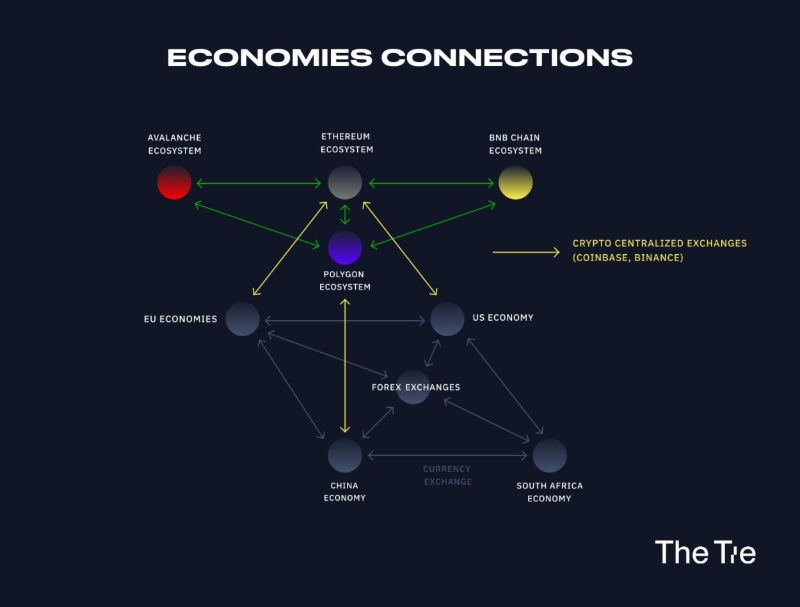
However, compliance with international laws creates artificial barriers across capital markets, restricting foreign capital flows into different asset classes and thus lowering market efficiency. Therefore, the borderless nature of public blockchains provides emerging asset classes with a competitive advantage against mature ones such as U.S. equities and fixed-income instruments.
- Infrastructure
Trading infrastructure impacts two components of liquidity: trading volume (the upper limit of total trades handled by market technology) and transaction costs. Infrastructure includes both the underlying technological systems and the efficiency of associated legal procedures.
Different market systems facilitate trading for each asset class, each subject to distinct regulatory constraints. Most economic activity, including transactions, occurs atop Automated Clearing House (ACH) systems. Clearing houses act as intermediaries, mitigating counterparty risk by ensuring sellers deliver securities to buyers and buyers make agreed-upon payments to sellers. In doing so, they help maintain the integrity and stability of securities exchanges.
The underlying ACH system settles transactions only after 1–3 business days and requires daily maintenance to operate. In contrast, public blockchain technology can execute this process in minutes, using smart contracts to guarantee agreed terms and enabling transparent, real-time matching and settlement of orders. Blockchain infrastructure has the potential to eliminate the human capital required to facilitate transactions while creating a less regulated yet more transparent process.
Transaction Costs
While there is still room for improvement, our current systems have already significantly reduced transaction costs for securities trading.
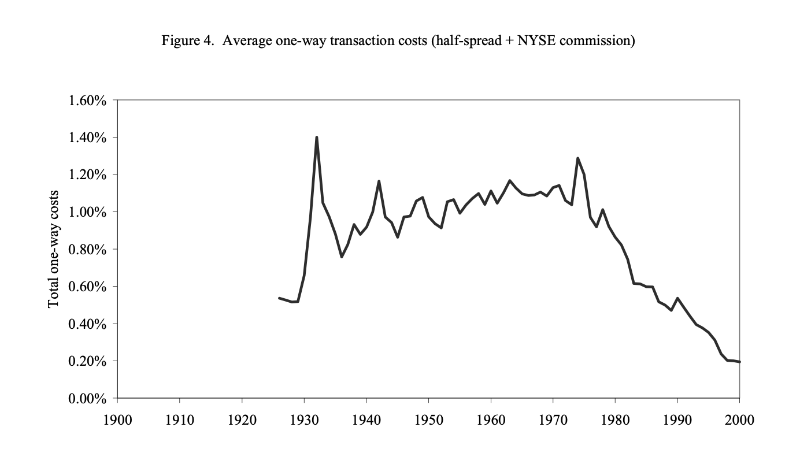
Fundamentally, transaction costs associated with exchanging assets arise from friction in infrastructure—such as operational expenses and intermediary commissions—sometimes caused by complex regulations and legal requirements. The more challenging it is to facilitate a trade, the higher the transaction cost for exchanging those asset classes.
Lowering transaction costs also increases investors’ net returns, creating incentives for liquidity provision across asset classes. Is decentralized securities the right path forward?
Tokenization
Reducing reliance on intermediaries creates leaner, cost-optimized trading processes for capital markets.
Although various technological approaches exist, using public blockchains for securitization offers a unique set of advantages and challenges.
Tokenized Assets Enable Global Payments
Although public blockchains are still seeking optimal scalability solutions for their infrastructure, settlement times and costs per transaction are already lower than ACH and significantly cheaper than traditional international wire transfers.
The peer-to-peer architecture of public blockchains supports settlement within minutes—or even seconds. Transaction costs on public blockchains range from a few dollars (Ethereum) to less than a few cents (Avalanche, Polygon, BNB Chain, or other Ethereum Layer 2s). Therefore, tokenizing and digitally securitizing real-world assets could significantly improve capital access for asset classes such as commodities, real estate, private equity, and hedge funds.
Increased liquidity can positively impact transaction costs by narrowing bid-ask spreads. Lower transaction costs translate into higher net returns for investors, thereby creating incentives for liquidity provision across asset classes. This also opens new doors for companies and enterprises to access more diversified sources of funding.
Bringing a New Set of Underlying Digital Assets to DeFi
Real-world assets are protected under centralized authorities within complex legal frameworks. Thus, tokenized securities issued by centralized entities can leverage both (1) traditional legal protections and (2) technological advancements and infrastructure of public blockchains to create a new suite of digital assets on public blockchains, backed by strong, valuable real-world assets.
Early Adopters of Tokenized Securities
KKR is one of the most prestigious private investment firms globally—historically accessible only to institutional investors and accredited participants in private markets.
However, Securitize Investment Arm recently launched a tokenized exposure to KKR’s Healthcare Strategic Growth Fund II on the public blockchain Avalanche. As a result, Securitize users can now gain portfolio exposure to KKR’s Healthcare Strategic Growth Fund II (HCSG II) entirely on-chain. This reflects Securitize's efforts to democratize access to institutional private-market strategies for individual investors and explore the benefits of tokenizing alternative assets on public blockchains.
While Ethereum's DeFi infrastructure is more mature and liquid, transaction fees on Ethereum’s mainnet (Layer 1) remain significantly higher than alternative options. These fees, along with support for customizable subnets (virtual machines) and tailored regulatory compliance for each virtual machine, led the Securitize team to choose Avalanche over Ethereum.
Conclusion
Although public blockchain infrastructure is still in its early stages, it shows promising potential in two key areas:
(1) Significantly increasing liquidity across asset classes;
(2) Reducing transaction costs for alternative assets while enabling broader global investor participation.
However, evolving digital asset compliance and regulatory requirements may challenge the tokenization pace of different asset classes, potentially hindering their ability to compete effectively with the success of equity and fixed-income markets.
Early adopters like Securitize Capital (the investment arm of Securitize), through the tokenization of KKR’s HCSG II on Avalanche, demonstrate strong interest in leveraging global blockchain technology to enhance financial market efficiency.
Effective use of blockchain technology holds promise for reducing transaction costs, enhancing liquidity, and increasing transparency, streamlining legal compliance through fast peer-to-peer payment rails. If these elements converge successfully, we can expect to see blockchain technology reshape capital market structures in the coming years—especially with support from global authorities and regulators.
Join TechFlow official community to stay tuned
Telegram:https://t.me/TechFlowDaily
X (Twitter):https://x.com/TechFlowPost
X (Twitter) EN:https://x.com/BlockFlow_News