dappOS — The Android Operating System for Web3
TechFlow Selected TechFlow Selected
dappOS — The Android Operating System for Web3
dappOS is an operating protocol designed to lower the barriers to interacting with crypto infrastructure, such as public blockchains and cross-chain bridges.
 Navigating Web3 tides with focused insights
Bringing DApps to You with a Web2 Experience
To bring the next billion users into Web3, user experience truly matters.
Currently, compared to Web2 accounts, Web3 accounts require a confusing recovery phrase (a unique password used for authentication and cryptographic wallet/account access, typically composed of 16–20 random English words).
Web3 accounts cannot be reset. This leads to two additional issues: when users forget their recovery phrase, the account is permanently lost; when users suspect their private key has been compromised, they must manually manage every asset/data across all DApps.
Due to fragmentation in Web3, assets and data are often sparsely distributed across different blockchains. Compared to CEXs (centralized exchanges), this is also highly inconvenient.
Another issue is complex workflows—most DApps are difficult to use. Take liquidity mining as an example: new users must go through a lengthy process involving approximately five contract interactions (approve token A/B, add liquidity, approve LP token, deposit).
The situation becomes even more complicated when using DApps across different chains. Numerous tutorials have been created to guide users through these complex workflows, significantly raising the barrier to entry for DApp usage. Therefore, lowering the threshold for entering Web3 is particularly important—it signifies the development of the entire industry ecosystem.
In early December, dappOS was selected into the fifth season of BinanceLabs’ incubation program as the first operating protocol for Web3. dappOS earned recognition from Binance for simplifying crypto infrastructure workflows. Binance Labs chose dappOS because it has a unique mission to open up the Web3 space for all Web2 users. Such simplified operations are crucial for scaling the Web3 user base from millions to billions.
dappOS will address these two issues by establishing an intermediate layer between users and crypto infrastructure. Users only need to interact with dappOS, which then handles interactions with the crypto infrastructure and automatically executes workflows on behalf of the user.
Next, we’ll analyze dappOS:
Project Overview
dappOS is an operating protocol designed to lower the barriers to interacting with crypto infrastructure (such as public chains and cross-chain bridges). The protocol aims to make the DApp experience as friendly as using everyday apps.
dappOS creates a universal platform connecting technologies across different blockchains, delivering a better experience for both developers and users in the Web3 world.
Technical Solution
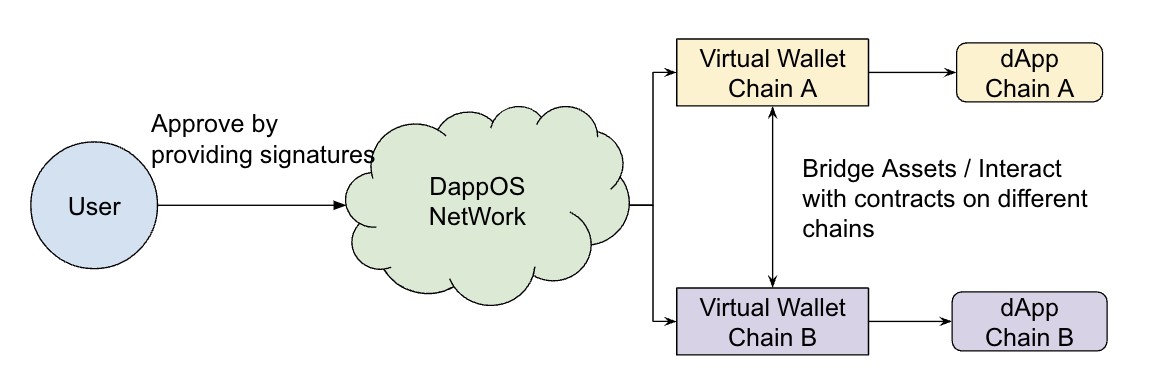
dappOS V1 consists primarily of two components:
dappOS Account: An implementation of account abstraction (virtual wallet) enabling automated workflow execution and flexible recovery methods.
dappOS Network: A decentralized network that helps users utilize their dappOS accounts.
Workflow:
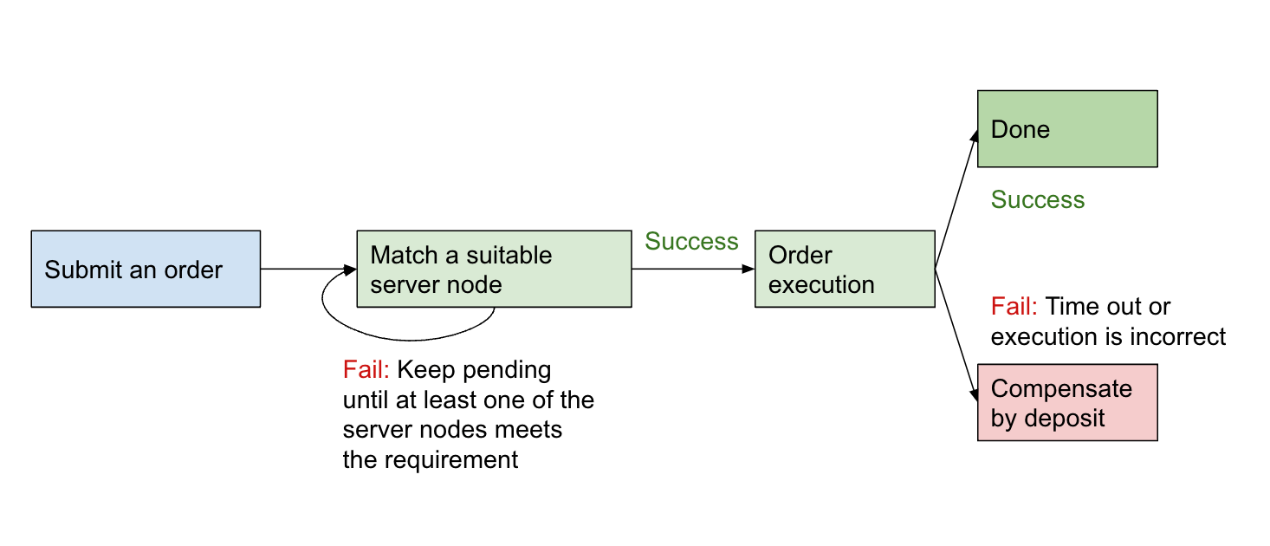
1. Users create an order via signature to confirm the entire workflow, including on-chain interactions across one or more chains, cross-chain assets, and fees for using the dappOS network.
2. DApps send the order to the dappOS network via JSON-RPC.
3. The dappOS network delegates the order to one of its permissionless nodes and guarantees proper execution—or the node compensates the user for any losses.
4. Incentivized by rewards, the selected node executes the entire workflow, including cross-chain asset transfers and on-chain transactions (from the user’s virtual wallet to the DApp contract).
dappOS Account: Within dappOS, users employ contract-based accounts instead of standard EOAs (externally owned accounts). These contracts are known as virtual wallets.
Virtual wallets support flexible recovery methods to reset management control. As a result, Web2 users can use and reset these wallets without traditional recovery phrases.
Using contract-based wallets allows third-party nodes to assist users in interacting with public chains. As long as accepted by the node, users can pay gas fees with any asset. Additionally, these wallets support batch processing without requiring new contract deployments.
When users first interact with a new chain, dappOS automatically creates a virtual wallet for them. Virtual wallets are unique for different users across different chains.
dappOS Network: The dappOS Network aims to provide a seamless user experience when using dappOS accounts across different chains. To meet current DApp requirements and deliver optimal UX, the network offers two core services:
-
Cross-chain asset transfers. In most cases, fees should be slightly higher than gas costs, and time should only be marginally longer than one transaction on the source chain plus one on the target chain.
-
Executing on-chain transactions from virtual wallets. Users should be allowed to pay gas fees using tokens from different chains, assets from CEXs, or even fiat currency.
dappOS network features two types of nodes: Super Nodes and Server Nodes.
-
Super Nodes delegate orders and penalize improper behavior by Server Nodes.
-
Server Nodes accept orders from Super Nodes and earn profits by executing them.
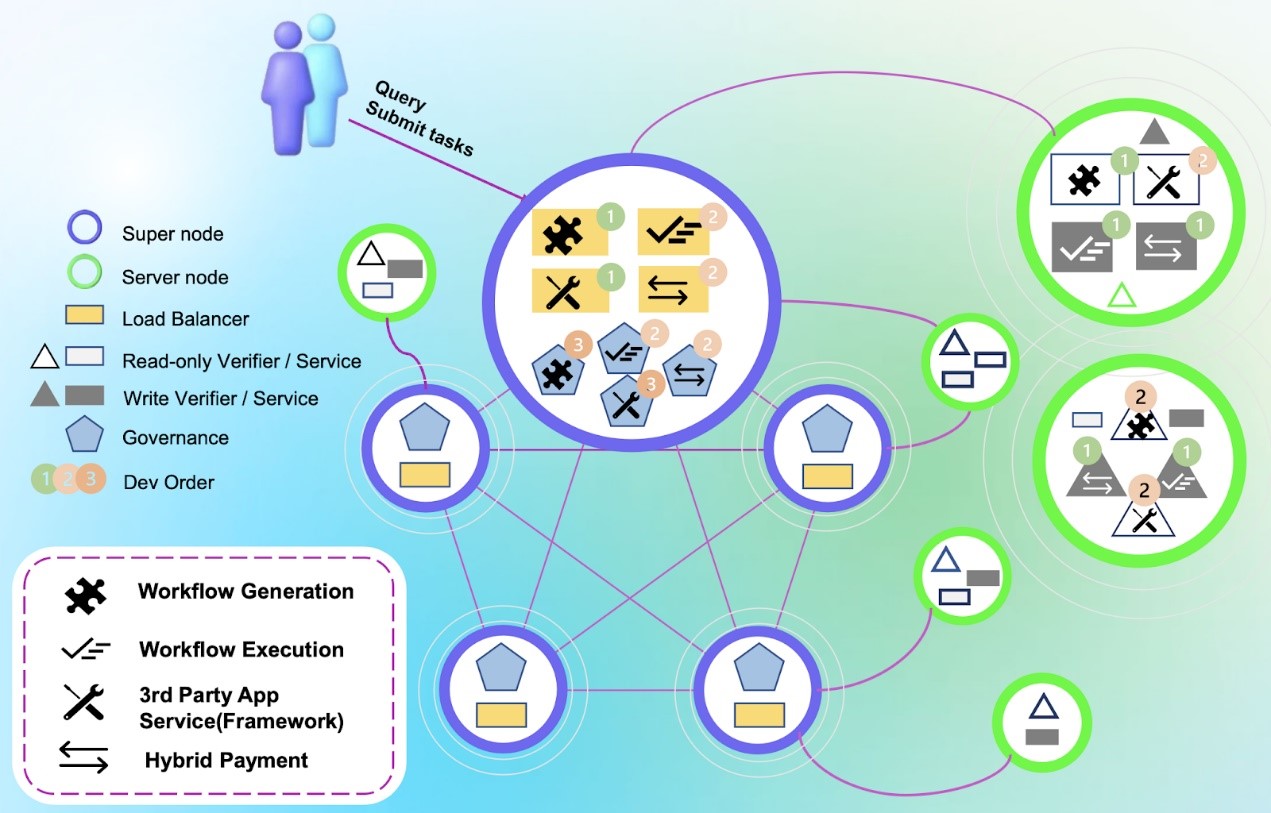
The order workflow is illustrated below:
Product Overview
dappOS products are divided into To B and To C, with corresponding functional distinctions.
To B – Targeting DApp Developers and Teams:
1. One-click multi-chain deployment for DApps: dappOS provides a native frontend SDK. Any DApp developer can integrate it without redeploying on other public chains.
2. Reduced interaction between DApps and public chains: Once users submit requests, dappOS handles the interaction with public chains on behalf of the application.
3. Development of additional application services: After SDK integration, DApp developers can build extra functionalities based on the service system, such as linking with Web2 social apps.
4. Advertising and marketing: On the integrated platform, developers can leverage built-in tools for advertising and marketing to attract traffic and users from other ecosystems and applications.
To C – User-Facing Features:
1. Virtual Wallet: Automatically created when users switch ecosystems—no recovery phrase required, unified account, eliminating complex multi-account management.
2. Recoverable Wallet Account: Accounts can be reset via other devices or third-party KYC services.
3. One-click execution of complex operations like cross-chain transfers: Users simply initiate a request—the system handles the rest. For example, a user holding ETH assets wanting to use a BSC app needing BSC doesn’t need to transfer or swap assets. They just initiate a request, and dappOS extracts an equivalent amount of ETH, performs the cross-chain swap, and the user only needs to confirm and approve the result.
4. Flexible Gas Payment Options: With node support, any asset on any chain within the account can serve as gas fee.
5. Cross-chain, cross-token consolidated payments: For instance, when paying a 1ETH fee but only having 0.8ETH in the account, the system can automatically draw 0.2ETH worth of assets from other chains to complete the payment—users only need to approve execution.
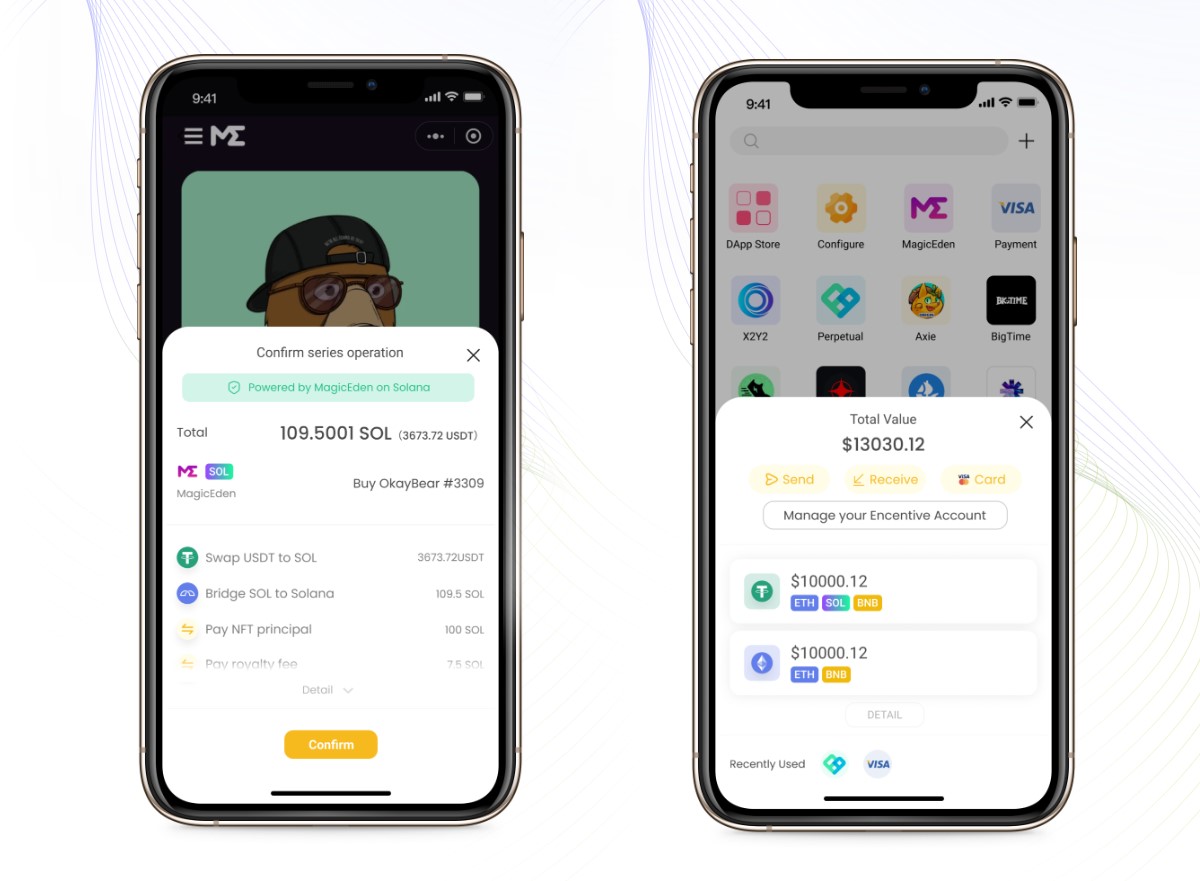
Current dappOS partnerships include:
Perpetual: https://perp.dappos.org/
Benqi: https://benqi.dappos.finance
Quickswap: https://quickswap.dappos.finance/farms
To better understand dappOS’s role, let’s compare user experience before and after integration using Perpetual as an example:
| Comparison of steps before and after Perpetual integrates dappOS (Assuming the user only holds ETH on Ethereum and has no assets on OP) |
|
| Before Integration |
After Integration |
| Visit app.perp.com and connect wallet; Use OP bridge to transfer $ETH from Ethereum to OP chain; $ETH on OP will be used for gas fees; Swap some $ETH to $USDC on Uniswap; Return to Perpetual Protocol, deposit USDC, and start trading. |
Visit perp.dappos.org (dappOS-powered test version), click “Connect Wallet” to Metamask, and switch network to BSC or Ethereum; Click “Deposit”, enter USDC amount, and confirm; USDC successfully deposited into Perpetual Protocol on BSC/ETH; |
| Operations: Switching between multiple protocols, multiple actions; Time spent: 30min; |
Operation: One-click; Time spent: 5min; |
Multiple user operations are simplified, saving significant time. The official team notes that the current test version supports limited coins and chains, with more to be added gradually.
In terms of security, dappOS employs a collateral mechanism. For each transaction, the responsible node locks collateral exceeding the value of the user’s transaction assets. If any issues arise, users are guaranteed compensation.
Although the number of DApps in Web3 is still small compared to Web2, even the existing limited user base finds it overwhelming. dappOS enables efficient DApp management, making it convenient and fast. Simpler operations can also attract new users entering the crypto space, serving as a conversion bridge. dappOS’s design philosophy and mechanisms offer crypto developers a new approach to attracting and retaining users—an actionable solution for converting large numbers of Web2 users.
Social Media Presence
Twitter Followers: 36.3K, over 100 tweets, overall engagement is quite strong;
Discord Members: 43K, with over 6K online members—the English community is highly active.
Judging from current social media metrics, dappOS demonstrates solid performance in product operations. A healthy community atmosphere is vital during the project’s early stages.
Project NFT
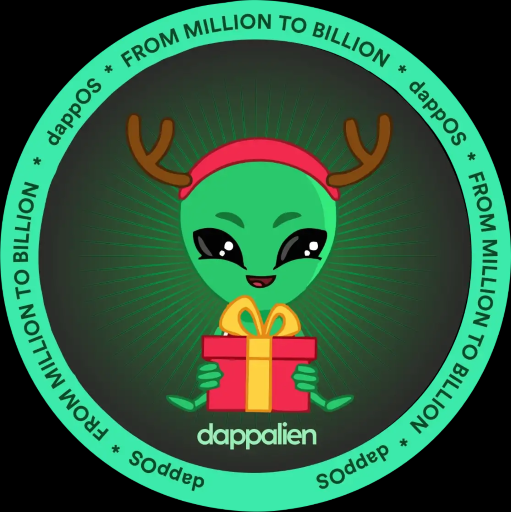
Recently, the team launched its first NFT series—baby Dappalien, awarded to community members actively contributing to project development. Besides baby Dappalien, there are currently five tiers announced: Student, Worker, Achiever, High-Flyer, and Legend.
Holders of baby Dappalien can complete tasks to level up. Brave souls who experience all five stages of Dappalien existence may evolve into Legend Dappalien. Holders at different tiers of the Dappalien NFT series will qualify for future airdrops and other benefits. This could be a hidden gem—perhaps NFT holders will receive future project tokens? Definitely worth watching.
NFTs are available on the GALEX platform. Follow the official Twitter for detailed information.
Development Roadmap
EVM contract V1 and network infrastructure (super nodes/server nodes) will achieve full decentralization in three phases:
- Stage 1: Centralized super nodes and server nodes (Q3 2022) — Completed
Primarily used for small-scale testing, contract debugging, and requirement validation.
Main Features:
1. Account abstraction;
2. Cross-chain fund transfers;
3. Service nodes.
- Stage 2: Centralized super nodes and decentralized server nodes (Q4 2022 – Q1 2023)
Enter the market quickly and scale up. System updates frequent during this period, with limitations on individual transaction size.
Main Features:
1. Support transactions involving multiple currencies.
2. Server nodes support multiple methods (e.g., CEX) for bridging assets.
3. Participation ranking mechanism for partial functions of service nodes.
4. Fee quotation mechanism.
5. Deposit, penalty, and ranking mechanisms for server nodes.
- Stage 3: Decentralized super nodes and server nodes (Q2–Q3 2023)
Highly decentralized and stable execution of large-scale transactions.
Main Features:
1. Construction of super node network.
2. Token issuance and implementation of economic model.
Current Progress and Partnerships
Currently, dappOS’s first-stage SDK is largely developed and gradually entering pilot testing.
Multiple DApps have already integrated for testing, and over 50 communities have expressed partnership interest.
Partners include Polygon, IoTeX, Nervos, Fortube, Perpetual, Alchemy Pay, among others.
Additionally, as a Binance Labs incubated project, further collaboration possibilities with Binance are promising.
Moving forward, according to the roadmap, the Host Network testnet will launch, followed by mainnet deployment. The goal is to integrate most top-tier DApps in the industry and establish more partnerships. After launching the mini-program platform, token issuance will follow.
Competitive Analysis
Simplifying operations has always been a focus in the crypto space, evident in developments like cross-chain solutions and wallet innovations. These efforts ultimately aim to attract more users, grow the Web3.0 user base, and expand blockchain adoption.
We’ve conducted competitive comparisons across different stages of dappOS products to highlight its characteristics and advantages.
| Stage 1 Competitive Comparison |
|||
| Project/Product |
MultiChain |
LayerZero |
dappOS SDK |
| Positioning |
Cross-chain tool |
Multi-chain interoperability protocol |
Cross-chain tool |
| Segment |
Infrastructure |
Infrastructure |
Tool protocol |
| Functionality |
Multi-chain asset bridging |
Asset and information bridging |
Asset and information bridging Multi-chain asset aggregation |
| Operation |
Multi-step, complex |
Multi-step, complex |
One-click, simple No redeployment needed for DApps, high flexibility |
| Speed |
Average |
Average |
Extremely fast |
| Fees |
Low |
Low |
Low |
| Security |
TSS (Threshold Signature Scheme) |
Dual-layer relayer with Oracle + Relayer |
Node collateral exceeding transaction value |
| Stage 2 Competitive Comparison |
|||
| Project/Product |
Metamask Standard Wallet |
Argent |
dappOS Mini-Program Platform |
| Positioning |
EVM Ecosystem Wallet |
Layer2 Ecosystem Wallet |
Multi-chain Virtual Wallet |
| Functionality |
Supports EVM ecosystem DApps Transactions, interactions, etc. |
Transfers between Layer1 and Layer2; supports Layer2 DApp operations |
Supports all-ecosystem DApps; Cross-chain consolidated payments |
| Join TechFlow official community to stay tuned Telegram:https://t.me/TechFlowDaily X (Twitter):https://x.com/TechFlowPost X (Twitter) EN:https://x.com/BlockFlow_News Add to Favorites Share to Social Media AuthorAvatarDAO Related Articles
| |||


![Axe Compute [NASDAQ: AGPU] completes corporate restructuring (formerly POAI), enterprise-grade decentralized GPU computing power Aethir officially enters the mainstream market](https://upload.techflowpost.com/upload/images/20251212/2025121221124297058230.png?x-oss-process=image/resize,p_50/quality,q_80)