








Arbitrum DeFi Ecosystem Overview: Innovative Real-Yield Protocols and GMX's "Remoras"
TechFlow Selected TechFlow Selected
Arbitrum DeFi Ecosystem Overview: Innovative Real-Yield Protocols and GMX's "Remoras"
9 Promising DeFi Protocols Deployed on Arbitrum
 Navigating Web3 tides with focused insights
By: Morty
According to DeFiLlama data, Arbitrum ranks first among Layer 2 networks in terms of total value locked (TVL), reaching $1 billion. Of course, this impressive figure is largely attributable to GMX, the flagship protocol on Arbitrum.
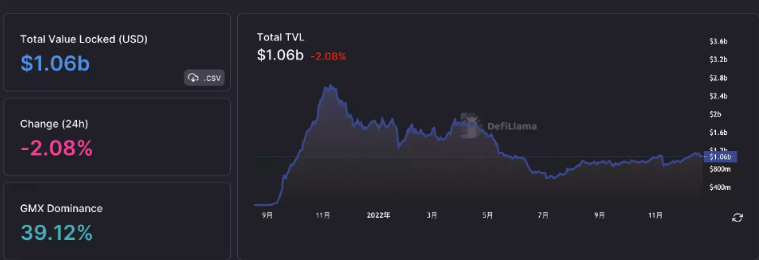
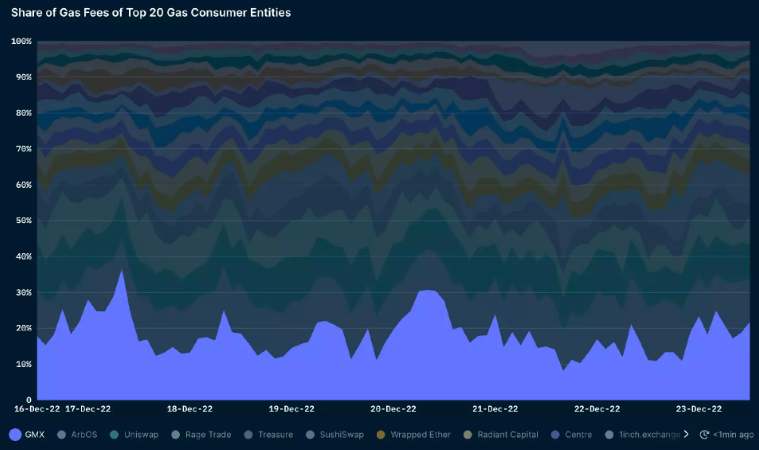
Currently, GMX’s TVL stands at $415 million. Additionally, according to Nansen’s Gas Tracker data, GMX consistently ranks first in gas consumption. As a result, an interesting phenomenon has emerged on Arbitrum—explosive innovation in DeFi, with most innovations centering around GMX.
Next, this article will analyze nine promising DeFi protocols deployed on Arbitrum.
TVL Over $10M
Dopex
Dopex is a decentralized European options protocol designed to maximize liquidity, minimize losses for option sellers, and maximize returns for buyers. It achieves this by enabling passive liquidity providers to earn yields through participation.
To accomplish these goals, Dopex has developed two core products: Single Staking Option Vaults (SSOV) and Straddles.
With SSOV, users have three options: buy call/put options or provide liquidity to option vaults and earn fees from option buyers.
The Straddles feature allows users to profit from volatility—gaining whether prices rise or fall—or to provide liquidity to Straddles and collect fees.
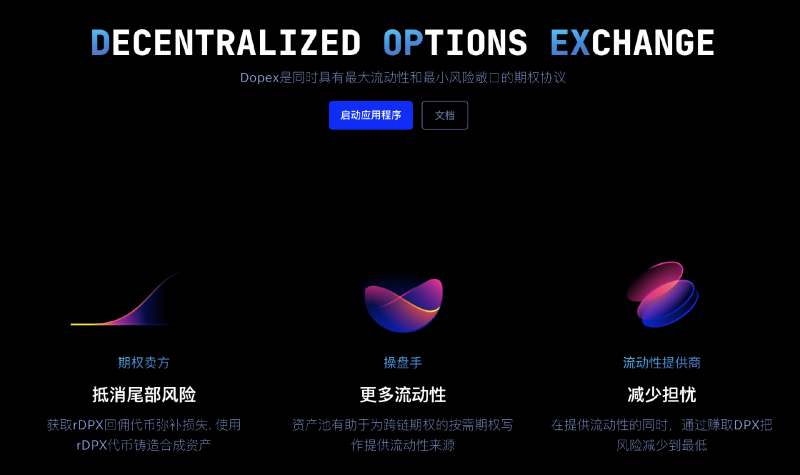
Within the Dopex ecosystem, there are two tokens: DPX and rDPX.
DPX is a limited-supply governance token that accumulates fees and revenue from pools, treasuries, and insured accounts. Dopex also adopts a veToken governance model.
rDPX is a rebate token compensating option sellers for losses. It can be used to mint synthetic assets such as index funds and stocks.
Currently, Dopex has a TVL of $22 million and a token market cap of $56 million. The team has announced plans to deploy on Polygon soon.
Link: https://www.dopex.io/
Camelot
Camelot is a decentralized exchange built on Arbitrum focused on trading long-tail assets.
To ensure sufficient liquidity for long-tail assets, Camelot introduced Nitro Pools. This product allows partner protocols to set parameters via spNFTs—such as minimum LP amount, time locks, or whitelists—and selectively distribute rewards to LPs. Thus, qualifying LPs receive higher incentives.
Another key feature of Camelot is its ability to apply dynamic and targeted fees on a per-pair basis during swaps. For example, it could set a 0.01% fee on buys and a 2% fee on exits, helping stabilize volatility during extreme events. This dynamic fee system adapts based on individual pair volatility and is highly composable with other protocols.
Additionally, Camelot’s native token GRAIL and its staked counterpart xGRAIL have a unique conversion mechanism. xGRAIL is an interest-bearing asset that earns protocol dividends and accelerates mining rewards but cannot be traded or transferred. To exit, xGRAIL holders must wait between 15 days (2 xGRAIL : 1 GRAIL) and up to six months (1 xGRAIL : 1 GRAIL).
Currently, Camelot’s TVL is $17 million.
Link: https://app.camelot.exchange/
Rage Trade
Rage Trade aims to build the most liquid ETH perpetual market and the highest-yielding stablecoin farm on Arbitrum.
ETH Perps are powered by Uniswap v3. By injecting omnichain recyclable liquidity into an 80-20 Vault, Rage Trade offers users perpetual contracts with up to 10x leverage. The 80-20 Vault serves as the primary liquidity source; users can deposit TriCrypto LP tokens, ETH, or USDC. 80% of deposited funds are allocated to protocols like Curve, GMX, and Sushi to capture fees, while 20% provides liquidity directly to Rage Trade.
Delta Neutral Vault stablecoin farms provide liquidity to GMX using a neutral strategy to earn ETH rewards from GMX. Additionally, the vault executes hedging strategies on Aave and Uniswap, offering users both risk-free and low-risk stablecoin yield pools.
Currently, Rage Trade’s TVL is $13.5 million, and the protocol has not yet launched a token.
Link: https://www.rage.trade/
PlutusDAO
PlutusDAO is a governance aggregation platform on Arbitrum, similar to how Convex relates to Curve, aiming to capture value by participating in ve-governance of other protocols. Currently, PlutusDAO has partnered with GMX, Dopex, Jones, and Sperax.
In its product design, PlutusDAO issues two types of assets: plsAssets and plvAssets.
plsAssets relate to governance aggregation, maximizing liquidity, and user rewards. Users deposit assets (Jones, DPX, SPA) into PlutusDAO, which permanently locks them as veTokens and returns equivalent plsTokens.
plvAssets are vault products designed for ease of use and reward maximization, also enhancing composability with other protocols. For example, users can deposit GLP into vaults to receive plvGLP, which earns compounded ETH rewards from the vault plus native PlutusDAO token incentives.
Currently, PlutusDAO’s TVL is $11 million, with a token market cap of $2.9 million.
Link: https://plutusdao.io/
TVL Under $10M
Jones DAO
Jones DAO is a yield, strategy, and liquidity protocol that enables users to access institutional-grade DeFi strategies with one click.
Jones DAO primarily targets three user groups:
1. Users who do not want to actively manage their strategies or prefer professional DAO strategist-curated strategies;
2. Users who wish to maintain liquidity without locking up assets;
3. DeFi protocols seeking additional yield without requiring treasury management expertise.
After depositing assets, Jones DAO issues jAssets to users, which can then be used across other protocols to earn additional yield.
Currently, Jones DAO’s TVL is $3.74 million, with a token market cap of $7.36 million.
Link: https://app.jonesdao.io/vaults
UMAMI
Umami bills itself as “Yearn on Arbitrum.” After the failure of V1, Umami launched V2. In its initial version, Umami was built atop GMX and aimed to generate ~20% returns for users’ USDC by participating in the stablecoin portion of GLP. However, it failed during significant ETH volatility. Fortunately, the protocol compensated all user losses.
Now, users can stake Umami tokens to receive 50% of protocol revenues distributed in WETH, yielding approximately 2.7% APY. (These yields are currently funded from the protocol treasury.)
On December 9, Umami released backtesting results for its GLP Vaults V2, showing:
Final strategy annualized return: 26.67%
Benchmark strategy annualized return: 11.8%
Worst-case loss: -4.55% (including trader PnL)
Average maximum Delta risk: -1.29% (standard deviation 2.10%)
Currently, Umami has not officially launched its new product suite. However, the team confirmed plans to launch DeFi Yield Vaults in Q4 this year, offering yield services for USDC, BTC, and ETH.
Notably, Circle, the issuer of USDC, is also a partner of Umami. Currently, Umami’s token market cap stands at $23 million.
Link: https://umami.finance/
GMD Protocol
GMD Protocol is a yield optimization and aggregation platform built on Arbitrum, leveraging GMX and GLP. It allows users to deposit WBTC, WETH, or USDC into single-asset staking vaults, use those assets to purchase GLP, and then distribute professionally managed GLP-generated yields to stakers.
Its key advantage lies in eliminating impermanent loss typically faced when purchasing GLP directly. After depositing into staking pools, users receive gmdTokens as receipts, which remain usable in other DeFi operations.
GMD is GMD Protocol’s native token. GMD stakers assume GLP impermanent loss risk but benefit from losses incurred by GMX traders. They also receive a share of profits generated by the single-asset staking vaults.
Another token within the GMD Protocol ecosystem is esGMD. This token is used for OTC swaps when GMD collaborates with other protocols. Tokens acquired via esGMD swaps are redistributed to GMD stakers. esGMD stakers also receive protocol revenue distributions, often at higher rates.
Looking ahead, esGMD may be distributed as rewards to single-asset staking vault depositors or used for vote bribing in governance. Converting esGMD to GMD requires a one-year waiting period. Currently, GMD Protocol’s TVL is $3.01 million, with a token market cap of $3.41 million.
Link: https://gmdprotocol.com/
Sperax USD
SperaxUSD is a 100% fully collateralized stablecoin protocol, issuing a stablecoin called USDs. USDs can be minted using USDC, FRAX, or DAI, and competes with these stablecoins by offering higher yields. The deposited USDC, FRAX, and DAI are deployed into various DeFi protocols to generate yield, which USDs holders automatically receive.
Beyond base yields, USDs holders can participate in liquidity mining for USDs-Token pairs on Demeter to earn additional returns. Redeeming USDs incurs a 0.02% fee, which goes to SPA stakers. In extreme cases, SPA may also serve as a reserve asset for USDs.
SperaxUSD employs a ve-governance model and regularly uses 25% of earnings to repurchase SPA from the open market.
Currently, SperaxUSD’s TVL is $2.62 million, with a token market cap of $8.77 million.
Link: https://sperax.io/
Buffer Finance
Buffer Finance is a decentralized binary options trading platform. Its main appeal is simplicity—users only need to select a strike price, expiry time, and direction (“up” or “down”) to place a trade. Correct predictions yield payouts. However, Buffer suffers from limited liquidity and lacks capacity for large whale-sized trades.
Within the Buffer ecosystem, two tokens exist: BFR and BLP.
BFR is a utility and governance token that captures up to 30% of platform fees.
BLP is issued to liquidity providers and accrues up to 70% of platform fees.
Currently, Buffer’s TVL is $110,000, with a token market cap of $1.72 million.
Although Buffer’s metrics are modest, its roadmap shows active development efforts, warranting continued observation.
Link: https://buffer.finance/
Other Protocols
SwapFish is a PancakeSwap clone and thus not analyzed here.
Vesta Finance briefly caught attention as an over-collateralized stablecoin protocol, but was disregarded due to its reliance on volatile assets like gOHM and GLP for backing.
Mycelium (formerly TraceDAO) is a decentralized perpetuals trading platform. Despite having a TVL exceeding $10 million, it appears impacted by the FTX collapse and announced staff reductions on December 15, so it is excluded from detailed analysis.
Conclusion
The emergence of Layer 2 solutions has accelerated DeFi innovation, thanks to lower gas fees, faster transaction speeds, and inherited security from Ethereum Layer 1. These advantages explain the surge in DeFi innovation on Arbitrum. Another major factor is the presence of the dominant protocol GMX, which meets the needs of most on-chain traders and has inspired a wave of derivative products built around GLP—these projects act like “remoras” hitching rides on the GMX whale, while simultaneously boosting GLP liquidity in return.
However, risks remain. GMX alone accounts for nearly 40% of Arbitrum’s total ecosystem TVL. If GMX expands to more chains or follows dYdX’s path by launching its own appchain, Arbitrum’s overall momentum could weaken. Therefore, Arbitrum needs continuous emergence of new flagship protocols to replace or complement GMX going forward.
Join TechFlow official community to stay tuned
Telegram:https://t.me/TechFlowDaily
X (Twitter):https://x.com/TechFlowPost
X (Twitter) EN:https://x.com/BlockFlow_News
 雨中狂睡Sleeping in the Rain






