








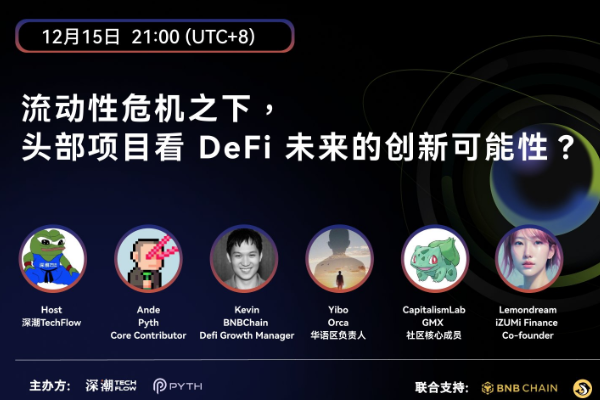
AMA Recap: Under Liquidity Crisis, How Do Top Projects View the Innovation Potential of DeFi's Future?
TechFlow Selected TechFlow Selected
AMA Recap: Under Liquidity Crisis, How Do Top Projects View the Innovation Potential of DeFi's Future?
After the FTX collapse, capital outflows triggered a liquidity crisis in the market, but at the same time, data from many DeFi products grew逆势ly.
 Navigating Web3 tides with focused insights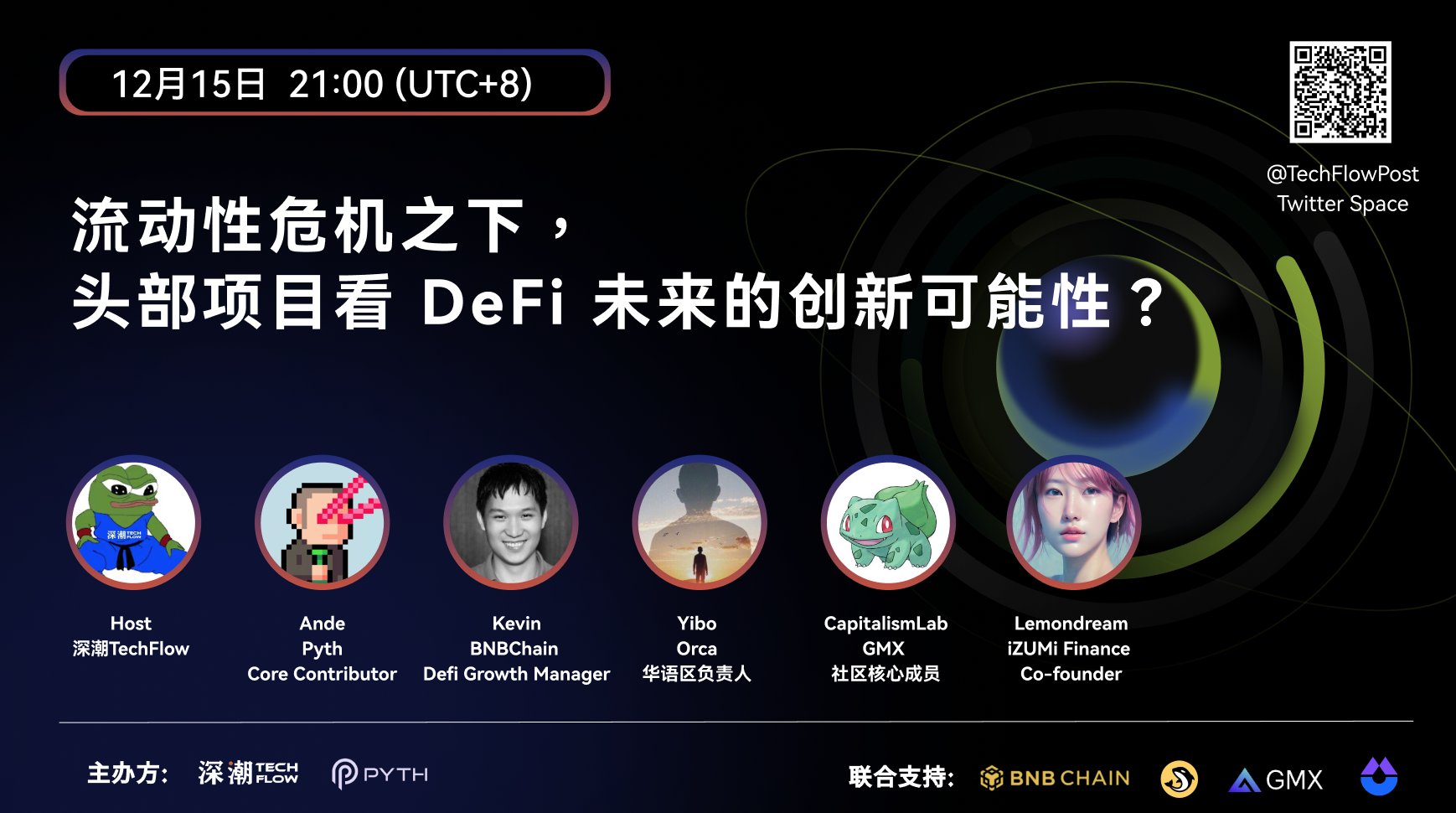
Compiled by: Yuang, TechFlow
After the FTX collapse, capital outflows triggered a market liquidity crisis—yet many DeFi protocol metrics逆势 grew.
From the perspective of project teams, how should we interpret these data trends? What insights can be drawn? We invited leading projects across multiple DeFi sectors to discuss the future possibilities for DeFi innovation.
Guests:
Ande, Pyth Core Contributor;
Kevin, BNB Chain DeFi Growth Manager;
Yibo, Head of Orca's Chinese Community;
CapitalismLab, Core Community Member of GMX;
Lemon, Co-Founder of izumi Finance;
Ande: I'm a core contributor at Pyth, an infrastructure project focused on oracles. Our goal is to innovate on oracle models and improve data processing, distribution, and consumption methods to overcome traditional issues like high latency and data inaccuracy. We aim to support all major blockchain ecosystems via cross-chain integration for DeFi development.
Kevin: I currently lead DeFi ecosystem growth on BNB Chain, focusing on emerging areas such as options/futures, bridging off-chain assets on-chain, and security. I've been involved in DeFi since 2016, working on various projects, so I consider myself relatively seasoned in this space.
Yibo: I primarily manage Orca’s Chinese community and marketing. Orca is Solana’s leading AMM, consistently ranking #1 in trading volume on Solana. We’ve launched Whirlpool—a V3-style concentrated liquidity pool—that greatly improves capital efficiency. I first got into Bitcoin in 2017 and started working full-time in crypto last year.
CapitalismLab: Hi everyone, I’m CapitalismLab, representing GMX today. I also run GNS’s Chinese community, so I'm quite familiar with decentralized derivatives.
Lemondream: "Izumi" means spring water in Japanese. We are a decentralized protocol focused on on-chain liquidity and trading. Our main product offers concentrated liquidity solutions, powered by our proprietary discrete liquidity AMM model. Recently, we’re launching the first fully on-chain orderbook DEX.
TechFlow: From your project's standpoint, what impact did the FTX collapse have? How was it reflected in your data?
Ande: The FTX collapse dealt a massive blow to the entire industry. Overall DeFi TVL remains depressed—around $40 billion, roughly one-third of its peak at the start of 2022. Similarly, Pyth’s Total Value Secured (TVS) has shrunk nearly tenfold.
The number of active projects using oracle services has declined, as many protocols no longer conduct on-chain trading and thus no longer require oracle data feeds.
Nonetheless, I believe there will be significant breakthroughs and innovations in DeFi going forward. For now, our focus is on continuous building—we hope that day comes soon.
Kevin: Whether it was Luna or FTX collapsing, short-term spikes in on-chain activity occurred as users rushed to hedge or swap into safer assets. However, due to the overall bearish sentiment, this hasn’t translated into sustainable growth. That said, it’s a good opportunity to encourage users to truly learn how to manage their wallets and dApps responsibly.
For project teams, we should mentally prepare for DeFi eventually surpassing CeFi in scale. Currently, many DEXs—especially derivatives platforms—still rely on centralized exchanges for price feeds, meaning price discovery depends on CeFi. If DEXs are to overtake CEXs, they cannot depend on a smaller underlying market. Therefore, exploring orderbook models—even if not optimal today—is worth considering.
Lemondream: Only about 10% of crypto trading volume happens on DEXs. Within that, Uniswap alone accounts for ~80%, and within Uniswap, ~85% of volume comes from major tokens.
If DEXs are to eventually replace CEXs, the biggest opportunity lies in migrating long-tail asset volumes and TVL from centralized exchanges onto chain.
For existing users, this relies on more native crypto assets emerging.
For new users, easier onboarding, lower barriers to entry, better security, and more user-friendly wallet + app combinations could unlock major opportunities for on-chain DEX adoption.
In terms of DEX protocols, combining orderbooks and AMMs presents certain conflicts. Traditional orderbooks are complex—each trade incurs significant on-chain costs and high friction, posing a key challenge. In contrast, AMMs are more open and scalable, supporting a wider range of assets.
What izumi is experimenting with:
We enable not only swaps but also limit orders for traders who want to buy high and sell low—all within a fully decentralized architecture. By adding single-point liquidity to our AMM design—placing liquidity tightly around a specific price—we achieve execution once that price is hit.
We're also optimizing the trading experience to make the frontend and functionality as close to CEX standards as possible.
CapitalismLab: GMX can be seen as a decentralized leveraged trading platform, with GMX token acting as a utility token. The past six months have been a bull market for GMX—its OI (open interest), trading volume, and fees collected have grown tenfold from June lows. This has also benefited partners; for example, Rage Trade’s collaboration with GMX on hedging strategies quickly scaled their position from ~$3M to $10M.
Overall, the decentralized derivatives sector is currently on an upward trajectory. GMX may be one of the few beneficiaries of FTX and 3AC collapses. As centralized institutions keep failing, attention and capital are increasingly shifting toward decentralized alternatives. GMX had solid fundamentals early on and offers a decent user experience. All GMX data is public—you can review it yourself.
Yibo: Since FTX collapsed in October, we tracked our data—Orca’s trading volume surpassed $100 million in the first three weeks of November. Our Whirlpool pools (V3-style concentrated liquidity) saw substantial growth compared to October.
We had zero funds on FTX and no investment from Alameda. While the FTX crash heavily impacted the Solana ecosystem and its applications, Orca was barely affected. Orca maintains the highest 24-hour trading volume among Solana AMMs.
Short term, the FTX incident dealt a heavy blow to the industry, especially during a bear market. Follow-on liquidations and other failures only made things worse.
Long term, it will lead to a healthier industry. Even if FTX hadn’t collapsed, similar events would have happened eventually. The earlier such crises occur—especially during a bear market—the more they motivate builders to innovate.
TechFlow: Some top performers in the secondary market believe the next bull cycle’s narrative will be "back to basics." This means the industry has many fake demands—new concepts flourish during bull markets but die in bear markets, only to reappear again in the next cycle.
So what matters most for investors? It’s identifying enduring narratives and fundamental needs. Right now, the most fundamental need revolves around trading—and within that, specific sectors like DEXs and lending.
Previously, both seemed solid—but after Luna’s fallout spilled into lending platforms, and recent issues with unsecured lender Maple Finance, DEXs now appear the most stable. If the next bull market scales N-fold, DEXs will likely grow proportionally. Plus, DEXs have a strong business model—earning fees, generating sustainable profits.
DeFi projects are closely tied to their underlying blockchains—Uniswap emerged from Ethereum, showing a symbiotic relationship between chains and apps. Why did your project choose its current chain? How do you view this relationship and mutual impact?
Ande: When choosing a blockchain, projects typically consider several factors:
Development perspective: A chain’s programming language, development difficulty, and developer community activity are critical. Developer engagement indicates innovation potential and the likelihood of new projects emerging.
Ecosystem perspective: Can the chain’s ecosystem support end-to-end collaboration? Are the necessary infrastructures available to meet innovative functional requirements? Can the ecosystem empower and support the project?
Infrastructure perspective: Are core DeFi infrastructures like oracles, bridges, and middleware mature—not just present, but high-performing? Robust infrastructure creates a favorable environment for application development.
Lastly, consider the number of active users and total liquidity on the chain.
Overall, DeFi projects have high demands for their chosen blockchain.
We believe in a multi-chain future—many chains will coexist, each hosting flagship projects, developer communities, and specialized apps.
It’s also a cross-chain future. Not every project should be confined to one chain. Cross-chain expands revenue streams, broadens user bases, and significantly improves risk resilience.
We aim for our infrastructure to serve all major chains—not be chain-specific. Through innovative designs, we want all blockchains to benefit from robust infrastructure. That’s exactly what Pyth is building today.
Lemondream: izumi initially built on Uniswap v3, offering additional incentives for LPs and enhanced liquidity management tools for protocols, while giving users higher fee rewards and yield opportunities. For example, a project can boost liquidity in a specific price range beyond base Uniswap v3 fees.
When selecting a blockchain, we don’t just look for technical performance—we also assess partnership and competitive dynamics.
Why we chose BNB Chain for our DEX:
Ethereum is too crowded.
BNB Chain’s dominant DEX still uses a V2 model. Compared to V2, concentrated liquidity (like V3) offers much higher capital efficiency. AMM evolution is essentially about capital efficiency optimization—so launching a concentrated liquidity protocol on BNB Chain gives us a clear product differentiation.
BNB Chain already has a large user base and hosts the most native assets among major chains.
Many GameFi projects exist on BNB Chain. Players often earn tokens in-game and immediately swap them on-chain rather than withdrawing to an exchange.
Thanks to our concentrated liquidity mechanism, we offer lower TVL requirements, reduced slippage, and better pricing—enabling wallets and aggregators on BNB Chain to automatically route user orders to our DEX.
We’ve deployed on many chains. Unlike other protocols, DEXs heavily depend on liquidity. When choosing where to deploy, we evaluate opportunities for deeper ecosystem integration, marketing resources, and early liquidity support. Leading DEXs enjoy strong network effects, traffic concentration, and capital aggregation.
We remain bullish on Ethereum’s ecosystem and plan further deployments across EVM-compatible chains, zk-Rollups, and L2s.
We won’t focus on niche emerging chains—they involve higher migration and coordination costs, and may turn out to be fleeting without lasting user adoption.
On cross-chain: izumi currently uses a multi-chain liquidity deployment strategy, which is operationally intensive—each asset requires dedicated liquidity bootstrapping. Due to security concerns, we haven’t adopted cross-chain bridging yet. Once security improves, we may explore cross-chain solutions.
Kevin: When building products, consider these factors:
1. User base: Many chains lack users. Launching a new project on such chains is risky—not just about product quality, but whether the chain itself gains traction.
2. Early-stage suitability: The future is multi-chain. We encourage BNB Chain projects to expand outward and welcome external projects to build on BNB Chain.
3. Team strategy: Some projects establish themselves on Ethereum first to build brand value, then expand elsewhere with incentives. Others avoid Ethereum congestion by rooting in alternative chains before challenging Ethereum later. Teams should assess their strengths and choose accordingly.
4. Ecosystem support: Does the chain offer BD support? My daily work often involves connecting projects with partners.
5. Marketing cost: User acquisition is expensive. But if a project is strong, BNB Chain can help promote it, significantly lowering customer acquisition costs.
The crypto industry still underestimates security. BNB Chain will launch a new security framework offering comprehensive audits, multisig deployment, smart contract controls, and more.
We offer various forms of support. For promising early-stage projects, we might provide gas fee rebates or temporary free services—like offering Orca a free period initially.
CapitalismLab: GMX was formed by merging Gambit and XVIX. XVIX was on Ethereum, Gambit on BSC. When deciding to create GMX, the X founder insisted on Arbitrum—confusing many at the time (August 2021), as Arbitrum wasn't well known. But he argued Arbitrum was fast and cheap.
Speed and low cost matter greatly for any chain or project—especially for leveraged trading like GMX. Fast oracle updates are crucial for day traders. Paying even a few cents per trade isn’t user-friendly.
Later, we expanded to Avalanche, which provided strong support—including a $4M grant from the Avalanche Foundation last month.
GMX hasn’t deployed on more chains mainly due to ongoing major upgrades—like X4 (synthetic asset iteration). The team may later hold a community vote to decide whether to launch on BNB Chain or Polygon first. After this upgrade, user experience will improve further—deploying on BSC afterward should allow us to reclaim that market.
Expanding to BSC would significantly grow GMX’s user base. While some see BSC as full of meme projects, it also hosts more risk-tolerant traders—ideal for leveraged trading. Just as GMX and Arbitrum mutually benefited, we expect a similarly positive relationship with BSC.
Core differences between GMX and GNS:
GMX offers full collateralization. If you go long 1,000 ETH on GMX, the underlying LP holds exactly 1,000 ETH—fully backed regardless of price surges.
GMX currently uses an internal price feed for speed, though it plans to migrate to Chainlink. There’s still some risk in the current setup.
GMX’s trading capacity cap depends on two factors: reliance on external oracles (and their liquidity), and GLP fund size. If GLP holds 1,000 ETH, maximum open positions are capped at 1,000 ETH.
GNS is not fully collateralized. Its LP doesn’t hold corresponding assets. If ETH enters a violent bull run, the LP could face deficit risks. Profits and losses are directly opposed—when you win, the LP loses, and vice versa.
GNS can theoretically trade any asset with an oracle. Its recent surge came from strong USD trends, EUR plunges, and booming forex markets. It’s the best platform for forex trading but can’t handle stocks—only existing on-chain assets.
GNS imposes many restrictions—on trade size and holding costs—leading to suboptimal trading experience and limited capacity.
Yibo: Orca currently has no cross-chain plans and will continue focusing on Solana. We aim to become Solana’s foundational liquidity layer—enabling other protocols to build atop Orca and contribute to the broader ecosystem. In July, we launched our first Whirlpools Developer Program, inviting developers to build on our pools, and we’ll continue hosting such initiatives.
I believe a few or even dozens of high-quality blockchains will emerge as major traffic gateways, advancing in parallel.
Why we originally chose Solana:
High performance—capable of handling up to 50,000 transactions per second;
Very low gas fees—beneficial for both developers and users;
Solana’s core team has unquestionable technical expertise;
Strong support for early ecosystem developers.
Solana’s issue: network outages.
TechFlow: Many founders face the question: on which blockchain should I launch first? Based on past experience, it’s somewhat of a mutual exploitation—both sides need traffic. Projects want chains to bring visibility; chains want apps to attract users.
A few months ago, a project shared their views on various chains:
Ethereum has legitimacy but is oversaturated—hard to stand out.
BNB Chain has strong user numbers and consumer traffic advantages.
Solana commands premium valuations—easier to pitch to major VCs willing to pay higher premiums, facilitating fundraising.
Other chains offer stronger support services.
We often describe DeFi as Lego blocks—stacked layer upon layer. Protocols may provide price feeds or liquidity to one another. Are there hierarchical tiers among DeFi projects? How do they influence each other?
Lemondream: I see two types of DeFi Lego dynamics: hierarchical dependency and peer-level cooperation.
Hierarchical model: Deposit liquidity on a DEX, receive LP tokens, then use them elsewhere for leveraged yield farming, staking, or borrowing. These secondary platforms may issue tokens, using token emissions as subsidies to attract users before eventually extracting value. In this case, success heavily depends on GMX—if GLP stability or yields falter, these projects face liquidity risks.
Peer-level model: Protocols act as mutual hedges. If you hold a position in one protocol, you can hedge it using tools from another. If one protocol fails, users aren’t dragged down. This model is vital for early-stage ecosystems and DEXs.
Kevin: We now strongly emphasize redundancy. For any critical node—especially oracles—there should be at least two sources. If one fails, the system remains intact.
CapitalismLab: Lego works when it’s mutually beneficial. Many now use GLP for hedging or other strategies—essentially expanding GLP’s user base. GLP acts like an index-enhanced product. Some users only want stablecoin yields. Partners like Rage Trade and Umami offer hedged strategies delivering ~20% GLP returns plus ~10–15% stablecoin yields—greatly broadening GLP’s appeal.
For Rage and Umami, this validates their business model and brings traffic.
For GMX, larger GLP means higher trading capacity and scale.
GMX has undergone audits and long-term real-world testing. Building layers on top introduces additional risk—the more Lego, the higher the danger.
GMX’s underlying BTC is wBTC. wBTC lacks deep liquidity and relies on BTC price oracles. wBTC and BTC are not equivalent—recent depegging raised concerns about BitGo’s solvency.
Each asset in GMX’s LP has a cap. Once exceeded, no more wBTC can be added—say wBTC target is 15%, but stops at 18%. If wBTC crashes severely, worst-case GLP loss is ~18%.
When doing Lego, choose partners wisely. If you Lego with a competitor and they fail, compensation might be unfairly minimal—used to undermine you.
For instance, Ankr was recently hacked, minting 10 trillion aBNBc tokens and draining liquidity pools. Wombat lacked monitoring, causing stkBNB to go to zero. Ankr compensated BNB fully but only partially compensated rival tokens like stkBNB and BNBx—effectively打压 competitors.
Therefore, projects must understand counterparty risks in Lego structures and implement defenses against extreme scenarios.
Yibo: DeFi composability is symbiotic. Next DeFi summer will likely combine stronger narratives with composability innovations.
First come infrastructures, then applications built atop them. Users increasingly seek “matryoshka”-style nesting—maximizing capital efficiency and returns. Future DEX innovation will be key to driving higher DeFi stacking.
Thoughts on oracles:
Should prices rely on a single oracle, multiple oracles, or blended data sources for greater accuracy?
How precise should pricing be—within 5%, 2%, or under 1%? Precision is critical for financial systems.
TechFlow: Which sectors do you看好 for the future? What new narratives might emerge?
Lemondream: The first DeFi summer captured TVL through subsidies, cultivating early users. But in winter, subsidy-driven models lose meaning—most DEXs operate at a loss.
izumi aims to build a DEX with a user experience closer to centralized exchanges. Models like Uniswap v3 inherently suffer from slippage and MEV frontrunning. To reduce friction, izumi uses limit orders via a fully on-chain orderbook—single-point liquidity with limit orders forming an orderbook structure.
Traditional orderbooks require extensive off-chain computation for matching, or semi-closed approaches like dYdX—which interact minimally with public chains.
For true decentralization, our solution lets users place orders while market makers use AMM-style liquidity provisioning within ranges. Buyers simply set desired prices and execute trades from that pool.
DeFi’s potential lies in attracting more professional users and meeting their sophisticated needs—exactly what izumi is pursuing.
Kevin: Two dimensions—sector and functionality.
Sectors:
Derivatives—including base-layer deDEXs like GMX, second-layer apps like Umami and Rage Trade, and options. May even converge with accelerator models.
RWA (Real World Assets): Tokenizing off-chain assets like equities, bonds, and real estate for investment.
Functionality:
Real yield: Products solving real problems with paying users generate genuine revenue.
User experience still lags—missing seamless Web2-to-Web3 transition apps.
CapitalismLab: Derivatives remain early-stage. Though GMX is already mainstream with over $100M in volume, there’s ample room for improvement versus CEXs.
Before DeFi, CeFi’s most profitable segment was derivatives—leverage and futures far exceed spot in volume and fees.
Lego built atop GMX could create DeFi-like structured products. These derivative-based products can capture CeFi market share and have big potential—though profitability and safety may not match base-layer protocols like GMX.
Liquid staking may see a turnaround. sETH faces challenges due to delayed Shanghai upgrades—large investors hesitate without sufficient exit liquidity. Once Shanghai activates staking withdrawals (~March next year), this sector will attract new players and uncertainty.
Ande: Our mission as an oracle is to lay a solid foundation for Lego—providing DeFi apps with optimal data, minimizing latency, maximizing accuracy.
For RWA, oracles must bring off-chain asset data on-chain. For example, we recently launched Dow Jones 30—bringing top U.S. stock data like Apple and Tesla on-chain. After listing silver data, we can build precious metal derivatives on-chain. We aim to cover more asset classes.
Improving risk management: Helping apps adjust risk parameters, define liquidation logic, and determine required oracle precision for accurate pricing and safe liquidations.
Traditional oracles push updated prices constantly to all dependent apps. Pyth developed a new model—pull-based on-demand data fetching.
We provide not just price data, but also a confidence interval. Alongside the price feed, we deliver additional risk parameters—enabling apps to build custom risk management algorithms.
For instance, if oracle certainty is low—due to wide variance among upstream price sources—the confidence interval widens. Downstream apps can then set thresholds—e.g., reject the current price feed if the confidence interval exceeds a threshold—preventing erroneous liquidations from oracle manipulation or sudden volatility.
Future crypto markets may expand beyond currencies into diverse asset classes and risk profiles—leading to broader Lego combinations. Risk management will become increasingly critical, making its enhancement a key frontier for innovation.
Yibo: Compared to traditional finance, DeFi is still new. DEXs and lending will see more specialized products. Decentralized insurance remains underdeveloped—nexus, a popular insurance app, holds less than 1% of DeFi TVL. Once user experience improves, this niche could unlock significant potential.
Audience Q: What’s the difference between GMX and GNS oracles?
CapitalismLab: Chainlink was too slow and insensitive to volatility for GMX’s needs, so we ran our own internal price feed. A keeper aggregates prices from multiple exchanges, enabling ultra-fast execution. Internal prices never deviate more than 2.5% from Chainlink—if they do, the trade won’t execute.
We have monitoring—another team member runs a watcher to observe the keeper. But since both are operated internally, there’s inherent risk of internal manipulation.
Now, GMX and Chainlink are collaborating on a low-latency price feed. Once live, GMX will fully switch to Chainlink—resolving the internal feed issue. Until then, forks of GMX carry risks—teams could exploit the internal feed mechanism to attack themselves (self-theft).
GNS currently uses aggregated Chainlink prices. Its trades aren’t zero-slippage, but pose little black-hack risk in financial contexts. The downside is higher slippage and poorer UX. Once Chainlink’s low-latency feed launches, most projects will gradually adopt it.
Audience Q: Why does GNS have slippage? I thought futures offer infinite liquidity at current price—but when I tried trading JPY/USD, it blocked my trade.
CapitalismLab: Likely, their risk mechanism detected excessive price deviation and blocked the trade. For small-cap assets, zero-slippage would expose them to price manipulation attacks. They use slippage as a defense mechanism.
Audience Q: Thoughts on Rage Trade? Could it become a project of GMX’s caliber?
CapitalismLab: Rage Trade initially built a decentralized perpetual contract for ETH, but essentially became a Perp v2 clone (Perpetual Protocol uses vAMM based on Uniswap v3—mediocre UX). Their improvements reduced impermanent loss and volatility, possibly increasing yields. But Perp failed competing against dYdX and GMX—so Rage’s incremental upgrades struggle against established rivals.
Now, Rage shifted to offering real yield with GMX, mimicking Alpaca—borrowing U from “risk-free” pools to scale up. This “risk-off” strategy yields ~5%, plus expected short-side gains—making their $10M pool fill instantly.
Revamping ETH perps proved too hard. Only dYdX, GMX, and GNS have succeeded in DEX perps. Making historic breakthroughs here is tough. Now partnering with GMX, their flexible team benefits from airdrop expectations and VC backing—can boost metrics short-term. Long-term, such
Join TechFlow official community to stay tuned
Telegram:https://t.me/TechFlowDaily
X (Twitter):https://x.com/TechFlowPost
X (Twitter) EN:https://x.com/BlockFlow_News







