nounsDAO Interview: The Latest Investment Logic in the DAO Sector
TechFlow Selected TechFlow Selected
nounsDAO Interview: The Latest Investment Logic in the DAO Sector
Featured Guest Introduction for This Episode Nouns DAO: The leading global DAO community and a flagship project driving the DAO sector, with a treasury holding nearly 30,000 ETH. Currently, the community brings together the world's top web3 builders.
 Navigating Web3 tides with focused insights
"OGtown" is an authorized article column by the Chinese-speaking Cryptopunks community.
------
Featured Guest Introduction
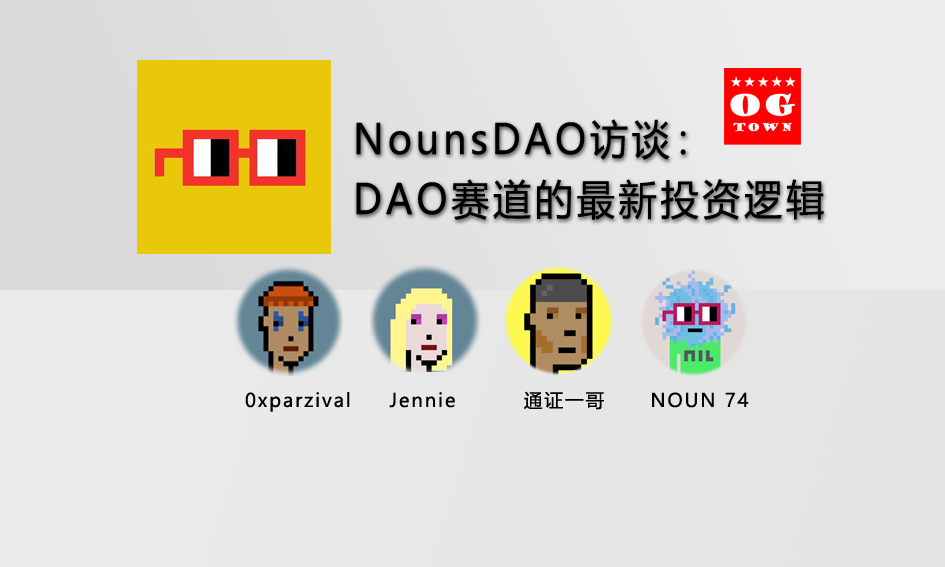
Nouns DAO: The leading global DAO community and a flagship project driving the DAO sector, with nearly 30,000 ETH in its treasury. It currently gathers top-tier web3 builders from around the world. The representative for this session is toady_hawk; the space was co-hosted by NounsDAO official and the Chinese-speaking cryptopunks community.
Guests from Chinese Cryptopunks Community:
Noun_74 (noun74): Founder of the Chinese Cryptopunks community and creator of the Noun Chinese ecosystem; has incubated and mentored multiple Chinese NFT projects to go global.
Token First Brother (punk1778): Researcher focused on blockchain since 2016. Author of mainland China's first best-selling NFT book. Co-founder of the Chinese CryptoPunk community and founder of Token Punk community.
0xparzival Song: Holder of Cryptopunks and Nouns, Founder of Three Keys Lab.
Jennie (punk1369): Holder of CryptoPunk and Nouns, entered the industry in 2018 focusing on Web3.0 infrastructure, Layer2, and NFT investments. NFT Native | Clonex, Doodle, BAYC holder.
Host Moonlight: Bilingual host based in the U.S. East Coast, outstanding builder at Binance Live and Huobi Live, head channel host at Ultiverse on Binance Live, planner and participant in thousands of programs and events.
Chief Translator Morningsun: Head of overseas market & operations at BCA.
Host Moonlight: How do you see the future of the DAO sector? And how should one invest in it?
toady_hawk: I'd like to hear if there are any different perspectives from the Punks community first.
0xparzival Song: I think investing in DAOs is a very broad topic. The initial form of DAOs emerged in 2017, but only in 2021 did we begin to see mature organizational models as we understand them today. As an investor, I'm happy to see various DAOs launching, but many seem fleeting—some even disappear shortly after launch. For example, Constitution DAO no longer exists—the project was shut down.
I've invested in several small-to-medium-sized venture DAOs and am optimistic about their future. However, I believe Nouns DAO differs from venture DAOs—and that’s a good thing. Venture DAOs haven’t produced particularly successful cases yet. Many of the smaller venture DAOs I’ve participated in mainly raise funds for larger projects. But in my view, that shouldn't be the primary mission of a DAO. DAOs should focus on doing something else.
Today’s DAOs resemble traditional companies more closely—but the concept of a company predates DAOs by decades. For investors in web3 or the DAO space, we must embrace a key idea: we should invest in the future, not the past. Since the company is a legacy model, truly successful DAOs may not look like companies at all. What they will become remains to be explored—and discussions like this one help shape that future.
NounsDAO Toady: I find 0xparzival's point—that “we shouldn’t treat DAOs as old-school companies”—very interesting, and I fully agree. Copying traditional corporate structures, business models, governance frameworks, and profit mechanisms into DAOs is straightforward and intuitive. But often, the less obvious path leads to real innovation. Web3 is a new technological frontier—we should experiment boldly with novel organizational forms.
In my mind, a DAO is less a company and more a community. All members participate relatively equally in governance, decision-making, and benefits. Of course, linking DAOs directly to financial returns is still an early-stage experiment—it shouldn't solely revolve around profits. Instead, it should function like a community where people unite around shared values to collectively govern systems or protocols.
Host Moonlight: As the leading DAO community, what opportunities and challenges is NounsDAO currently facing?
NounsDAO Toady: The biggest challenge NounsDAO has faced recently—about two months ago—was the shutdown of their Discord community. This left many members feeling hopeless and disheartened. They desperately wanted the community to return, but had no power to bring it back quickly.
This incident underscores the importance of decentralization. Right now, founders hold too much influence over the DAO—it feels overly centralized. When the founder decides to shut down Discord, it shuts down. My suggestion is to foster sub-communities—for instance, creating a China-based sub-community where members can meet regularly and collaborate, thereby diluting the central authority of the founding team.
To me, a DAO should embody community spirit—helping others while growing together. This doesn’t need to happen within a single core institution. With numerous sub-communities operating independently yet aligned toward a collective macro goal, we might achieve a more ideal DAO structure.
Host Moonlight: Both Nouns and Loot have drawn attention in China’s collector circles. How do you view the differences between these two communities?
NounsDAO Toady: There's a project called Hypeloot—it's a game combining Loot’s gameplay elements with crypto features. People should check it out.
0xparzival Song: Both communities received significant attention in China, but they differ fundamentally. Loot was the first CC0 project, built on a Dungeons & Dragons-style GameFi model. One of its founders, Dom, gained major recognition about 12 months ago.
We’ve played various GameFi projects. The Loot GameFi DAO emphasizes grassroots community building. In my view, it prioritizes players as the foundational layer—the base—of the community.
Compare that to Cryptopunks, which follows a top-down architecture—similar to many centrally managed DAOs. But Loot operates bottom-up. While Loot is GameFi-oriented, Nouns leans more heavily into cryptographic IP creation and value appreciation.
Both share common traits: they're rooted in CC0, composable, support on-chain interactions, and exhibit core blockchain-native DAO characteristics. Yet one focuses on gaming, the other on IP—so they’re ultimately quite different.
Token First Brother (punk1778): I see both similarities and differences. Their commonality lies in openness—they genuinely embody WEB3 principles, unlike many current PFP or metaverse projects that barely reach web2.5. Compared to those, Nouns and Loot come infinitely closer to true web3 and authentic web spirit.
As for differences: Nouns focuses on web3 IP development—licensing, derivative works, etc. It builds cultural momentum through IP management and expands industrially via community culture. Projects like BAYC, Azuki, Doodle, and Moonbird follow similar avatar-based paths aiming to create super IPs. Where Nouns excels is being more decentralized and open. Moonbird, for example, opened up later—not truly decentralized from the start. Nouns pioneered CC0 among PFP projects—that’s its greatest strength.
Second difference: Loot isn’t about super IPs. Its minimalist text-based design lacks visual appeal. It doesn’t aim to build culture through aesthetics à la Disney. Rather, it serves as modular building blocks for constructing the metaverse—tools for developers.
Third, Nouns is far wealthier than Loot. NounsDAO has significantly more capital, enabling faster, larger-scale initiatives. Loot, while more fragmented and decentralized, struggles with slower execution due to funding constraints—though individual projects remain highly vibrant.
Therefore, I believe combining Nouns and Loot could unlock powerful synergies. Some projects already integrate Nouns IP into Loot-based games—like the aforementioned Hyperloot. By merging Nouns’ financial strength with Loot’s decentralized innovation, during the next bull run, these genuine web3 forces—the sparks—could converge and ignite a transformative new era.
Host Moonlight: As a Nouns Chinese holder, how do you view Nouns’ recent performance?
Noun_74 (noun74): As mentioned earlier, tensions have arisen recently—and previously—between the Nouns community and the nounders, including the closure of certain Discords. These issues stem essentially from bear market anxieties that require an outlet. Nouns inherently contains various game-theoretic mechanisms—debates over whether these are fair naturally become emotional release valves for holders. As founders, the nounders inevitably become targets of criticism.
Secondly, China represents a massive market, yet Nouns hasn’t effectively penetrated it. Much work remains. Perhaps Nouns’ high entry price early on excluded many potential followers, contributing to this situation. Within the punks community, I conducted a survey: ownership overlap between punk holders and Nouns holders is very high—both globally and within Chinese communities. We now plan to leverage existing punk-related resources and networks to rebuild a dedicated Nouns Chinese community, ensuring Chinese participants secure a rightful place within the global Nouns ecosystem—starting with high-end collectors. We’re honored to have Toady join us today and sincerely invite him to support our efforts and serve as an advisor.
NounsDAO Toady: I’m unsure how effective I’d be as your mentor, but I deeply appreciate your efforts in China. I believe the noun square has enormous growth potential. Partnerships across countries—Japan, Brazil, Portugal—can unlock collaborative opportunities and co-create innovative things.
Jennie_zizi: I’ve been involved in NFTs for over two years. Previously active in CLONE and AZUKI communities, I switched to a Nouns profile picture today given the topic. Let me briefly introduce myself. Our company is a U.S.-listed firm providing foundational tech for the metaverse. With a strong technical team, we offer 3D rendering services for games and metaverse platforms. Personally, I lead investment and incubation efforts, primarily in NFTs.
Today’s discussion on Nouns and Loot resonates deeply. From early days with PUNKs and Bored Apes, I’ve followed Nouns closely. From an investment standpoint, today’s wave of PFP-driven NFT projects differs entirely from the NFT discourse led by traditional institutions back in 2017–2018. Now, NFTs feel more cultural—centered on community co-creation and self-governance.
For example, Universal Studios Singapore has a Transformers-themed park, while Japan’s version reflects local economic identity—each infused with regional character and community culture. Similarly, each NFT community—Nouns, Cryptopunks, Bored Ape—carries unique cultural attributes and shared consensus. I closely follow these projects, but Nouns evokes complex emotions—not hate, but mixed feelings. Other communities tend to emphasize activity and collaboration. Take AZUKI: its community engagement is extremely high. Fans love its visuals, design, and texture. They organically spend money hiring artists or forming teams to create derivatives. When Nouns’ community was open, I saw many artists, holders, and enthusiasts contribute product designs featuring various Nouns avatars. Due to Nouns’ unique minting mechanism, its gameplay is distinct. But this uniqueness may also explain why owner engagement lags behind other projects—perhaps attracting more technically inclined users.
Recently, when I noticed the Discord shutdown, I tried reaching out to Nouns holders and knowledgeable individuals—but found few channels. Nouns stands among the few successfully established flagship projects. Early on, a Silicon Valley team attempted a 9x9 grid concept: each customer owned a cell, could color it individually or collaboratively, culminating in a collectively created artwork. That project failed. We analyzed why—two main reasons. First, unless abstract art, modern NFTs require aesthetic appeal—something visually captivating at first glance. Multi-author NFTs often fail to convey coherent artistic vision. Still, the intent was noble. Later, seeing solo artist-created full-frame NFTs succeed validated this. Today, I’m here to learn from fellow Nouns holders and hear others’ views on Nouns’ evolution—that’s my hope for the project.
NounsDAO Toady: I’ll highlight two points. First, I greatly commend the initiative to build a Chinese-speaking community. Its potential is immense. Many guests today emphasized China’s significance as a major market and the strategic importance of DAOs. I hope for more opportunities ahead for Chinese contributors to actively shape the broader Nouns community.
Second, regarding the Discord shutdown’s impact on members: numerous unofficial subgroups remain active—on Discord, other platforms, or spaces like today’s Jungle or Nouns Square. Communication channels abound. While losing the official Discord is regrettable, we mustn’t let it halt progress.
Host Moonlight: What’s your view on Nouns’ development status in Chinese communities? Do you think starting from China could bring new dynamics to Nouns?
NounsDAO Toady: Nouns has achieved great success in many countries—Brazil, Japan—and I’m confident it will thrive in China too. The Chinese market’s importance cannot be overstated. Though we can’t guarantee outcomes, China’s vast population offers immense potential. Entry points into Nouns vary widely—not everyone needs to spend 30–50 ETH on glasses. Twitter Spaces, sub-communities, and alternative channels offer accessible pathways onto the Nouns ship. China is undeniably a huge market teeming with passionate participants. Chinese NFT projects, like those in Brazil and Japan, are rapidly advancing. As a premium project, Nouns holds enormous latent fan potential in China—making it critically important for the community. I believe countless possibilities lie ahead.
@NounsCN Representative Karl: I previously helped establish the Nouns Singapore community and am now collaborating on the Chinese one. Nouns is a large family—with presences in Australia, Africa, Latin America, and Spanish-speaking regions—making it a truly international community. Given that Mandarin is the second most spoken language globally, its importance is self-evident. Moreover, China boasts abundant web3 talent. I look forward to deeper collaborations. Building communities inevitably involves challenges and frustrations. But such dissatisfaction is natural in a DAO—we’re owners, not followers led by a central team. Our journey will involve stumbles and imperfections. These processes must be normalized. China can serve as a strategic base. Despite internet barriers, we possess uniquely large and tightly-knit Chinese-language social ecosystems—like Weibo—with massive user bases. Beyond mainland China—the core Mandarin region—there are Hong Kong, Macau, Taiwan, Singapore, and overseas Chinese communities—all potential members. Language carries culture, and Chinese will generate distinctive cultural expressions. Culture is generative—that’s at the heart of NounsDAO.
--------
Column Introduction
"OGtown" is an authorized article column by the Chinese-speaking Cryptopunks community, founded in 2021 as the earliest and highest asset-holding private NFT community in China. Membership requires verification as a PUNK holder. Currently, the community includes over 200 Cryptopunk holders—the largest concentration of web3 influencers in the Chinese-speaking world. Members include founders, executives, representatives from Christie's and Sotheby’s Asia and Greater China, listed companies, renowned NFT projects, exchanges, veteran blockchain media, Chinese opinion leaders, and whale NFT collectors. The community maintains strong ties with top-tier international OGs. We welcome friends from all sectors to connect with PunksCN and jointly advance the development of the Chinese-speaking NFT space.
Join TechFlow official community to stay tuned
Telegram:https://t.me/TechFlowDaily
X (Twitter):https://x.com/TechFlowPost
X (Twitter) EN:https://x.com/BlockFlow_News