
How to Choose Among Three Major Platforms – ParaSpace, BendDAO, and Binance NFT – for Ape Staking Mining?
TechFlow Selected TechFlow Selected
How to Choose Among Three Major Platforms – ParaSpace, BendDAO, and Binance NFT – for Ape Staking Mining?
Opinions among NFT holders and token holders in the APE ecosystem are divided regarding the design of the Ape Staking initiative.
 Navigating Web3 tides with focused insights
By JamesX
Yuga Labs, in collaboration with Horizen Labs, officially launched the ApeStake.io website on December 5, initiating a one-week pre-staking phase for Ape Staking. The official staking rewards for APE tokens will begin distribution on December 12. Based on current pre-staking data (as of December 8), the expected APY yield exceeds 1000%.
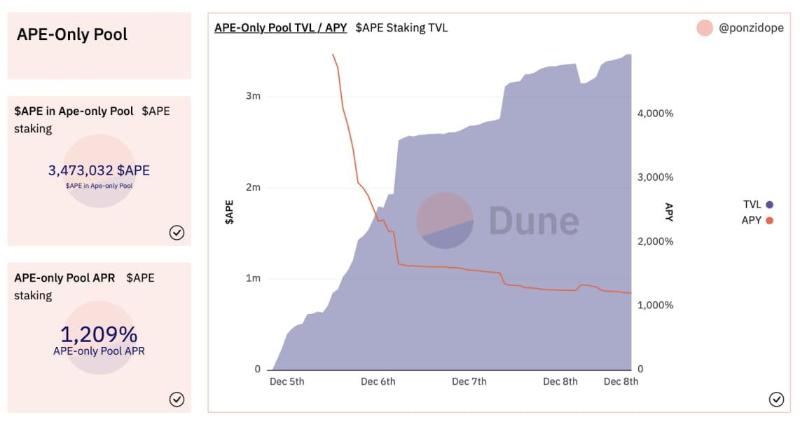
Although the official mining launch is still a few days away—and the projected APY will inevitably decline as more APE tokens and BAYC/MAYC/BAKC series NFTs join the staking pool—Ape Staking remains an unmissable investment opportunity for investors and NFT collectors alike.
This article will detail the official rules of Ape Staking, highlight associated risks, and compare the staking mechanisms and expected returns across three third-party platforms—ParaSpace, BendDAO, and Binance NFT—to help you make the most rational decision based on your individual circumstances.
Official Staking via ApeStake.io
The initial Ape Staking proposal, AIP 4 & 5, was rejected by community vote. After extensive discussions, consensus was eventually reached with the approval of AIP 21 & 22, paving the way for implementation.

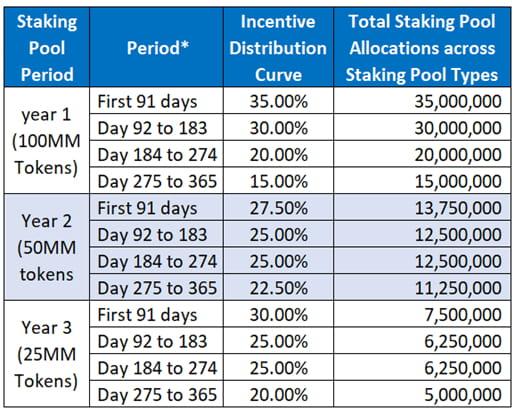
The chart below illustrates the quarterly release schedule of APE token incentives over the three-year Ape Staking program. Early participants will receive significantly higher APE rewards and enjoy elevated APY yields.
Ape Staking offers four independent staking pools: the APE token pool, BAYC pool, MAYC pool, and BAKC pairing pool. In the APE token pool, users can stake any amount of APE tokens, with rewards proportional to their share of the total pool. For BAYC and MAYC pools, NFTs act as containers that must be paired with APE tokens to participate in staking; each NFT has a maximum APE pairing limit, and reward allocation depends on the quantity of paired APE tokens. BAKC NFTs must first be paired with a BAYC or MAYC before they can participate in staking alongside APE tokens. Refer to the chart below for specific APE collateral limits and quarterly incentive distributions per pool.
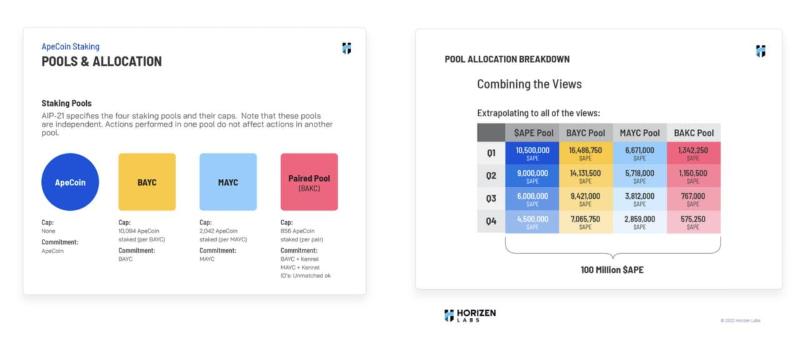
Note: If you stake directly through ApeStake.io, be aware that selling your Ape NFT during the staking period will result in the immediate loss of all paired APE tokens. Always remember to unstake and reclaim your APE tokens before transferring ownership to avoid being exploited by arbitrageurs.
The above outlines the official method of participating in Ape Staking. However, achieving maximum APY requires simultaneous ownership of both qualifying NFTs (BAYC/MAYC/BAKC) and sufficient APE tokens up to the pairing cap. If you own only NFTs or only APE tokens—or if you seek higher yields and greater liquidity—you have three superior alternatives: ParaSpace, BendDAO, and Binance NFT.
ParaSpace
You may not be familiar with ParaSpace, as it's a new entrant in the NFT lending space. However, its sister project, Parallel Finance—the leading lending protocol in the Polkadot ecosystem—is well known. Both are developed by Para Labs.
Para Labs’ first step in its multi-chain, multi-market expansion strategy is ParaSpace—an innovative NFT lending platform built on Ethereum, conceptually similar to Uniswap Labs’ recent move into the NFT marketplace. As its debut in the Ethereum NFT lending market, ParaSpace has launched a comprehensive product suite for Ape Staking, offering early participants an additional 30% APY in APE token rewards during the pre-staking phase.

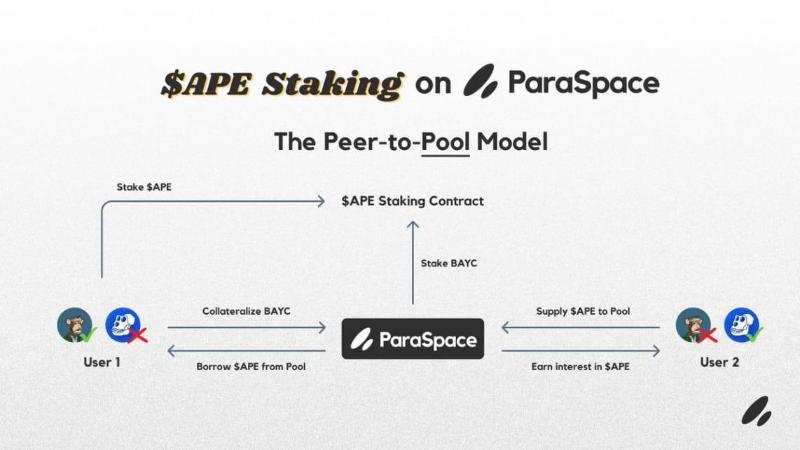
Like BendDAO, discussed next, ParaSpace uses NFT-backed lending as its foundational mechanism. By integrating this with Ape Staking, NFT holders can obtain liquid funds via borrowing while simultaneously earning APE staking rewards. However, ParaSpace adopts an innovative Peer-to-Pool model that greatly enhances capital efficiency.
Specifically, Ape NFT holders can stake their NFTs on ParaSpace and borrow the required APE tokens from the APE lending pool to pair with their NFTs—no need to find individual APE holders to manually pair with. This drastically reduces market friction. Meanwhile, APE token holders simply deposit their tokens into the lending pool to earn yield through lending interest and staking incentives.
(ParaSpace Twitter)
One inherent risk in NFT-backed APE staking is the potential liquidation of the NFT. ParaSpace cleverly mitigates this issue. Since APE token price and Ape NFT floor prices are strongly correlated, liquidation risk is naturally lower than in ETH-collateralized loans. In extreme cases, when liquidation is triggered, ParaSpace automatically redeems the staked Ape NFT but deducts necessary amounts from its staking rewards to ensure loan repayment—without subjecting the NFT to actual auction.
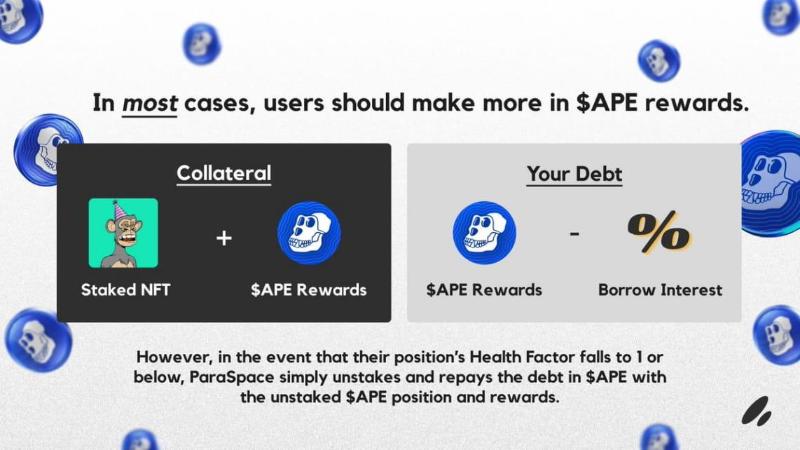 (ParaSpace Twitter)
Additionally, regarding the earlier-mentioned risk of losing paired APE tokens upon selling a staked Ape NFT, ParaSpace’s smart contract eliminates this vulnerability. For any Ape NFT staked via ParaSpace, if a transfer occurs during the staking period, the platform automatically unstakes and returns all APE tokens prior to the transaction—effectively preventing exploitation and ensuring the security of its lending pool.
On contract security, although ParaSpace is a new NFT lending platform and its Ape Staking contracts were deployed on mainnet on December 10, they have already undergone audits by 0xQuit, Certik, Trail of Bits, and Secure3.io. Additional top-tier auditors—including SlowMist, VeridiseInc, and Quantstamp—are currently conducting final reviews.
For users restricted from accessing ApeStake.io due to geographic limitations, ParaSpace has developed a front-end interface that directly interacts with the official staking contract, enabling seamless participation for these users.
BendDAO
BendDAO is no stranger to most blue-chip NFT investors. Having operated steadily for nearly nine months, it has weathered significant volatility in blue-chip NFT prices, including numerous liquidations. It was once criticized for potentially accelerating a downward spiral in NFT prices and questioned about its bad debt management. However, through continuous product upgrades and community-driven governance adjustments, BendDAO has proven its leadership in the NFTFi space. Thus, it plays a crucial role as a third-party platform in the Ape Staking initiative.
BendDAO’s support for Ape Staking originated from a community proposal, followed by another successful vote setting the protocol fee at 4%—a benchmark example of DAO governance in the NFTFi sector.
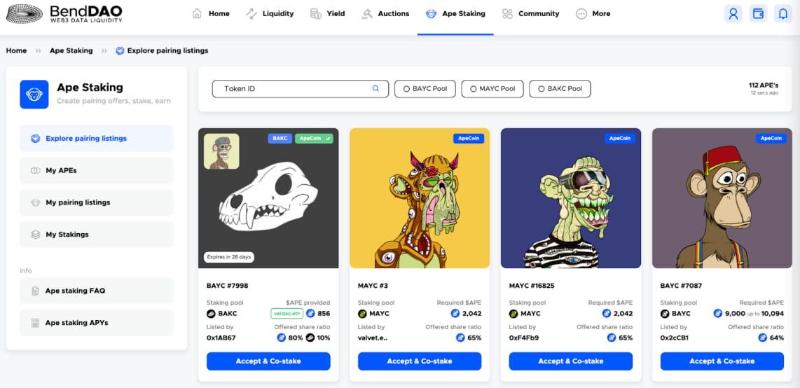
Unlike ParaSpace’s Peer-to-Pool approach, BendDAO employs a more flexible Peer-to-Peer model. When a BAYC or MAYC is deposited into BendDAO’s Ape Staking vault, the NFT holder can freely set two key parameters: 1) the percentage of total APE rewards allocated among the Ape NFT owner, APE token staker, and BAKC partner; and 2) the required amount of APE tokens for pairing.
APE token holders can then choose which Ape NFT to pair with, primarily based on the preset reward distribution ratio.
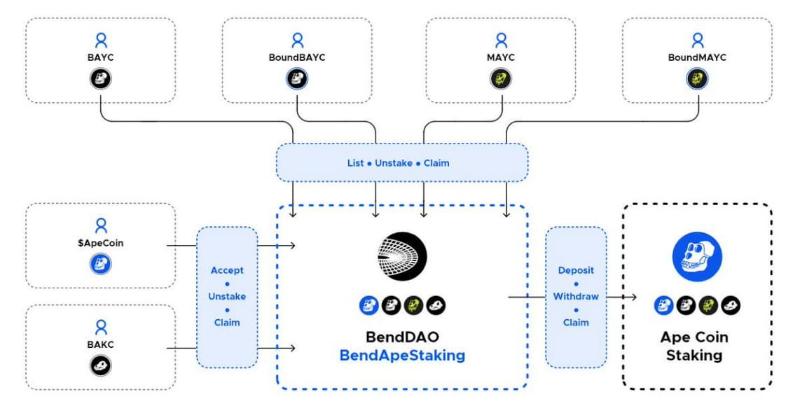
This Peer-to-Peer model maximizes user flexibility but introduces higher matching friction. For instance, if an NFT owner sets a high reward share for APE stakers, pairing may be easier, but their own profit might underperform compared to other platforms. Conversely, a low APE staker reward share could result in no one willing to pair. Consequently, after Ape Staking launches, NFT owners may frequently redeem and reconfigure their reward splits based on competing platforms’ yields, undermining long-term stability for all participants.
Binance NFT
Centralized exchanges have also found their niche in Ape Staking. On December 6, Binance NFT announced it would launch its Ape NFT staking program on December 12.
Among all Ape Staking initiatives, Binance NFT’s rules are the simplest. Users need only stake their BAYC or MAYC NFTs on the Binance NFT platform to receive daily APE token rewards. This provides a centralized staking service where NFT holders earn without worrying about APE token pairing mechanics.
Users can choose flexible or fixed-term staking (30, 60, or 90 days). While the official announcement doesn’t specify yield differences between terms, longer lockups are expected to offer higher APY.

Notably, once staked, withdrawing an Ape NFT takes 48 hours for flexible deposits and up to 7 days for early withdrawal of fixed-term deposits—with a full 7-day forfeiture of staking rewards. Given the high volatility of the NFT market, this redemption process is far from user-friendly. Moreover, unlike ParaSpace and BendDAO, which operate entirely via audited smart contracts (“DeFi-style”), Binance NFT’s centralized model carries counterparty and operational risks. However, NFT holders can verify their BAYC/MAYC staking status on-chain through official channels.
Binance NFT has not yet disclosed its revenue model, expected yields, or how it sources APE tokens for pairing—likely drawing from Binance Earn’s Ape Staking program. The exact cut it takes remains unknown. Therefore, real yield comparisons will only be possible after December 12. That said, estimated returns should exceed those of pure NFT staking on the official platform but fall short of paired NFT + APE staking yields.
Summary
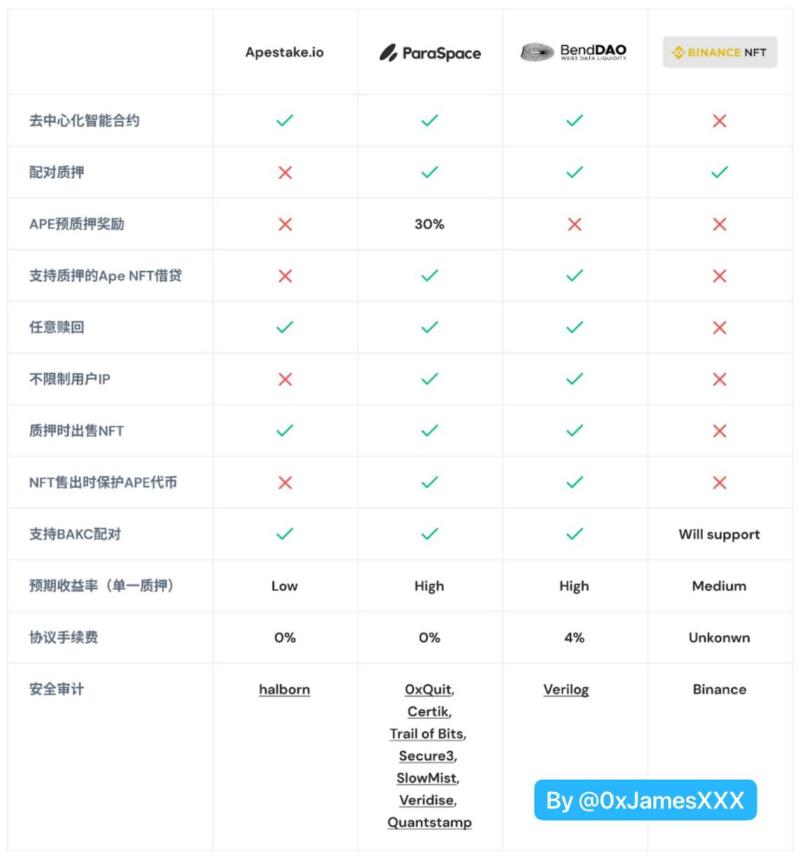
To facilitate direct comparison among the four Ape Staking platforms discussed, I’ve prepared the following reference table:
Despite mixed opinions on Ape Staking’s design within the APE ecosystem, as a DeFi researcher, I am encouraged to see native NFT projects increasingly integrating DeFi mechanisms—such as Art Gobblers recently adopting OlympusDAO’s (3,3) model.
The NFTFi space exemplifies this trend: trading-as-mining platforms like LooksRare and X2Y2 evolved into listing + bid-to-mine models like Blur.io, while lending platforms such as ParaSpace, BendDAO, and JPEG'd use over-collateralized loans as core infrastructure—significantly enhancing liquidity and capital efficiency in the NFT ecosystem.
With continued innovation in tokenomics and NFT-native mechanisms by builders across the ecosystem, we can expect soon to see more compelling PFP collections, RWA investment opportunities anchored in NFTs, and customized financial instruments—solidifying NFTs’ pivotal role in the future of on-chain finance.
Join TechFlow official community to stay tuned
Telegram:https://t.me/TechFlowDaily
X (Twitter):https://x.com/TechFlowPost
X (Twitter) EN:https://x.com/BlockFlow_News