How Far Can Solana Go? Untangling Solana's Ties with FTX
TechFlow Selected TechFlow Selected
How Far Can Solana Go? Untangling Solana's Ties with FTX
The aftermath of the FTX collapse has yet to subside.
 Navigating Web3 tides with focused insights
The aftermath of the FTX collapse has yet to subside. Solana, once hailed as an "Ethereum killer," was dragged into the crisis and pushed to the brink.
While the simultaneous collapse of Terra and LUNA is understandable, what exactly links FTX and Solana—two seemingly independent projects? Why has Solana ended up in such a precarious position? What consequences will the sharp depreciation of SOL bring to Solana? Can this so-called “world’s highest-performance blockchain” survive the storm? As the web3 industry collectively reflects on the FTX incident and draws lessons from it, R3PO examines the situation from Solana's perspective to answer these questions.
Why Solana?
After the FTX collapse, Solana was immediately thrust into the eye of the storm—a connection that traces back to DeFi Summer in 2020. At the time, Solana was relatively unknown, just one among many public blockchains attempting to solve the "impossible trinity." However, SBF (Sam Bankman-Fried), co-founder and CEO of FTX and founder of Alameda Research, took notice of Solana. Beyond participating in multiple funding rounds for Solana, he chose to build Serum—the first decentralized exchange on Solana—on its network. He later invested in numerous Solana-based applications, including offline map Maps.me, institutional broker Oxygen, Bonfida which fully leverages Solana's potential, Raydium with integrated AMM/mining/IDO functions, and others.
This tangible financial backing tightly linked SBF and Solana in the public mind; early on, some even mistakenly believed he was Solana’s founder. The extensive cross-holdings of tokens between FTX, Alameda, and Solana caused SOL to plummet sharply following FTX’s implosion on November 9, halving its price.
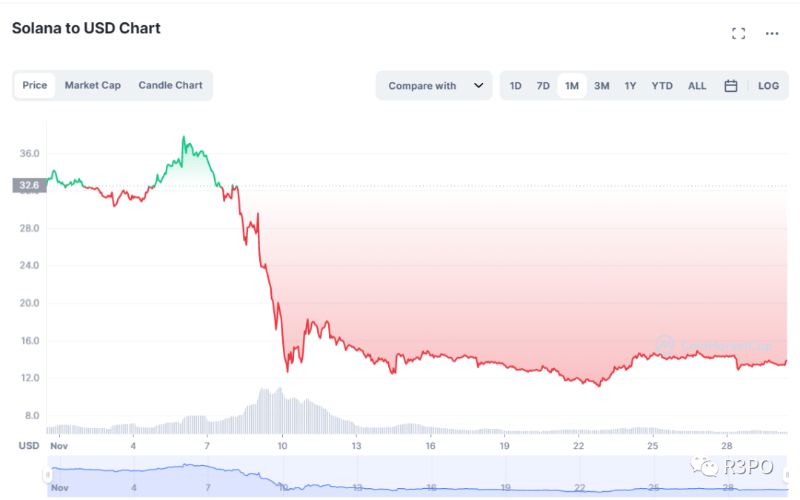
Image: Recent one-month price chart of SOL Source: CoinMarketCap
In many ways, the degree of interpenetration among FTX, Alameda, and Solana closely resembles the symbiotic relationship between Terra and LUNA. Thus, when FTX collapsed, it effectively signaled the downfall of Solana’s key backer, making it natural for attention to turn toward Solana—and inevitable that the domino effect would follow.
Particularly, Serum—one of Solana’s foundational DeFi infrastructures—no longer represented speed and low cost after the FTX collapse but instead became a source of embarrassment and scrutiny, quickly failing and disintegrating.
On November 13, due to concerns that Serum might have been compromised during the FTX hack, Solana developers urgently forked the FTX-developed DEX Serum. The new version, OpenBook, rapidly launched on Solana’s mainnet, achieving daily trading volume exceeding $1 million, while Serum’s trading volume and liquidity dropped nearly to zero.
Amid spreading negative sentiment, capital within Solana’s DeFi ecosystem is drastically shrinking. According to DefiLlama data, Solana’s total value locked (TVL) has plunged to $280 million (as of writing), significantly lower than levels seen during the crypto market downturn in June 2021.
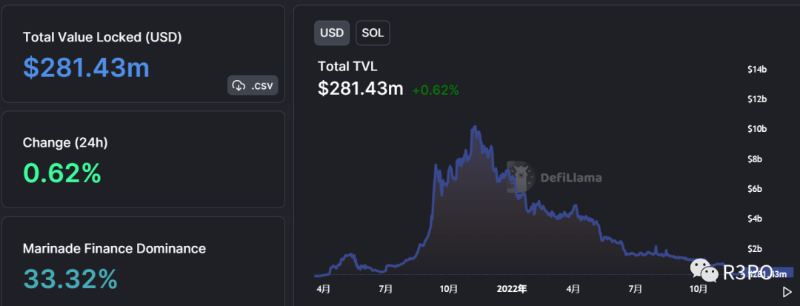
Image: Total Value Locked in Solana DeFi Source: DefiLlama
While the DeFi ecosystem faces emergency conditions, the NFT ecosystem suffers from a sell-off shock. As reported by Forbes, the FTX collapse is devastating Solana’s NFT ecosystem and triggering a wave of selling. Public data shows that NFT trading volumes on Magic Eden, OpenSea, and Solanart—marketplaces on the Solana chain—increased more than threefold from around 80,000 daily a week earlier to over 250,000 at peak, indicating holders are rapidly offloading their NFTs.
Besieged externally by emerging competing blockchains and internally entangled in the massive FTX crisis, does Solana still have a chance to recover?
What is Solana?
To answer these questions, we must first understand what Solana is and where its value lies.
Solana is a public blockchain founded by Anatoly Yakovenko and two former Qualcomm colleagues, Greg Fitzgerald and Stephen Akridge. Their solid technical backgrounds gave investors and the market greater confidence.
Founded as a technical response to the blockchain "impossible trinity," Solana aims to improve scalability using a novel blockchain architecture based on Proof of History (PoH). It positions itself as the world’s fastest high-performance public chain.
According to its whitepaper, PoH encodes trustless passage of time into the ledger—an append-only data structure. When combined with consensus algorithms like Proof of Work (PoW) or Proof of Stake (PoS), PoH reduces message overhead in Byzantine fault-tolerant state machine replication, enabling sub-second finality. Solana also proposes two algorithms leveraging PoH’s timing properties: a PoS algorithm recoverable from partitions of any size and an efficient Proof of Replication (PoRep). Together, PoRep and PoH defend against ledger forgery related to time (ordering) and storage.
Theoretically, Solana can achieve 710,000 TPS on a standard 1Gbps network.
Solana’s eight core innovations make its high performance and low cost possible.
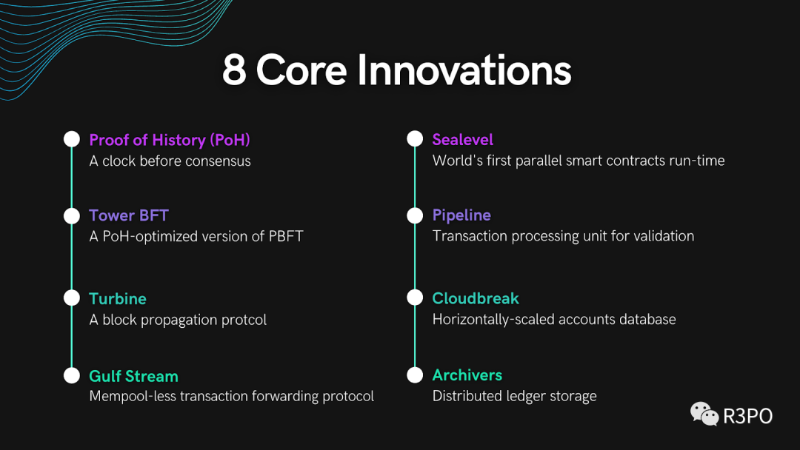
Image: Solana's Eight Core Innovations Source: The Tie
Solana supports smart contracts, dApps, DeFi platforms, and NFT markets built on top of it. To some extent, Solana has fulfilled Anatoly’s vision: creating a high-throughput, low-fee blockchain network capable of hosting numerous applications.
Solana achieves massive scalability without sharding, allowing applications to freely compose across a unified Layer 1 network. In contrast, Ethereum long relied on a resource-intensive PoW governance model before the Merge, becoming increasingly strained. With Wormhole—a cross-chain bridge protocol—Solana offered a low-cost, fast migration path without rewriting contracts, facilitating the transfer of many quality projects and active users to its platform.
Moreover, Solana offers “predictability,” a burden-free programming model: developers know their code will remain functional indefinitely, and future execution costs will be lower than today’s. This gives developers and project teams sufficient confidence to build and maintain projects long-term.
Overall, Solana’s strengths complement Ethereum’s weaknesses well, offering developers and projects an attractive, stable alternative. Based on this, Solana began aggressively building its ecosystem.
As a blockchain infrastructure, Solana gained recognition from many applications.
Take Francium, a project in Solana’s ecosystem, which outlined “Three Reasons to Build DeFi on Solana”:
Advantages in underlying chain capabilities such as low transaction fees, long-term scalability, higher network value, and decentralization;
Stateless transaction execution enabling large-scale parallel programming;
Rapid ecosystem development reaching critical mass, providing a foundation for composable Lego-like building blocks.
Solana didn’t stop there—it established long-term ecosystem grant programs, regularly hosted high-prize hackathons, organized community-building Breakpoint conferences, and partnered with leading industry players to form multiple ecosystem funds and creator funds, providing real financial incentives for project growth. A steady influx of new projects, highly active users and developers, and ample funding support created a thriving ecosystem.
Additionally, Solana issued its native cryptocurrency SOL, which uses a delegated Proof-of-Stake (PoS) consensus mechanism. Validators earn rewards by staking SOL to help secure the network. SOL is used to pay transaction fees, stake, and participate in governance. The tokenomics set an initial inflation rate of 15%, decreasing by 15% each year until stabilizing at a long-term rate of 1%-2%. This design enables rapid early supply growth followed by gradual stabilization.
Where is Solana headed?
The direct impact of the FTX event on Solana appears to have bottomed out. According to Solana’s official website, the network experienced no significant performance or uptime issues during the FTX crisis. Meanwhile, the Solana Foundation clarified recent community panic regarding SOL token unlocking, stating this is a routine occurrence every two to three days—token holders can request unstaking at the end of each epoch. The current large-scale unlock involves approximately 29 million SOL from 250 addresses being unstaked at the end of Epoch 370. Originally, 63 million SOL were expected to be unlocked, but the Solana Foundation delayed the unstaking of its originally planned 28.5 million SOL, which will take effect soon.
Though bad news, another shoe has dropped: according to Sollet interface announcements, soBTC issued on Solana by FTX or Alameda has been confirmed irredeemable. Solana Compass also noted that 48,636,772 SOL tokens previously controlled by Alameda are now held by liquidators and unlikely to be sold for nearly a decade.
Solana Foundation Balance Sheet Exposure to FTX / Alameda
According to Solana’s official site, the Solana Foundation holds about $1 million in cash or cash equivalents on FTX.com, which has suspended withdrawals. This represents less than 1% of the Foundation’s total cash or equivalents, so operational impact is negligible.
The Solana Foundation does not hold any SOL on FTX.com
Solana Foundation Asset Exposure to FTX/Alameda
According to Solana’s official site, assets held in its FTX.com account (as of November 6, when FTX.com stopped processing withdrawals) include: approximately 3.24 million shares of FTX Trading LTD common stock, about 3.43 million FTT tokens, and roughly 134.54 million SRM tokens, with risk exposure of $75.46 million and $107.6 million respectively for the latter two.
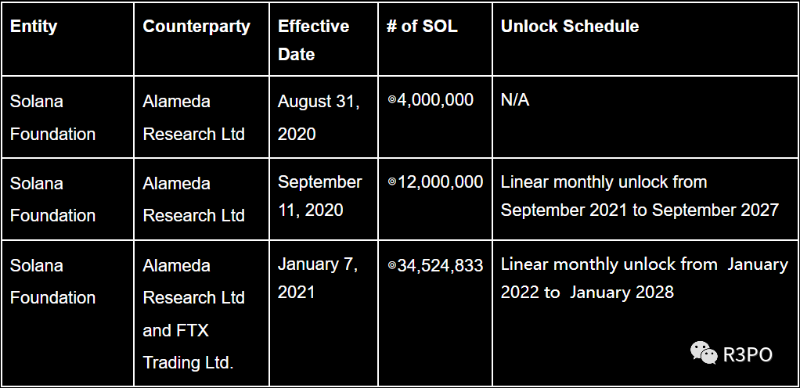
Image: Summary of Solana Foundation’s SOL sales to FTX / Alameda
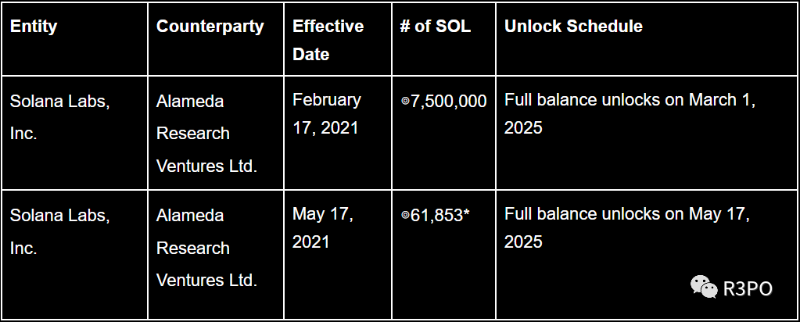
Image: Summary of SOL sales by SolanaLabs, Inc to FTX / Alameda
According to Solana’s official site, regarding wrapped assets on Solana affected by the Sollet custodial bridge, the total exposure value of Sollet-based assets in circulation on Solana is approximately $40 million, though the status of the underlying assets remains unknown.
Although exposures are now clear, the ripple effects of the FTX incident are not over, and SOL prices have not yet bottomed out. Especially for Solana, even without the FTX crisis, it already faced numerous challenges: fierce competition in the blockchain infrastructure space, late market entry, lack of substantial commercial content and clear functionality, heavy VC allocation, frequent network outages (three since March 2022), extremely low fees leading to unsustainable operations, and a narrow target audience. The FTX storm swept away not only capital but also opportunities and confidence. Time is running short for Solana. Strengthening its fragile foundation is now its most urgent priority. Optimistically speaking, within the broader blockchain infrastructure landscape, no product has yet emerged to fully replace Solana’s role and function in the market. Aptos, despite high expectations, underperformed after mainnet launch and failed to pick up the baton. Solana still has a slim chance.
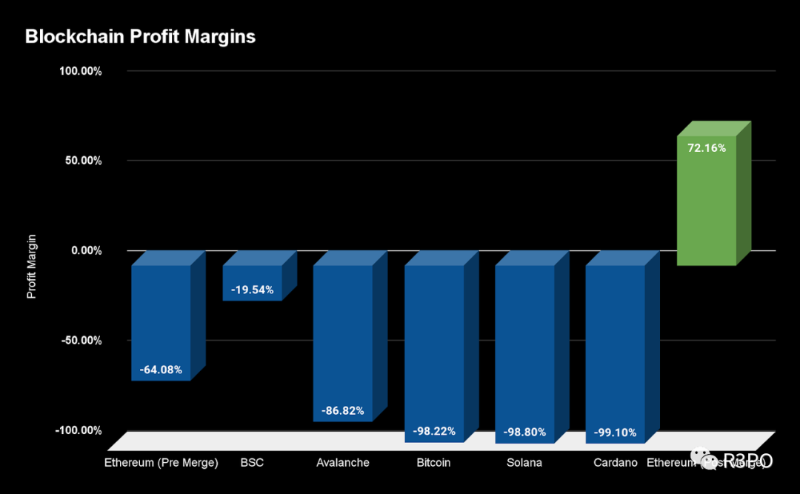
Image: Profitability of major blockchains Source: Bankless
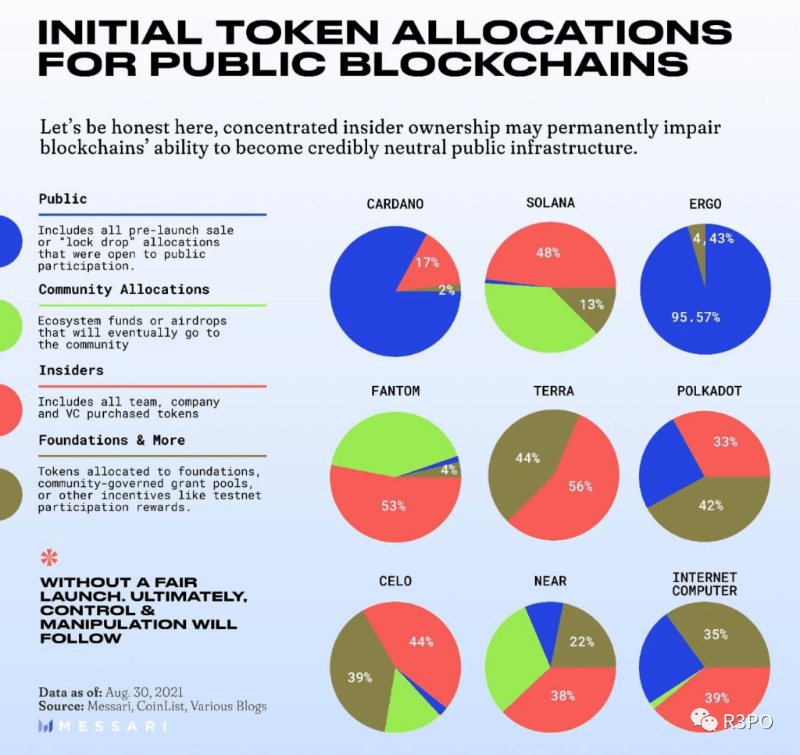
Image: Initial token distribution across major blockchains Source: Messari
Discussions about Solana on social platforms are rampant, but a general consensus seems to be forming: Solana’s future lies in its ecosystem (if it has one). Fortunately, this belief isn’t confined to Solana insiders or SOL holders—it resonates with many project teams and developers within the Solana ecosystem. For NFT projects in particular, Solana ranks second only to Ethereum as the largest blockchain, with sales exceeding $1.7 million—more than eight times that of third-place Cardano. Solana provides globally accessible tools catering to developers of all scales, serving as both a minimalist and comprehensive infrastructure platform, with all tools open-source and free. Participants can freely create NFT art and build communities. If Solana were to fall, it would be a loss NFT developers would deeply regret.
Some technical data also suggest Solana remains on a development trajectory. Maximum transactions per second (TPS) have steadily increased since the beginning of the year, quickly recovering its upward trend despite short-term impacts from the FTX incident.
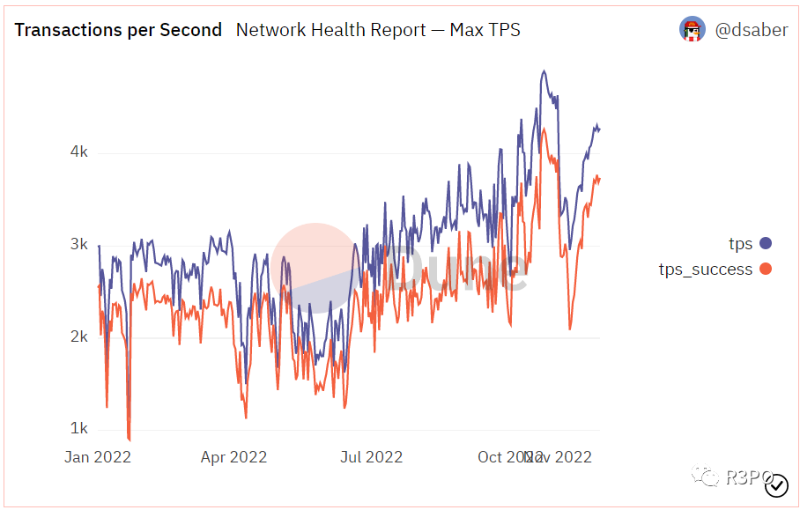
Image: Solana TPS from January 2022 to Present Source: Dune@Dsaber
In its October report, Solana introduced technical changes addressing existing issues, aiming to improve network stability, increase revenue without raising fees, and expand its user base:
Implementing QUIC on Mainnet Beta:
QUIC is a protocol developed by Google designed for fast asynchronous communication. It improves upon Solana’s previous UDP-based protocol used to transmit transactions between RPC nodes and the current block leader. UDP lacks flow control and acknowledgment mechanisms, making it ineffective at preventing abuse. To address this, Solana is reimplementing its transaction ingestion protocol atop QUIC, which enables session and traffic control. QUIC currently runs on testnet and mainnet beta, though UDP remains supported. QUIC is planned to become the default transaction ingestion and forwarding protocol on mainnet beta. Once adopted, it will offer more options for optimizing data ingestion and blocking abusive behavior.
Increased Transaction Size:
Currently, transactions on the Solana network are capped at 1,232 bytes. This limit restricts composability between programs. With QUIC implementation, increasing transaction size becomes feasible.
Stake-weighted Quality-of-Service (QoS):
Built in parallel with QUIC and enabled before full QUIC adoption on mainnet beta. Currently, block producers accept transactions regardless of origin. As a proof-of-stake network, stake-weighted QoS extends stake-based utility to transaction quality. Under this model, a node holding 0.5% of stake would have the right to transmit at least 0.5% of packets to leaders. Regardless of traffic from non-staked nodes, transactions submitted by validators who hold stake will always be accepted by block producers.
Fee Market:
The fee market has been partially introduced and is expected to be further implemented after full QUIC adoption. The first phase supports priority fees. Previously, the network processed transactions on a first-come, first-served basis, giving users no way to signal transaction urgency. Priority fees change this by allowing users to voluntarily pay extra fees to expedite execution and inclusion in blocks. Priority fees are calculated based on estimated computational resources required. For example, a simple token transfer incurs lower total priority fees than an NFT mint expressing the same urgency. Since July 2022, priority fees have operated on mainnet beta. Future versions will add more features, including new RPC methods to help users and apps determine the minimum additional fee likely needed for next-block inclusion, higher fees for contested accounts, and improved block scheduling. These pending upgrades aim to create a more efficient fee market for all Solana participants.
From an ecosystem standpoint, over 500 projects have been built on Solana, forming an ecosystem spanning eight major categories: DeFi, NFTs, gaming, tools, wallets, dApps, and developer resources, covering subfields like DEXs, derivatives, trading analytics and visualization, lending, synthetic assets, and stablecoins. Supported by these vast niche markets, Solana still retains the ambition to become Web3’s most important infrastructure.
Solana also revealed that its mobile initiative is progressing: the first-generation Saga developer kit will ship in December, the SolanaMobile dApp Store will launch in January 2023, and consumer devices will hit the market in early 2023. Challenging Ethereum and Apple alike, Solana appears confident about its future.
Conclusion
Solana rose with SBF—and fell hard because of him. R3PO believes that throughout, Solana itself did not experience serious internal failures. When it encountered SBF, it earned his full backing through its own merits. SBF’s downfall may, ironically, offer Solana a chance to prove itself anew.
Within the public chain race, Solana’s unique features, advantages, and utility remain unmatched—for now. But opportunity windows are fleeting. Whether Solana can seize this moment and succeed remains to be seen. R3PO believes Solana’s immediate priority should be strengthening its fundamentals—resolving downtime and profitability issues—rather than rushing ahead prematurely. After all, in winter, tender shoots face not only sunlight—but also frost.
Join TechFlow official community to stay tuned
Telegram:https://t.me/TechFlowDaily
X (Twitter):https://x.com/TechFlowPost
X (Twitter) EN:https://x.com/BlockFlow_News