








Can Big Time's innovative blend of Web2 mechanics and its newly unveiled economic model lead the way for 3A blockchain games?
TechFlow Selected TechFlow Selected
Can Big Time's innovative blend of Web2 mechanics and its newly unveiled economic model lead the way for 3A blockchain games?
Unveiling the 3A blockchain games' performance during the bear market!
 Navigating Web3 tides with focused insights
W Labs Editor's Note: Among last year’s most anticipated 3A games, Bigtime is likely the only blockchain game that has delivered partial progress this year—respect for that! Yesterday, Bigtime updated its economic model, finally introducing the TIME token into what was previously a simple NFT-based system. The new model brings innovation in how in-game items, NFTs, and tokens are layered together. Let K Boss (Twitter: @LuxuryWzj) break it down for everyone!
As an action-combat, NFT-collecting, multiplayer co-op RPG adventure spanning history, Bigtime has consistently emphasized the principle of fairness. Even this latest economic model is built upon that foundation. The game positions cosmetics (akin to non-stat-affecting skins in traditional competitive games) as the cornerstone of the entire Bigtime economy. Through multiple scenarios such as personal Spaces, utility NFTs, and the open world; multiple resources including Time Crystals, TIME tokens, and cosmetic fragments; and multiple game modes like gear crafting, Hourglass creation, and combat farming, the design aims to enable diverse player roles and specializations, ultimately forming a self-sustaining in-game ecosystem.
1. Scenarios
In addition to the main open-world map where players live and play, the most important scenario is Space (the first-generation NFT traded by players, aside from PASS cards).
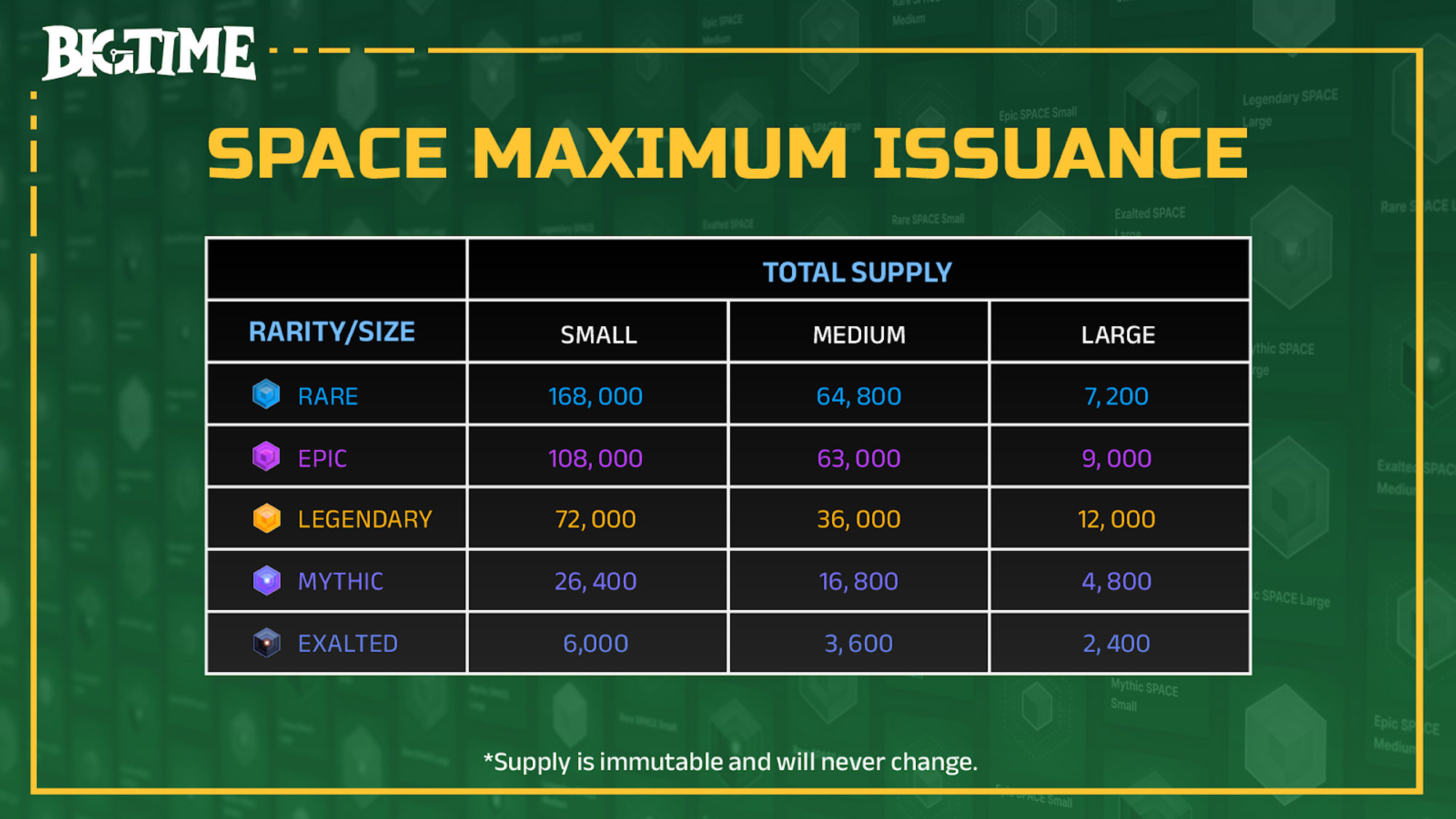
SPACE Maximum Supply (by Rarity and Size)
Beyond basic functions such as storage, decoration, and tradability, the most interesting aspect of Space is its entrance-exit connection mechanism. Each Space has one entrance and multiple exits. Connections between Spaces can only be made by linking an exit from one Space to the entrance of another (the same applies to utility NFTs). SPACE comes in various rarities and sizes—larger and rarer Spaces allow players to connect more utility NFTs, place more decorative collectibles, and host more friends within their Space.
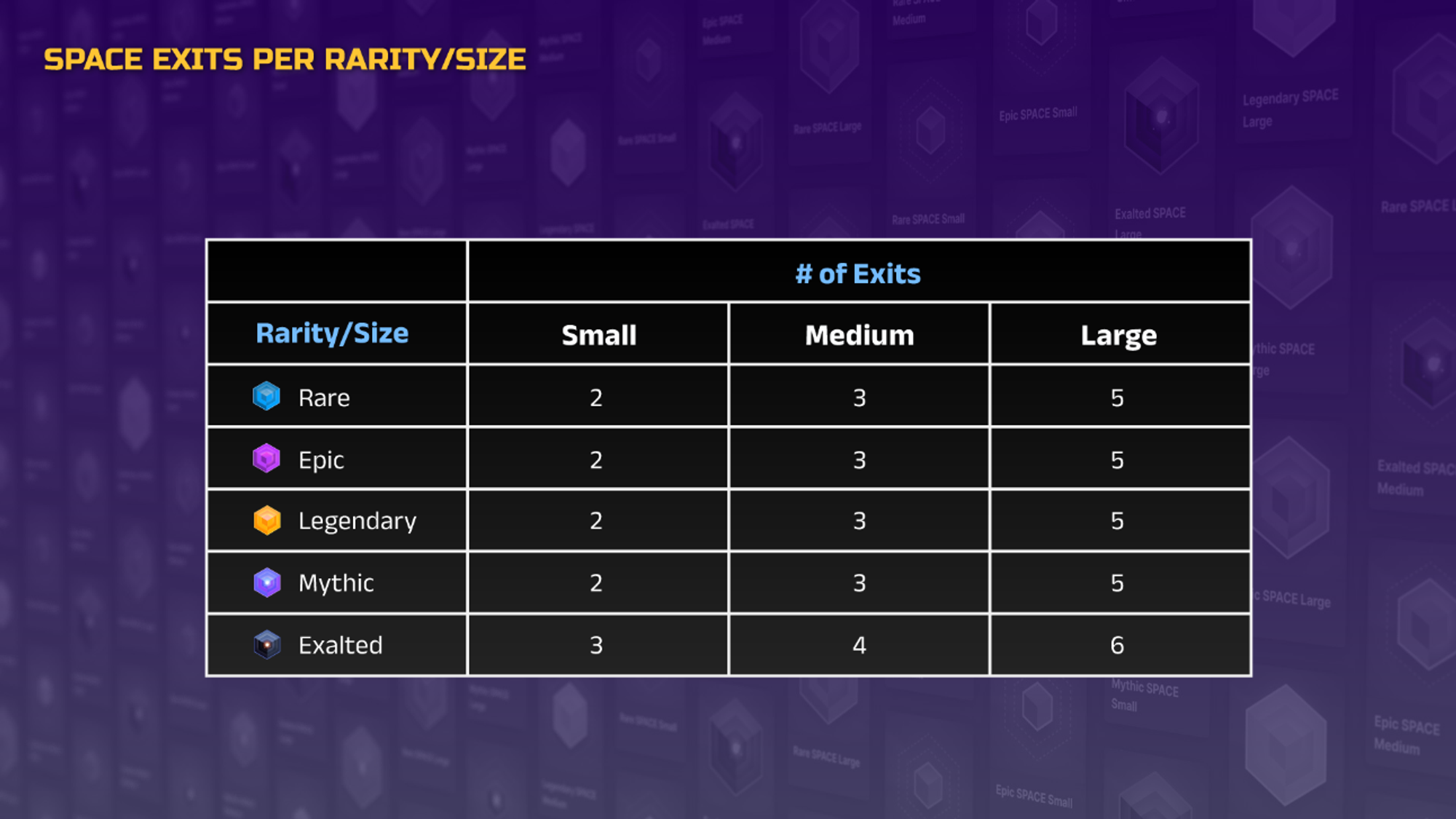
Number of Exits by Space Rarity and Size
PS:
1. Both utility NFTs and cosmetics have rarity tiers, meaning high-rarity utility NFTs and cosmetics can only be connected or placed in high-rarity Spaces.
2. Utility NFTs include: Time Wardens, Forges, Armories.
3. Higher-rarity Spaces have a higher chance of dropping broken hourglasses (one-time use).
4. Spaces will also have unique traits revealed only after irreversible unsealing (similar to mystery hotel rooms).
5. Both Spaces and utility NFTs support rental systems.
2. Resources
Currently, BigTime’s economy revolves around three primary resources: Time Crystals, TIME token, and Cosmetic Fragments.
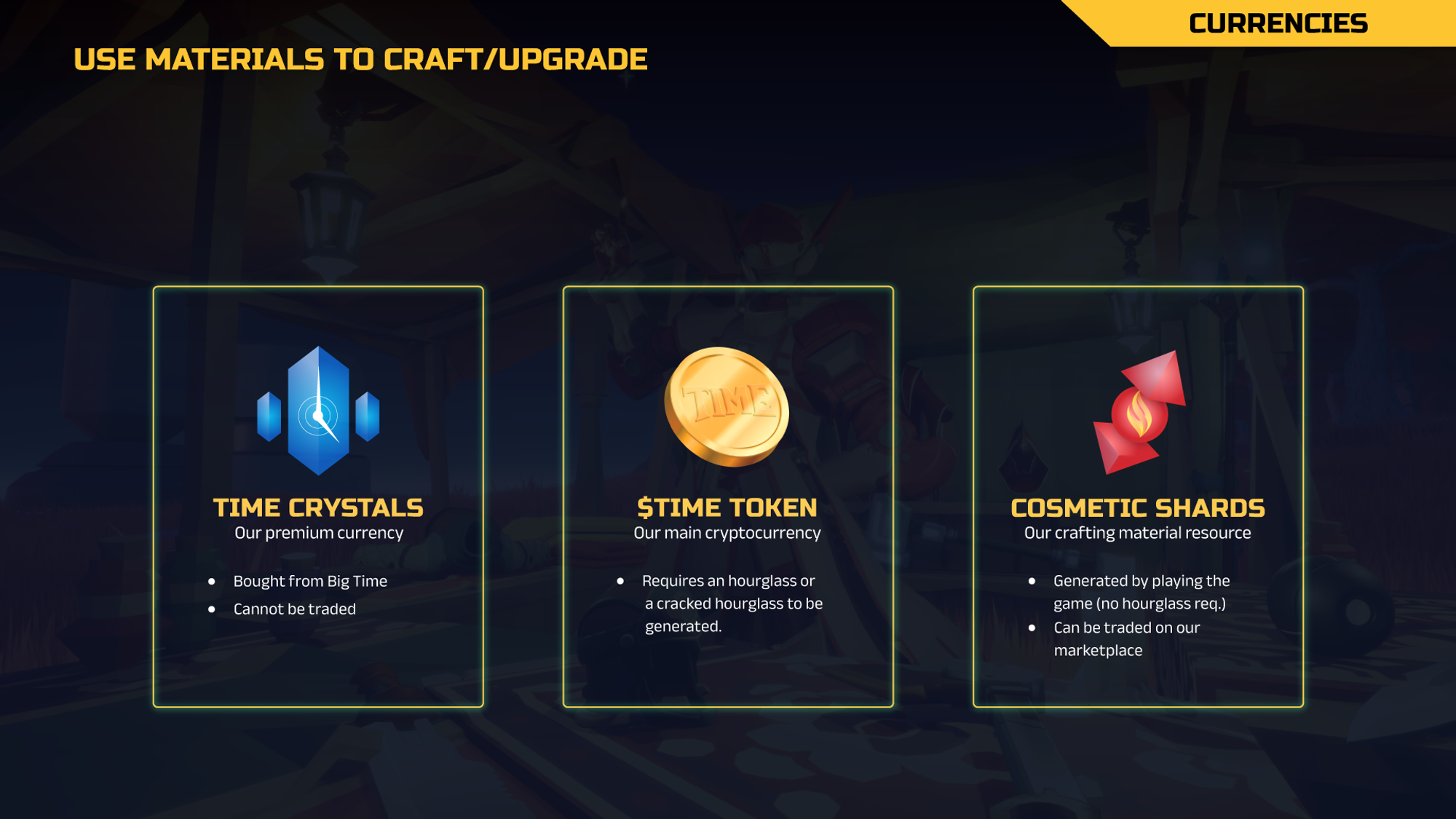
Time Crystals are a non-cryptocurrency premium currency in Big Time, obtainable either through low-probability in-game drops or direct purchase from Bigtime. Bound to accounts, they cannot be traded (similar to bound元宝 in Web2 games).
Time Crystals are required for core gold-farming activities such as upgrading utility NFTs, crafting/upgrading/charging Hourglasses, expanding equipment slots, and purchasing access tickets to special zones. Given their scarcity and non-transferable nature, this setup appears to be deliberately pay-to-win oriented.
TIME Token is the primary cryptocurrency driving the Big Time economy. With a maximum supply of 100 billion tokens, it is primarily earned in-game (requiring Hourglasses) and cannot be traded within the game.
The TIME token is used for upgrading utility NFTs, crafting/accelerating/evolving cosmetics, and purchasing special zone access. Unlike many in-game tokens, TIME in BigTime serves more as a soft link to NFTs, primarily catering to crafters and cosmetic-focused players.
Cosmetic Fragments are in-game materials categorized by function and seasonality. All players can obtain them through combat (no Hourglass required). Their main purpose is to combine into Premium Cosmetic Fragments, which are then used to craft seasonal cosmetics.
Combining wild fragments with corresponding cosmetic fragments to create premium ones adds a layer to user progression. Seasonal categorization further enhances resource and cosmetic circulation while significantly reducing the actual流通 volume of materials in the game.
3. Modes
The overarching framework of BigTime’s economic ecosystem can be simply summarized as follows:
Players who own Time Warden NFTs craft Hourglasses; players equip Hourglasses to farm TIME tokens; players use Cosmetic Fragments + TIME to craft cosmetics; other players purchase these cosmetics on the marketplace—forming a closed loop.
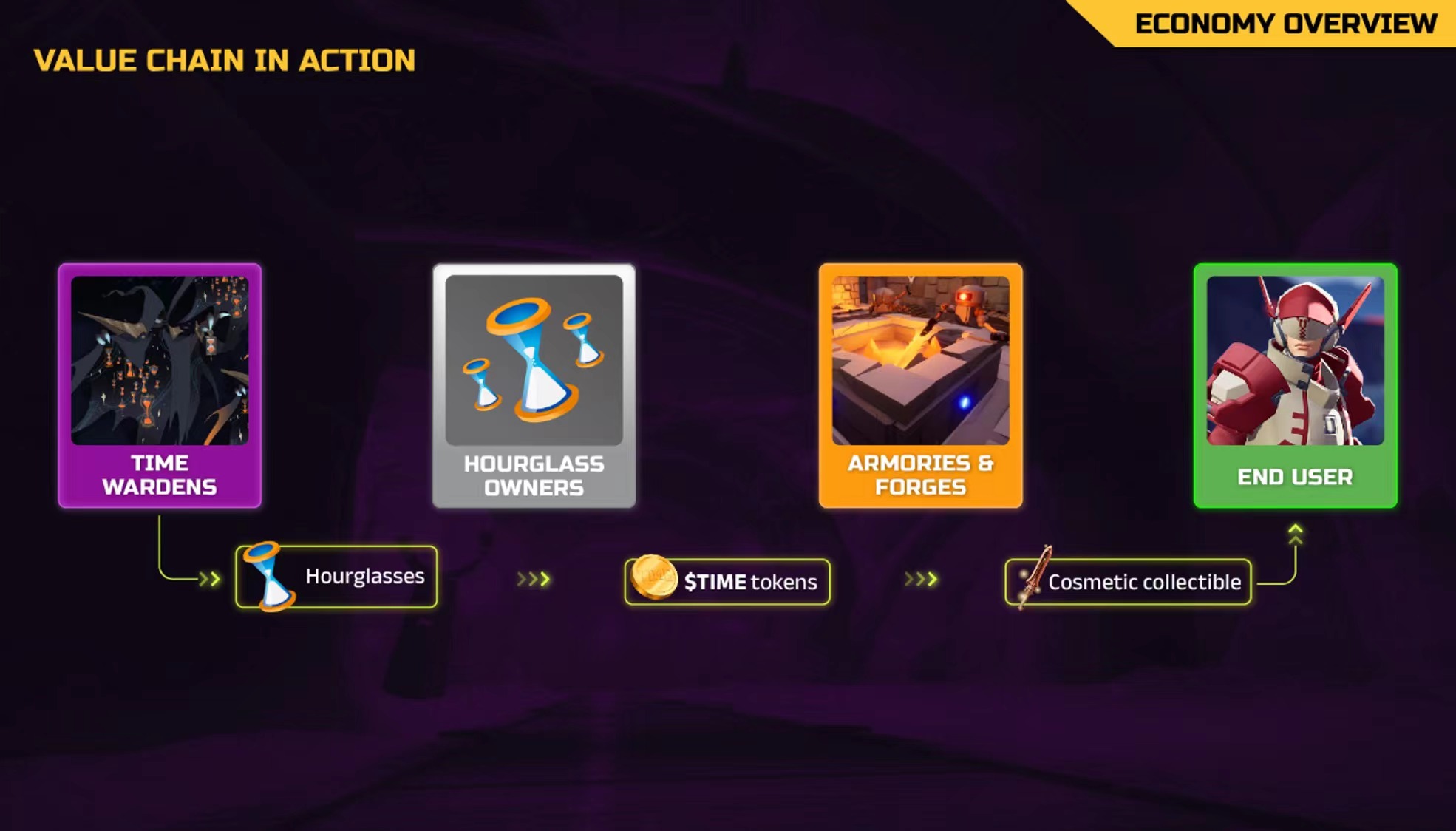
Key points summarized:
1. Hourglasses are essential for earning TIME tokens in-game. Each player can equip up to five simultaneously. Hourglasses range from Common to Peerless across ten tiers, affecting yield efficiency (with limited quantities per tier).
2. High-rarity Spaces have a chance to drop broken hourglasses (single-use). Otherwise, all Hourglass-related actions—crafting, charging, etc.—require Time Crystals.
3. Both cosmetics and Hourglasses can be upgraded in rarity using tokens + materials via a three-in-one fusion mechanic. Whether forging, fusing, or charging, there is always a waiting period involved (TIME tokens can accelerate the process).
4. Some cosmetics may drop in-game but cannot be crafted.
5. BigTime releases content in seasonal cycles (~90 days each), introducing new cosmetics, materials, content, and events each season (encouraging continuous engagement).
4. Summary
BigTime’s economic system breaks away from the typical Web3 pure-play gold-farming model, incorporating more traditional Web2 game design principles. At first glance, it appears full of亮点—with considerations for token sell pressure, circular economies, and phased pacing. It allows players to take on varied roles beyond just “gold farmers,” fostering distinct player archetypes: free explorers, material grinders, time-pressed farmers, pay-to-win cosmetic collectors, and so on.
However, upon closer inspection, there remains essentially only one viable path forward—the burden and focus still heavily rest on cosmetic collectors. A sustainable large-scale economy cannot rely solely on appearance-driven players (even with various mechanisms reducing liquidity). Thus, judging from community data, the official team offers additional incentives to cosmetic holders, such as high rewards for top-tier seasonal players, exclusive dungeons, and airdrops.
From an individual player’s perspective, this model is not particularly friendly to gold farmers. Mandatory barriers like Hourglasses, the token-to-NFT trading mechanism, and low liquidity caused by synthesis and seasonal mechanics all increase the risks for farming-focused players.
Upcoming mystery box sales and the continuous future sale of Time Crystals will ensure the project maintains sufficient funding. Let’s see if more incentives will be returned to players down the line~
(Don’t just feed yourself—remember the long-term players; PASS card holders are already crying…)
PS:
1. For details on utility NFT mystery box sales and veteran player airdrops, please check the official website or community channels.
2. This analysis is based solely on the latest official economic model documents. For questions about relationships between legacy gear systems and the new cosmetic system, please consult official community sources.
3. There are additional minor mechanics in-game, such as Bonus Roll—refer to the whitepaper or official videos for deeper exploration.
Reposting is welcome. Original work is hard—please credit "W Labs" as the source.
W Labs Website: http://www.wlabsdao.com/
W Labs Discord: https://discord.gg/wggdao
W Labs Twitter: https://twitter.com/GuaTianGuaTian
W Labs In-depth Research Articles on Mirror: https://mirror.xyz/iamwgg.eth
W Labs on Medium: https://guatianwgg.medium.com/
Join TechFlow official community to stay tuned
Telegram:https://t.me/TechFlowDaily
X (Twitter):https://x.com/TechFlowPost
X (Twitter) EN:https://x.com/BlockFlow_News
 瓜田实验室W Labs


