A tailor-made EUTXO model—ushering in Cardano's DApp ecosystem layout?
TechFlow Selected TechFlow Selected
A tailor-made EUTXO model—ushering in Cardano's DApp ecosystem layout?
Tailored EUTXO Model: Is Cardano's DApp Ecosystem Taking Center Stage?
 Navigating Web3 tides with focused insights
Comparison of UTXO and Account Models
In the UTXO model, movement of assets is recorded as a directed acyclic graph composed of transaction outputs, with new outputs added by each additional block.
In contrast, in the account model, balances are stored as global state of accounts, maintained and updated in real time by every node with each new block—similar to a database, where accounts hold information such as balance, contracts, and nonce. This leads to the core bottleneck—the state explosion problem:
The total size of Bitcoin’s entire history (the sum of all blocks) grew to 229GB over ten years, while Ethereum’s network grew to 262GB (Geth) / 180GB in just four years. Thus, larger transaction volumes under the account model place heavier burdens on users and wallets.
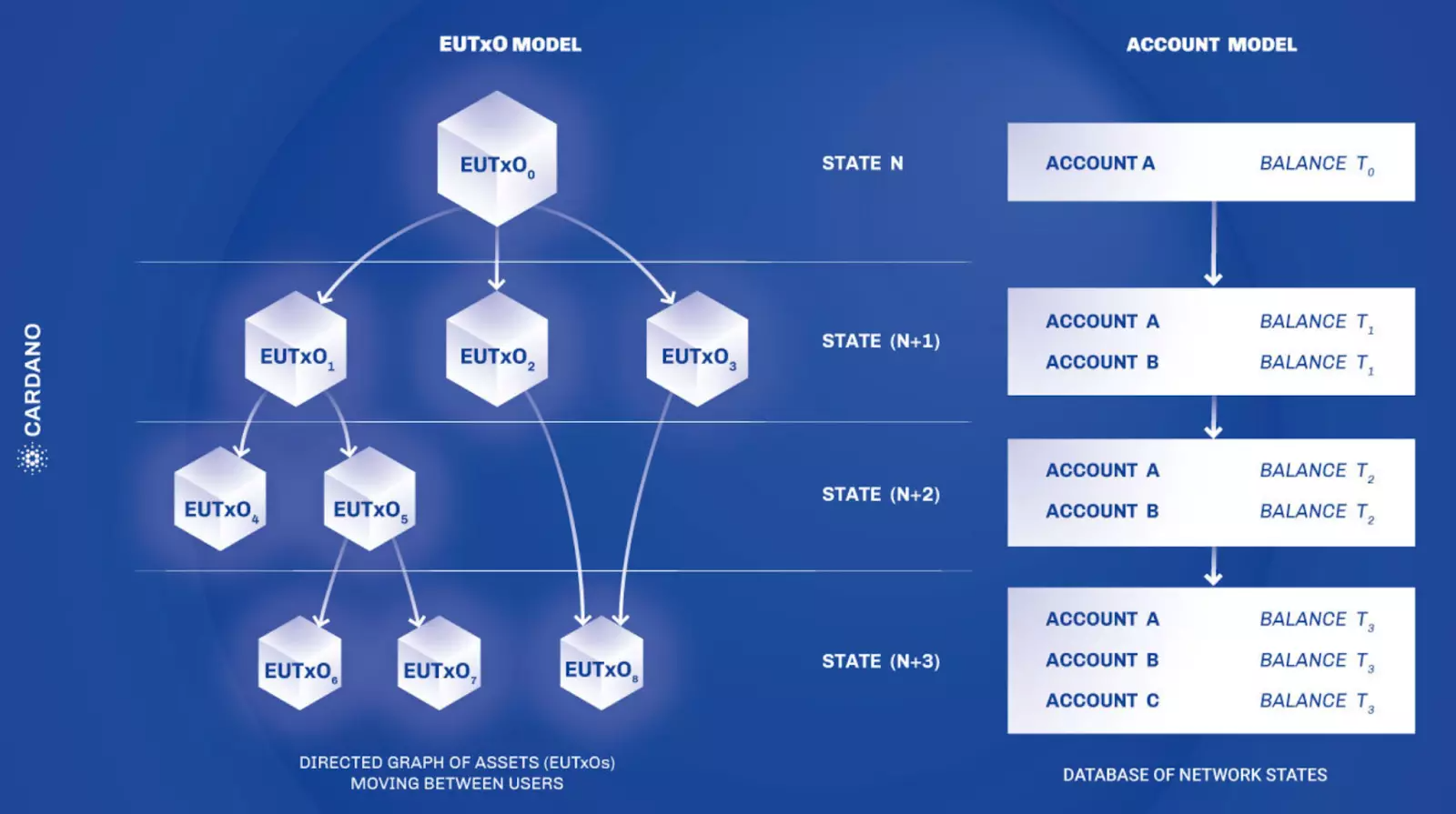
In short, the UTXO model offers storage advantages due to smaller state and transaction sizes, while the account model is more efficient for scaling solutions (such as state and payment channels) and sharding.
To illustrate simply, it's like building high-rises:
- The advantage of UTXO lies in minimizing cost and materials while ensuring security—whereas an account model might only afford one floor at the same cost, UTXO could build three floors with equivalent resources. However, once built, optimization space is limited, making future renovations or expansions difficult;
- The account model reserves ample room for future expansion. Even if starting as a minimalist dormitory, continuous upgrades can eventually transform it into a luxury apartment. But this comes at high cost and immense resource consumption.
Each has its strengths—can we combine their advantages?
EUTXO: Combining Strengths
From this perspective, Cardano’s EUTXO (Extended UTXO) inherits Bitcoin’s low-resource-consumption UTXO model at the consensus layer, while incorporating improvements inspired by Ethereum’s design for smart contract implementation needs.
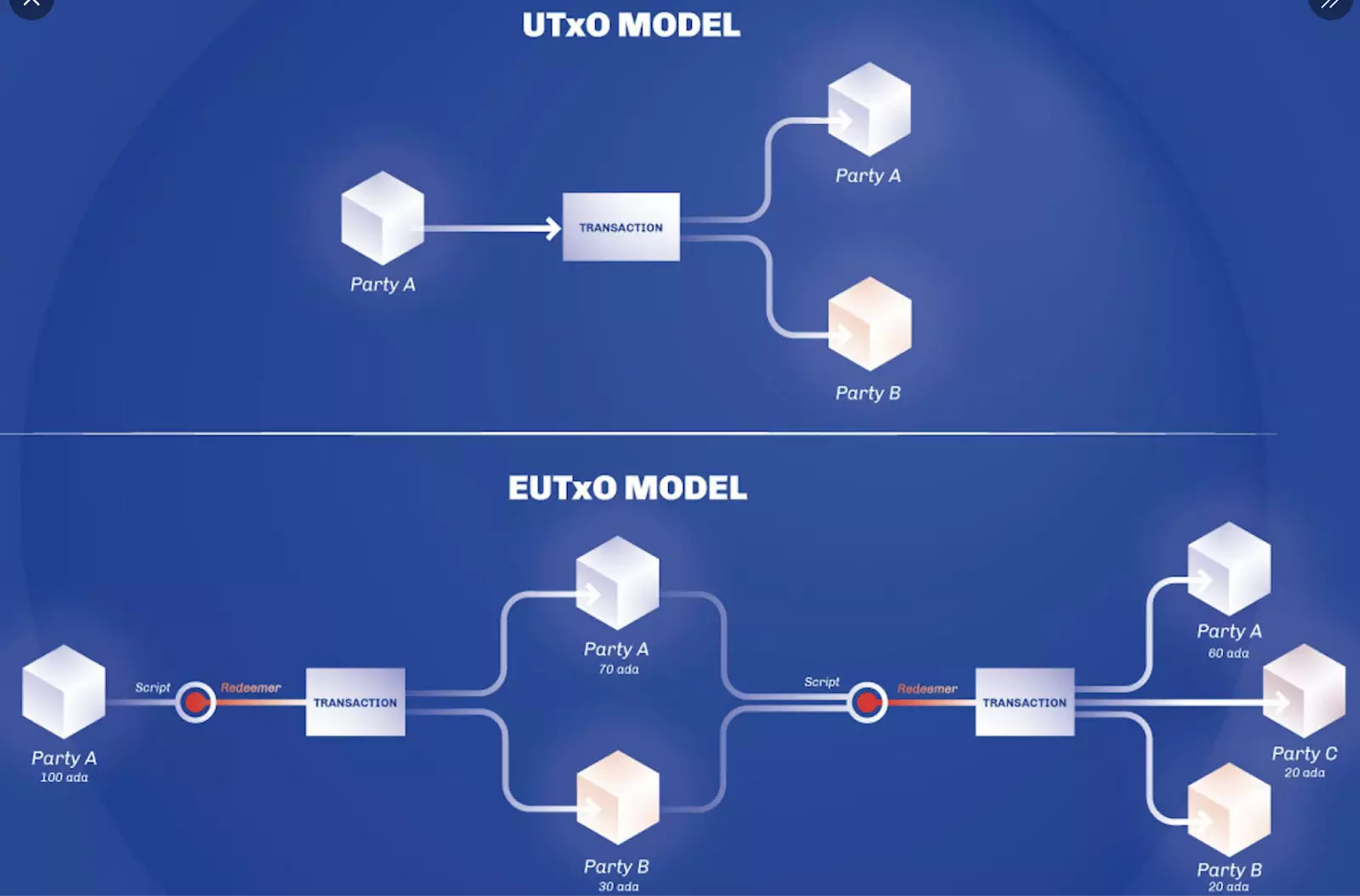
Put simply, EUTXO integrates and further enhances Bitcoin’s security with Ethereum’s programmability, making the model significantly superior to account models used by other blockchains. It ensures several key features:
- Enhanced security: Each transaction uses a different address, preventing others from tracking addresses or determining a user’s total balance;
- Scalability: The UTXO ledger enables parallel transactions, greatly reducing on-chain congestion;
- Interoperability: With off-chain and sidechain protocols, EUTXO makes it easier for Cardano to establish interoperability across different blockchains;
Within Cardano, EUTXO retains the security and simplicity of UTXO while improving interoperability and scalability through optimized adjustments借鉴from the account model, maximizing throughput and overcoming performance bottlenecks for future commercial applications.
Most directly, developers previously working on Ethereum and other EVM-compatible chains can leverage EUTXO’s interoperability, avoiding re-education costs and quickly gaining traction, enabling rapid project migration.
Developer-Friendly Plutus Architecture
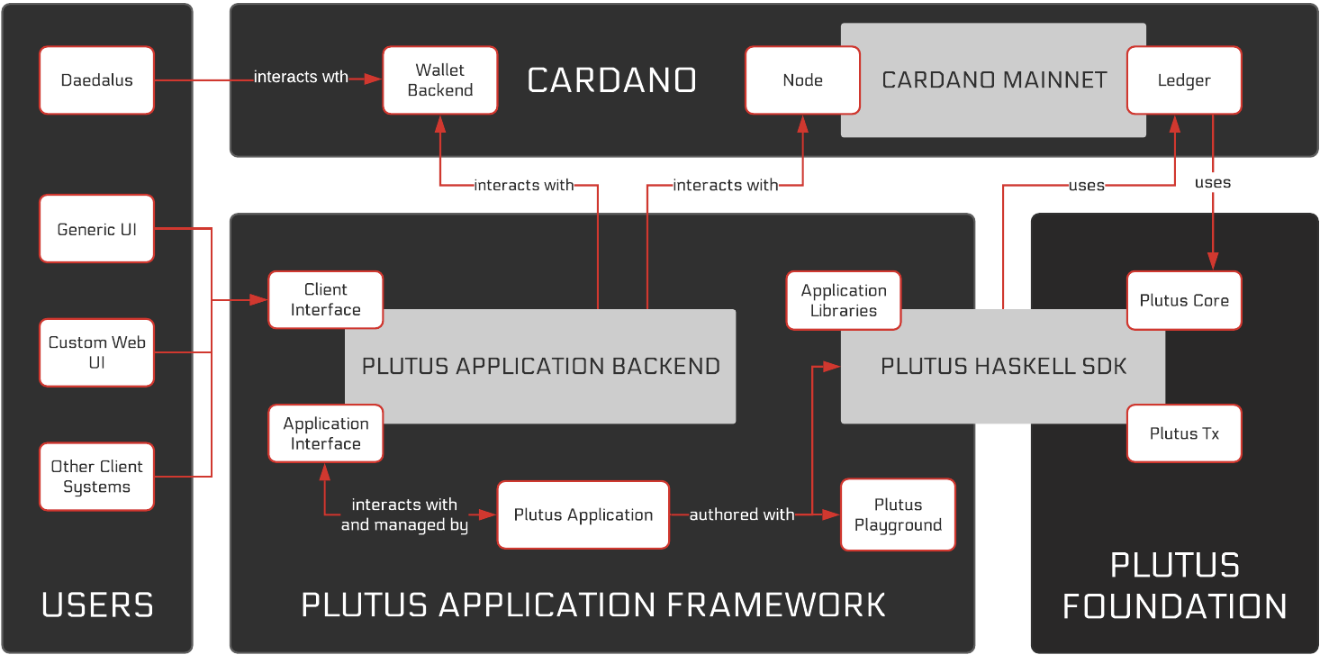
- Functional languages like Haskell are more compatible with EUTXO;
- Object-oriented programming languages like Solidity are better suited for account models;
As the underlying customized language for Cardano’s smart contract platform Plutus, Haskell is essentially purpose-built for DApps, centered around the keywords “lightweight” and “security”:
- Haskell’s predictability makes bugs in smart contracts much easier to identify. In contrast, Solidity requires deep expertise—for example, understanding issues like reentrancy attacks;
- After compiling Haskell into Plutus, functions return only two outputs: True/False. This means no unpredictable state changes—outputs depend entirely on inputs, producing identical results regardless of how many times a function is called. These functions are also typically easier to debug, as there's no need to track variable states;
From this angle, Haskell may well represent the next opportunity developers should focus on, providing them with effective tools (see Adaverse’s NFT marketplace DEMO code repository for reference).
This allows any visionary entrepreneur or developer to unleash their creativity, using powerful yet relatively secure and lightweight editors to build their own DApp world like assembling LEGO bricks.
The Myth of New Public Chains
The industry’s dramatic evolution—feeling like decades compressed into days—has prompted renewed reflection on the myth of new public chains. Once-prominent "Ethereum killers" like Solana have fallen from grace, and their once-massive ecosystems crumbled overnight amid collapsing confidence and vanishing market caps.
After the fading of excitement around new public chains, only Bitcoin and Ethereum appear more resilient and worthy of attention.
Yet, despite the solid dominance of Bitcoin and Ethereum, it remains extremely difficult for developers or projects—especially startups—to break through in already saturated markets.
People often ignore the elephant in the room—established public chain projects like Cardano that have weathered multiple crypto bull and bear cycles, maintaining stable valuations and communities tested by time and market forces.
All past events are merely prologue. We saw major "public chain booms" in 2018 and 2021, but very few ultimately succeeded—the industry delivers the most fitting verdict.
Cardano is often the overlooked "elephant in the room." For instance, few noticed the significance of the successful activation of Cardano’s Vasil hard fork upgrade on September 22, marking its entry into the smart contract era. Smart investors remain highly alert to such hidden opportunities.
However, competition among public chains is always fierce. Cardano, having just entered the smart contract era, is still in its early stages. As more DApps launch on Cardano, richness and liquidity within its ecosystem are expected to grow substantially.
As Cardano advances deeper into the smart contract era, riding this visible macro trend, Adaverse—the global incubation investment fund for Cardano backed by the official team—focuses on incubating and investing across Cardano’s full ecosystem, bringing more developers into the Web3 space and helping build a broad Web3 DApp ecosystem based on Cardano’s blockchain infrastructure.
Meanwhile, Ken Kodama, CEO of EMURGO—one of Cardano’s commercial incubators and venture capital arms—announced that Emurgo will invest over $200 million to support Cardano’s ecosystem growth over the next three years. The funding, drawn from Emurgo’s own capital, will directly support projects on Cardano and on other networks whose products integrate with the Cardano network.
Winds begin at the tips of blades of grass. If before 2022 Cardano was seen merely as an established public chain, post-2022—with its positioning as a "smart contract public chain"—it presents both significant challenges and vast imaginative potential. What kind of breakthroughs it will achieve in this direction remains to be seen.
About Adaverse
- Official Homepage: adaverse.co
- Twitter: @Adaverse_Acc
- Facebook: Adaverse Accelerator
- Instagram: @adaverse_acc
- Medium: Adaverse Accelerator ; Adaverse Asia
- LinkedIn: @Adaverse
- Telegram: @Adaverse Founders Group
Join TechFlow official community to stay tuned
Telegram:https://t.me/TechFlowDaily
X (Twitter):https://x.com/TechFlowPost
X (Twitter) EN:https://x.com/BlockFlow_News