GenesysGo: A Low-Key but Important Infrastructure Provider in the Solana Ecosystem
TechFlow Selected TechFlow Selected
GenesysGo: A Low-Key but Important Infrastructure Provider in the Solana Ecosystem
As long as the revenue generated from providing computation for Shadow RPC, Shadow Cloud, and Shadow Drive exceeds the cost of operating a Shadow Operator, we can expect to see continued interest in Shadow Operators.
 Navigating Web3 tides with focused insights
Original Title: "GenesysGo: the crucial infra provider on Solana you don't know about"
Authors: Allen Zhao, Mustafa Yilham, Henry Ang & Jermaine Wong, Bixin Ventures
Translated by: Evan Gu, Wayne Zhang, Bixin Ventures
Introduction
GenesysGo is a blockchain infrastructure provider on the Solana network.
It operates three core businesses:
Shadow Operators, the RPC (Remote Procedure Call) layer
Shadow Drive, a decentralized data storage layer
Shadow Cloud, a decentralized cloud computing platform
In this research report, we will first introduce these business segments, then dive into the tokenomics and analyze the fair value of the $SHDW token.
Shadow Operators
Remote Procedure Call (RPC) nodes act as traffic controllers, enabling DApps to communicate effectively with their underlying blockchain. RPC nodes on Solana handle the same traffic as validators and provide additional bandwidth required for serving data queries. In practice, these RPC nodes are often overloaded, leading to poor user experiences—especially when using DApps that rely on free RPC services.
Recent reports that Infura and Alchemy restricted access to data from the Tornado Cash smart contract have further highlighted the urgent need for a fully decentralized RPC layer. As of today, Pocket Network and Ankr are the only two fully decentralized RPC providers available, while others—including GenesysGo—operate with varying degrees of centralization.
While a decentralized set of RPC nodes is important, there is currently no economic incentive for operators to run individual nodes independently. This challenge creates an opening for Shadow Operators.
GenesysGo developed a smart contract allowing users to pay RPC service fees directly in USDC. Previously, Shadow Operators were compensated solely in $SHDW. This change ensures that operational costs for Shadow Operators are denominated in stable fiat terms, insulating them from volatility in the $SHDW token price.
GenesysGo offers three RPC services: one free tier and two monthly subscription plans priced at $325 and $795 respectively. All fee revenue is distributed directly to Shadow Operators. To provide services, Shadow Operators must stake 10,000 $SHDW tokens as collateral. They may be penalized (with partial or full slashing of staked tokens) for downtime and must replenish their stake to continue receiving USDC rewards.
Currently, the Shadow Operator network consists of 27 operators who were early collaborators with the GenesysGo team. This size will remain fixed—at least until the network becomes self-sustaining through user demand. We believe that once the demand and economic viability of Shadow Operators are further validated, more participants will join the RPC network, contributing to greater decentralization over time.
The Need for High Throughput, Reliability, and Decentralized Storage
The Shadow Drive
There are three ways to store data on Solana:
Validators and RPCs, which store approximately one week of ledger history
Google BigTable storage
Third-party solutions such as Arweave and Filecoin
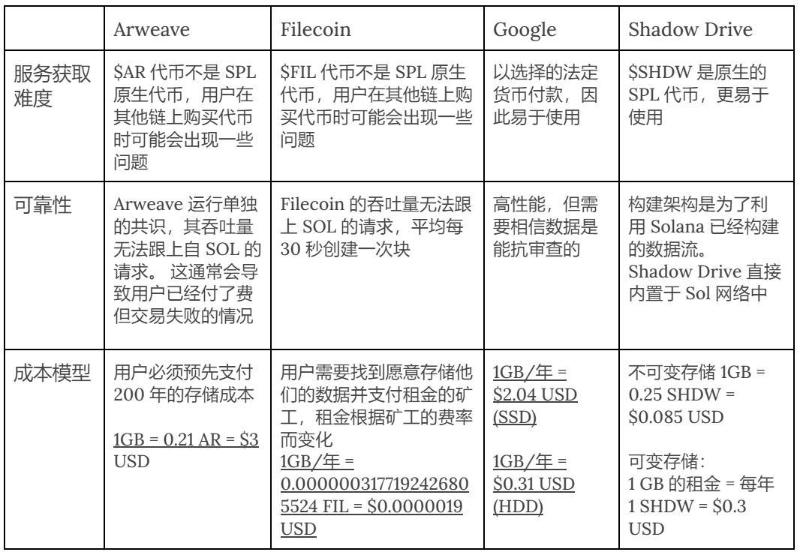
Although Arweave and Filecoin are the most commonly used third-party storage solutions, they are incompatible with Solana. Their storage costs are paid in native tokens rather than SPL tokens, and neither chain’s throughput can match Solana’s speed, resulting in frequent transaction failures.
These issues make integration cumbersome for developers.
Google BigTable, given its vast global infrastructure, offers a reliable alternative. However, users must trust that data stored on Google is censorship-resistant—an assumption that contradicts the ethos of decentralization. Additionally, it is more expensive compared to decentralized alternatives.
So what is Shadow Drive, and why should it be considered a decentralized data storage solution?
Shadow Drive is a customized version of Ceph, an open-source software-defined storage program, offering several advantages:
Open Source: Supported by over 179 repositories, 10,000 forks, and a large community
Resilient and Adaptive: No single point of failure that could lead to data loss; integrates with smart contracts to protect stored data from malicious attacks
High Performance: Clusters are so fast that a completed block can be scraped, stored, and served in real-time before the next block is propagated
Scalable: The largest cluster on record has successfully stored 1 billion unique objects, making it suitable for Solana’s rapid block production rate (146 million blocks at the time of writing)
Efficient CRUSH Mapping Algorithm: Enables data placement dispersion at the byte level
Furthermore, the GenesysGo team integrated Shadow Drive directly with Solana’s proof-of-history mechanism, relaying on-chain events to enable consensus among validators regarding the continuous existence and integrity of stored data.
Moreover, Shadow Drive serves as a unified platform for data storage, upload, and delivery.
In contrast, Arweave uses Bundlr to accelerate uploads, but this layered approach adds complexity to the user experience.
Click here for a detailed explanation of the Shadow Drive architecture.
Overall, Shadow Drive offers cost efficiency and ease of access, optimized specifically for Solana’s speed and reliability, delivering a seamless user experience.
Decentralized Cloud Computing Environment
The Shadow Cloud
Shadow Cloud is a recently launched service by GenesysGo, offering decentralized cloud computing at lower prices than traditional centralized providers like Amazon and Microsoft.
The technical backbone of Shadow Cloud is DAGGER (Directed Acyclic Gossip Graph for Efficient Replication), a Layer-1 distributed ledger technology developed by the GenesysGo team to manage large-scale data structures.
A testnet environment for Shadow Cloud will launch during the Solana Breakpoint conference, where developers can try it out. Public information remains limited, with more details expected to be shared during the event.
Tokenomics
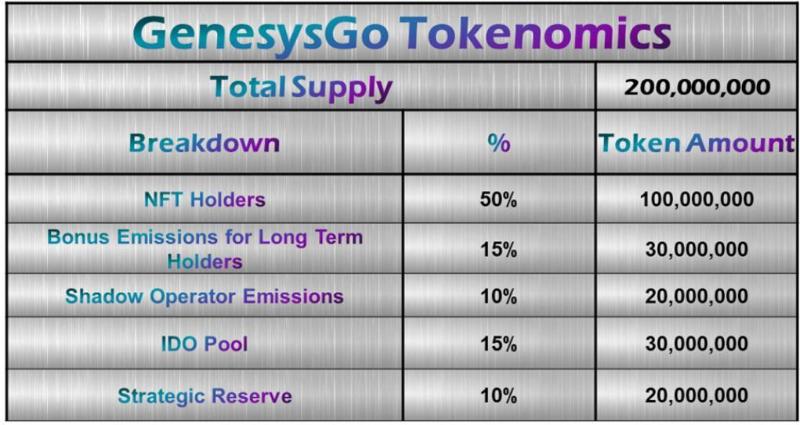
GenesysGo conducted an NFT sale on November 3, 2021, selling 10,000 NFTs at 2.5 SOL each when SOL was trading around $220.
It then launched its IDO on January 3, 2022, raising $52 million, with the $SHDW token priced at approximately $1.73 at TGE (Token Generation Event).
Details of token stakeholders:
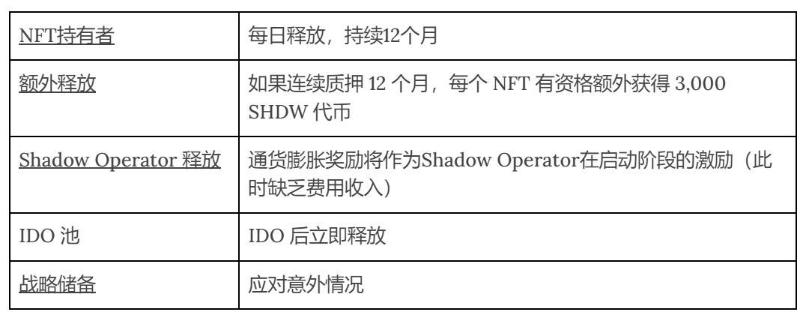
Key events in token supply:
As of October 31, approximately 82.5 million of the 130 million SHDW tokens sold via NFT remain locked in the NFT staking contract, representing 48.5% of total supply.
The first unlock of NFT-released tokens will occur in January 2023.
Seven million tokens under strategic reserve were loaned to Alameda to provide liquidity in Serum and Orca pools. The loan term is three years, with options to purchase multiple tranches at undisclosed prices—all significantly above the IDO price of $1.70.
Demand for $SHDW comes from two main sources:
Use as a payment token for data storage fees on Shadow Drive
Staking collateral for Shadow Operator nodes
Shadow Drive
According to data from Metaplex, 15 million NFTs have been minted over the past year. Assuming an average image size of ~50MB, this requires 750,000GB of decentralized storage. Under the assumption of immutable storage, this implies a minimum annual demand of 187,500 SHDW tokens. However, if storage space is variable and 750,000GB worth of SHDW is locked as rent, this becomes the upper bound.
Another significant use case is storing Solana’s historical state, which grows at a rate of 4PB (4 million GB) per year. Under immutable assumptions, this would require staking 1,000,000 SHDW tokens annually. With variable storage, up to 4,000,000 SHDW tokens could be staked annually—representing the demand ceiling.
Combining these two major use cases, we estimate an annual potential demand of 1,187,500 to 4,750,000 SHDW tokens.
In other words, 0.69% to 2.80% of the total annual SHDW supply could be demanded for storage fees on Shadow Drive.
Shadow Cloud + RPC
According to GenesysGo, there are currently 27 Shadow Operators. Given that each operator must meet a 1,000 SHDW staking requirement to qualify for SHDW rewards and fee sharing, we can infer that 27,000 SHDW tokens are already removed from circulation.
The team also envisions a network of “thousands” of Shadow Operators powering both the RPC network and Shadow Cloud.
Assuming 1,000 operators, this would result in 10 million SHDW tokens being locked as collateral, reducing circulating supply by 5.88%.
Conclusion
Overall, the token economy is designed to be utility-driven.
Two types of users drive demand for the token:
(a) Users seeking storage solutions via Shadow Drive
(b) Operators contributing compute resources in exchange for income
From perspective (a): As long as Shadow Drive delivers a storage experience comparable to traditional cloud providers at lower cost, it will attract more users through business development and education. As adoption grows, so will demand for storage and thus for the token.
From perspective (b): As long as the revenue from providing compute power to Shadow RPC, Shadow Cloud, and Shadow Drive exceeds operational costs, we can expect increasing demand for becoming a Shadow Operator. This increases the amount of SHDW locked as collateral—a process analogous to purchasing ASICs for mining.
On the supply side, we expect token emissions to stabilize after Q2 2023.
Beyond the remaining NFT-based token unlocks, there are no further token emissions planned. At that point, total supply will be fully fixed and driven entirely by the aforementioned utility mechanisms.
We will continue monitoring key developments from the team, particularly progress on Shadow Cloud and its impact on the $SHDW ecosystem.
Join TechFlow official community to stay tuned
Telegram:https://t.me/TechFlowDaily
X (Twitter):https://x.com/TechFlowPost
X (Twitter) EN:https://x.com/BlockFlow_News
 Bixin Ventures