








A preliminary concept for a crypto game asset leasing model
TechFlow Selected TechFlow Selected
A preliminary concept for a crypto game asset leasing model
How to integrate the experience of non-crypto and crypto players? A rental system is a viable approach.
 Navigating Web3 tides with focused insights
Preface:
Jonas is a friend I've met in person—someone I've known for a while. We both transitioned from the finance industry into the WEB3 space, and have had multiple in-depth discussions about various aspects of blockchain gaming. This time, Jonas has shared an article on GameFi NFT leasing models, hoping to spark further discussion with the community. Jonas’s Twitter: @jojonas_xyz—you’re welcome to follow and engage.
TL;DR
(1) Why choose a leasing system?
Based on our outlook for the future of crypto games, integrating the experiences of non-crypto players and crypto players has become an important challenge. The leasing system offers a viable solution—by reallocating capital and time resources between big spenders ("whales") and free-to-play players, it enables the vast majority of free players to access games more easily, thereby expanding the potential player base for crypto games. It maintains distinct but not overly fragmented experiences for both non-crypto and crypto players.
(2) Pros and cons of the leasing system
Pros: ① Lowers user entry barriers; ② Increases whales’ investment incentives; ③ Helps preserve high-tier NFT value; ④ Expands reach to a broader player market based on (1).
Cons: ① Industrialized gold farming; ② Maximized designed output leading to currency inflation.
(3) Proposed NFT leasing workflow
① To improve user experience, the system should be permissionless and collateral-free—this is still feasible at the current stage of crypto gaming;
② With the overall goal of the leasing system in mind, design post-paid rent for lessors that floats with market demand, and proportional rewards for lessees—the remainder flows back into a leasing pool as staking rewards for all lessors;
③ Implementation flow: Lessor selects lease duration → NFT enters corresponding leasing pool → Lessee leases NFT permissionlessly and without collateral → At maturity, pays rent (market-determined; peer-to-peer; paid in-game earnings) → Withdraws their share of revenue (determined by official or governance system) → Remaining portion returns to the pool as yield for NFT lessors.
(4) Choosing the right timing to launch the leasing system to achieve second-stage growth
(5) Evolution of the leasing system—inspired by perpetual bonds, allowing permanent NFT托管 by lessors
(6) Which parameters in the leasing system can be adjusted by governance?
Below is the main text—
Recently, I’ve been thinking about how to "integrate" different types of players through mechanism design.
What does this mean?
—We can divide the audience of crypto games today into three groups: “traditional gamers,” “crypto players,” and “non-gaming crypto users.” Considering the behavioral paths of these different groups raises many questions worth exploring.
Avoiding Fragmentation Across Player Groups
On the Classification of "Non-Gaming Crypto Users"
Why include “non-gaming crypto users” in the target audience? A key reason is that even if they don’t play, crypto game tokens will inevitably come into their view and may be considered as investment assets. From their perspective, they evaluate such tokens using criteria different from gameplay—such as trading volume, circulating supply, and market cap growth potential—rather than token emission mechanics or game rules. Or they might simply treat them as speculative or algorithmic trading instruments.
Regardless, they are inevitably drawn into the ecosystem of crypto games. Moreover, roles often overlap—there’s no clear boundary between “crypto players” and “non-gaming crypto users.” This article artificially separates them only for logical clarity.
From a crypto game design standpoint, “non-gaming crypto users” can act as liquidity providers, arbitrageurs contributing to market equilibrium, or primary drivers of token speculation—but they could also be the ones to bring down the game’s longevity. Therefore, they remain a critical group to consider.
Although according to a somewhat unconvincing recent survey, this group makes up less than 3% of the total player base—well, who doesn’t love games?
Fragmentation Between Traditional Gamers and Crypto Players
To a large extent, traditional gamers are disconnected from the latter two groups. The first wave of GameFi didn’t account for this demographic (per the above survey, ~81%); subsequent blockchain games introduced free-to-play options, but overall, these feel more like patchwork than true integration.
How can we organically integrate traditional gamers and crypto players so they enjoy similar, high-quality experiences (Goal One), while ensuring long-term economic stability (Goal Two)? This has been my ongoing puzzle.
An obvious challenge is that these two goals often conflict. Economic sustainability requires balancing inflows and outflows of value. But these flows are highly uncontrollable—one downside of financializing game assets, since over-reliance on markets amplifies sentiment-driven volatility. Once net value outflow persists, it triggers a leveraged downward spiral akin to the money multiplier effect.
This contradicts Goal One. Ensuring comparable experiences means free players shouldn't feel disadvantaged, at least in terms of gameplay content. Splitting players into separate tracks is the cleanest approach, but clearly imperfect and unconvincing—you can’t openly discriminate against your users, especially within the game.
If gameplay paths converge, another issue arises: you can’t let free players earn incentive tokens—even at 1% capacity—or lemon market dynamics will repeat. So you must offer them a completely different in-game currency—call it “gold.” This creates fragmentation across the entire game.
This fragmentation is everywhere. Let's take an example. If we design a rich cosmetic system via governance, how do we price it for both sides? From an NFT perspective, limited-edition collectibles usable in-game and boosting governance power might be ideal. From a regular player’s in-app purchase angle, they pay real money but get only cosmetics. If we aim for fairness, we must assign different prices—this is the so-called “fragmentation.”
Other approaches—like letting regular players mint their in-game items into NFTs—create even more problems, such as adverse selection (only rare non-NFTs get minted), leading to a lemon market where once-rare NFTs become common.
NFT Lending: Should It Be Built Into Games?
The above covers my thoughts on integrating player experiences.
The benefits are clear: more traffic, stronger community consensus; increased player base leads to greater value capture—games, as internet products, benefit from high development costs and low distribution costs, along with network effects. Also, don’t overlook the hidden “consumers” among free players—this is the real ace.
Therefore, integrating crypto and free player experiences is inevitable—we must solve the problem rather than seek alternatives. This brings us to the topic of this article: intuitively, NFT lending could be a promising solution.
Note: Leasing still operates under asset income rights logic, so this article follows the core idea of NFT gold farming. Given that some NFTs are already treated purely as collectibles or consumer goods (e.g., Blankos, the first blockchain game on Epic), crypto game development paths may diverge. Hence, this clarification is necessary.
Why Build a Leasing System?
Should games incorporate NFT lending?
(By the way, that term sounds fancy but is awkward—I’ll use “leasing system” from now on.)
My earliest discussion on NFT lending was in "Understanding Blockchain Games, Stepn & Skyweaver Experience Report." There, I argued that using NFTs as entry tickets isn’t wise—it blocks new players (and excludes “consumers”—early GameFi didn’t leave room for them). A leasing system could lift this restriction but introduces new issues—output would be maxed out.
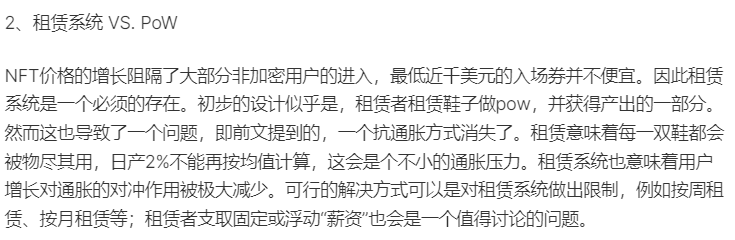
Take Stepn: if a player owns thirty pairs of shoes, they likely can’t run daily. But if they can rent them out, output gets maximized—long-term, bad for game economy.
But deeper reflection revealed blind spots.
1. Even if Stepn doesn’t implement leasing, the problem persists—people hire students to run for them. That’s an off-chain leasing system. “Maximizing output” and “if I can earn free, I will” are human nature. Since it’s unavoidable, why not embrace it?
2. What’s the true purpose of a leasing system? Fundamentally, it reallocates resources—exchanging time and money between those with abundant time but little wealth and those with wealth but little time. The core needs served are: free gold farmers wanting income, and whales seeking social status, achievement, passive income—anything requiring sustained gameplay.
3. Do whales really have time to play? Generally, whether socially or otherwise, whales won’t sit at computers grinding daily. Post “honeymoon phase,” routine activities may be outsourced to bots or farms. Again: since it’s unavoidable, why not internalize it?
4. A leasing system opens doors for free players, pushing games into broader markets. Axie Infinity guilds once supported a generation in the Philippines (though not anymore). Precedents exist where internet companies subsidized users to gain market share—free access is a powerful growth lever. For any product needing consensus, broad user base is foundational—you can’t expect consensus from a 100-person community; that’s just “shared opinion.”
5. What if free players could farm without affecting total output? That reconciles Goals One and Two. Similar to existing guilds, many players exchange labor for rewards split from NFT owners. We could cap such output at 90%. Since leasing meets core needs of whales and free farmers, slightly reduced output should be acceptable.
Advantages and Disadvantages of Leasing Systems
Let’s summarize pros and cons:
Pros: ① Lower user barriers; ② Boost whale investment willingness; ③ Broader market reach based on (1).
Cons: ① Industrialized gold farming; ② Maximized designed output causing currency inflation.
Interestingly, advantages affect external factors, while disadvantages relate more to internal ones—designers can adjust to mitigate these.
First Drawback: Industrialized Gold Farming
Designed for free players, if leasing becomes profitable, bots may dominate—defeating the original intent and destabilizing the economy. How to prevent this?
(1) Set participation thresholds.
Where should thresholds come from? They shouldn’t exclude outright—more like “playfully resisting.” For example, requiring wallet addresses and screening activity might filter bots, but risks excluding most lessees—who may come from “non-crypto” backgrounds. Where would they get active wallets?
Adding CAPTCHA at login filters bots without exclusion, but lacks the “playful resistance.”
Alternatively, assign random tasks during lease—if incomplete, confiscate output. If tasks are moderately difficult, randomized, and engaging, this works well.
Or require sufficient in-game activity before qualifying for leasing. While annoying from our view, imagine a “non-crypto player” unfamiliar with “gold farming,” especially one never inclined to pay—might this spark interest? Suddenly, “renting an NFT” shifts from “an official feature” to “a small gameplay goal.”
(2) Must lessees profit?
If the main target is Web2 free players, profitability isn’t essential. As previously discussed, merely avoiding experience fragmentation suffices. Thus, lessees could return all output upon lease end—or keep a small share.
(3) Bot restrictions.
If free players still “freeload,” bot controls are needed. Many methods exist. Here’s a playful one: assume one-month lease, require waiting until month-end to withdraw output, then apply a Turing test at lease end. Bots fail? Sorry, assets confiscated. Thanks for your contribution—your output will join others as holiday red packets for all players. Thank you…
Second Drawback: Designed Output Maxed Out
I think this stems from inflated expectations—50-day ROI feels slow, yet implies 2% daily return. Some say principal depreciates… ask why.
As for solutions, earlier hints apply: leasing serves core needs of whales and free farmers, so slightly reduced output should be acceptable. Suppose we reduce output to 80% normal, allocating 20% to lessee and 60% to lessor. For whales, it’s still solid passive income; for the game, harmless; for lessees, slightly weak incentive.
BTW, traditionally, annual returns over 20% imply capital risk. By prior calculation, 20%/60%/365 isn’t exciting for crypto—but even 10x yields only 0.9% daily (110-day breakeven), which many still find insufficient…
In my view, these expectations must be reset. Otherwise, stick to pure consumption NFT games like Blankos—they sell fine. Crypto games aren’t obligated to deliver 100-day ROI. If you’d rather buy理财产品 than play, then…
FYI, 100-day ROI equals 365% APR; P2P defaults hover around 80% APR…
Lessee Incentives
Back to lessee motivation.
Earlier, I noted lessees should return most output to lessors. To boost incentives, offer choices—e.g., allow discounted purchase of assets earned via leased NFTs.
Building on prior assumptions, here’s an example: An NFT owner wishes to lease. They pick lease duration (5 days, 1 month, 3 months, 1 year). Each term has a reward coefficient: e.g., 40%, 60%, 80%, 100% of normal output. After selection, NFT enters matching pool and starts earning linear staking rewards from residual system income. To avoid shorter leases gaining disproportionate rewards, payouts are distributed across the total leasing pool based on NFT value.
A non-crypto player (or crypto free player), after progressing in the free path and achieving certain in-game milestones—beating a dungeon, killing a boss, daily activity—gains eligibility to lease NFTs for free gold farming.
They enter the leasing system, see a marketplace-like interface filtering by lease period, rent, NFT type. After selecting a desired NFT (and term), they can lease permissionlessly, paying rent from output upon maturity and claiming their share afterward.
Further, suppose after lease ends, the lessee grows attached and wants to keep the NFT. How? Allow a path, but at a premium—say 120% market price. Willingness to overpay proves emotional attachment—acceptable cost. The lessor, losing one cherished NFT (unlikely to rent again), gains probabilistic yield boosts, then smiles facing their warehouse of 10,000 NFTs.
Proposed NFT Leasing Workflow
Returning to the leasing process—it differs significantly from current NFT lending.
Permissionless, Collateral-Free Design
A key feature: no collateral, no permission required. Why design it this way?
Compared to existing NFT lending (mostly NFTs as collateral), they fail to meet real demand—why would I rent an NFT? And why pledge massive assets to do so?
The first question remains unsolved outside gaming (potential is huge, but mature on-chain leasing markets don’t exist yet). The second stems from trustless algorithms failing to overcome “zero-cost identities” tied to on-chain addresses.
Why do most on-chain loans use inefficient over-collateralization? Simply because loss of identity anchoring prevents credit systems. A basic script can generate thousands of anonymous addresses. Even behavior analysis fails if users employ anti-detection techniques. Without verifiable identity, no credit system—and thus no low-cost finance.
Hence, general-purpose NFT lending protocols are premature.
Yet games can perfectly solve both issues.
Why can games easily create leasing demand? Because games build worlds atop human entertainment. Once inside, users follow world rules to gain feedback. If they lack an asset but want to use it, leasing becomes natural.
Why no collateral in-game? Simple—player behavior *is* the collateral. Character progression, inventory materials, completed quests—all represent in-game reputation. Regardless of whether current crypto games run on centralized servers or fully on-chain, players can’t risk their in-game reputation. Renting and not returning? Might as well quit playing—so why bother?
Post-Paid Rent, Fixed Returns
Another aspect: post-paid rent, fixed returns.
Consider standard leasing: renting a house for $1,000, moving out later. Or guilds leasing assets with revenue sharing. The latter involves post-payment but not fixed amounts—typically, lessees keep all yield, meaning lessor payouts equal rent received.
Why should lessors receive fixed rent?
If lessors get a percentage, their income depends on lessee performance. But lessees, entering free, lack strong incentive to maximize output. Compared to permissionless, collateral-free lessees, lessors are more risk-averse—they need guaranteed returns.
Conversely, should lessees get residual profits?
If I said yes, lessees would push output to the max, earning commensurate rewards—sounds great. But sorry, as designer, I can’t let them max output (unless I cap it upfront).
So, cutting deeper: lessees can get a share, but only from output *after* rent deduction.
Huh?
Recall leasing’s purpose: satisfy whale passive income, serve free players, broaden market reach. Without deducting rent first, idle lessees might fail to cover rent. Even if shortfalls occur occasionally, rent priority ensures market-driven payments come first. When output falls short, lessors bear loss—but rare—and we’ll handle lessee reputation accordingly.
—Honestly, we don’t care how hard lessees try, okay? (Ah, how无情 I am)
In truth, from a free player’s view: permissionless, collateral-free NFT rental, pay rent from output post-lease, keep a cut—real freeloading. Why not?
Pool-Based Yield Distribution
Finally, after lessors and lessees claim their shares, what happens to the remainder?
Don’t give it directly to either—else prior logic breaks. Consider rewarding third parties? No intermediaries here. Maybe dump it into a pool—classic move for unresolved surplus.
So into the pool it goes.
In Morpho, I compared “peer-to-peer lending” vs. “pool-based lending.” Latter advantages: instant liquidity, stable yield (for lenders), transparent rates, no maturity. Downsides: lower capital efficiency, wider lending spreads, less market-rate adjustment.
For crypto games, low capital efficiency and wide spreads are actually beneficial—reducing token selling pressure. In pool models, everyone can easily “free ride.” I believe a dynamic balance emerges: lessees freeload → lessor returns drop → fewer lessors → undersupply → rents rise → freeloaders deterred → …
And faster matching may be the more critical requirement.
Strictly speaking, borrowers don’t pay cash—they pay via in-game assets earned from leasing.
Final check: Are both lessee and lessor interests well protected?
For lessees: permissionless, collateral-free leasing, free gameplay with monetary incentives. Whether rewards are fixed or variable matters little—the core is experiencing NFT features freely and earning some income.
For lessors: renting idle NFTs for passive income. Their core concerns?
Return and asset security.
(1) Asset security. With no permission/collateral, lessors must trust NFT safety. Easy: if game uses custodial wallets like Stepn/Skyweaver, simply disable transfers for leased NFTs. If game links directly to user wallets (then “non-crypto players” don’t exist anyway = =)—few options, but contradicts premise. I believe future crypto games must consider non-crypto players, and built-in or third-party wallet/account systems will trend.
“Permissionless” mainly boosts matching efficiency; permission is granted once when adding NFT to pool. You can add approval steps—but unnecessary.
(2) Return enhancement. Pure fixed rent feels “lacking.” Recall depositing valuables somewhere, agreeing to 3-month term—collect interest later, decide renewal. Sounds familiar? That’s a fixed deposit!
Fixed-term rent hurts lessor retention—reward experience is discontinuous (joy only on payout day). But if a pool continuously allocates rewards, the experience extends.
Could residual system income fund this reward pool?
We already have four leasing pools (mentioned earlier).
Thus, the leasing system design takes shape:
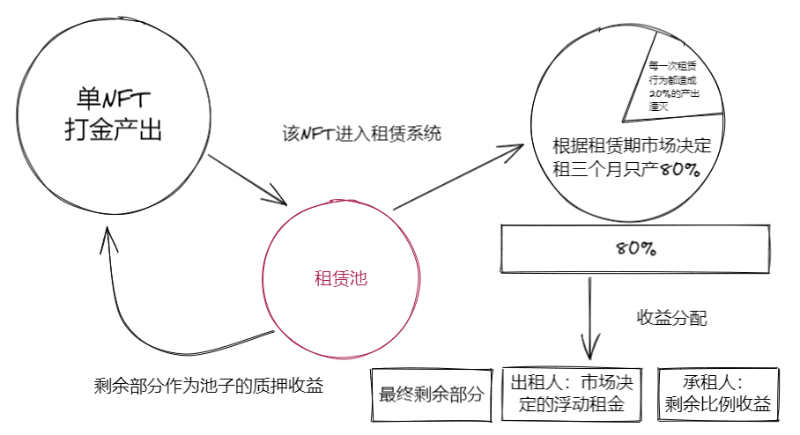
Lessors gain dual returns (absolute value may not be high): one, guaranteed rent adjusted by market demand, paid at maturity; two, continuous staking rewards from leasing pool, accrued over time.
Lessees gain “money-making ability” via free gold farming—modest, but remember: main targets are “non-crypto players,” primary goal is experience integration.
For the game, output reduction due to leasing demand even reduces total output.
Implementation: How and When? Follow-up Thoughts
Next question: How to implement? Where to deploy?
How to Implement?
Includes: which assets qualify for leasing? What leasing methods?
First, asset scope. Crypto game assets stem from in-game items represented as NFTs or tokens. Classifying NFTs: primary NFTs (used for gold farming per current GameFi), secondary NFTs (gems, helpers), cosmetic NFTs, utility NFTs, governance NFTs (badges, collectibles). Suitable for leasing: primary and cosmetic NFTs.
For cosmetic NFTs, leasing fits mature markets (i.e., enough players exist). Lessee psychology mirrors real-world. But if cosmetics have unique perks, market dynamics shift entirely.
Focus remains on primary NFTs. Second question: leasing method?
Traditional ownership includes possession, use, income, disposal—roughly corresponding to holding, playing, farming, trading. Playing and farming heavily overlap. Leasing transfers usage rights—lessee pays rent for gameplay access, like renting a house. This raises issues:
① Lessee cannot alter NFT via in-game actions;
② Must lessee get part of final yield?
On (2), must users pay to lease NFTs? People rent DVDs, equipment, Steam accounts—but you can’t expect players to pay for NFTs to play garbage. When product quality fails to attract, charging isn’t smart. That’s why guilds evolved: players rent *and* earn. (No one compares—shouldn’t NFT leasing mirror DVD rental? Experience economy hhh)
Thus, lessees effectively become “employees.” Early corporate theory debated employee-boss compensation, generally concluding “risk-takers get residual returns.” Boss bears higher risk, so employees get fixed pay, bosses get excess. But if employees earn only fixed wages, who’s motivated to work harder? Hence performance incentives—options, commissions, etc.
But real-world economy is circular—everyone is simultaneously consumer and producer. Games lack this layer. If employees work harder, produce more, it harms overall economy. I think I covered this earlier. (This article’s structure feels Möbius—I’m panicking)
Anyway, lessees don’t necessarily need yield share—that’s from “player” lens. But as “producers,” they deserve partial returns. Discussed earlier—won’t rehash.
More thoughts on leasing methods—originally meant for earlier section, but flow carried on, lost place. Decided to put here—anyway, few will read this far. (So Möbius)
Thus, actual leasing process: Lessor selects lease term → NFT enters matching pool → Lessee leases permissionlessly and without collateral → Pays rent at maturity (market-determined; peer-to-peer; paid in-game output) → Claims fixed share (set by official/governance) → Residual returns to pool as yield for leased NFTs.
Logic checks out.
When to Launch?
Refers to timing—launch with game, or later?
Answer requires revisiting leasing benefits: lower entry barrier, broader market; higher whale investment; industrialized farming; maxed output causing inflation.
Right after launch? INO brings first NFT players. If INO underperforms, skip leasing. Assume a hot game: 1,000 INO participants, 10,000 more want in. Launch leasing immediately—what happens? Initial NFT/token prices skyrocket—newcomers need NFTs. Those rejecting high prices turn to leasing, driving rent up. Once demand fades, early 1,000 profit handsomely—none of leasing’s goals achieved…
Launch later? Same INO size, same backlog. After launch, new NFTs flood, hype cools, economy stabilizes into positive cycle. This cycle peaks—under P2E, when new inflow slows. Leasing suits this moment—internet jargon calls it finding “second growth.”
Target group: the 81% mentioned earlier. Leasing “stocks” idle NFTs, lets new players enter zero-cost. Since new players naturally act as “consumers,” their arrival may stabilize economic cycles, even ignite new growth.
Lessor Eligibility
Earlier, to prevent bots from crowding out genuine demand, lessees need participation thresholds. What about lessors?
Lessor threshold should lie in NFT quality. Given current setup, NFTs mainly serve gold farming. Low/mid-tier NFTs usually used by individuals, rarely idle. Those leasing likely belong to mid/high tiers—whales. Allowing all NFTs to lease increases system load; oversupply hands advantage to bots. Plus, maxed output undermines NFTs’ “buffer” function.
Restricting to mid/high-tier NFTs restores system health, elevates leasing perception, and promotes consumption of low-tier NFTs.
Bot Mitigation
Leasing assumes robust bot countermeasures. If idle NFTs can auto-farm via scripts, leasing—with lower returns—becomes uncompetitive.
For handling idle NFTs, owners have three options: sell, idle, or lease.
To make leasing optimal, it must offer highest return. Yet currently, leasing yields only a fraction of script profits—not always better than selling.
Path A: restrict scripts; Path B: make leasing most profitable.
Path A:
Script restriction targets lessors. For lessees, even if they script-farm “free” gains, they fill market gaps. Once lessors dwindle or lessees flood, rent rises, limiting infinite scripting.
Detect script behavior via Turing tests—simple for humans, hard for bots. Example: for players farming >2hrs/day (assume most under 2hrs), randomly pop “Which monster did you kill today?” during non-combat—image-based, with two tweaks:
(1) Game-related images—e.g., “Pick today’s grind mob”—random trigger + random image, keeps immersion;
(2) Reframe verification as “random reward quiz”—correct answer lets user claim prize (gas fee applies, like ERA7 check-in; optional redemption). Since lessors are Web3 users, gas payment is fine.
Path B:
1. Add extra leasing incentives—not output-based (would encourage abnormal behavior, raising total output). Governance perks: reputation boost, conditional cosmetic NFT raffles.
2. Penalize script use. If logs detect cheating, don’t ban—tag gear, disabling output for X days unless placed in 3-month leasing pool.
3. Reduce sale fees for NFTs meeting cumulative leasing thresholds.
These ideas invite further discussion—just food for thought.
Why Not Make It Perpetual Bonds?
An unaddressed issue: after receiving output, lessors may “dump and run.” Given NFTs are locked during leasing (to prevent misuse like unauthorized transfers), most lessors can’t actively upgrade them.
Also, leasing “stocks” NFTs, but retention is weak. Earlier, leasing discounts full output—only “non-material incentives” can boost it. When lessors retrieve NFTs, mismatched progression disincentivizes upgrades—more likely to sell. “Childhood sweetheart, returned no longer compatible.”
—Better not return at all. What if leasing became a black-hole version?
Players choosing to lease trade their NFT for a perpetual bond. Thereafter, they receive only rent and pool yield—never reclaim the NFT. The pool is permanently managed by official/governance. Lessees follow normal leasing process.
Introducing Governance
Won’t elaborate much here. Obvious ideas: use “reputation score” to build virtual “credit,” granting governance power boosts; or combine governance activity, reputation, etc., to detect bots. More to explore later—this piece already nears 10k words (also late night). Avoid echo chambers—looking forward to exchanges and inspiration.
Reposting welcome. Original work—please credit “GuaTian Lab W Labs”
GuaTian Lab website: http://www.wlabsdao.com/
GuaTian Lab Discord: https://discord.gg/wggdao
GuaTian Lab Twitter: https://twitter.com/GuaTianGuaTian
GuaTian Lab Research Mirror: https://mirror.xyz/iamwgg.eth
GuaTian Lab Medium: https://guatianwgg.medium.com/
Join TechFlow official community to stay tuned
Telegram:https://t.me/TechFlowDaily
X (Twitter):https://x.com/TechFlowPost
X (Twitter) EN:https://x.com/BlockFlow_News
 瓜田实验室W Labs






