








Wang Yuehua, Partner at Draper Dragon Innovation Fund: Trends and Thoughts on Web3
TechFlow Selected TechFlow Selected
Wang Yuehua, Partner at Draper Dragon Innovation Fund: Trends and Thoughts on Web3
Early-stage investing requires thinking about the future—but what exactly is the future?
 Navigating Web3 tides with focused insights
Early-stage investing requires thinking about the future. We often hear that “the future is already here,” but what exactly does that mean? What will the future look like?
It’s indeed difficult to judge or predict.
Yet reflecting on the future is something investors and entrepreneurs must constantly remind themselves to do—considering what might happen next year, in five years, or even ten. How might society, the economy, technology, business applications, the environment, or even our personal lives change?
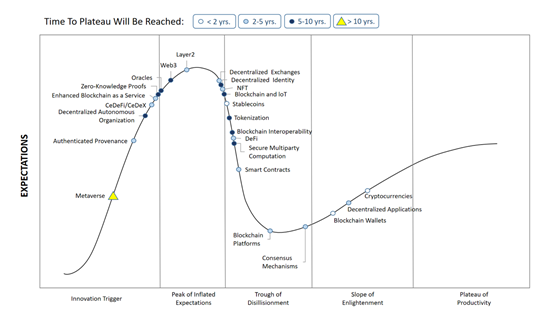
Thinking ahead is essential for both investors and founders. In recent years, hot topics such as Web3, DAOs, and the metaverse have dominated discussions about the future. According to Gartner's July 2022 assessment of the blockchain ecosystem and its subdomains, the metaverse still needs over a decade to move from early adoption to industrial maturity, while DAOs and Web3 require another 5–10 years. From an early investment perspective, this means now is precisely the time for investors to begin positioning themselves and for entrepreneurs to start exploring opportunities.
The internet has evolved significantly, with centralized platforms and institutions solving many problems, improving efficiency, and accelerating ecosystem development—especially by maximizing network effects.
However, while Web2 solved certain issues, it also created new ones: identity leaks, data opacity, lack of user autonomy, privacy violations, and even data theft threatening financial security. Asymmetric advantages and industry monopolies held by centralized platforms have eroded user freedom and trust in these systems.
Innovations such as distributed databases, smart contracts, privacy-preserving computation, self-sovereign digital identities, and decentralized storage aim to resolve these challenges and push the internet forward. This is why we are moving toward Web3. Together with DAOs and the metaverse, Web3 will shape the blueprint of a new future. These three forces will drive innovative infrastructure, deconstruct traditional business models, and reconstruct new economic organizations, paradigms, and models—ultimately advancing human civilization.
Thus, we say Web3 is the future’s infrastructure, DAOs represent the future form of economic organization, and the metaverse embodies the future mode of living.
Today, many projects claim to be Web3 initiatives, but most only touch upon concepts or basic technical infrastructure. While these aspects are part of Web3, they don’t fully capture its essence. It’s like the parable of the blind men and the elephant—each touches a piece but fails to grasp the whole. In truth, the full picture hasn’t yet taken shape; it continues to evolve through innovation. However, three core elements are driving Web3’s evolution:
-
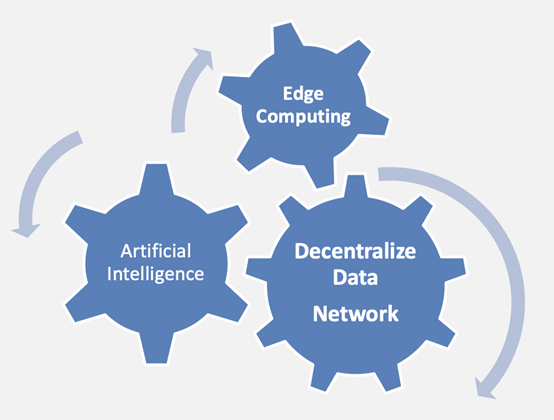
Artificial Intelligence (AI) and Smart Contracts: Readers may wonder—Isn’t AI an old technology? Indeed, AI has been developing for over 30 years, primarily in specialized applications like video recognition. Yet a certain level of AI capability is foundational to Web3. Concepts such as the Semantic Web and Spatial Web, commonly discussed in Western tech circles, rely heavily on advanced AI. In every Web3 application scenario, data must be processed by intelligent algorithms—ranging from weak to strong AI—with stronger AI enabling superior user experiences.
-
Distributed Computing, also known as edge computing, operates at a broader, more generalized level. Since Web3 data originates from distributed sources, privacy-preserving computations must occur locally. Each distributed node must effectively handle computation and storage functions for a Web3 system to process data efficiently. Thus, edge computing forms a critical foundation.
-
Distributed Data Networks: The term "network" here emphasizes the structure of data itself, which must be based on blockchain-like protocols and consensus mechanisms. Data sourcing, validation, and verification are all implemented automatically via code within a distributed database architecture.
These three elements constitute the fundamentals of Web3. Imagine, three years from now, a fully autonomous vehicle equipped with sufficient AI to drive itself. The car acts as a powerful edge computing node, capable of processing incoming data from other nodes and seamlessly transmitting processed or newly generated native digital data outward. The driver simply looks at a transformed windshield displaying AR imagery, fully immersed in their own metaverse experience.
The core logic of Web3 is actually simple and intuitive: user autonomy, which equates to decentralization.
Many describe Web3 as decentralization, but the real focus lies in user autonomy. Achieving true user autonomy at the technical level demands innovative infrastructure. Only when this infrastructure matures can native Web3 applications flourish.
Therefore, Web3 aims to achieve complete user autonomy and, based on that, spawn new business models and even entirely new industries.
Beyond logic and fundamental components, we can draw an analogy between Web3 and operating systems. The underlying layer of Web3 stems from distributed ledger technologies and distributed databases—akin to a computer’s file system (Filing) and input/output (I/O) systems—and corresponds to Layer 1 in blockchain, which handles data structures.
Distributed storage parallels the OS file system, distributed computing directly mirrors the CPU responsible for processing tasks, and distributed data transmission (or communication) resembles I/O operations.
CPU, File System, and I/O are essential components of any operating system. Similarly, these elements underpin the foundational layers of Web3. But could there one day emerge a single unified protocol to build Web3?
I believe this is unnecessary. Web3 should inherently consist of modularized, composable, layered protocols—like LEGO bricks. With enough building blocks, anyone can assemble a finished product.
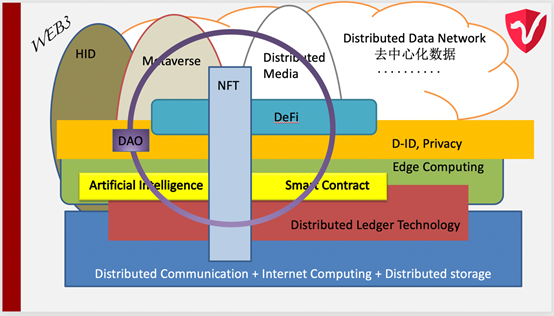
Beyond the aforementioned infrastructure, Web3 introduces two previously inaccessible key components: decentralized digital identity and privacy-preserving computation. These middleware layers are deeply interconnected.
Digital Identity is not a new concept. Within Web3, DID (Decentralized Identifier) is a fundamental necessity—much like how a person without an ID card cannot go anywhere or prove who they are. Without verifiable identity, no institution can recognize or trust you. Hence, ID is the most crucial foundation; without it, there can be no assets. In native Web3 networks, IDs are typically represented by wallet addresses. However, wallet addresses aren’t the only possible ID. Decentralized identity allows for multiple IDs that can be disaggregated and recombined. The reputation and credibility of each ID must be verified and accumulated through interaction data tied to that ID, ultimately belonging to the user. Even with multiple IDs, different combinations and integrations can give rise to novel use cases and business models.
Beyond native Web3 IDs, traditional Web2 identities also need upgrading—enhanced with privacy protection and privacy-preserving computation. Privacy-preserving computation dates back to 1985, when S. Goldwasser introduced zero-knowledge proofs. In 1987, Oded Goldreich and others built upon Professor Yao Qizhi’s two-party secure computation framework to develop multi-party secure computation. Combined with homomorphic encryption and federated learning algorithms, privacy computation has found increasing application in data protection. Beyond native Web3 use cases, it is now being commercially deployed in healthcare, finance, government services, supply chains, and other web domains.
Once the technical architecture of Web3 becomes clear, the future trend will center on applications built atop these foundational technologies. All data used in these applications comes from and is processed by distributed data networks, giving rise to today’s well-known DApps (decentralized applications)—including NFTs, DeFi, the metaverse, creator economies, decentralized media, decentralized social platforms, and decentralized credit rating systems.
Within the Web3 ecosystem, another critical element is a new organizational form. Currently, DAOs appear to be the most Web3-native architectural model for evolving organizational structures. The core logic of DAOs shifts the traditional concept of shareholders to stakeholders—embodying the principle of “everyone for me, I for everyone.” A DAO’s functions and attributes can dynamically adapt via smart contracts tailored to specific goals. These smart contracts function like LEGO blocks, incrementally assembled by DAO members according to predefined rules. Members’ rights, responsibilities, and benefits are determined across various dimensions—contribution, credit score, participation—forming unique, soulbound reputations.
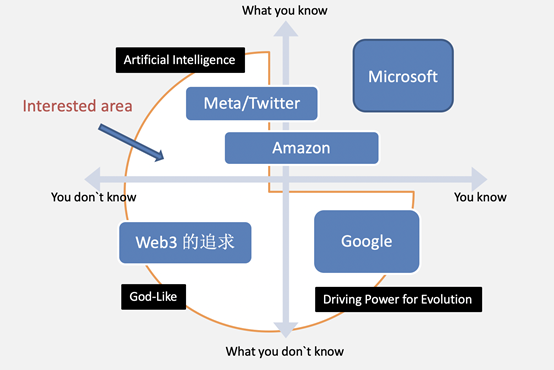
Finally, Web3 shapes the future through the core principle of decentralization, which manifests practically as user autonomy. But if we stretch our imagination further, perhaps Web3 is venturing into the realm of the “unknown unknowns.” Traditionally, “known knowns” constitute knowledge, while “known unknowns” can be explored using Web2 tools like Baidu or Google. For “unknown knowns,” Web2 platforms like Amazon or Facebook use AI to uncover insights for users. But what about the “unknown unknowns”? That may be where Web3’s greatest opportunity lies. Looking forward to co-creating the future together.
Join TechFlow official community to stay tuned
Telegram:https://t.me/TechFlowDaily
X (Twitter):https://x.com/TechFlowPost
X (Twitter) EN:https://x.com/BlockFlow_News






