XEN Marketing Data Analysis: A Brief Discussion on Digital Marketing Applications in the Web3 Domain
TechFlow Selected TechFlow Selected
XEN Marketing Data Analysis: A Brief Discussion on Digital Marketing Applications in the Web3 Domain
When the entire internet is buzzing about how the minting of XEN Crypto caused Ethereum's gas fees to skyrocket, as marketers, we're more interested in how XEN Crypto actually became popular.
 Navigating Web3 tides with focused insights
Author: GuLiang, Web3 MKT
XEN Crypto was likely the most discussed project last week. While the entire internet热议ed how "the minting of XEN Crypto caused Ethereum gas fees to skyrocket," as marketers, we’re more interested in understanding how XEN Crypto gained traction.
On a whim, let’s examine the XEN project from a traffic and data perspective to see if it can offer insights for fellow Web3 marketers navigating this space—decoding the traffic pathways behind its explosive popularity.
This article will analyze the XEN Crypto project website to explore:
-
Traffic overview and trend changes
-
Audience demographics and geographic distribution
-
Traffic composition and source breakdown
-
Potential factors contributing to the project's virality
1. Traffic Overview
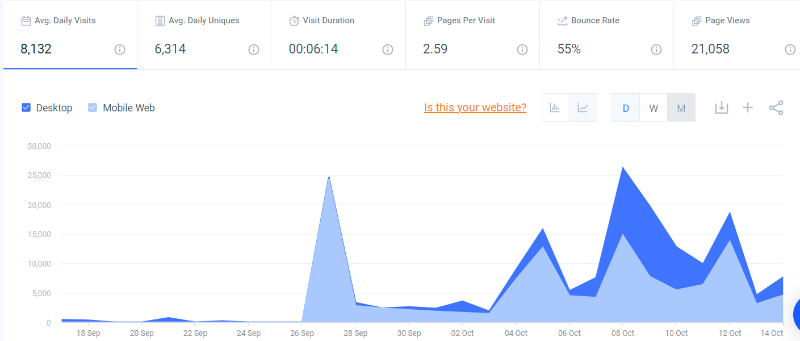
XEN Crypto information site traffic overview, as of October 14, 2022, has reached 178,000 visits.
From a traffic trend perspective, the first peak occurred around September 27, prior to the official launch. A second peak appeared around October 5, followed by the first post-launch peak on October 8—the official release date—and a secondary peak on October 12 (influenced by rumors of an attack).
In terms of traffic sources, mobile dominated before the official launch. After launch, desktop traffic share steadily increased, resulting in a roughly 2:1 ratio between mobile and desktop traffic.
(Data source: Similarweb)
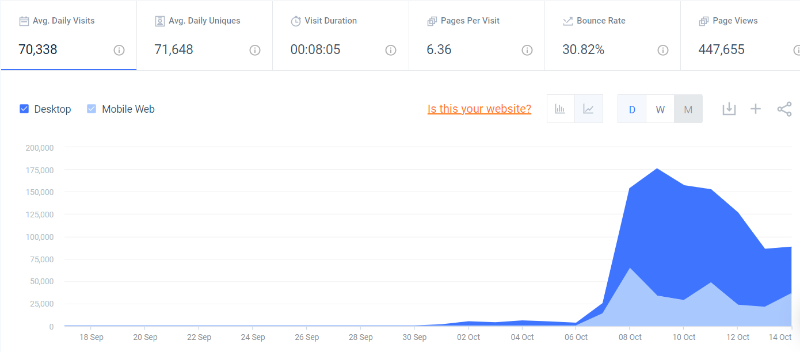
XEN Crypto minting site traffic overview, as of October 14, 2022, has reached 984,000 visits.
From a traffic trend standpoint, after its initial announcement on Twitter on October 2, traffic gradually built during the pre-launch phase, spiked dramatically on the official launch date of October 8, peaked on October 9, and remained high over the following 1–2 days due to ongoing online discussions.
Comparing the traffic trends of the XEN Crypto information site and the minting site reveals a sequential and cascading relationship: the main information site absorbed the majority of early traffic during pre-launch awareness and user acquisition, then funneled visitors to the minting site via internal links.
In contrast to the information site, the minting site sees only 27% of traffic from mobile and 72% from desktop. This reflects that users still prefer desktops for token contract interactions, while mobile dominates information consumption due to the amplification power of social media on mobile platforms.
(Data source: Similarweb)
2. Geographic Distribution of Visitors
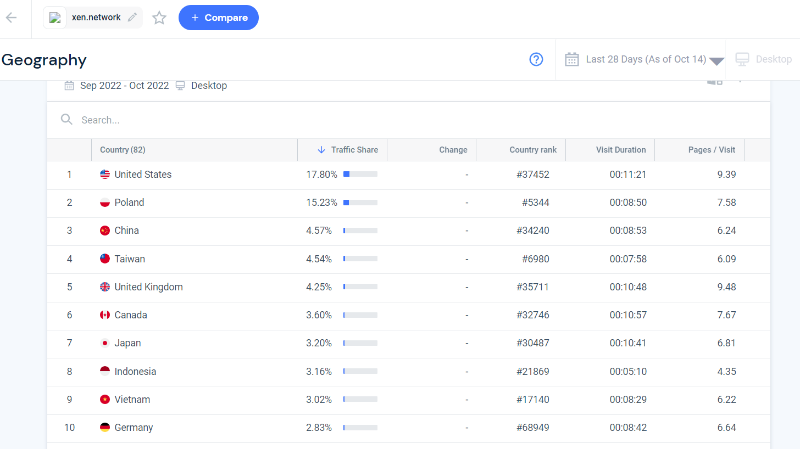
Since Similarweb only captures desktop user locations, to better illustrate geographic distribution, we focus on the XEN Crypto minting site, where desktop traffic dominates, to analyze audience demographics. Three key observations stand out:
-
Poland recorded the highest traffic in Europe, which contradicts conventional assumptions and highlights Web3’s potential in emerging markets.
-
Southeast Asian countries including Indonesia and Vietnam also showed strong momentum. Singapore may not have ranked in the top 10 due to its small population size.
-
Average time spent per visit exceeded 8 minutes—an impressively high engagement rate—but also suggests a steep learning curve for users navigating such platforms.
(Data source: Similarweb)
Looking at this demographic breakdown, my immediate takeaway is the borderless nature of Web3 and the rising influence of emerging markets. The prominence of countries like Poland, Indonesia, and Vietnam suggests that over the next 5–10 years, leadership in Web3 may not necessarily come from traditional Western hubs. Emerging markets could deliver unexpected breakthroughs, opening new avenues for future Web3 expansion.
3. Traffic Composition
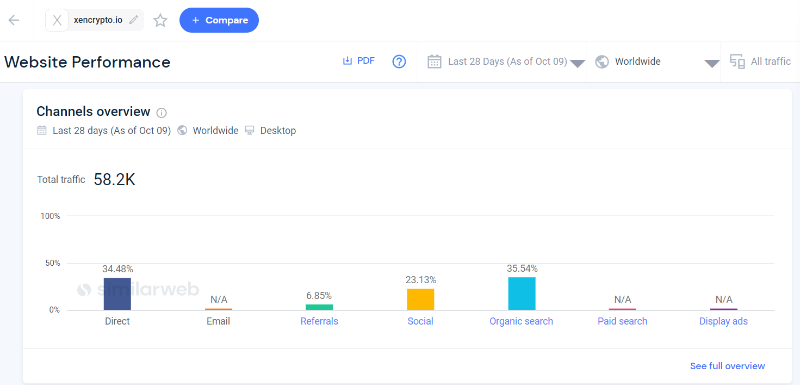
The project’s success was undoubtedly driven by traffic. Next, we’ll analyze the traffic sources of the XEN Crypto information site. We focus on this site because, from a traffic溯源 perspective, it handled the bulk of traffic both before and immediately after launch. Breaking down its sources helps reconstruct how traffic surged so rapidly.
(Data source: Similarweb)
As shown above, total site traffic breaks down as follows:
-
34.48% Direct — users who accessed the site by typing the URL directly or clicking from bookmarks
-
6.85% Referral — traffic referred from other websites
-
23.13% Social — traffic coming from social media platforms
-
35.54% Organic Search — traffic from search engines like Google, Yahoo, and Bing via keyword searches leading to site clicks.
We’ll now break down each traffic source in detail.
Referral Traffic
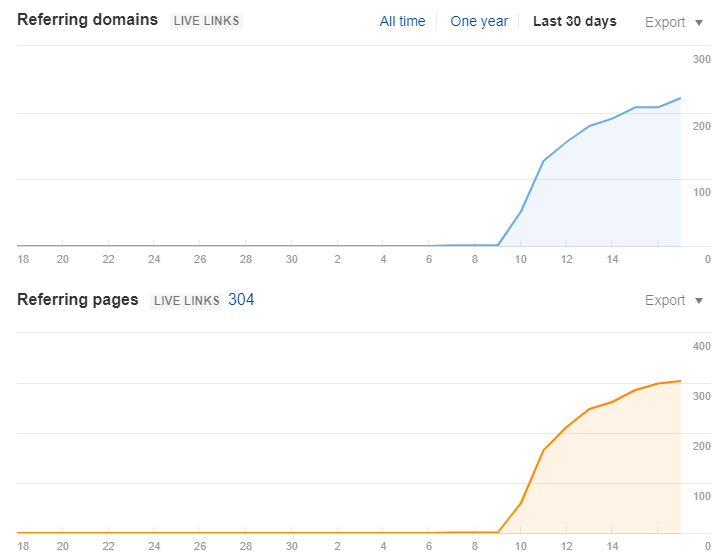
The chart below pulls referral traffic to the XEN Crypto information site over time. Referring sites have seen consistent growth since October 9, accumulating over 300 backlinks to date—including numerous crypto news outlets.
(Data source: Ahrefs)
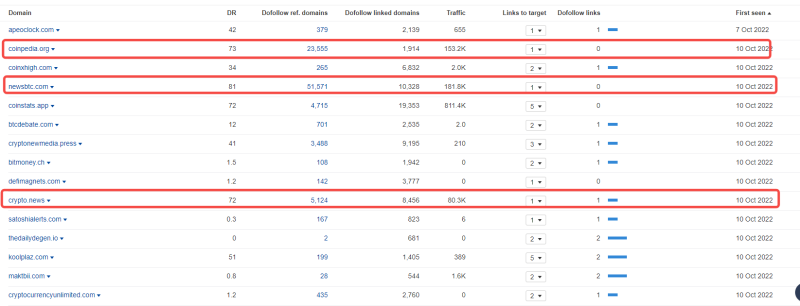
Further analysis identifies key sites that boosted XEN Crypto early on. Many are high-authority sites with domain ratings above 70. There’s no doubt these platforms played a critical role in amplifying the project’s visibility. Additionally, news articles published on these sites were often shared simultaneously on their social media channels, further fueling social dissemination. We preliminarily conclude that this was the primary traffic driver behind XEN Crypto’s viral explosion.
(Data source: Ahrefs)
Social Traffic
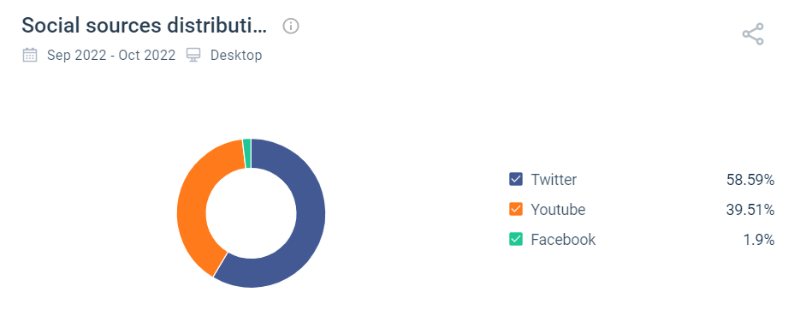
According to Similarweb, 58.59% of PC traffic to the XEN Crypto information site came from Twitter, and 39% from YouTube.
While Twitter’s importance in Web3 communication is undeniable, YouTube deserves special attention here. Based on keyword tracking of “XEN Crypto” on social platforms before the launch (pre-October 8), we can preliminarily conclude that YouTube served as the second major traffic booster, driving momentum during the pre-launch phase and enabling the project to go viral immediately upon launch.
(Data source: Similarweb)
Although Twitter dominates social traffic, YouTube appears to be the platform where original content was primarily created during the pre-launch phase, later amplified on Twitter to drive broader reach.
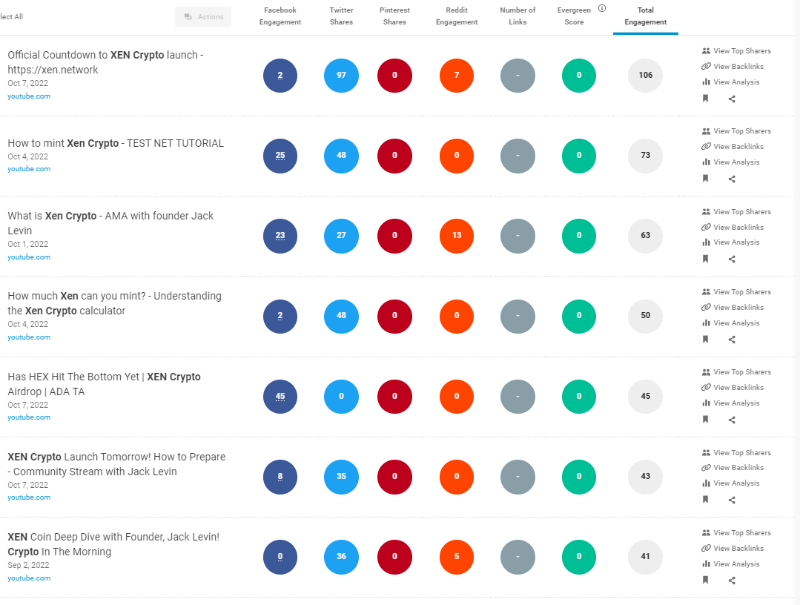
The image below shows keyword tracking results from BuzzSumo for “XEN Crypto.” It reveals that the project team conducted intensive content campaigns on YouTube before October 8—essentially training potential users. Several noteworthy strategies stand out:
-
Founder Jack Kevin hosted live interactions with multiple crypto-focused YouTube channels. Though these channels had modest subscriber counts, their audiences were highly targeted, evident from video view and engagement metrics.
-
Unlike typical one-off YouTube promotions, several creators treated XEN Crypto as a dedicated series. Between October 1 and 7, they released multiple videos covering mechanics, gameplay, founder livestreams, performance metrics, etc., ensuring depth and breadth of coverage and repeated touchpoints with potential users.
(Data source: BuzzSumo)
Organic Search Traffic
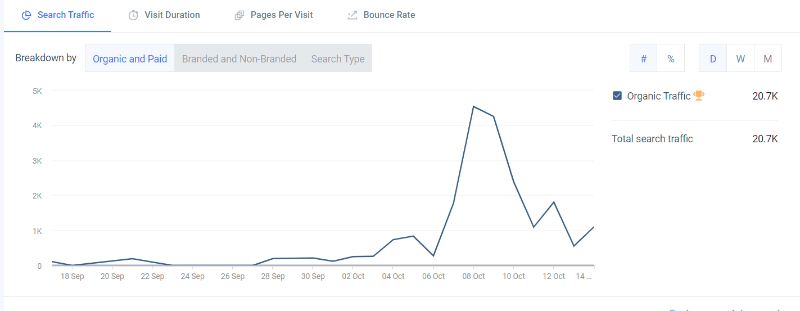
Regarding organic search traffic, search volume peaked around the launch date. This suggests that early promotional efforts triggered subsequent search behavior.
(Data source: Similarweb)
Further breakdown of the keywords driving user searches and the site’s top visited pages reveals some interesting patterns. Beyond the homepage, well-known gas cost discussions, and official responses to attack rumors, the most visited blog posts focused on explaining XEN Crypto’s game theory, related “how-to” guides, and instructions for connecting with MetaMask.
The clear takeaway: even when targeting crypto-native audiences, never underestimate the learning curve. It’s essential to lower entry barriers as much as possible, clearly explaining both “how” and “why” at the most fundamental level to attract broader attention. User behavior on the site strongly supports this observation.

(Data source: Ahrefs)
4. Additional Insight: Founder-Centric Marketing
The reasons behind XEN’s surge in popularity were thoroughly analyzed in “Is XEN’s Popularity the Result of Calculated Strategy or a Random Event?”. Here, we emphasize the role of founder Jack Levin throughout the project’s rollout.
In Web2 startups, founder marketing is a common tactic—using the founder’s story and persona to build brand credibility and emotional connection.
XEN provides an excellent case study for applying founder marketing in Web3.
Too often in Web3, projects nominally led by influencers result in minimal actual involvement, ultimately becoming mere extraction schemes.
With XEN Crypto, however, Jack Levin was deeply involved, serving as the project’s spokesperson. More importantly, he cultivated a clear, memorable, and shareable personal tagline: #Google21. The project even published two dedicated articles on its initial Twitter and blog posts elaborating on the founder’s background and his ties to Google.
Typically, a project’s first official tweet best reflects its market entry strategy. XEN’s choice to lead with the founder’s story indirectly confirms the team’s strategic thinking in content marketing.

(Image source: Screenshot from @XENCryptoio Twitter account)
5. Additional Insight: Leveraging Rumors and Mystery in Communication
Rumors and mystery always spread fastest and widest. Their power lies in containing emotionally charged, attention-grabbing elements that fuel self-propagation. During our social monitoring of the XEN project, we found a Reddit post circulating on October 7, just before launch.
While this single Reddit thread wasn’t widely shared, a Google search reveals over 132,000 results containing both “XEN” and “Satoshi Nakamoto.”
Early blog content from the XEN team also subtly fostered associations between XEN and Satoshi Nakamoto. Whether or not they started the rumor, they certainly didn’t discourage it.

(Data source: Brand24)
6. Key Takeaways for Web3 Marketers
What marketing lessons can we draw from the XEN Crypto project? In summary:
-
The PR outreach list used during XEN Crypto’s campaign offers valuable reference
-
Prioritize YouTube creators and organize series-style coverage to drive social buzz
-
Thoroughly plan and anticipate content needs to lower the onboarding barrier for new users
-
Create discussion-worthy topics by embedding emotionally resonant, viral-ready tags into the project—such as “Google’s 21st Employee” or “XEN Reviving Satoshi”—to spark conversations
-
Integrate founder marketing into the project’s vision and storytelling to enhance credibility and trust
About Web3 MKT
Web3 MKT is a Web3 growth strategy study group initiated by TechFlow, aiming to dissect real-world cases, study Web3 marketing and growth tactics, and transform insights into practical capabilities to help projects achieve better global market performance.
We welcome anyone interested in exploring Web3 marketing and growth to join us. For inquiries, add WeChat zolohands to connect and share. Web3 MKT Link
Join TechFlow official community to stay tuned
Telegram:https://t.me/TechFlowDaily
X (Twitter):https://x.com/TechFlowPost
X (Twitter) EN:https://x.com/BlockFlow_News