








A Quick Overview of 29 Unlaunched Token Layer1/Layer2 Protocols and How to Participate
TechFlow Selected TechFlow Selected
A Quick Overview of 29 Unlaunched Token Layer1/Layer2 Protocols and How to Participate
This article compiles 29 blockchain projects that have not issued tokens (with tutorials included). Readers who are interested can follow and participate.
 Navigating Web3 tides with focused insights
Author: Zhui Feng Lab
On October 19, Aptos distributed approximately 20 million APT tokens to participants in its incentivized testnet, sparking renewed interest in Layer1 projects across the crypto market. This article compiles information on 29 unlaunched public blockchain projects (with tutorials), which readers may find interesting to follow and engage with.
1) Sui
Sui is a next-generation smart contract platform powered by Move, offering high throughput, low latency, and an asset-oriented programming model.
Key Features of Sui:
1. High scalability and instant settlement: Sui scales horizontally to meet application demands.
2. Uses Move-based smart contracts.
3. Sui's scalability extends beyond transaction processing—storage is also low-cost and horizontally scalable, enabling developers to define complex assets with rich attributes that exist directly on-chain rather than relying on off-chain storage.
4. Mysten Labs will release the open-source Sui Developer Kit (SDK).
Tokenomics: Sui has announced it will issue a native token called SUI, with a maximum supply capped at 10 billion. A portion will be released at mainnet launch, while the remainder will be distributed over several years as future staking rewards. The SUI token serves four purposes: staking to participate in the proof-of-stake (PoS) mechanism, paying gas fees for transactions and operations, serving as a versatile and liquid asset supporting the broader Sui economy, and participating in on-chain governance voting.
Official website: Link
Official Twitter: Link
Team info: Link
Official blog: Link
Related introduction: Link
Roadmap: Link
Node tutorial: Web Link
Ecosystem projects: Web Link
Official Updates:
On July 1, Sui announced its incentivized testnet would launch in August. See official Medium post.
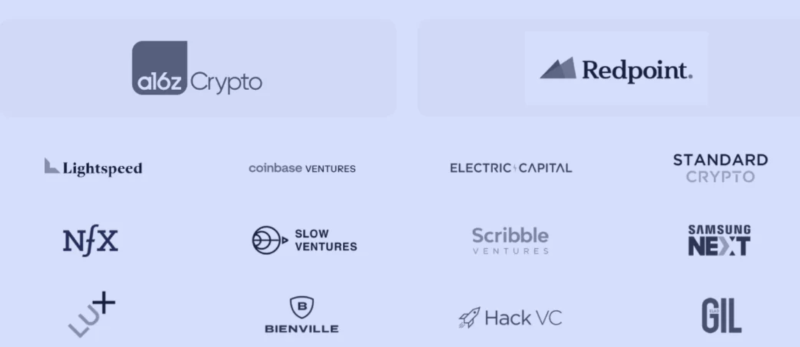
Investors in Mysten Labs (Sui’s parent company):
2) Linera
A next-generation decentralized protocol based on FastPay and Zef. Linera aims to become the first low-latency blockchain capable of scaling as easily as web2 applications.
On June 29, 2022, Linera announced a $6 million seed round led by a16z, with participation from Cygni Capital, Kima Ventures, and Tribe Capital.
Official website: Link
Official Twitter: Link
Team info: Link
Official blog: Link
Related introduction: Link
CEO Mathieu Baudet's Twitter: Link
3) Aleo
Aleo is the first decentralized, open-source platform supporting private and programmable applications. Using zero-knowledge cryptography, Aleo moves smart contract execution off-chain to enable decentralized applications that are both fully private and scalable to thousands of transactions per second. Aleo brings all the flexibility of Ethereum but with a more scalable architecture—miners don’t need to re-execute every transaction, only verify their correctness.
Aleo builds a high-performance blockchain network with strong privacy, usability, and programmability, providing a fully private application development platform that protects user data through decentralized systems and zero-knowledge proofs. Users can access a truly personalized web experience without surrendering control over their private data.
Aleo's founding team formed in 2019. After nearly two years developing the core protocol framework, Aleo raised $28 million in a Series A round in April 2021, led by a16z, with participation from Placeholder VC, Galaxy Digital, Variant Fund, Coinbase Ventures, Ethereal Ventures, Polychain Capital, Slow Ventures, Dekrypt Capital, Scalar Capital, Zero Knowledge Validator, and Balaji Srinivasan (former CTO of Coinbase).
In February this year, Aleo completed a $200 million Series B round led by SoftBank and Kora Management, with continued participation from a16z, and additional investors including Tiger Global and Samsung Ventures.
Aleo positions itself as a privacy-focused public chain supporting smart contracts, with core technologies centered around Zexe and Leo. The Zexe consensus protocol improves upon zk-SNARKs from ZeroCash, enabling not only encrypted token transfers but also private interactions at the application level. Leo, Aleo’s native programming language, modularizes zk-SNARKs within the Zexe protocol, allowing any Dapp on the Aleo platform to utilize zero-knowledge proofs.
Notably, earlier this year Aleo partnered with Forte, a blockchain gaming platform (which raised over $900 million last year), to bring zero-knowledge proofs into blockchain gaming.
Previously, Aleo completed two rounds of testnet trials, with a third round currently in preparation. Following the completion of the third testnet phase, Aleo will transition toward mainnet launch, at which point its token will be released. Aleo previously disclosed its token will follow a halving-style inflation model.
Official website: Link
Official Twitter: Link
Official blog: Link
Testnet tutorial: Link
Related reading: Web Link
4) Iron Fish
Overview: The name Iron Fish originates from a WWII-era U.S. communication system built using Native American languages, symbolizing the power of cryptography. Iron Fish is a privacy blockchain network designed to serve as a universal privacy layer for all chains. It is a decentralized, proof-of-work (PoW), censorship-resistant, and publicly accessible blockchain project aiming to provide robust privacy guarantees for every transaction.
Just as the invention of SSL/TLS in the 1990s paved the way for e-commerce and benefited countless industries, we believe privacy is essential for protecting users and expanding cryptocurrency adoption. Iron Fish was built from the ground up as a new cryptocurrency, strictly following the Sapling protocol to deliver easy-to-use, fully private payments. Each account includes a view key, granting read-only access to its holder.
Iron Fish positions itself as a Layer1 privacy network using PoW consensus combined with zk-SNARKs and the Sapling protocol to provide the highest level of privacy protection for on-chain transactions. Its standout feature is maintaining privacy without sacrificing transaction accessibility. To achieve this, Iron Fish assigns each address an additional "view key," allowing the owner to grant others read-only access.
This mechanism effectively addresses regulatory challenges faced by privacy-focused Layer1 blockchains. By using the "view key," Iron Fish enables authorized institutions to review account details in read-only mode, helping comply with anti-money laundering (AML) requirements.
Currently, Iron Fish remains in its second incentivized testnet phase, which will continue until nodes stabilize, functionality is complete, and the network is ready for mainnet launch.
According to plans, Iron Fish will eventually establish cross-chain bridges with other major blockchains, offering privacy protection for mainstream assets and gradually realizing its ultimate vision—to become the privacy shield layer for the entire Web3 ecosystem.
In November 2021, Iron Fish announced a $27.7 million Series A round led by a16z, with participation from Elad Gil, Sequoia Capital, Electric Capital, Dylan Field, Alan Howard, Jeff Weiner (LinkedIn Executive Chairman), MetaStable, A Capital, Divesh Makan (Iconiq), Do Kwon (Terra), Matt Luongo (Keep Network), Nathan McCauley (Anchorage), and Arrington XRP.
Official Twitter: Web Link
Official website: Web Link
Related articles: Web Link
Testnet tutorial: Web Link
5) Anoma
Anoma is a privacy-focused PoS public chain strongly backed by renowned venture firm Polychain Capital. The Anoma Foundation is a blockchain technology company based in Switzerland.
Anoma is a structural framework for self-contained and autonomous coordination protocols and mechanisms. Built on advanced cryptography, programming language theory, and research, Anoma’s primary goal is to facilitate private transactions using any form of digital value representation, regardless of issuer.
Anoma emphasizes two core concepts: “barter” and “privacy.” The project aims to build a privacy payment system for everyone, returning financial sovereignty to individuals.
“Barter” refers to Anoma’s goal of creating a network where any asset can serve as a medium of exchange or payment, allowing individuals to freely choose their preferred asset class during transactions. Notably, “any asset” includes any tradable goods, services, or digitally representable items with intrinsic value—including assets created on Anoma, assets transferred via interoperability protocols, and fiat currencies in stablecoin form.
“Privacy” is straightforward: in Anoma, sender, receiver, amount, and asset denomination are all encrypted to protect user privacy and prevent data tracing. Zero-knowledge proofs ensure fund transfers. Additionally, Anoma uses a unified shielded pool shared across all assets, rather than separate pools per asset. As more participants join and more assets flow through, transaction anonymity increases significantly.
In April 2021, Anoma raised $6.75 million in its first funding round, led by Polychain Capital, with participation from Electric Capital, Coinbase Ventures, FBG Capital, CMS Holdings, Lemniscap, Cygni Labs, and Walden Bridge Capital. In November of the same year, Anoma secured another $26 million, again led by Polychain Capital, with additional investors including Fifth Era, Maven Capital, Zola Capital, Electric Capital, and CMCC.
Official Twitter: Web Link
Official website: Web Link
Related articles: Web Link
6) Altlayer
AltLayer is a temporary scaling layer built on Optimistic Rollups, connecting to various Layer1 and Layer2 platforms such as Ethereum, Solana, Polkadot, Cosmos, Arbitrum, and Optimism. AltLayer supports multiple chains and VMs, with default compatibility for EVM and WASM. As such, AltLayer isn't tied to any single Layer1 or Layer2; instead, it functions as a modular, pluggable scaling solution compatible with all EVM and WASM chains.
AltLayer raised $7.2 million in a seed round led by Polychain Capital, Jump Crypto, and Breyer Capital, with participation from Gavin Wood (Polkadot founder), Balaji Srinivasan (former CTO of Coinbase and former a16z partner), Sean Neville (Circle co-founder), and Kain Warwick and Jordan Momtazi (Synthetix and Bodhi Ventures co-founders).
The AltLayer Network announced it will host Dark Forest—a decentralized real-time strategy game built using zkSNARKs—on its dedicated gaming execution layer. A community round of the game will run from September 9 to September 11, 2022 (48 hours), with top 20 players on the leaderboard receiving the AltLayer OG badge.
Official Twitter: Web Link
Official website: Web Link
Related articles: Web Link
Team introduction: Web Link
7) ESPRESSO Systems
Overview: Espresso Systems developed the Configurable Asset Privacy (CAP) protocol, enabling digital assets to have customizable privacy features. The first application of CAP is CAPE (Configurable Assets for Privacy on Ethereum). CAPE is a smart contract application allowing asset creators to mint new assets with custom privacy settings and generate private versions of existing Ethereum assets, adding privacy features to ERC-20 and eventually ERC-721 tokens. While CAPE can operate on any EVM-compatible blockchain, the team plans to deploy it soon on the Ethereum Goerli testnet as a demonstration, with future migration to Espresso Systems’ own infrastructure and interaction with Ethereum assets via token bridges.
Official Twitter: Web Link
Official website: Web Link
Related articles: Web Link
Tutorial: Web Link
8) Monad
In mid-April (before Terra severely impacted Jump Trading), Keone Hon, head of research at Jump Trading, announced his departure to found Monad. His vision is to unlock the full potential of the EVM ecosystem by building a high-performance, EVM-compatible blockchain that dramatically improves EVM execution efficiency. According to Keone, Monad is expected to achieve performance exceeding Ethereum by over 1,000 times, supporting more complex applications and broader adoption.
Monad believes that due to extensive user education around Ethereum, EVM has become the de facto standard—akin to JavaScript in the web2 world. However, current Ethereum scaling approaches—whether sharding or rollups—fragment the blockchain into isolated execution environments, breaking composability. Thus, a higher-performance base layer is needed.
While Monad emphasizes the need for Layer1 to achieve much higher TPS to support application innovation, it hasn’t yet detailed exactly how it will achieve this leap in performance. However, from limited descriptions on its website, Monad is likely focusing on low-latency programming, compiler optimization, and multi-threaded computation.
Official Twitter: Web Link
Official website: Web Link
Related articles: Web Link
9) Sei Network
Sei Network is a Layer1 blockchain built using the Cosmos SDK and Tendermint, featuring a built-in Central Limit Order Book (CLOB) module.
Sei is purpose-built so that applications can be constructed atop the CLOB. Other Cosmos-based blockchains can also leverage the CLOB as a shared liquidity hub to create markets for other assets.
As infrastructure for DeFi products, Sei prioritizes reliability, security, and high throughput. Applications built on Sei benefit from dedicated order book infrastructure, fast execution, deep liquidity, and fully decentralized matching services.
Official Twitter:
Official Twitter: Web Link
Official website: Web Link
Related articles: Web Link
Tutorial: Web Link
10) Gear
While the Cosmos ecosystem has Canto, the Polkadot ecosystem has Gear, a highly anticipated Layer1. Gear is an advanced smart contract chain supporting WebAssembly (WASM). Once it successfully secures a parachain slot and connects to Polkadot, developers will be able to deploy their Dapps to Gear in under five minutes—the simplest and most efficient method to enter the Polkadot ecosystem.
Technically, Gear offers several notable features:
-
Support for multiple programming languages such as Rust, C, and C++, significantly lowering the entry barrier for developers unfamiliar with blockchain and attracting more talent to the industry;
-
When running in browsers, WebAssembly allows programs to execute at near-native speed, improving user experience;
-
For smart contract interactions, Gear uses the Actor model, which is inherently sharded and parallelizable, enabling asynchronous programming in different languages and enhancing transaction processing efficiency—allowing diverse business logic Dapps on Gear to run at high speed.
In December 2021, Gear, the smart contract layer built on Polkadot, announced a $12 million raise led by Blockchange, with participation from Three Arrows Capital, Lemniscap, Distributed Global, and Gavin Wood (Polkadot founder).
Official website: Web Link
Official Twitter: Web Link
11) Celestia
Celestia was formerly known as LazyLedger. It is a uniquely structured Layer1, positioning itself as the “first modular blockchain network”. Specifically, Celestia modularizes the blockchain tech stack and decouples consensus from execution. As the consensus layer, Celestia handles only transaction ordering and data availability verification, while actual transaction execution is delegated to execution layers connected to Celestia (such as Celo).
The roadmap indicates Celestia plans to launch a testnet in 2022, followed by incentivized testnets and mainnet in 2023. The team has confirmed a future token will be issued for PoS staking.
Celestia’s architecture bears some resemblance to Polkadot’s “relay chain + parachains,” but Polkadot’s multi-chain path hasn’t progressed as smoothly as hoped. Whether Celestia can meet expectations remains to be seen.
Seed round participants include Interchain Foundation, Binance Labs, Maven 11, KR1, Signature Ventures, Divergence Ventures, Dokia Capital, P2P Capital, Tokonomy, Cryptium Labs, Michael Ng, Simon Johnson, Michael Youssefmir, and Ramsey Khoury.
Celestia was co-founded by Mustafa Al-Bassam (Ph.D. in blockchain scalability from University College London), Ismail Khoffi (former Tendermint engineer), and John Adler (former ConsenSys Layer2 researcher).
Team highlights:
-
Zaki Manian — Co-creator of IBC and early contributor to Cosmos
-
Ethan Buchman — Co-founder of Tendermint and Cosmos
-
Morgan Beller — General Partner at NFX and co-founder of Diem (formerly Libra)
-
Nick White — Co-founder of Harmony
-
James Prestwich — Founder of Summa (acquired by Celo)
-
George Danezis — Professor of Security and Privacy Engineering at University College London
Official Twitter: Web Link
Official website: Web Link
Related articles: Web Link
12) Fuel
Fuel is the first Optimistic Rollup deployed on Ethereum mainnet, primarily suited for payment-centric applications. The upcoming Fuel V2 will introduce a highly parallelizable minimal execution system based on UTXO and support for smart contracts, featuring Ethereum-like interoperable Turing-complete smart contracts—not just simple transfers.
Progress: Fuel is a modular execution layer. In June, it launched SwaySwap, a demo AMM app on its developer network.
Funding: Raised $1.5 million in September 2021, led by CoinFund, with participation from Fenbushi Capital and Origin Capital.
Features: Fuel is an Optimistic Rollup for Ethereum, initially scaling Ethereum using technologies like UTXO (Unspent Transaction Output). Version 1.0 focuses on payment applications.
However, after mainnet launch, due to limited use cases and lack of smart contract support, user interaction remained low. Thus, Fuel 2.0 pivoted to become a modular execution layer. One of its co-founders, John Adler, is also a co-founder of Celestia.
Fuel promotes three technical innovations: 1) Parallel transaction execution via UTXO to boost performance; 2) FuelVM (Fuel Virtual Machine), optimizing traditional VMs and addressing EVM compatibility; 3) Introducing Sway, a programming language, and Forc, a toolchain, for developers.
Official Twitter: Web Link
Official website: Web Link
Related articles: Web Link
13) Polygon Avail
Polygon Avail’s solution is very similar to Celestia’s. In fact, Celestia co-founder Mustafa Al-Bassam claimed Avail copied Celestia, even replicating almost word-for-word the description he wrote for Celestia in 2019.
Progress: A general-purpose modular solution providing DA. Launched its testnet in June this year.
Official Twitter: Web Link
Official website: Web Link
14) EigenDA
EigenDA is the data availability (DA) solution proposed by EigenLayer. EigenLayer itself is an Ethereum restaking layer.
Founder Sreeram Kannan argues that trust between blockchains and DApps is fragmented, requiring each ecosystem to pay high capital costs to maintain trust. For example, Ethereum’s beacon chain currently has over 13 million ETH staked, and Ethereum pays ~5% APR to stakers to maintain this level.
EigenLayer enables restaking—allowing stakers to reuse their stake not only for PoS but also for middleware, oracles, and DApps—improving capital efficiency and reducing trust costs.
EigenLayer is built on Danksharding and ETH staking. EigenDA is EigenLayer’s DA solution, specifically designed for Optimistic Rollups and ZK-Rollups. Public information about the project is limited.
Official Twitter: Web Link
Official website: Web Link
15) Assembly
A modular smart contract layer on IOTA. Currently in Stake Phase 3. Users can stake MIOTA via firefly.iota.org to earn 0.000001 ASMB tokens every 10 seconds. Wallets must accumulate at least 1 ASMB to receive the airdrop. 20% of total ASMB supply will be allocated to IOTA stakers. Assembly mainnet is expected to launch this year, enabling ASMB transfers.
Funding: Total funding reached $118 million. Investors include Huobi, LD Capital, HashKey Capital, and Signum Capital.
Features: Assembly is built on IOTA. Unlike Ethereum’s account model, IOTA uses a UTXO ledger supporting high concurrency. However, UTXO isn’t naturally compatible with smart contracts. Additionally, IOTA uses DAG (Directed Acyclic Graph) structure, beneficial for concurrency.
In the IOTA+Assembly setup, IOTA achieves high performance via UTXO and DAG. Since UTXO lacks smart contract support, IOTA is ideal as a Layer1 focused solely on DA and settlement—without DApps competing for block space. Assembly then acts as a smart contract layer on IOTA, enabling smart contract support for rollups.
Security for rollups on the IOTA mainnet (transaction validity/fraud proofs) is enforced by specialized smart contract chains deployed on Assembly. Transaction validation is performed by top-ranked root-chain validators.
The IOTA+Assembly structure resembles Polkadot+Moonbeam and Cosmos+Evmos—modular smart contract layers supporting smart contracts for rollups and parachains.
Official Twitter: Web Link
Official website: Web Link
16) zkPorter
zkPorter is the off-chain DA solution proposed by zkSync. In June, zkSync launched its 2.0 testnet, featuring zkEVM and zkPorter as key components. zkSync 2.0 mainnet is expected to go live at the end of October or early November.
Features: zkSync supports both zk-Rollup and zkPorter. The former keeps DA on-chain; the latter stores DA off-chain. zkPorter’s off-chain DA is maintained by Guardians (zkSync token holders) and includes slashing penalties. Relying on Guardians for DA is relatively centralized.
Official Twitter: Web Link
Official website: Web Link
17) StarkEx DAC
Official Twitter: Web Link
Official website: Web Link
18) Arbitrum Anytrust
Arbitrum launched Nova Chain in August, based on Anytrust technology. Nova Chain is already live
Join TechFlow official community to stay tuned
Telegram:https://t.me/TechFlowDaily
X (Twitter):https://x.com/TechFlowPost
X (Twitter) EN:https://x.com/BlockFlow_News






