From SBTs, can Otterspace inject new vitality into DAOs?
TechFlow Selected TechFlow Selected
From SBTs, can Otterspace inject new vitality into DAOs?
A DAO tool focusing on the SBT concept, enabling DAOs to issue SBTs to their members.
 Navigating Web3 tides with focused insights
By Aya, TechFlow
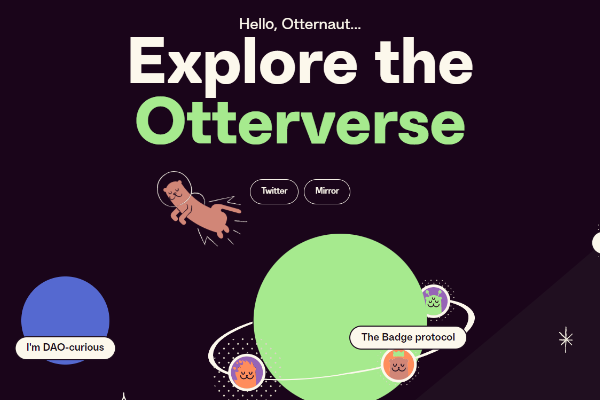
Just recently, the DAO tool Otterspace secured a $3.7 million seed round led by institutions including Cherry Crypto and Coinbase. This SBT-focused platform offers various "badges" to DAOs, enabling them to tag members according to roles and thereby improve participation, coordination, and the distribution of power and permissions.
At the same time, Otterspace aims to gradually enhance DAO autonomy and permissionless participation by providing individuals with clear pathways and incentives.
Project Overview
Otterspace is a DAO tool built around the concept of SBTs, allowing DAOs to issue SBTs to their members. Members can use these SBTs for governance participation and access verification. The project aims to enhance the DAO experience, enabling Web2 users to more clearly and directly engage in daily DAO activities and make meaningful contributions.
For a long time, contributor experience within DAOs has been a persistent challenge. To address this, Otterspace has launched a modular and composable toolkit, along with community-derived best practices, enabling DAOs to flexibly integrate these tools into daily operations.
Otterspace is designed to reward community members with NFTs for specific behaviors rather than requiring them to purchase NFTs.
For example, once a contributor completes certain tasks or actions set by the DAO through an application, they receive a non-transferable NFT badge. This badge defines their role within the DAO and grants corresponding rights. These badges allow DAO members to form teams, identify core contributors, and automatically gain access to spaces on Discord or Telegram. They can be used for governance voting or simply as part of a reputation system.
The Logic Behind Member Segmentation via "Badges"
Until now, DAO members have primarily been differentiated only by the amount of DAO tokens they hold. In most cases, there's a clear distinction in governance rights between token holders and non-holders. However, the composition of DAO members is far more nuanced—some individuals contribute full-time without holding tokens, while others hold tokens but only participate sporadically as guests. More complex permissioning often relies on manual, secondary interventions.
Today, DAOs are increasingly using reputation, work quality, social capital, and experience to determine how to treat specific members. But if rights and responsibilities could be determined based on on-chain records, DAOs would become more autonomous and permissionless—decisions could be automated, such as unlocking new spaces or granting greater governance authority.
With Otterspace, DAOs can create non-transferable badges, set expiration times, and distribute them to members. These badges functionally differentiate types of DAO members and automatically allocate power and influence based on role and reputation—members must complete specific tasks to earn badges and the associated governance rights.

This approach makes DAO governance significantly easier.
Administrators no longer need to manually decide who participates in governance. Members can systematically earn their rightful influence through verifiable contributions. By breaking down DAO membership into smaller units and capturing them on-chain, badges enable DAOs to automate decentralization without human intervention, fulfilling the promise of true decentralization and self-governance.
Team and Funding
Otterspace raised $3.7 million in its seed round, co-led by Cherry Crypto and Inflection, with participation from Coinbase Ventures and others.

Otterspace was founded in February by former SoundCloud employees Rahul Rumalla and Emily Fron, along with ex-VC Ben Dobbrick, who previously served as a partner at Btov Partners and Paua Ventures—both firms also participated in this seed round.
Project Assessment
Many believe that Web3 lacks a proper reconstruction of on-chain social identity, making it heavily dependent on existing Web2 structures. Meanwhile, DAO governance models have become increasingly problematic: how can organizations maintain efficient operations with large memberships while avoiding excessive centralization and preserving decentralization?
And do SBTs truly matter?
These questions about on-chain identity, DAOs, and SBTs remain hotly debated.
Now, Otterspace offers a new approach—a systematic, individual-level governance model that minimizes the economic relationship between community members and DAOs by using badges instead of tokens.
Within DAOs, Otterspace materializes reputation and recognition through SBT badges. This method encourages community members to maintain long-term, active engagement with their communities.
Will this new paradigm fully unlock the potential of DAOs? Only time will tell.
Join TechFlow official community to stay tuned
Telegram:https://t.me/TechFlowDaily
X (Twitter):https://x.com/TechFlowPost
X (Twitter) EN:https://x.com/BlockFlow_News