








Seeing the Big Picture from Small Details: How Will Web3 Gaming Evolve in the Future?
TechFlow Selected TechFlow Selected
Seeing the Big Picture from Small Details: How Will Web3 Gaming Evolve in the Future?
Cryptocurrency will serve as the foundational layer accelerating the mass adoption of open economies in the virtual world.
 Navigating Web3 tides with focused insights
Author: Richard Kim, Partner at Galaxy Interactive
Translation: TechFlow
Blockchain gaming — in early 2018, we decided to invest based on the thesis that "cryptocurrencies would become the foundational layer accelerating mass adoption of open economies in virtual worlds."
Investing in blockchain games in 2018 was a profitable strategy. Blockchain gaming has been a direct beneficiary of the shared mental model around the "M" word. Top consulting firms predict the total market cap of the metaverse industry could reach $5–15 trillion by 2030.
It wasn’t just that blockchain gaming in 2018 was “right” (at least economically), but that it was highly “non-consensus.” Anyone discussing cryptocurrency in the gaming industry would immediately be ostracized and dismissed as belonging to a class of investors not to be taken seriously. In such an environment, beta mattered more than alpha, and riding the wave mattered more than picking individual winners.
But now, things are different. While blockchain gaming still has no shortage of critics (and will for some time), the biggest shift in 2021 was the rapid rise of Axie Infinity. Blockchain gaming achieved its first breakthrough (financially). The investor question shifted from “Should I invest in this company?” to “Can I really afford not to invest?”
With widespread opportunities for 100x token returns and DeFi participation, massive amounts of capital flooded into blockchain gaming. Clearly, it was no longer a non-consensus space. This shift was epitomized by a major gaming fund whose general partners claimed in 2019 they didn’t believe in blockchain — yet today are deploying nearly all their capital into blockchain gaming, often at “extremely unreasonable prices.”
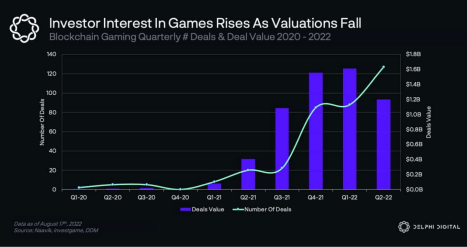
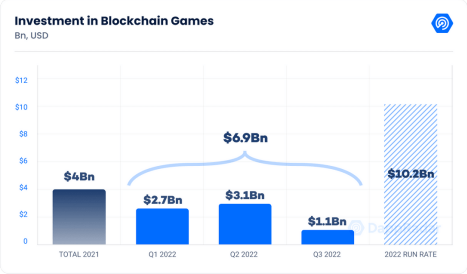
According to Delphi, approximately $5 billion has been invested in blockchain gaming since 2021 across about 130 deals. As definitions broaden, DappRadar x BGA puts that figure closer to $11 billion since 2021.
That’s a massive amount of capital for a sector that hasn’t yet made meaningful impact with mainstream gamers.
Howard Marks wrote in his 1993 letter to investors: “The problem is that extraordinary performance can only come from correct non-consensus forecasts, but non-consensus forecasts are hard to make, correct forecasts are hard to make, and acting on them is harder still.”
While blockchain gaming gained significant momentum in 2021 and 2022, we’ve worked hard to avoid simply chasing hype. Amid the noise, we’re proud to have collaborated with many talented entrepreneurs advancing the field, while remaining vigilant about key issues: unsustainable economics, high valuations, lack of team experience, and structural/regulatory concerns.
- - Sustainability. Over the past two years, countless unsustainable Axie clones have emerged. At one point, we had to take a break from every pitch featuring words like crypto, blockchain, or metaverse. Few teams considered how games could generate organic, sustainable player demand beyond speculation, or how to design effective token recycling mechanisms.Integrating speculators/whales into the gameplay experience without undermining fun for the broader player base remains a difficult design paradigm that the market has yet to crack.We believe there’s much to learn from Web2 open-economy games like EVE Online and genres like SLG (strategy games), as well as from Chinese publishers who excel at modern mobile monetization. Those most likely to succeed are teams experienced in player conversion and retention in Web2, actively experimenting with Web3 primitives while maintaining maximum design flexibility (note: token sales represent sold options).
- - Valuation. Over the past two years, token pricing felt more like an options pricing model than fundamental investment analysis: lock-up periods, liquidity depth, and narrative热度 ("option term and volatility") were fully priced into discounts to spot or expected market caps at launch ("option price"). During this period, exiting early in speculative hot potato games mattered more than fundamentals or fully diluted valuation (FDV). As a result of these distortions, we frequently saw pre-product token valuations in the hundreds of millions — Illuvium’s fully diluted valuation before launch exceeded the price Bethesda sold to Microsoft for!
- - Experience. The biggest risk in game investing isn’t whether a particular game succeeds, but whether the studio can actually ship a game. Many crypto investors now realize they were functionally investing in a crypto gaming SPAC (i.e., the “shell”) rather than a real game studio. It’s a good time to be an outsourcing studio.
- - Structure/Regulation. There are fundamental questions about what rights tokens actually grant investors. Most crypto games will continue generating fiat revenue, yet token holders have no contractual claim to those profits. Even if studios wanted to distribute economic rights to token holders, they might violate securities laws. Yet most crypto investors want tokens because they offer a shorter liquidity path (1–3 years) compared to equity venture timelines (7–10 years), creating major dislocations in the funding market. No one asks the obvious question: if your virtual currency relates to only 1–5% of the game economy, why should its valuation be 100–500% of your equity?
Despite these concerns, we’ve seen promising progress, and investors may want to look for leading publishers and experienced founders in the space. The depth and experience of teams building crypto games have improved significantly, and valuations have come down to more reasonable levels. By early Q3 2022, only mature founders and publisher spin-offs could raise funds at those token FDVs, unlike inexperienced studios in Q1/Q2 '22. Now, in September 2022, we see few pure "token-only" deals, as equity + token warrant structures have become standard, typically with valuations under $100 million. While top projects still command high valuations, we believe experienced developers have a strong opportunity — they tend to have the confidence and expertise to build Web3 games that can impact the mainstream world.
We’re looking for a combination: compelling IP that resonates with players, a sharp understanding of how to sustain open economies, and a balanced approach to token launches that aligns with crypto-native communities — ultimately enabling expansion into the mainstream. Flexibility in investing across layers of value accumulation — whether collectibles (NFTs), tokens, or equity — will be key.
We remain optimistic about the potential for virtual currencies to accumulate lasting economic value without being classified as securities. However, there’s a fine line: it becomes easier if tokens are distributed to reward participants rather than sold as fundraising tools. Aligning the interests of equity and token holders is essential. Pursuing flexible strategies without liquidity pressure is critical. We’re seeking digital cooperative organizations.
Web3 largely unlocks the creation of digital cooperative organizations: (i) transparent governance structures, (ii) ecosystems that reward creators/developers, (iii) embedded mechanisms for exchanging value via digital collectibles.
● Transparent governance structures. Having on-chain rules that make it difficult for developers to unilaterally change system parameters. Transparent governance plays a vital role in immersion and fostering open-world activities.
● Reward ecosystems for creators/developers. Creating mechanisms to return growth upside to contributors. The role of open-world game developers will evolve from closed-loop designers to founding contributors of open ecosystems.
● Exchanging value through digital collectibles. NFTs have the potential to create "status-as-a-service" businesses around gaming environments and social structures.
Contrary to conventional crypto wisdom, we believe experienced teams from Web2 gaming (founders and publishers) will outcompete so-called "crypto-native" peers who’ve never run a game studio. Betting on incumbents who’ve already proven themselves in Web2 has turned out to be a "non-consensus" strategy.
We believe experience, patience, and an open mindset will be the winning combination for transitioning to open-economy games.
Ultimately, our North Star is captured in three keywords: interactivity, community, and agency. “Meaning” is the product of the experiences we create (interactivity), the depth of relationships we form (community), and the self-sovereignty we exercise (agency). Crypto has the potential to significantly enhance virtual experiences along these dimensions, but it often requires careful balancing between money and fun.
Is crypto “necessary” to achieve this? Not necessarily — crypto isn’t the only, first, or even best way to bring markets into games.
Rather, its true power lies in: Cryptocurrency’s ability to incentivize communities, thereby driving creation, expression, and commercialization within virtual worlds — it’s an open-source creative model and a business framework that enables mass participation.
Join TechFlow official community to stay tuned
Telegram:https://t.me/TechFlowDaily
X (Twitter):https://x.com/TechFlowPost
X (Twitter) EN:https://x.com/BlockFlow_News






