








EMIT: Upholding the spirit of crypto, building infrastructure for Web3 public chains
TechFlow Selected TechFlow Selected
EMIT: Upholding the spirit of crypto, building infrastructure for Web3 public chains
Can Web3 balance scalable markets with the principles of the crypto world?
 Navigating Web3 tides with focused insights
The Paradox of Web3 and the Cryptocurrency World?
I have always believed that the mission of the next-generation internet should be to reconcile the large-scale markets of Web2 with the principles of decentralization.
For over a decade, the guiding principle of the crypto world has been complete permissionlessness, absolute neutrality, and decentralization. Yet the still-ambiguous concept of Web3 often leads to definitional confusion with the cryptocurrency industry—and even appears to be replacing it in market orientation. More new projects and foundational technologies are entering this space under the banner of Web3 rather than crypto.
It's like standing on opposite ends of a bridge: one group advances under the name of Web3, quietly sacrificing crypto ideals to reach broader markets. When technology fails to constrain them, many abandon their initial commitment to crypto principles in governance. On the other end, another group holds firm to those principles. Though they may eventually reach the destination, their inability to capture current market interest causes many to give up along the way.
Web3 must target mass markets—that’s a necessary premise for a new era. But after so many years of Layer1 infrastructure development, must we still pay a heavy price by compromising core cryptographic principles in order to scale Web3?
Despite renewed excitement around Meta-affiliated public chains, the overall landscape remains bleak. While these new-generation blockchains boast technical innovations and attract capital, they resemble earlier projects like Algorand, Nervos, or Dfinity—offering limited problem-solving capability despite massive valuations, with only narrative-driven ecosystem scaling as an improvement.
Underneath the capital accumulation, however, ecosystem quality is worrying. Fundamentally, these chains have not achieved qualitative technological breakthroughs in solving the challenge of scaling Web3 while preserving crypto values.
Even more critically, most public chains implicitly acknowledge they are merely imperfect prototypes—even Ethereum at its inception. Yet, many have since lost their way.
Without strong ecosystem applications, there can be no market. The current market is filled with primitive, stone-age-like decentralized apps (dApps), trapped in self-delusion. Under the halo of decentralization, other user needs seem unimportant—even leading to rejection of Web2-style applications and extreme unfriendliness toward developers.
Take, for instance, how new programming languages themselves have become speculative trends—an absurdity. While Move language offers asset operations better suited to digital assets and improved security over Solidity, it remains constrained by its original design context for Libra. It also imposes significant limitations on defining digital assets. In practice, novice developers using Move may not write safer business logic than experienced Java or Go programmers.
These realities have created opportunities for centralized "Web3" projects.
What Problems Does EMIT Solve?
EMIT (Core) takes a pragmatic approach. From the outset, its design incorporates lessons from top Web2 platforms—a stark contrast to most blockchain projects—while still maximizing adherence to crypto principles.
The real obstacles preventing Layer1 from enabling scalable Web3 adoption are four major pain points:
Persistent Performance Bottlenecks: Stemming fundamentally from unavoidable competition among nodes when ordering unrelated transactions, performance gains through adding more nodes hit a hard ceiling.
Complexity and Security Trade-offs: Sharding—the nearly sole viable solution for scalability—is still limited because cross-shard transactions require coordination via a main chain. Even state-based sharding cannot escape the constraint that each application must reside within a single shard, making scheduling complex and inherently risky.
Resource and Performance Drain: Because smart contract states across nodes must remain perfectly consistent, execution cannot leverage full computing power. This severely limits optimization and efficiency—effectively a regression compared to traditional computing—and hampers market scalability.
Constraints on Complex Applications and Contracts: Limited by performance bottlenecks and transaction consensus mechanisms, smart contracts can perform only basic tasks. For example, business logic must be triggered by account-initiated transactions—an experience akin to regressing from the steam age back to agrarian times for complex, large-scale applications.
EMIT has spent the past four years rethinking these issues, working from the ground up to find optimal solutions—and ultimately achieving success.
In short, EMIT Core Protocol is a decentralized blockchain protocol—the standard and set of rules governing how nodes in the EMIT Core network maintain ledger data and interact with one another. These nodes operate independently within a network environment, exchanging information to form a scalable, efficient, and immutable decentralized infrastructure.
The EMIT Core Protocol possesses the following key characteristics:
1. Dependency-Free Cross-Chain Support
Achieving various forms of consensus without requiring native fungible tokens, and natively supporting cross-chain interoperability, enables better utilization of existing blockchain assets. This shifts user focus toward ecosystems and their assets—not toward assets defined solely by EMIT Core itself.
2. Elastic Scalability
Sustained growth of EMIT requires expandable capabilities in computation, storage, and bandwidth to meet ever-growing business demands.
3. Simplified Development of Complex dApps
Building highly complex decentralized applications within traditional virtual machine frameworks is extremely difficult. EMIT Core aims to support and simplify the development of such sophisticated dApps.
4. Native Support for Complex Digital Assets
Beyond fungible tokens, Web3 will revolve around non-fungible assets in diverse production activities. Asset types will diversify, and crucially, EMIT provides flexible, native-level support for complex asset structures in a unified format.
5. User Privacy Protection
Privacy is a fundamental right and symbol of individual independence and freedom. EMIT Core supports private assets and transactions, including at the smart contract level.
Summary of EMIT's Core Technologies
Through five original technologies, EMIT pioneers breakthroughs in overcoming these industry-wide technical barriers.
1. E-Lattice Ledger Structure
EMIT Core adopts an enhanced Block-lattice model—specifically, a lattice-style sharded ledger—with the following features:
- Each account functions as an independent blockchain.
- Blocks on each chain can only be generated by the holder of the corresponding private key.
- Each account maintains a Merkle tree recording its current state.
- When an outgoing transaction is matched with its corresponding incoming transaction, the outgoing transaction is marked as settled. At this point, the sender can discard the settled block, retaining only the account state and pending blocks.
- Accounts can offer Key-Value storage space beyond transaction records.
- Assets are described by (Field, ID, Count), where Field indicates the application ID, ID identifies the asset, and Count denotes quantity. This universal format supports both fungible and non-fungible assets.
Unlike grouped sharding models, this ledger generalizes cross-chain behavior. To achieve high throughput and low latency, transactions are decoupled into two parts—initiation and receipt—created separately by different accounts.
Since block creation across different accounts does not interfere with one another, and with settlement status introduced, this model achieves exceptional elasticity in storage and throughput.
Compared to Nano—the original Block-lattice implementation—EMIT Core natively supports diverse asset types and smart contract environments. By incorporating UTXO-compatible account models, it also introduces optional privacy protections via Merkle trees.
2. Extreme-Sharding Support
In EMIT's account structure, every account has its own chain. Transfers between accounts are inherently cross-chain. The lattice architecture separates transaction sending and receiving into two distinct actions, simplifying complexity. Since each account operates independently, massive throughput becomes possible.
While Nano and Vite use similar approaches, Nano relies on eventual consistency algorithms, which cannot support smart contracts or dApps and are prone to forks and state rollbacks.
Vite improves upon this by introducing smart contracts and resolving rollback issues but reintroduces a "snapshot chain" acting as a central coordinator—similar to group sharding. This undermines the lattice/sharding advantage, ultimately capping throughput based on the snapshot chain's performance.
3. Final Consistency Model for Smart Contracts
Traditional smart contract systems rely on Turing-complete virtual machines, where the final state of stored data defines the outcome of the contract.
This necessitates maintaining identical states across all nodes. Regardless of operations, each node must ensure internal contract state consistency—typically verified via comparison of Merkle Tree roots.
In EMIT Core, decentralized applications consist of a group of P2P network nodes that only need to agree on input and output sequences.
Within EMIT Core’s implementation, a dApp is a special type of account whose inputs and outputs exist as blocks on the same chain. This mechanism allows parallel processing of computational logic, fully leveraging hardware performance for superior throughput.
4. E-Random Consensus Algorithm
EMIT employs a random-check consensus algorithm compatible with block-lattice account models, addressing ledger synchronization performance under full decentralization.
However, unlike regular accounts that require private-key signatures for block creation, dApp account signatures are generated via aggregate signatures from a node group selected by VRF (Verifiable Random Function).
Decentralized app nodes have two roles: producer nodes and auditor nodes, both selected via VRF. Producer nodes generate blocks; auditor nodes verify and sign blocks.
After selecting these two types of nodes, their respective weights are calculated based on PoS status, further ensuring fairness and security of consensus through economic incentives.
5. Flexible Application Integration and Expansion
Built atop this technical framework, EMIT offers highly accessible integration methods tailored for traditional developers.
- Each application exists as an independent account-chain. Beyond EMIT’s built-in EVM environment, Web2 developers can use familiar architectures and development processes, tailoring their applications’ security and latency requirements and choosing appropriate transaction levels.
- They can build far more complex and robust applications, delivering user experiences close to those of Web2.
- Additionally, EMIT natively supports multi-chain aggregation and compatibility, seamlessly integrating assets with major blockchains. Common components like oracles are easily implemented as standalone application-ledgers.
- Finally, EMIT’s transaction mechanism allows applications to define their own transaction costs and fee models, avoiding the barrier posed by gas fees for mass adoption.
Layer0-1: EMIT Ushers in a New Web3 Ecosystem
EMIT Core effectively fulfills the missions of both Layer1 and the emerging Layer0 concept, seamlessly combining them into a powerful, supercharged public chain infrastructure for Web3 applications.
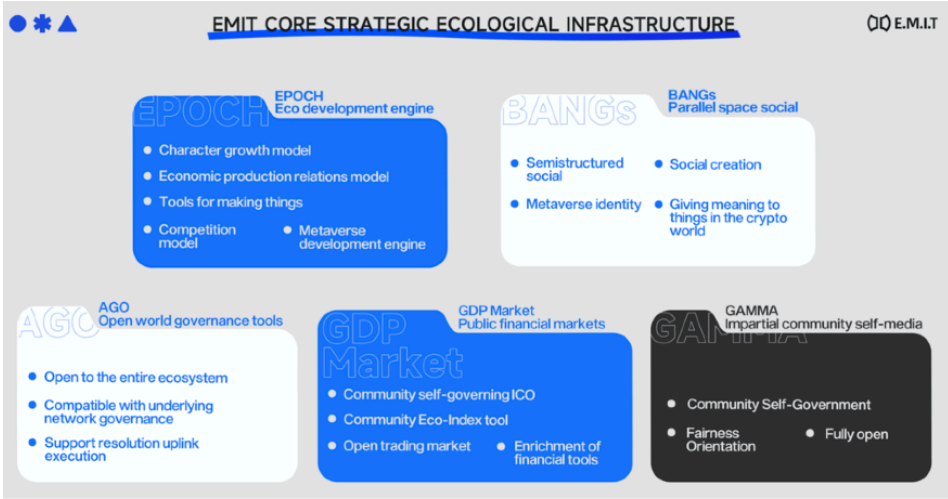
EMIT Base Ecosystem Application Cluster
Beyond being developer-friendly for the broader Web2 community, EMIT’s existing ecosystem includes numerous Layer2-level foundational tools designed for Web3 applications—lowering development barriers and enhancing core Web3 interaction patterns.
These include a Metaverse development engine, Web3 social plugins, SBT-enabled DAO and community management tools, advanced and user-friendly DeFi financial instruments, and content creation and traffic distribution tools for Web3 media.
Notably, due to EMIT’s unique technical attributes, these ecosystem applications differ significantly from existing decentralized apps in the industry. Across interface design, user experience, and functional richness, they represent nothing less than an industrial revolution for dApps—from the agrarian age to modern industry—while still preserving their cryptographic essence.
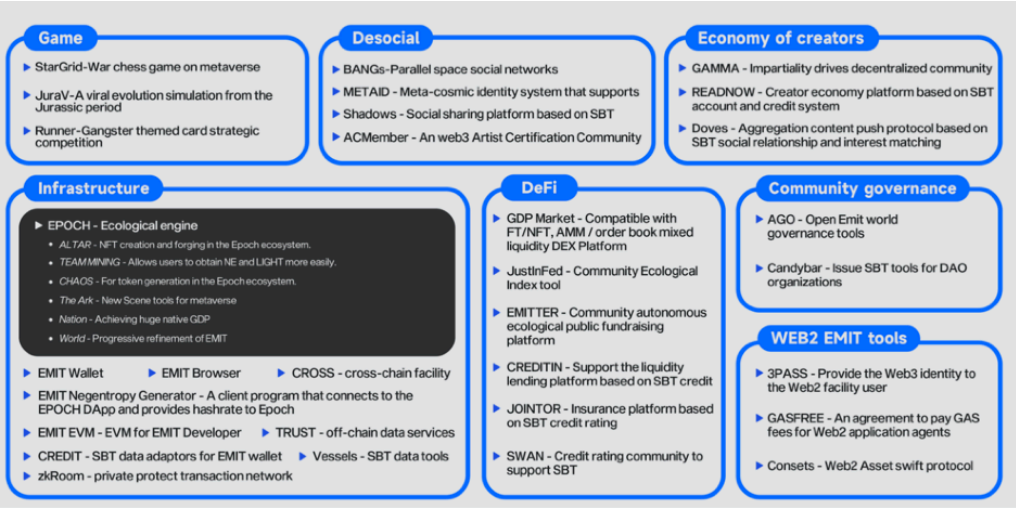
Partial View of the EMIT Ecosystem Universe
The EMIT team is committed to promoting this revolutionary blockchain technology among a wider internet developer community. By breaking through technical limitations, EMIT could catalyze transformative breakthroughs in Web3’s path to mass-market adoption, fostering disruptive Web3 applications and expanding EMIT’s own network consensus.
EMIT will also invest heavily in global hackathons. For tech enthusiasts aiming to enter the Web3 space, this represents a historic opportunity—to shape the future of Web3—while facing unprecedented challenges, as their competitors may well be elite engineers from traditional Web2 backgrounds!
Epilogue
If Web3 ultimately compromises with the market and succumbs to pseudo-centralization, we might already foresee the next wave of disruption—Web4 narratives.
But now we have EMIT. EMIT ensures that the founding principles of the crypto world remain at the heart of the entire Web3 era. This isn’t optional—it’s a choice we must actively make.
May the spirit of cryptography forever remain with us!
Join TechFlow official community to stay tuned
Telegram:https://t.me/TechFlowDaily
X (Twitter):https://x.com/TechFlowPost
X (Twitter) EN:https://x.com/BlockFlow_News


![Axe Compute [NASDAQ: AGPU] completes corporate restructuring (formerly POAI), enterprise-grade decentralized GPU computing power Aethir officially enters the mainstream market](https://upload.techflowpost.com/upload/images/20251212/2025121221124297058230.png?x-oss-process=image/resize,p_50/quality,q_80)






